In recent months, the EB-5 industry has seen USCIS apply closer scrutiny to investors’ Form I-526E filings. Source-of-funds documentation, loan proceeds, tax records, prior immigration forms, and even small inconsistencies across an investor’s records are now receiving a more demanding review. For EB-5 investors and immigration attorneys, these adjudication trends cannot be ignored. A weak or incomplete filing can trigger a Request for Evidence (RFE) or Notice of Intent to Deny (NOID), adding months of delay and, in some cases, putting the petition at risk of denial.
This higher level of scrutiny comes at a critical moment for the EB-5 market. Investors who want the protection of the current EB-5 rules must file their I-526E petitions by September 30, 2026, to be grandfathered against future changes or lapses in the Regional Center Program. But filing before the deadline is not enough. The petition must be thorough, accurate, and well documented. As the deadline approaches, avoidable mistakes can slow down or jeopardize an investor’s immigration process.
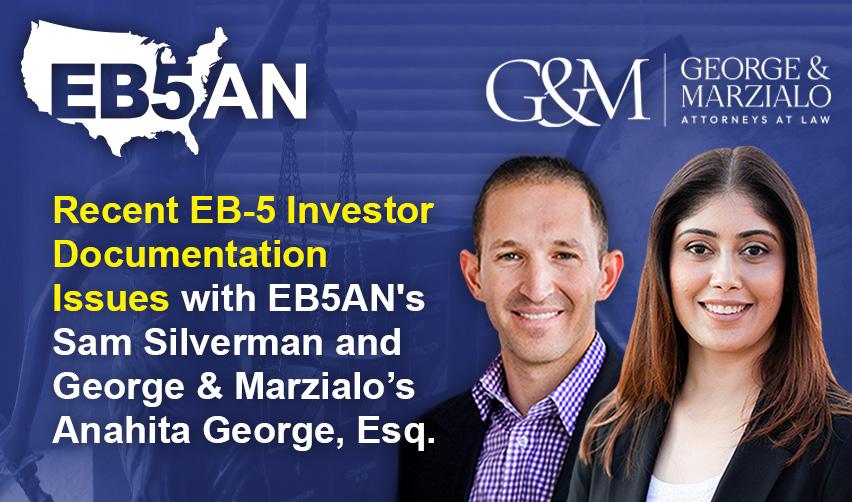
With these issues in mind, EB5AN held a comprehensive webinar on current documentation problems in EB-5 filings and how investors can reduce the risk of RFEs and NOIDs. The webinar was hosted by EB5AN managing partner Sam Silverman and Anahita George, Esq., founder and managing partner of George & Marzialo PLLC. Anahita is a leading EB-5 immigration attorney whose firm has handled more than 1,800 EB-5 applications since 2014. Before founding her EB-5 practice, she worked as a forensic accountant with major accounting firms, giving her deep experience in tracing funds, reviewing financial records, and preparing detailed source-of-funds documentation.
This blog post summarizes the key points covered in the webinar, including USCIS’s current focus on loan proceeds, HELOCs, stock-backed lines of credit, 401(k) loans, gifts, tax returns, name variations, employment history, and consistency across immigration filings. Investors who understand these issues early can work with their attorneys to prepare stronger I-526E packages, avoid months of delay, and improve their chances of securing U.S. Green Cards as quickly as possible.
We invite you to watch the full webinar video, highlights, or read our summary below.
Full Webinar:
Highlights:
USCIS’s Use of AI and Its Impact on EB-5 Adjudications
HELOCs, Mortgages, and Stock-Backed Lines of Credit
401(k)-Backed Loans
Loans from Regional Centers, NCEs, JCEs, and Related Parties
Gifts and Loans from Friends and Family
Tax Return Documentation: Five Years Versus Seven Years
Consistency Across Immigration Forms and Prior Records
Secure Your U.S. Green Card with a Strong I-526E Filing
USCIS’s Use of AI and Its Impact on EB-5 Adjudications
USCIS appears to be using AI-assisted tools to review EB-5 source-of-funds documentation more closely than in the past. That shift has raised the practical standard for preparing Form I-526E petitions. A filing that may have avoided scrutiny several years ago can now draw questions if the record contains unexplained transfers, missing account histories, inconsistent facts, or legal explanations that are not clearly presented in the main body of the filing.
The issue becomes especially important when an investor has a complex financial history. Many EB-5 investors move funds through several accounts before investing, including brokerage accounts, checking accounts, savings accounts, business accounts, and accounts used for interbank transfers. When several active accounts are involved over a period of years, USCIS may expect the filing to trace the funds across the full record. Large inflows, account-to-account transfers, or gaps in the financial trail can invite scrutiny if they are not fully explained.
A source-of-funds package often includes thousands of pages of bank records, tax documents, and supporting evidence, along with a narrative explaining the path of funds. In the past, USCIS might not have identified every missing link in a large submission. With AI-assisted review, omissions are easier to detect. An unexplained large inflow, an unsourced account transfer, or a mismatch between two records can become the basis for further questions.
The source-of-funds narrative now carries more weight. The filing should explain how the capital was earned, where it was held, how it moved, and how each major transaction fits into the overall funding path of funds. Documents alone may not be enough if the story behind them is unclear. Dates, account numbers, employment history, tax records, loan records, and transfer amounts should all be checked against the narrative before filing.
AI-assisted review also affects how legal arguments should be drafted. Important legal explanations should appear clearly in the main text of the filing, rather than being buried in footnotes or left to implication. If USCIS is using software to scan the petition, the strongest explanations must be easy to identify. This is especially true for loan proceeds, brokerage accounts, and other funding sources that require more legal and financial context.
A strong source-of-funds package should be complete, organized, and internally consistent. Every meaningful transfer should be traceable. Every major inflow should be explained. Every important legal point should be stated plainly. As USCIS review becomes more data-driven, investors should prepare the I-526E package with the expectation that gaps and inconsistencies will be found.
HELOCs, Mortgages, and Stock-Backed Lines of Credit
HELOCs, mortgages, and stock-backed lines of credit are among the most common ways EB-5 investors access capital for their investment. These funding sources can still be viable, but USCIS is reviewing them in greater detail than before. An investor using borrowed funds should be ready to document the loan itself, the asset or account supporting the loan, and the movement of the proceeds into the EB-5 investment.
For home equity lines of credit and mortgage-backed funds, a closing disclosure alone may no longer be enough. A stronger I-526E package should include the property purchase agreement, the closing disclosure, mortgage interest records, and property tax bills. These documents help show that the investor owns the property, that the loan is legitimate, and that the investor has complied with the payment obligations tied to the property.
Loan applications have become another area of review. USCIS may want to see what the investor told the lender when applying for the loan. The purpose of the loan should be stated clearly and accurately. If the proceeds will be used for investment purposes or for an EB-5 investment, the loan application should not create confusion or conflict with the I-526E filing.
The loan terms and conditions deserve close attention before filing. Some loan agreements restrict how proceeds can be used. If a loan agreement prohibits investments or securities transactions, that restriction can create a serious issue because EB-5 investments are treated as securities. USCIS may question whether the investor violated the terms of the loan by using those proceeds for EB-5 capital.
Bank documentation can create its own challenges. USCIS may prefer actual bank statements instead of transaction histories, even when a transaction history shows the same activity before a statement is formally generated. Investors who file with transaction histories may later need to supplement the record with finalized statements. A USCIS online account can be useful for uploading additional documents and reducing the chance of an avoidable RFE or NOID.
Stock-backed lines of credit raise many of the same concerns. USCIS may ask what the investor told the lender, what the loan terms allow, and how the loan proceeds moved into the EB-5 investment. Brokerage accounts often involve frequent transfers, margin activity, or large inflows, so the filing should clearly trace the account history and explain how the funds were lawfully obtained.
Loan-based EB-5 filings also need a clear legal explanation. USCIS has questioned some loan proceeds under older interpretations of EB-5 capital rules, including rules related to indebtedness secured by the investor’s assets. Under the Reform and Integrity Act, the key issue is that the loan cannot be secured by assets of the new commercial enterprise or job-creating entity. A loan secured by assets outside the NCE or JCE may be acceptable, but the filing should explain the structure clearly in the source-of-funds narrative.
Careful drafting can make a meaningful difference here. The filing should explain the loan structure, identify the collateral, show the investor’s repayment responsibility, and include the documents needed to support each point. Important legal arguments should appear in the body of the source-of-funds memorandum, along with the supporting exhibits. A complete loan record can help avoid unnecessary delays and reduce the risk that USCIS misunderstands the structure of the investor’s EB-5 capital.
401(k)-Backed Loans
A 401(k)-backed loan can be a useful source of EB-5 capital, but it must be documented with care. USCIS may ask for the loan terms and conditions, along with evidence showing how the investor built the retirement account used to support the loan. The filing should make clear that the funds were accumulated through lawful employment income and regular payroll contributions.
Payslips can play an important role in this type of source-of-funds record because 401(k) contributions are usually withheld directly from an employee’s paycheck. The payroll records should match the retirement account contributions. If the current 401(k) includes funds rolled over from a prior employer’s plan, the earlier plan may also need to be documented. That can require prior employer 401(k) statements, additional payslips, and a clear explanation of how the funds moved from the old account into the current one.
The filing should also explain that 401(k) loans are governed by IRS and Treasury rules. This helps show that the loan terms are not informal or discretionary. The plan must operate under the applicable retirement-account rules, and the loan should be presented as a regulated transaction within that framework.
Repayment should be addressed when the records allow it. If the loan is repaid through payroll withholding, the filing should explain that structure and provide evidence if repayment has already begun. A payslip showing the repayment deduction can connect the loan to the investor’s employment record and show how the repayment obligation is being handled.
Loans from Regional Centers, NCEs, JCEs, and Related Parties
Loans from regional centers, new commercial enterprises, job-creating entities, or other related parties carry serious risk. USCIS has taken a strict position on these arrangements and has been denying filings that rely on these types of loans. Investors should be extremely cautious before accepting any EB-5 funding structure connected to the regional center, the NCE, the JCE, or another party tied to the project.
A similar issue can arise when a project or regional center works with a lending institution that offers financing only to investors in that specific project. A lending license may not resolve the source-of-funds problem. If the lender is structured as an LP or LLP, USCIS may ask for the source of funds behind that entity. The investor may then need to document where the lending entity obtained its capital.
The problem becomes even more difficult if the lender’s capital was raised from multiple private investors. If an LP or LLP collected funds from many individuals to create a lending pool, USCIS may scrutinize that fundraising mechanism. The filing could then require evidence far beyond the investor’s own financial records, including documentation related to the lender’s investors and the lawful source of the lender’s capital.
Project-connected financing should therefore be approached with extreme caution and reviewed carefully by experienced EB-5 counsel. A loan that appears convenient at the beginning can create serious problems during adjudication if USCIS treats it as a related-party loan or questions the source of the lender’s funds. The cleanest funding sources are those that can be independently documented and clearly separated from the regional center, NCE, JCE, and project sponsor.
Gifts and Loans from Friends and Family
Gifts and loans from friends and family require careful planning because USCIS is looking more closely at the relationship between the investor and the person providing the funds. Gifts from friends can be especially difficult. A large gift from a friend may invite questions about why the funds were given, whether the arrangement is genuine, and whether there is any undisclosed agreement behind the transfer.
A large transfer from a friend may be stronger if it is structured as an arm’s-length loan rather than a gift. The loan should have clear written terms, a proper interest rate, and a defined repayment structure. Interest-free loans can create problems under U.S. tax rules, so the transaction should generally include an applicable federal rate and regular principal and interest payments. The lender’s own source of funds also needs to be documented, since USCIS may ask where the friend obtained the money used for the loan.
Company loans can create additional issues. If an investor borrows from a company, USCIS may ask whether that company has a lending license. If the company does not normally lend money, the filing may need to explain whether a one-time loan is allowed under the relevant state rules. A loan that appears simple at first can become difficult to defend if the company lacks the authority or documentation to support the transaction.
Family gifts and family loans may receive less scrutiny than gifts from friends, but the family relationship still has to be proven. USCIS may not accept informal cultural descriptions such as “aunt,” “uncle,” or “cousin” without documentation. Birth certificates or other records should show the actual relationship between the investor and the person providing the funds.
Gifts made within the United States may raise tax-reporting issues as well. If the amount is above the reporting threshold, a gift tax return may need to be filed. Even when no tax is owed, the gift may still need to be disclosed against the lifetime exemption. If the gift was not properly reported, USCIS may ask for evidence showing that the transfer was treated correctly under U.S. tax rules.
Tax Return Documentation: Five Years Versus Seven Years
USCIS is now taking a stricter position on tax return documentation in EB-5 filings. While five years of tax returns may have been accepted in some prior adjudications, investors should now be prepared to provide seven years of tax returns. This can be a major issue for investors who did not keep older returns or assumed transcripts would be enough.
The safest approach is to provide the full federal and state tax returns as filed. IRS tax transcripts alone may not satisfy USCIS if they do not show the state component of the return. Even when state and federal transcripts are provided, USCIS may still ask for the actual return that was filed with the government. If both the full returns and transcripts are available, including both can make the record stronger.
Older tax records can be difficult to obtain. IRS and state retention periods may be limited, and some states may retain transcripts for only a few years. Investors who are missing older returns should begin the retrieval process early by contacting the IRS, state tax authorities, and prior CPAs. If a return must be recreated from transcript data, the filing should clearly explain why the original return is unavailable and how the recreated return was prepared.
Amended tax returns can draw additional scrutiny. USCIS may want to compare the original return, the amended return, and the transcript from the tax authority. This process can take time, especially if a state tax agency must mail older records. Waiting until a NOID arrives can leave too little time to gather the missing documents, since a NOID may give the investor only 30 days to respond.
Tax documentation should be handled early in the I-526E preparation process. Missing tax returns, incomplete state records, or unexplained amendments can create avoidable risk. A complete seven-year tax record can help show lawful income, tax compliance, and consistency between the investor’s financial history and the source-of-funds package.
Consistency Across Immigration Forms and Prior Records
USCIS is now comparing information across an investor’s full immigration history more closely. Prior visa applications, prior petitions, Form I-526E, and Form I-485 should tell the same factual story. Discrepancies in addresses, employment dates, job titles, or name variations can create problems even when the mistake was accidental.
Address history is one area where small differences can matter. An investor who listed one address history on a DS-160 and a different address history on the I-526E or I-485 may need to explain the discrepancy. Employment history carries the same risk. Form I-526E asks for 20 years of job history, so prior work should be listed with care, including U.S. jobs, part-time jobs, full-time jobs, and any other employment required by the form. If USCIS already has the information from another filing, leaving out a position can raise questions.
Errors are harder to fix after filing. When an investor submits a petition and later tries to correct it, USCIS may treat the amendment with skepticism. A simple mistake can become harder to explain if USCIS views the correction as possible misrepresentation. For that reason, the forms, source-of-funds narrative, supporting documents, and prior immigration records should be checked against one another before submission.
Name variations need the same attention. Some investors have different versions of their names across passports, visas, and prior immigration records. One document may list a full name with “last name unknown,” while another may list the name in a different order or format. These variations should be identified in the filing. If USCIS asks whether the investor has used other names and the answer omits a known variation, that omission can create avoidable risk.
Immigration compliance does not stop after conditional permanent residence is granted. Address changes must continue to be reported properly, including after the investor receives a conditional Green Card. A missed address update can create problems later, including at the Form I-829 stage. USCIS may treat the failure to update an address as a serious compliance issue, so investors should keep their immigration records current throughout the EB-5 process.
Secure Your U.S. Green Card with a Strong I-526E Filing
USCIS is now examining I-526E petitions more closely, especially the evidence used to prove the lawful source and path of EB-5 investment funds. Loan proceeds, tax returns, family transfers, employment history, name variations, and prior immigration filings all need to be consistent, well documented, and clearly explained. A weak filing can lead to an RFE or NOID, causing months of delay and placing the investor’s Green Card process at risk.
The September 30, 2026, filing deadline makes preparation even more urgent. Investors who want to preserve eligibility under the current EB-5 rules must file on time, but the quality of the filing matters just as much as the filing date. To avoid preventable delays and prepare a strong I-526E petition, schedule a free consultation with EB5AN today.