
For many prospective EB-5 investors, the first big question is about timing.
How long the EB-5 process takes depends heavily on one factor that investors sometimes underestimate: your country of birth. While the EB-5 program offers the same legal pathway to all applicants, the waiting time to receive a Green Card can vary dramatically depending on how many investors from your country are already in line.
As of April 2026, the differences between China, India, and most Middle Eastern countries are significant, and understanding those differences early can shape your entire strategy.
Understanding Why Backlogs Exist
Chinese Investors
Indian Investors
Middle Eastern Investors
The Strategic Role of Set-Aside Categories in 2026
Planning Your EB-5 Timeline Strategically
Understanding Why Backlogs Exist
The EB-5 Immigrant Investor Program allocates roughly 10,000 immigrant visas per year, and that number includes not just investors but also their spouses and children. There is also a per-country cap: no more than 7% of the total annual visas can go to applicants from a single country unless unused numbers are redistributed later.
When demand from a country exceeds its annual share, the U.S. Department of State establishes a priority date cut-off in the monthly Visa Bulletin. Investors whose priority dates fall after that cut-off must wait until a visa number becomes available.
That’s what creates a backlog. And in 2026, the impact can be very different depending on where you were born.
Chinese Investors
China remains the most oversubscribed country in the EB-5 category. Demand has historically been strong, and although filings fluctuated over the past decade, the accumulated queue is still substantial.
As of April 2026, the unreserved EB-5 category for mainland-born Chinese investors remains significantly retrogressed, with final action dates sitting in 2016. In practical terms, that means only investors who filed roughly a decade ago are currently receiving immigrant visas under the standard (unreserved) EB-5 allocation.
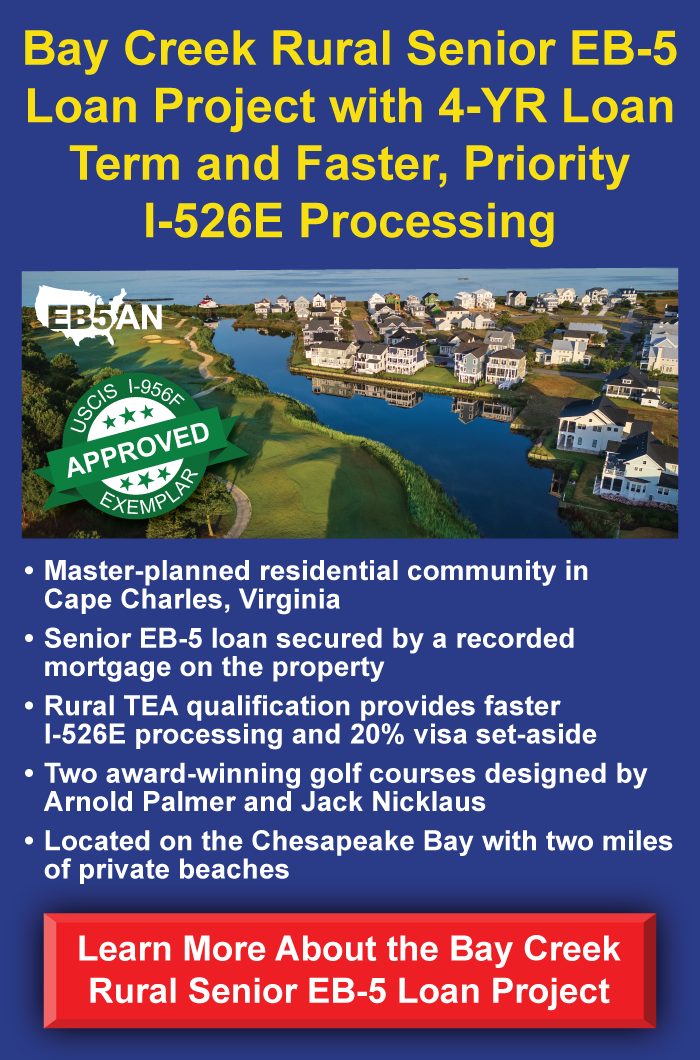
However, the picture changes when looking at the EB-5 set-aside categories created under the EB-5 Reform and Integrity Act. Rural, high-unemployment (urban), and infrastructure projects each have reserved visa allocations, and as of April 2026, all three set-aside categories remain current for all countries, including China.
That distinction is critical. For Chinese investors who qualify for and select a qualifying set-aside project, the backlog issue may be avoided, at least for now. Of course, future demand could affect these categories, but currently they represent the most realistic path to a faster timeline.
For Chinese families, the key takeaway is this: EB-5 is still viable, but it must be approached strategically and with long-term planning in mind.
Indian Investors
India’s EB-5 demand has grown dramatically over the past several years. As more high-net-worth families look for global mobility options and U.S. residence solutions, India has moved into oversubscribed territory.
As of April 2026, the unreserved EB-5 category for India reflects a multi-year backlog, with final action dates currently in 2022. Compared to China, this may seem manageable but it is still a meaningful delay for families planning education timelines, relocation strategies, or business expansion in the United States.
Like Chinese investors, Indian applicants also benefit from the fact that the set-aside categories remain current as of April 2026. This has become a major strategic consideration. Investors who select rural or urban projects may be able to proceed without entering the unreserved backlog although the rural category provides a clear advantage due to priority processing.
For Indian investors already in the queue, monitoring Visa Bulletin movement is essential. For new investors, project category selection may be the single most important timing decision they make.
Middle Eastern Investors

The situation looks quite different for investors from Middle Eastern countries, including the UAE, Saudi Arabia, Qatar, Egypt, Jordan, and others.
As of April 2026, the unreserved EB-5 category remains “current” for countries outside of China and India, including the Middle East. In practical terms, that means there is no visa backlog based on country of birth. Once the immigrant petition is approved and processing is complete, a visa number is available without waiting for priority dates to advance.
This does not mean the process is instant. USCIS adjudication times and consular processing still require patience. But Middle Eastern investors are not competing against a country-specific quota bottleneck.
For investors in this region, EB-5 remains one of the more straightforward U.S. immigration pathways available at the investment level, particularly when compared to the timelines facing oversubscribed countries. Selecting rural projects can also offer a strategic advantage here, especially when combined with concurrent filing for investors who already reside in the U.S.
The Strategic Role of Set-Aside Categories in 2026
One of the most important developments in recent years has been the introduction of reserved visa categories under the Reform and Integrity Act.
Rural projects receive the largest reserved allocation, followed by high-unemployment areas and infrastructure projects. As of April 2026, all of these categories remain current across all countries.
This has reshaped the EB-5 conversation. For traditionally oversubscribed countries, the choice of project is no longer just about return profile and risk mitigation; it is also about immigration timing.
That said, availability today does not guarantee availability forever. If demand surges in the reserved categories, backlogs could eventually form there as well. The window of opportunity is open, but it may not remain open indefinitely.
Planning Your EB-5 Timeline Strategically

The EB-5 program in 2026 remains active and viable, but it is not uniform across nationalities. Visa availability is shaped by demand, legislation, and annual numerical limits, and those forces do not affect every investor equally.
Across all regions, early filing matters. Your priority date establishes your place in line. The sooner a well-prepared petition is submitted, the sooner that clock begins. In all cases, informed planning makes the difference between uncertainty and clarity. And in a program where timelines can stretch years into the future, clarity is one of the most valuable investments you can make.
EB5AN has helped more than 2,700 families from 70+ countries become lawful permanent residents of the United States. Our expert team has more than a decade of experience and offers clients first-rate, low-risk EB-5 regional center projects with a 100% USCIS project approval rate.
If you would like to know more about your EB-5 investment options, book a free call with our expert team today.