

As Reuters put it on March 17,2026, the “U.S.-Israeli war on Iran is now in its third week, with at least 2,000 people killed and no end in sight.’” That stark assessment captures the reality of the 2026 conflict. What began as a direct military confrontation involving Iran and the United States has already grown into a wider regional emergency, with diplomacy faltering, energy routes under pressure, and governments across the world bracing for further escalation. Even the basic question of where this ends remains unanswered, because the war is no longer just about one battlefield or one dispute.
The consequences are now spreading across the Middle East. Fighting tied to the Iran war has intensified in Lebanon, the Gaza ceasefire has come under renewed strain, and the Strait of Hormuz remains severely disrupted while outside powers hesitate to intervene directly without de-escalation and talks.
Unfortunately, the entire Middle East is once again facing a period of violence, with the region’s economic stability and civilians’ safety on the line.
Are you—or family members—searching for immigration options to escape the rising uncertainty across the Middle East? Many Middle Eastern residents are doing so.
The 2026 conflict has propelled interest in the EB-5 visa, an immigration-by-investment program that can result in U.S. permanent residency in only a matter of months.
With investors in rural EB-5 projects widely receiving their initial approvals within 12 months—and even as fast as 2.7 months—EB-5 is often the fastest immigration option for families interested in a quick path to U.S. Green Cards.
And, considering the deepening geopolitical crisis in the Middle East, EB-5 can offer a significantly safer future for investors and their families.
“Time and again,” explains Sam Silverman, managing partner of EB5AN, “we see investors choose EB-5 as the most straightforward and practical path to U.S. Green Cards. Understandably, many foreign nationals around the world want to benefit from the safety and stability the United States has to offer.”
EB-5’s Rising Popularity in the Middle East During the 2026 U.S.-Iran Conflict
How EB-5 Can Help Middle Eastern Nationals Move Quickly to the U.S.
Next Steps for a Secure, Stable Future in the U.S.
Seize the Opportunity to Become Permanent Resident of the United States
If you are considering immigration options for yourself and your family, this post will provide a practical guide to the EB-5 visa and how to get started on the immigration process.
First, let’s survey the Middle East’s rising interest in EB-5 immigration.
EB-5’s Rising Popularity in the Middle East During the 2026 U.S.-Iran Conflict
As the Economic Times reports, the Middle East, particularly the Gulf States, “has long represented stability and economic opportunity. Businesses operate there, careers operate there, and children attend school there.”
“But when geopolitical tension dominate headlines, families often begin to reassess long-term mobility.”
Indeed, the EB-5 market is seeing a surge in interest from Middle Eastern nationals. The above article observes: “As days pass without a clear resolution, some families are beginning to consider the possibility that the instability might persist.”
That scenario is seeming increasingly likely, with ongoing conflict in the region with no concrete plans for peace.
And with a high concentration of high-net-worth individuals (HNWIs) and skilled professionals, the Middle East is an ideal region for EB-5 immigration.
Interestingly, Middle Eastern nationals who are already in the United States on non-immigrant visas such as H-1Bs and F-1 student visas might also view EB-5 as a direct path to a Green Card.
One Middle Eastern resident quoted by the Economic Times states, “We always hoped our children would study in the United States, but there didn’t seem to be any urgency. We need to think about the kids and understand what our Plan B is.
“We need to be realistic rather than simply hope [the conflict] resolves quickly.”
How EB-5 Can Help Middle Eastern Nationals Move Quickly to the U.S.
In 2026, EB-5 remains one of the fastest ways for foreign nationals to move toward U.S. permanent residence, especially through rural projects. The process starts with filing Form I-526E. For investors who choose a rural EB-5 project, approval within 12 months is now the industry-wide standard.
Most rural petitions are in fact being approved within that time frame. EB5AN’s own rural I-526E petitions have even seen approvals in as little as 2.7 months, which shows just how fast current rural processing trends have become.
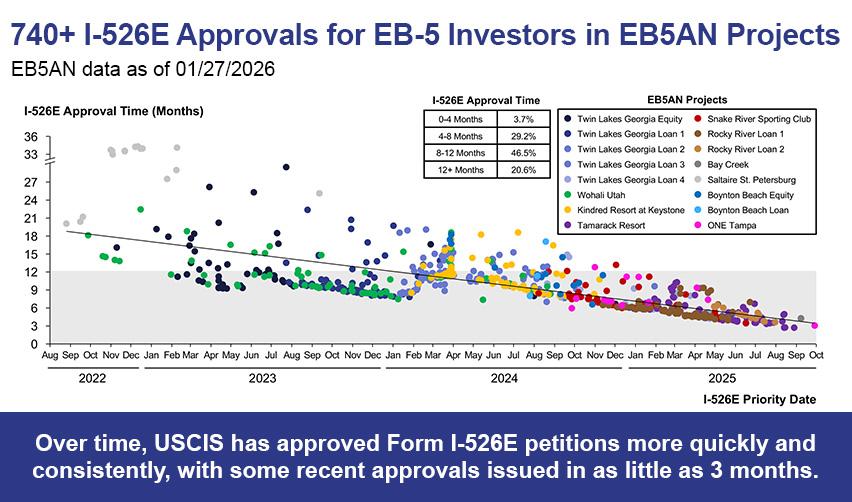
Adjudication speed is important, because once the case moves forward, investors and their dependent family members can obtain conditional U.S. Green Cards and begin enjoying the practical benefits of permanent residence. They can live anywhere in the United States, work freely, and travel internationally with relatively few restrictions compared to temporary visa holders.
Later, after meeting the EB-5 requirements, they file Form I-829 to remove the conditions on their Green Cards.
For many families, this makes EB-5 especially attractive at a time when speed is crucial. In 2026, rural I-526E adjudications are moving quickly, and that has created a rare window of opportunity for investors who want to relocate to the United States without years of waiting.
As Silverman notes, “For investors who want to move to the United States as quickly as possible, rural EB-5 has created one of the clearest and fastest paths available today.”
EB-5 can also be valuable for foreign nationals from the Middle East who are already in the United States on H-1B, F-1, or similar visas. Once they file their I-526E petition, they may also file for adjustment of status in the United States, regardless of the temporary visa they were using before. That allows them to remain in the country while their EB-5 case is being adjudicated instead of having to leave and wait abroad.
At the same time, these investors can also apply for work and travel permits, which may be issued in as fast as 90 days. That gives families immediate practical benefits while the Green Card process continues. For someone already living in the United States and looking for a stable long-term solution, EB-5 can offer both speed and flexibility at exactly the right moment.
Next Steps for a Secure, Stable Future in the U.S.
While the door is currently open for a U.S. Green Card through EB-5, the EB-5 industry is approaching an important deadline in September 2026. By September 30, EB-5 investors must file their I-526E petitions in order to be “grandfathered” in under the current program rules and have their petitions processed.
If you and your family are considering immigrating to the U.S., what practical steps can you take now?
First, hire an immigration attorney before spending weeks comparing projects. As filing activity increases, many firms will be handling a high volume of short-term cases, and some may stop taking new clients once they reach capacity. Starting with counsel now gives you time to build a filing plan, spot issues early, and avoid losing valuable time.
Second, begin your source-of-funds work and prepare your capital right away. This is often the slowest part of the process, even when it seems straightforward at first. Documents can take time to collect, bank records may require follow-up, currency transfers can create delays, and financing tools such as HELOCs may take longer than expected. The safest approach is to have your attorney review your source of funds while you continue your project diligence at the same time.
Once those two steps are underway, investors can choose the EB-5 project and regional center that best fit their immigration and investment goals. That includes deciding between rural and high-unemployment projects, considering repayment timing, and weighing backlog risk. Investors should also look closely at the regional center itself, since it plays an ongoing role in oversight, compliance, and investor protection.
A reputable regional center, an experienced developer, and a project already under construction can help reduce both immigration and financial risk as the September 30, 2026 deadline gets closer.
Seize the Opportunity to Become Permanent Resident of the United States
“For Middle Eastern nationals,” concludes Silverman, “the EB-5 visa is a particularly valuable immigration option: a fast, direct path to U.S. Green Cards.”
“We expect interest in the EB-5 visa to continue to grow in the Middle East in 2026.”
Indeed, you and your family could relocate to the United States under your Green Cards in a relatively short time. We invite you to schedule a free consultation with EB5AN to get personalized guidance on the next steps in your immigration journey.