Selecting an EB-5 project is one of the most consequential decisions an EB-5 investor will ever make. Essentially, a good EB-5 project must meet two criteria at once. It has to comply with USCIS requirements and create enough qualifying jobs so that investors can secure timely approval of their Green Cards. At the same time, it must be financially sound so that it can return investors’ capital at the end of the investment term.
If a project fails on either front—if it falls short on compliance or runs into serious financial trouble—investors risk not only losing their entire investment but also jeopardizing their immigration outcome and long-term plans for their families.
For investors facing this decision in a crowded EB-5 market, it is not enough to read marketing brochures or high-level summaries. There is enormous value in learning directly from people who have already gone through the process, selected a project, and committed real capital.
Hearing how successful EB-5 investors evaluated risk, what they prioritized, which red flags they watched for, and how they organized their due diligence can help new applicants build a practical, step-by-step strategy of their own.
Learning from a successful EB-5 investor is perhaps the fastest way to get started on a safe path to an EB-5 Green Card.
This is why EB5AN has invested heavily in building an in-depth investor testimonial series. Over the past several years, we have recorded more than 20 full-length interviews with real EB5AN investors across multiple projects and backgrounds. These are detailed conversations that focus on process and reasoning, not on simply advertising our EB-5 offerings.
To our knowledge, no other EB-5 firm has made a comparable effort to educate investors by putting so many of its own clients on record, in their own words, about how they made this life-changing decision.
This article is the second installment in a new series that revisits some of the most compelling interviews in our library. Each installment focuses on one of the core decisions in the EB-5 journey.
In this post, we highlight why these investors chose their specific EB5AN projects and how they assessed the risk profile of those offerings—immigration risk, job-creation risk, and financial risk. Their experiences offer concrete, practical guidance on what to look for when comparing projects, how to ask harder questions, and how to distinguish marketing claims from verifiable facts.
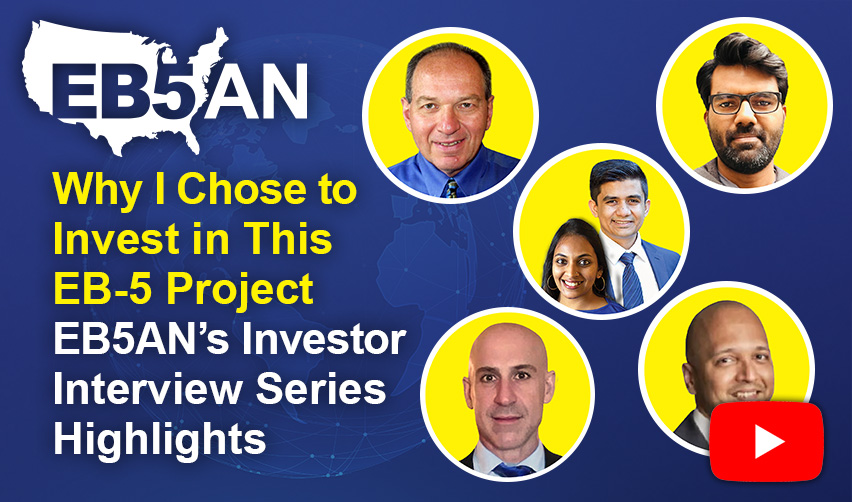
You’ll hear from investors from India and Canada, in both rural and urban EB-5 projects.
In the sections that follow, you will see how thoughtful investors approached this decision and how their strategies can help you select a safe EB-5 project.
We also invite you to watch these highlights in the following compilation video featuring our investors’ key responses.
Watch All EB-5 Investor Testimonials
Basic Criteria for Project Selection: Green Card Timeline, Risk, and Return of Capital
Choosing Rural to Avoid Backlogs and Delays
Developer Track Record: A Key Indicator of Success
Job Creation as the Key Indicator of Immigration Risk
Analyzing Financial Risk
Urban Projects When Rural Advantages Are Less Critical
The Path to U.S. Green Cards Begins With Careful Research
Basic Criteria for Project Selection: Green Card Timeline, Risk, and Return of Capital
“It goes back to the same question: Okay, what is the criteria for what do you want from this? Eventually, you want a Green Card, and you want to reduce the risk level of that money so you can get it back sometime in the future. So what I was looking at specifically, the three criteria: When do I get my money back, how much risk is involved, and the Green Card timelines.”
“The second one was how much risk is involved. Who’s the developer? So I believe both of them was Kolter. So the risk was … Okay, yeah, they have a great track record. They have done everything. And so that is also sorted.”—Tarun
Tarun, an Indian national who invested in our Rocky River rural project, reduced a complex decision to three questions: when he would get his money back, how much risk he was taking, and how long it would take to secure his Green Card. Instead of starting from marketing materials or project brochures, he started from his own priorities—immigration timing, capital preservation, and repayment—and then used those three tests to compare specific projects.
Rocky River did not win by default. Tarun was actively comparing it with other projects, including our ONE Tampa urban offering, and weighing both against the same framework. With the same successful developer behind both projects, he focused on immigration timing and repayment risk.
This is a useful pattern for other investors: clarify your own priority of goals first, then use that to compare viable projects rather than trying to rank every project on the market.
“It came down to basically the third point, which is when do you get your Green Card, which is much faster in a rural area because of the much more allocation for the Indian and the Chinese investors. So it nearly came to that point where, okay, if I invest now, when do I actually get my conditional Green Card, part-two Green Card, and eventually the citizenship.”— Tarun
Because of India’s backlog of EB-5 visas, Tarun was determined to invest in a rural project. For Tarun, the faster conditional Green Card timelines available under the rural set-asides finally pushed him toward Rocky River. His choice shows how a project can move to the top of the list when it combines a credible developer with a specific immigration benefit.
Choosing Rural to Avoid Backlogs and Delays
“At the time of my application, everything was current. All the different categories and the set-aside was current. But I was looking at the numbers published by various groups on this EB-5 data, especially this FOIA request and all those things, and everything kind of mentioned that urban numbers were twice the pending request. The pending applications for the urban were twice compared to the rural one, even though rural had 20% set-aside. And everyone was expecting urban to get into a backlog situation pretty soon. So within a year or so, they were expecting urban to get into a backlog situation, especially for India and China. So that was one thing which pushed me to say, “Okay, rural and nothing else,” because that had 20% set-aside. Yeah, I think that alone drove the decision to rural projects.”—Anoop
Anoop, an investor in Rocky River, approached rural versus urban by looking at the available data. At the time of his application, all categories were current, but he did not stop at the Visa Bulletin. He studied EB-5 data from FOIA responses and independent analyses and saw that pending urban applications were already roughly double the rural volume, despite rural having a 20% visa set-aside. For an Indian investor, that imbalance pointed to a likely future backlog in urban projects.
Instead of waiting for a backlog to be officially recognized, he treated the data as an early warning. That led him to pursue a rural project as a protection against getting stuck in a long queue.
“One of the things that really played a key part in my decision was the RIA Act of 2022 specifically states that rural projects get priority processing. That’s different from premium processing. In the H-1B world, that’s a 15-calendar-day processing time. But rural projects are prioritized over urban projects in terms of USCIS processing. So that played a key role in shifting towards rural, because it looked like urban projects might take a lot longer in terms of USCIS reviewing the application.”—Kumar
Kumar from India added a legal layer to the same conclusion. He focused on how the EB-5 Reform and Integrity Act of 2022 gives rural projects priority processing at USCIS. Rural applications go to the front of the line. For him, the risk was not only retrogression but also slow adjudication of I-526E petitions for urban projects. That led him to the Rocky River project.
“USCIS is giving what they call priority processing to rural projects. So there probably will be some benefit to an application even coming from somebody in a country without retrogression and backlogs, such as Canada. Maybe we’ll end up getting the I-526E approval six months to a year earlier. But six months is still a significant amount of time. So that was a consideration.”—James
James, who invested in the Twin Lakes rural project, reached a similar result from a very different starting point. As a Canadian, he was not facing retrogression, but he still saw value in rural priority. If priority processing can reduce six to twelve months—or even years—off the time to I-526E approval, that is meaningful for a family planning schooling, work, and relocation. His reasoning shows that rural advantages can matter even when the investor’s country is not facing a backlog.
Developer Track Record: A Key Indicator of Success
“One of the first criteria I was looking at was who is the developer of the project and what is the regional center. Who are the major players of this particular project? What is their track record? That was important to me. Have they successfully executed such projects in the past, or is this one of their first or second projects? So that was the experience or the tenure. That was one factor that was pretty important to me.”—Kumar
For Kumar, the first filter was always: who is building the project, and who is structuring the EB-5 offering. Before looking at returns or timelines, he wanted evidence that the developer and regional center had executed similar projects successfully, not just once, but over time. He treated this as a basic qualification test: if a team could not show a solid record, the project did not merit further analysis.
“To my mind, the single most important factor that matters in a real estate development like this is the track record of the developer. If they have a successful track record of doing this in the past and not once, but multiple times, that gives me great comfort that they know what they’re doing and they’re going to repeat the track record. Kolter Homes has a long track record in the Southeast of developing residential real estate like the Twin Lakes projects. Given that track record, I felt that they would be an excellent source of investment and would produce the results I was looking for. That’s the number one.
Number two, as I mentioned, is the demographics. The people they’re selling to are people who I think will be able to manage through this possible recession we’re looking at, if there is one, and continue to buy homes. I don’t think that a recession would disrupt that as it might other real estate developments in some other parts of the country. The Southeast is a prospering and growing area; people are moving there, and the doctors and lawyers who are buying into the Twin Lakes project should be able to keep doing that in almost any economic scenario. That helps. It’s in the Southeast of Atlanta, where there is a growing population, and people are moving there to the Sun Belt to hire.”–Ken
Ken, who invested in the Twin Lakes rural project, took the same principle and made it even more explicit. In his view, the single most important factor in a real estate development is the developer’s track record. Kolter’s long history of building residential communities in the Southeast gave him confidence. He also linked track record to buyer demographics. Established developers who sell primarily to stable, professional households in growing regions are better positioned to handle a downturn. For him, Kolter’s history and the Sun Belt region’s demand profile worked together to reduce the chance of a half-finished project.
“We looked at Kolter as a construction group, and we looked at just their past of successful projects.”
“Again, that gave us a lot of confidence just in the terms of scale and also the terms of volume that they have delivered over the last I think three decades or something. So there’s a lot of background over there that we typically ignored when we were starting off this research. Most of the developers that the other RCs are working with sometimes turned out to be very small, or a brand-new developer is just working on this one project. So compared to that, Kolter seemed to be a lot more familiar and larger name in general. They had a lot of successful projects, as the volume of houses that they have delivered over the last 20, 30 years has been massive.”—Niharika and Ishaan
Niharika and Ishaan reached a similar conclusion. These Indian investors in Rocky River built a scoring metric across multiple regional centers and noticed that many other developers were small or new, sometimes working on a single flagship project with no prior history. Kolter, by contrast, had decades of production and large volumes of completed homes. That contrast in scale and experience became one of the core reasons they ranked Rocky River above other competing options. Their process illustrates how track record can be quantified and compared, not just relied on as a general impression.
Job Creation as the Key Indicator of Immigration Risk
“The EB-5 program requires that you create 10 jobs over a period of two years, so I’d suggest that people read up on what are the types of jobs that need to be created. So please do your research there and try to understand the RIMS model and all that’s involved there, especially for the rural stuff. And you’ll see that the job creation is the important part, because you can get a conditional Green Card, but if the job creation isn’t met, you’ll never be able to satisfy the removal of conditions. So that’s a very important part.”—Kumar
Kumar put job creation at the core of his analysis. He understood that getting the conditional Green Card is only the first step; without sufficient job creation, investors cannot remove conditions at the I-829 stage. That is why he studied the job-creation methodology for rural projects, including the RIMS econometric model, and urged others to do the same. He wanted to understand how those numbers were derived and how much cushion existed above the minimum.
“For an investor going into the EB-5 visa process the number one priority (from my perspective), is that the application is accepted, that the conditional Green Card is received. And that the job creation requirements are met, so that when the I-829 application is filed, the permanent Green Card will be received by the investor and their family. That’s the most important element, and the most important part of that is to ensure that the job creation requirements are met. So, we really like the Twin Lakes project, from that perspective, because not only is it rural and has the priority processing ( and hopefully, we’ll get the conditional approval faster), but the job creation requirement for the 50 EB-5 investors has already been met.”
“So, the job creation is already in place. And whatever happens with the project, after our investment, we should be receiving the conditional Green Cards.”–James
James took an even more conservative stance by selecting a project where job creation for all EB-5 investors was already met. At Twin Lakes, the required jobs for the full EB-5 raise had already been created before his investment. That structure almost eliminates job-creation risk: even if the project faces later challenges, the basis for I-829 approval is already in place. For James, this aligned with his view that the top priority is not return on capital but securing both the conditional and permanent Green Cards for his family.
“Yeah, so we came up with a whole metric to rank each of the projects in our regional centers to select which project we wanted to go with. One of the top things that we considered was it needs to be a 956F-approved project given that Ishaan and I didn’t have our EB-2 and EB-3 I-140s approved, so we couldn’t have taken that risk of a denial down the line. So a 956-approved project, and enough job cushion to get us the jobs needed for the EB-5 Green Card.”—Niharika and Ishaan
Niharika and Ishaan were determined to lower their immigration risk as much as possible. Their scoring metric favored projects with a strong job cushion and I-956F approval. Because they did not have approved I-140 petitions, they were especially wary of any project-level risk that could lead to a denial later. A pre-approved project with ample job coverage reduced both project risk and adjudication risk, and that combination played a central role in their choice of Rocky River.
Analyzing Financial Risk
“A common problem builders face, whether it’s in India, the U.K., or America, is running into capital-related problems.”
“You start a project, hoping people will buy X number of homes, and then you build the rest of the project based on what they give you. But if interest rates rise or there is a crisis and fewer customers appear than you projected, you won’t be able to complete the project. You’ll have to look for a buyer who will buy it from you in a fire sale and then complete it. The first thing that struck me was that Kolter projects have been capitalized with a full capital stack that includes a senior construction loan from a well-known conservative lender, like Wells Fargo.”
“I recently started working as a banker at Wells Fargo and I know they are a very conservative organization. They don’t just give construction loans to builders they don’t have confidence in. The fact that Kolter has recently announced a condo project in Florida with a $240 million senior construction loan gave me a sense that Wells Fargo is comfortable with Kolter and their projects and the way they manage their capital expenditure.”
“I think this acts as a big assurance, because in scenarios where you have imperfect information or information asymmetry, you try to arrive at a proxy of what situations will look like in the future based on how a more reliable and established person or institution has evaluated the project.”—Siddharth
Siddharth brought his experience as a successful investment banker to his EB-5 investment in Twin Lakes. An Indian national, Siddharth focused on a risk that many investors overlook: capital shortfalls that stop a project halfway. Drawing on his experience, he described how developers can be forced into exits when presales slow, interest rates rise, or funding is scarce. He did not want to rely on optimistic sales projections. Instead, he looked for projects with a complete capital stack, including a senior construction loan from a conservative financial institution such as Wells Fargo.
Siddharth knew firsthand how cautious the underwriting process is at an institution like Wells Fargo. Seeing Wells Fargo extend a large senior loan to a Kolter project showed him that an independent, sophisticated lender had already scrutinized the sponsor and its business plan.
If Wells Fargo considered Twin Lakes to be a safe investment, Siddharth did as well.
“Then the capital stack of that particular project: How is it funded and financed? How is the construction done for that, and how are the revenues generated? That’s another sub-criteria, which is is it on a rolling basis or is it that the entire construction has to complete before even a single dollar can come in? So there were aspects of that. Was it leased? Is there a government involved here?”—Kumar
Kumar approached the capital stack from a slightly different angle but with the same goal. He wanted to understand how construction was funded, how and when revenues would start, and whether any government or long-term leases were involved. He paid attention to whether income would come in on a rolling basis or only after full completion. These details influence both the risk of cost overruns and the likelihood that the project can weather a slowdown without stalling.
“A 956-approved project, enough job cushion to get us the jobs needed for the EB-5 Green Card, and then picking a project which was rural and the capital stack which ranked in the senior loan capital stack. So that was kind of the early criteria we went with.”—Niharika and Ishaan
For Niharika and Ishaan, capital structure and EB-5 funds’ position within it were key items. They favored projects where EB-5 capital sat in a higher loan position rather than at the bottom, behind large amounts of riskier capital. Combined with Kolter’s scale and the presence of institutional lenders, this structure made Rocky River stand out when compared against other offerings where the developer was small or untested. Their approach shows how investors can use capital stack details to evaluate risk.
Urban Projects When Rural Advantages Are Less Critical
“Being Canadian, I think that the advantages of the rural, it wasn’t as important to me whether it was rural or urban. I was easily able to go with either of them.”
“At the end of the day, the ONE Tampa project, I like the fact that it was 47% sold at that point that I was evaluating, and I liked that there was a high sales of units. I actually called the project. I was going to go visit it. But the project managers there were very responsive as well.
I just felt, after evaluating, it had the highest probability of getting built, getting done, and returning my investment within the time that’s promised.”—Mike
Mike’s situation illustrates that an urban project can still be a rational choice when country-specific risks are different. As a Canadian investor in our ONE Tampa urban project, he did not view rural versus urban as a decisive factor. Without the risk of a visa backlog for Canada, he was comfortable considering either category and shifted his focus to immigration risk and capital returns.
When he evaluated ONE Tampa, he focused on proof that the project was already working in the market. The high percentage of units sold at the time of his review suggested strong demand and higher odds of completion. He independently contacted the project and found the on-site managers responsive. This gave him confidence that the Kolter team was active and organized.
The Path to U.S. Green Cards Begins With Careful Research
Choosing a safe EB-5 project ultimately comes down to understanding the risks that matter and confirming, with evidence, that a project can meet its obligations.
The investors featured here approached that decision in different ways, but they all relied on concrete details—job creation, capital structure, developer history, visa timing—not on assumptions or marketing language.
Their interviews show that a project becomes “safe” only when an investor can see how the immigration requirements will be met and how the capital will be protected through completion. For anyone beginning this process, the most useful takeaway is: study the facts closely enough that you can explain why a project works, how it protects your goals, and its actual risk profile.
For personalized help on getting started on the EB-5 process, schedule a free consultation with EB5AN.