
If you’re in the United States on a temporary visa, such as H-1B, or considering relocation from abroad, the question is often the same: how do you secure U.S. permanent residency without tying your future to an employer, a lottery, or an uncertain sponsorship process?
As of 2026, the EB-5 Immigrant Investor Program remains one of the most direct answers. For many investors, the program now delivers immigration benefits, work authorization and travel permission, within months of filing. In some cases, conditional Green Cards are being issued far faster than traditional employment-based categories.
This article explains who EB-5 is best suited for, how the process unfolds from initial planning through permanent residence, how to evaluate immigration and financial risk, and why the choice between rural and urban projects has become a defining strategic decision.
Below is a step-by-step overview of how EB-5 works in 2026 and how to begin.
Is EB-5 Right for You? Understanding the 2026 Landscape
2026 Program Fundamentals
From Investment to Green Card, How the EB-5 Process Unfolds
Managing Risk for Immigration Compliance and Capital Preservation
Rural or Urban? How Project Location Shapes Timelines
- Reserved Visas Explained
- Why Rural Projects Often Move Faster
- Urban Set-Asides and Capacity Limits
- Choosing the Right Path
How to Get Started
Is EB-5 Right for You? Understanding the 2026 Landscape

EB-5 is particularly relevant for individuals already living in the U.S. on nonimmigrant visas such as H-1B, E-2, F-1, or TN who want to remove the instability associated with employment-based status. Layoffs, corporate restructuring, or visa limits can quickly put lawful status at risk. EB-5 offers a path to residency that is independent of ongoing employment or employer sponsorship.
When an EB-5 petition is filed while the investor maintains valid status, applicants can typically remain in the U.S. during processing once an adjustment of status application is filed. With concurrent filing established, many investors receive an Employment Authorization Document and Advance Parole shortly after submission. These benefits allow unrestricted employment, business ownership, and international travel while the case is pending.
For investors living outside the United States, EB-5 can also represent one of the most predictable immigration options available in 2026. The program does not rely on extraordinary credentials or job offers. Instead, eligibility is based on a qualifying investment and the creation of U.S. jobs. A spouse and unmarried children under 21 are included in the same petition, allowing families to immigrate together.
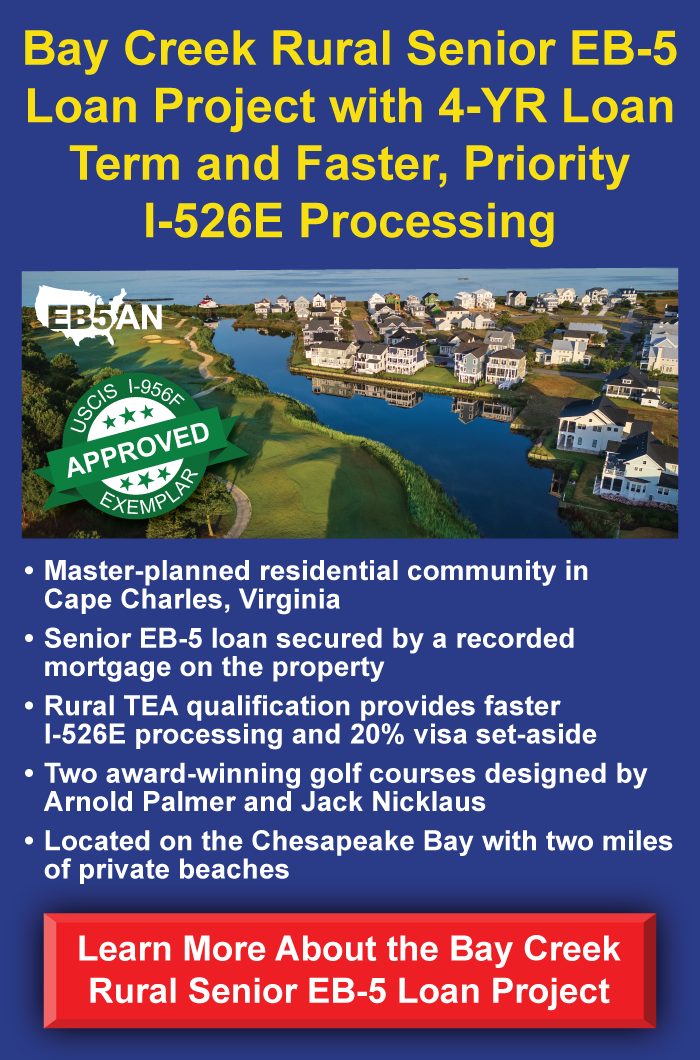
Importantly, USCIS continues to prioritize certain EB-5 filings in 2026, and many investors in EB5AN-sponsored rural projects are still seeing approvals in a matter of months.
2026 Program Fundamentals
At its core, EB-5 requires an $800,000 investment into a project located in a targeted employment area (TEA). Most EB-5 investments are tied to real estate development. The law requires that the capital be placed at risk, meaning returns cannot be promised or guaranteed.
Risk, however, is not binary. While no EB-5 investment is risk-free, careful project selection can significantly reduce exposure. Equally important is the requirement to document that all invested funds were lawfully obtained.
Investors must work with immigration attorneys to compile detailed evidence tracing funds from origin to investment. This often includes proof of employment income, business revenue, real estate sales, loans, gifts, inheritance, tax filings, bank statements, and transfer records.
For investors who can document lawful source and path of funds and are comfortable with an at-risk investment, EB-5 remains a viable and attractive route to permanent residency in 2026.
From Investment to Green Card, How the EB-5 Process Unfolds
Although interim immigration benefits may arrive quickly, in 2026, EB-5 should still be approached as a long-term immigration strategy.
Step 1: Initial Review and Eligibility Assessment
The process begins with a meeting with EB5AN. Investors complete a brief background and financial questionnaire, followed by a confidentiality agreement that allows access to detailed project materials. EB5AN then provides offering documents and project summaries.
Investors should carefully review these materials, including timelines, capital structure, developer background, and risk disclosures. Questions about TEA designation, job creation, or exit strategies should be discussed with EB5AN or immigration attorneys before proceeding.
Step 2: Project Selection
All EB5AN offerings qualify for TEA status, allowing investors to use the $800,000 investment threshold instead of the higher non-TEA amount.
TEAs fall into two categories:
- Rural locations outside metropolitan areas and cities with populations above 20,000.
- High-unemployment (urban) areas, where unemployment exceeds statutory benchmarks.
Selecting a project requires more than choosing a location. Investors should evaluate construction progress, market fundamentals, developer experience, job creation projections, and capital stack structure. The right project is one that aligns with the investor’s priorities; whether speed, capital preservation, or long-term returns.
Step 3: Source-of-Funds Preparation

USCIS applies rigorous scrutiny to the source of EB-5 funds. Preparing source-of-funds documentation is often the most time-intensive stage of the process.
Documentation requirements vary widely depending on how capital was accumulated and the investor’s country of origin. Working with an EB-5–experienced immigration attorney, particularly one familiar with local financial systems, is critical to avoiding delays or requests for evidence.
Step 4: Executing Investment Documents and Funding Escrow
Once a project is selected, the investor completes the subscription agreement and related disclosures. EB5AN provides step-by-step guidance to ensure accuracy.
After review and countersignature, the investor wires the investment amount, typically to an escrow account. These executed documents become part of the USCIS filing.
Step 5: Filing the I-526E Petition
With funds committed and documentation finalized, the attorney files Form I-526E. The submission includes the source-of-funds analysis, investment agreements, project approvals, TEA evidence, and supporting documentation from EB5AN.
USCIS issues a receipt notice that establishes the investor’s priority date and allows online case tracking.
Step 6: EAD, APs, and Your Conditional Green Card
Investors already in the U.S. may file Form I-485 concurrently, allowing them to remain lawfully in the country while the petition is pending.
At the same time, applications for work authorization (Form I-765) and Advance Parole (Form I-131) can be submitted. Many investors receive these benefits within weeks or months.
Once the I-526E is approved, investors either adjust status in the U.S. or complete consular processing abroad, ultimately receiving a two-year conditional Green Card.
Step 7: Removing Conditions and Securing Unconditional Permanent Residence

During the final 90 days of the conditional period, Form I-829 is filed. This petition demonstrates that the investment remained at risk and that the required U.S. jobs were created.
After filing, projects may repay invested capital according to their terms and after sustainment requirements are satisfied. Once approved, the investor receives a 10-year renewable physical Green Card and unconditional permanent resident status.
Managing Risk for Immigration Compliance and Capital Preservation
In 2026, EB-5 risk falls into two categories: immigration risk and financial risk.
Immigration risk involves USCIS approval of both the project and the investor’s petition. Clear documentation, compliant project structure, and sufficient job creation are essential.
Financial risk stems from the fact that EB-5 investments cannot be guaranteed. The objective is to reduce downside exposure while remaining fully compliant with program rules.
A reputable regional center plays a central role in mitigating both risks. Experienced regional centers oversee job creation tracking, economic analysis, compliance reporting, and coordination with legal counsel.
Investors should evaluate:
- Capital stack structure and EB-5 position
- Collateral and completion support
- Job creation buffer
- Construction oversight and fund controls
- Developer track record and transparency
Strong underwriting and disciplined project management materially improve the likelihood of both immigration success and capital repayment.
Rural or Urban? How Project Location Shapes Timelines

Project location has become one of the most important EB-5 decisions in 2026.
Reserved Visas Explained
Each year, EB-5 visas are allocated across categories: 20% reserved for rural projects and 10% for high-unemployment urban projects. These reserved visas exist alongside the unreserved pool.
For investors from high-demand countries such as China and India, reserved categories can significantly reduce exposure to long visa backlogs.
Why Rural Projects Often Move Faster
USCIS continues to apply priority processing to rural I-526E petitions. In practice, this has resulted in faster adjudications for many rural filings. EB5AN continues to see rural approvals arrive in months rather than years.
Urban Set-Asides and Capacity Limits
Urban reserved visas represent a smaller allocation. If demand increases, urban set-asides may become constrained sooner than rural, potentially extending wait times.
Choosing the Right Path
- Investors from backlogged countries who prioritize speed often benefit from rural projects.
- Investors from non-backlogged countries may still prefer urban projects if the investment profile aligns with their goals.
EB5AN offers both options because investor circumstances vary. The optimal choice balances immigration timing, risk tolerance, and capital objectives.
How to Get Started

To get started on the EB-5 journey in 2026, organizing financial records early is essential, as clear and well-documented source-of-funds evidence plays a critical role in the success of an EB-5 petition. Investors should also take time to assess whether a rural or urban strategy better fits their circumstances, factoring in potential visa backlogs and current USCIS processing priorities. Working with experienced professionals is equally important—particularly EB-5–focused immigration counsel and transparent regional centers with a strong compliance track record. Finally, investors should plan with the full timeline in mind, understanding that EB-5 is a multi-year process that ultimately concludes with I-829 approval.
EB5AN has helped more than 2,700 families from 70+ countries become lawful permanent residents of the United States. Our expert team has more than a decade of experience and offers clients first-rate, low-risk EB-5 regional center projects with a 100% USCIS project approval rate.
If you would like to know more about your EB-5 investment options, book a free call with our expert team today.