When I started planning my EB-5 process, I felt it was important to share my experience so that others could see what this journey actually looks like from the inside. I had spent years dealing with visa limits, comparing different options, and trying to find a path that would let me build my life in the U.S. without constant interruptions.
I know many people face the same issues, so I wanted to explain why I moved toward EB-5 and what finally made things clear for me.
In this post, I walk through the steps I took—how I compared visas, how I chose my attorneys, how I evaluated different regional centers, and what made me settle on the project I selected. My hope is that anyone planning their own EB-5 investment can use my experience to think through their own decisions with more confidence and avoid some of the uncertainty I went through.
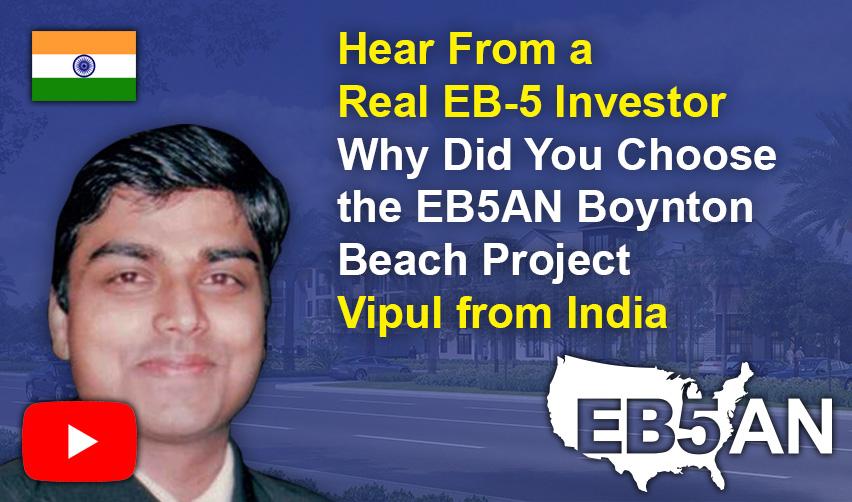
Watch Vipul’s Full Interview
Watch Vipul’s Interview Highlights
Read the Full Transcript of Vipul’s Interview
Why I Made an EB-5 Investment vs. Other Immigration Paths
My Strategy for finding an EB-5 Immigration Attorney
Why I Chose EB5AN’s Boynton Beach Urban EB-5 Project (Equity)
My Top Advice for Fellow EB-5 Investors
Why I Made an EB-5 Investment vs. Other Immigration Paths
I am a CPA with two CPA qualifications, and I have been active in the United States for close to a decade. During that time, I kept running into the same problem. There were projects we wanted to do, and we were ready to move on them, but we did not have regular status in the U.S. Because of that, we had to compromise on opportunities that were good for us. After facing this again and again, we reached a point where we felt we needed a clean and stable path that would let us work on our projects without these roadblocks. That is what pushed us toward EB-5. It looked quicker, it looked cleaner, and it would remove the constant struggle we had every time our status became an issue.
Before choosing EB-5, we did look at other visa options. Because I am Canadian by nationality, we considered the TN visa. We also looked at the L-1. We tried to make those routes work. But every one of them had the same limitation. They were tied to employment in one way or another. That meant we would always be restricted in what we could do and what we could not do. Our projects require freedom and flexibility, and these visas did not give us that. We wanted something that did not force us into an employment-based structure.
Even though we gave the other options a fair try, we kept coming back to the same conclusion. If we wanted long-term flexibility and the ability to move on opportunities in the U.S. without hesitation, EB-5 was the only option that made sense for us. That is why we chose it, and that is what led me to invest in the Boynton Beach multifamily equity project.
My Strategy for finding an EB-5 Immigration Attorney
Once I decided that I was going to move forward with EB-5 in a serious way, I spent a long time talking not only to different immigration attorneys but also to several regional centers. I had been in touch with the lawyers we ended up hiring for quite some time as well, because they had handled other visa matters for us before, including TN and L-1. We had already received feedback from them in the past, and we spoke to them again on more than one occasion once I started looking at EB-5.
During these conversations, one particular lawyer gave me a much stronger sense of confidence. I felt more convinced after speaking with this lawyer compared to the others. That is really what pushed us toward selecting and retaining this legal team. For me, the main idea was simple: I wanted the entire process to go smoothly. I did not want to take a risk with someone cheaper and then end up in a situation where the visa does not get approved. That was the background behind choosing these attorneys.
Once they were hired, the source of funds process– turned out to be very tough. It was not the lawyers’ fault—it was the overall situation. The U.S. economy had become very uncertain in the past few months, so arranging the funds became expensive and quite challenging. Still, once the lawyers were officially on board, we arranged the funds within a couple of months. We had one funding company withdraw at the last moment because my current visa was about to expire. We explained that a new application was already in process, but they were not convinced, so they refused. After a few more months, we managed to pull everything together, and now our application is complete from our side, even though it is still pending.
Throughout all of this, both the lawyers and the regional centers supported us at every step. They offered every flexibility we needed.
If I were to give advice to someone starting EB-5, I would say that every person’s situation is unique. You should speak to more than one lawyer—or even a team of lawyers—and see who actually fits your needs. The lawyer we hired fit me perfectly, but that does not mean the same lawyer will fit you. Spend time talking to them. Get opinions from trusted family members, like I did. The key is to speak to a few people before deciding who to hire.
Why I Chose EB5AN’s Boynton Beach Urban EB-5 Project (Equity)
I had been watching different regional centers for a long time, but once I decided I needed to move ahead, I had to compare the projects that were actually available at that moment. I spoke with several groups. One of them tried to tell me they could give me a 35% return. Right away, that did not feel real to me. Maybe it was not fully impossible, but the chance of getting that kind of return in this space did not feel right. I also checked where each project was happening. Most EB-5 projects are tied to real estate, so I wanted to know what was actually being built and where. My lawyer also helped by giving me background on different projects, which gave me a more balanced view. Between my own research, the place where each project was located, and the conversations with people involved, I started to feel more confident about choosing this project.
Some of the differences between EB5AN and the other regional centers were clear to me early in the process. Several other projects felt too expensive when I looked at the terms. Some of them also had documentation that was still waiting for approval. I did not want to invest somewhere only to find out later the documents were not approved and my entire immigration process was stuck. My lawyers helped me understand that risk. As an accountant, I also ran my own numbers. I looked closely at what it would cost me, what the expected return was, and what I could realistically afford. When I put all of that together, I felt comfortable moving forward. At every step, EB5AN’s team was extremely helpful.
The Boynton Beach Equity project stood out mainly because of the location. It is in an area that is growing fast. Based on everything I saw, the chances of the project failing felt extremely low. The expected return also made sense. It was not exaggerated, and it matched what a real project in a real market could produce. I also saw that the documentation for Boynton Beach was complete, not half-finished or still waiting on approvals. That gave me even more confidence.
The developer, The Kolter Group, was also a major factor. I researched them on my own. I read about their history and the projects they have completed. Then I asked my lawyer for an opinion as well, since they deal with many developers. Hearing that Kolter had a strong track record added another layer of comfort. All of this together helped me make the final decision to invest in this project.
When comparing urban and rural projects, I felt urban made more sense for me. I believe the chance of success in an urban area is higher because the market is more stable and predictable. With rural projects, you are never fully sure how changes in policy or the broader environment could affect the outcome. There is always a chance something unexpected could stop the project. Urban felt more reliable.
Between the equity option and the debt option, I chose equity. In finance, more risk usually means more return, and I felt that principle applied here. Funding in the United States is expensive these days, so when I compared the cost and the return, equity seemed like the better fit. The debt investment was another choice, but the return did not match what it would cost me to take that route. The equity option, with a 5% return, felt reasonable and aligned with how the project worked. Again, comparing that to the unrealistic 35% return someone else tried to offer me made it even clearer.
Working with the EB5AN team stood out compared with the other regional centers I had contacted. I felt the team was transparent. With some of the other groups, I honestly questioned their transparency. Whenever I needed help, EB5AN was available. It did not matter if the question was about the investment or something related to the project itself. When I reached out, someone from the team was ready to speak with me. Nothing was ever left hanging or delayed. Even when our funding was delayed and we needed to request an extension, they worked with us and were flexible enough to allow it. That level of support made a real difference for me.
My Top Advice for Fellow EB-5 Investors
I always tell other Indian EB-5 investors to work only with people who have real experience. I was putting in my lifelong savings, and I had to be fully sure about where my money was going. That was the starting point for me. I needed a team I could trust, people who were willing to talk with me, explain things clearly, and walk through every detail. That is why I tell others to sit down with the right team first and really discuss everything before making any decision.
I also tell people to pay close attention to what is happening with the EB-5 program itself. Right now, no one can say with confidence what the future of this category will be. The political environment keeps changing, and rules can shift. It is still early, but a year from now the picture may be different. So if someone is planning to start this process, they should keep a close watch and not assume things will stay the same.
When I look back, I would absolutely recommend EB5AN and my attorney. I felt comfortable with both the lawyer and the regional center team. They made the process feel manageable. But I also tell people to do their own assessment. What worked for me may not be the right fit for someone else. Every investor should make an informed choice.