
One of the most common questions in the EB-5 Immigrant Investor Program concerns how investor funds are deployed and how long they must remain invested to satisfy USCIS requirements. While many investors focus primarily on project selection or processing times, the mechanics of fund flow between entities and the legal meaning of “sustainment” can have significant immigration consequences.
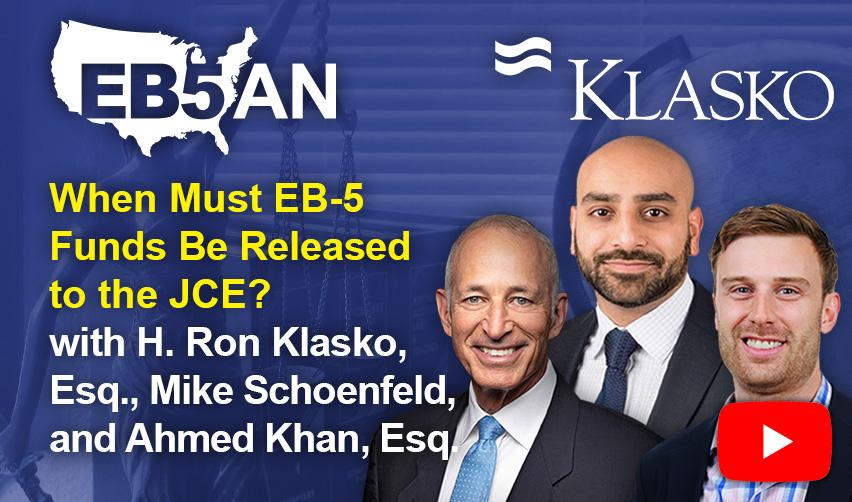
In a recent webinar, EB-5 attorney Ron Klasko, founding partner and Chairman of Klasko Immigration Law Partners, joined EB5AN Senior Vice President Ahmed Khan and Managing Partner Mike Schoenfeld to address these issues directly, clarifying how EB-5 capital typically moves from escrow to the job-creating enterprise (JCE), what “at risk” truly means under the law, and whether investor funds must remain at the JCE for a full two years in order to qualify for I-829 approval.
The discussion offered important guidance for investors evaluating EB-5 projects, particularly those structured with delayed deployment schedules or construction-based capital draws.
Watch Webinar Highlights:
Watch Full Webinar:
Understanding the EB-5 Capital Flow
Where Must Funds Be Sustained?
- The Sustainment Requirement Applies to the NCE
- Why Funds Cannot Simply Sit Idle at the NCE
- “Made Available” Does Not Mean “Immediately Transferred”
- What About USCIS Policy Guidance?
Practical Implications for EB-5 Investors
Focus on Structure, Not Myths
Understanding the EB-5 Capital Flow
To understand the legal analysis, it is essential to first understand how EB-5 capital is normally structured and deployed in a regional center project.
In most EB-5 offerings, investor funds do not go directly to the developer at the time of investment. Instead, the process begins with the investor wiring funds into an escrow account. The placement of funds into escrow is what allows the investor to file their Form I-526E petition.
Once the I-526E is filed and USCIS issues a receipt notice, the funds are typically released from escrow and transferred into the new commercial enterprise (NCE). The NCE is the entity in which the investor actually invests. In most EB-5 structures, the NCE is organized as a limited partnership or limited liability company.
At this stage, the investor’s capital is fully invested and at risk, but it is not yet in the hands of the developer. Instead, the funds remain in the NCE, which will later deploy capital to the JCE, usually through a loan agreement, according to the project’s financing and construction schedule.
Developers rarely need all EB-5 capital immediately. Instead, they typically request funds in phases, tied to construction milestones or specific expenses. For example, a developer may request $8 million on a specific date to cover invoices related to materials, labor, or other development costs. The regional center reviews the request to confirm it aligns with the USCIS-approved business plan (submitted in the Form I-956F), and only then releases funds from the NCE to the JCE.
This phased deployment is not unusual. In fact, it is common in large development projects where capital needs fluctuate over time.
Where Must Funds Be Sustained?

Against this background, the key legal question addressed in the webinar was straightforward but critical: Do EB-5 investor funds need to remain at the JCE for a full two years to satisfy the sustainment requirement, or is it sufficient for the funds to remain at risk within the NCE?
Some investors assume that because the sustainment period lasts two years from the beginning of conditional permanent residence through the filing of Form I-829, the money must physically sit with the JCE for that entire period. However, as explained by Ron Klasko during the webinar, this assumption is not supported by the law.
The Sustainment Requirement Applies to the NCE
Under the EB-5 statute and regulations, investors are required to sustain their investment throughout the two-year period of conditional permanent residence. What is often overlooked is where that investment is legally considered to exist.
Klasko explained that investors do not invest in the JCE. They invest in the NCE. The NCE, in turn, deploys capital to the JCE. Because of this structure, the sustainment requirement logically applies to the investor’s interest in the NCE, not to the location of funds within the broader project structure.
From a legal standpoint, there is no statutory or regulatory requirement stating that EB-5 funds must physically remain at the JCE for two full years. The law requires that the investment be sustained and remain at risk, but it does not mandate a specific duration of time that funds must reside with the JCE.
As long as the investor’s capital remains invested and at risk within the NCE for the required period, even if all of the money has not gone to the JCE yet, but all of the money is clearly made available to the JCE, the sustainment requirement is met. This is the requirement under the Matter of Izummi.
Why Funds Cannot Simply Sit Idle at the NCE
To explain it further, it is clear that EB-5 funds cannot remain indefinitely unused.
If the NCE simply holds investor capital without deploying it toward job creation, the project would run afoul of long-standing EB-5 precedent, specifically Matter of Izummi, one of the most important EB-5 precedent decisions.
Matter of Izummi establishes that the full amount of an EB-5 investment must be made available to the business most closely responsible for creating the required jobs; in other words, the JCE. This does not necessarily mean that the funds must be immediately transferred, but they must be available for deployment in a meaningful and enforceable way.
If EB-5 capital were never deployed, or if the structure prevented the JCE from accessing funds when needed, the investment would not meet EB-5 requirements.
“Made Available” Does Not Mean “Immediately Transferred”
A critical distinction emphasized in the webinar is the difference between funds being transferred and funds being made available.
In many EB-5 projects, the JCE has the contractual right to draw capital from the NCE according to a predetermined schedule. Even if all funds have not yet been transferred, the capital is still considered “made available” because the JCE can access it when needed.
From a legal perspective, this satisfies Matter of Izummi. The funds are committed, at risk, and available for job creation, even if they are deployed in stages rather than all at once.
Therefore, in a structure where investor funds remain in the NCE and are drawn down by the JCE over time, there is no requirement that all funds reach the JCE immediately, nor that they remain there for two years.
What About USCIS Policy Guidance?
During the webinar, Klasko also addressed a 2015 draft USCIS policy memo that occasionally causes confusion among investors and practitioners.
This draft memo was never finalized and therefore does not carry the force of law. Even if it had been finalized, policy guidance does not override statutes, regulations, or precedent decisions. Nevertheless, it provides insight into how USCIS may think about certain scenarios.
The draft memo suggests that if, at the time USCIS adjudicates the I-829, often several years after the conditional residence period, the EB-5 funds still have not been deployed to the JCE, that could present a problem. Such a situation would need to be evaluated on a case-by-case basis, and while arguments might be made to justify the delay, it is not an ideal position for an investor.
Importantly, this guidance does not say that funds must remain at the JCE for two years. Rather, it reinforces the idea that EB-5 capital must eventually be deployed in a way that supports job creation.
Practical Implications for EB-5 Investors

For EB-5 investors, the key takeaway is that phased deployment structures are legally permissible, provided they are properly designed and documented.
Investors should focus on whether:
- Their funds are fully invested and at risk in the NCE.
- The NCE has a clear, enforceable plan for deploying capital to the JCE.
- The deployment schedule aligns with the USCIS-approved business plan.
- Capital is actually deployed within a reasonable timeframe.
Well-structured projects anticipate these issues and ensure that EB-5 funds are both sustained and meaningfully used to create jobs.
Focus on Structure, Not Myths
The idea that EB-5 funds must sit at the job-creating enterprise for two full years is a common misconception. As the webinar made clear, the law focuses on sustainment of the investment at the NCE level, not on the precise timing or duration of fund transfers to the JCE.
At the same time, EB-5 capital cannot remain idle indefinitely. Funds must be made available to the JCE and ultimately deployed in a manner consistent with job creation requirements.
For investors evaluating EB-5 opportunities, understanding how funds flow and how the law treats sustainment can help avoid unnecessary concerns and allow for more informed decision-making. As always, working with experienced EB-5 counsel and reputable regional centers remains essential to navigating these complexities successfully.
If you would like to better understand how EB-5 funds are structured, deployed, and sustained in different projects, book a free call with our expert team today.