
At the start of the EB-5 immigration process, most EB-5 investors focus first on the project. They look at the location, the market, the developer, and the job creation. But behind every EB-5 project is another question that is just as important: Which regional center is managing the offering?
The regional center controls the structure of the investment, oversees the funds, tracks job creation, and communicates with USCIS. If the regional center makes mistakes, the consequences can affect both your immigration process and your capital.
Not every EB-5 regional center is a reliable partner for your investment. Some have sponsored dozens of successful projects and guided hundreds of families through I-526E and I-829 approvals—as well as the repayment of their funds. Other regional centers are new, less reputable, or have limited experience managing large developments under the current policies of the EB-5 Reform and Integrity Act of 2022 (RIA).
Indeed, a regional center’s professionalism—or lack thereof—often determines whether jobs are created on time, I-526Es are approved promptly, and investors are repaid as planned. A strong track record is evidence that a regional center knows how to navigate the unique requirements of the EB-5 industry.
For that reason, every EB-5 investor should examine a regional center’s history before committing their funds to a project. How many projects has the regional center sponsored? How many approvals has it secured? Has it repaid prior investors? Has it maintained full compliance under the current EB-5 policies?
The answer to these questions could mean the difference between a timely Green Card approval and repayment or losing your $800,000 investment and a USCIS denial.
At the same time, there are multiple factors to consider when vetting an EB-5 regional center, ranging from its USCIS approvals to its transparency to its record of repayment. Many new EB-5 investors may find it challenging to undertake this challenging yet crucial step of the due diligence process.
To that end, we’ve prepared an actionable guide to evaluating any regional center, breaking down exactly what investors should be looking for, particularly in terms of the regional center’s track record.
This post also examines EB5AN’s track record of consistent success throughout our 13+ years in the EB-5 industry.
As Sam Silverman, managing partner of EB5AN, puts it, “In EB-5, the numbers tell the story. If a regional center has consistently delivered approvals, created jobs, and repaid investors, that record speaks louder than any claims or promises the regional center could make.”
We also invite you to watch highlights of our interviews with EB5AN investors, who explain their criteria for choosing a strong regional center.
The Role of EB-5 Regional Centers
Why a Regional Center’s Track Record Matters
How to Evaluate an EB-5 Regional Center
- Questions to Ask the Principals Directly
- Analyzing the Regional Center’s Track Record
- USCIS Compliance and Transparency With Investors
- Using a Due Diligence Checklist
EB5AN’s Impeccable Track Record of Regional Center Management
- 28 Form I-956F Project Approvals
- 740+ I-526E Approvals Under the RIA
- Strong Developer Partners
- A 100% USCIS Project Approval Record
- A Regional Center You Can Trust
For a Successful EB-5 Investment, Choose a Strong Regional Center
The Role of EB-5 Regional Centers
Choosing a regional center is one of the first and most important decisions in the EB-5 process.
There are hundreds of USCIS-designated regional centers across the United States, and the vast majority of EB-5 investors choose to work with regional centers rather than investing directly. In recent years, well over nine out of 10 EB-5 visas have been issued through regional center investments.
An EB-5 regional center is a USCIS-approved economic entity that promotes job creation and economic growth within a specific geographic area. When selecting a regional center project, instead of investing directly into a business and trying to create 10 jobs on your own, you inject your capital into an investment fund that is set up and managed by the regional center. This investment fund is known as a new commercial enterprise (NCE).
The regional center then partners with a job-creating entity (JCE)—the developer—to deploy your funds into an EB-5 real estate project designed to create the required jobs. Throughout this process, the regional center also pools capital from other investors, manages the flow of funds, oversees job creation reports, and helps prepare the EB-5 documentation that supports investors’ I-526E and I-829 petitions.
In a typical regional center structure, the regional center’s responsibilities go far beyond marketing the project. The regional center sets up and manages the NCE, coordinates with the project developer, tracks how funds are used, and prepares the economic reports that show how many jobs have been created. It is also responsible for EB-5 compliance and reporting to USCIS—a much more stringent requirement under the policies of the RIA.
In sum, a successful regional center must have policies and procedures in place to monitor projects, update investors regularly, and respond to changes in EB-5 policy without putting investors at risk.
Why a Regional Center’s Track Record Matters
While most investors devote their time to analyzing projects, the regional center’s track record matters just as much as the project itself.
A regional center that has sponsored various projects and seen those projects complete construction, create enough jobs, and return capital to investors has already demonstrated that it is capable and trustworthy.
By contrast, a regional center with little experience—or a history of project denials, I-526E denials, compliance problems, or unfinished projects—creates extra immigration and financial risk, no matter how attractive the current project it’s sponsoring might seem.
How to Evaluate an EB-5 Regional Center
A thorough review of the regional center’s management is one of the simplest ways to begin due diligence.
To begin this review, look at the regional center’s principals—the people listed in the offering documents as the regional center’s management team. Their education, work history, and prior roles should make sense for the job they are doing now. You should know where they went to college, what they studied, and which firms they worked for before joining or founding the regional center.
You should also ask how long they have worked in EB-5, how many EB-5 investments they have managed, and what the outcomes were.
If they have managed large amounts of capital and many projects without major problems, that is a positive sign. But if they cannot give you clear answers about their background, or if they avoid questions about past failures, that is a red flag.
Questions to Ask the Principals Directly
Many EB-5 investors skip one of the easiest and most powerful steps: speaking directly with the regional center principals before investing.
The principals are responsible for the regional center’s strategy, choose which projects to sponsor, and decide how to respond when problems arise. A short call with them can often tell you more than reading all of a project’s marketing materials.
During that call, you should ask them to describe their role in the project, how they evaluate developers, and how they monitor projects over time. You should also ask them to walk you through specific examples of past projects that went well—and projects that did not go as planned—and what they learned from each one.
Analyzing the Regional Center’s Track Record
When you turn to the regional center’s project history, start with the basics: How many EB-5 projects has the regional center sponsored? In what industries and locations? How many are still active, how many have been completed, and how many have failed or been restructured?
Ask for the number of investors who have received I-526/I-526E approvals and the number who have achieved I-829 approvals. These numbers indicate your chances of immigration success if you invest with this regional center.
You should also ask whether the regional center has previously worked with the same project developer who is behind the offering you are considering. If they have collaborated successfully on similar EB-5 projects, the risk level will be much lower.
You should expect the regional center to provide clear documentation of its success rate. A well-established regional center should be willing to share project lists, approval statistics, and repayment history. And it should be willing to provide these details in writing, not just orally.
Lastly, you should ask about any troubled or failed projects, loan defaults, or delays in repaying investors, and you should insist on direct answers. No regional center can avoid all problems, but a strong regional center will explain what went wrong, how it handled the situation, and what it changed afterward.
If the regional center refuses to discuss past issues or seems defensive when you ask about them, that is another red flag.
USCIS Compliance and Transparency With Investors
Compliance history is another key part of track record.
Because regional centers are responsible for compliance and reporting to USCIS, you need to know whether they have ever had a project denied on compliance grounds or faced sanctions for failing to meet the EB-5 program’s stringent standards.
A good regional center will have a clear, written compliance policy and will follow it strictly. It will also stay up to date on EB-5 regulations and adjust its practices when rules change.
You should ask directly whether any of the regional center’s projects have been denied by USCIS for reasons related to the regional center’s actions or documentation. If there is a history of denials or serious compliance problems, immigration risk is high, and it is wise to avoid that regional center.
Perhaps the most important indicator of compliance with USCIS policy is the project’s history of Form I-956F approvals. Regional centers must submit an I-956F for each EB-5 project they sponsor. The I-956F submission must describe the project’s structure, business plan, job creation potential, and more to ensure full compliance with USCIS standards. In fact, every EB-5 project must receive I-956F approval from USCIS before investors can receive I-526E approvals and obtain their Green Cards.
Transparency and communication are also signs of a strong track record in action. A regional center that has successfully managed projects in the past will usually have a standard system for investor updates and reporting. Before you invest, ask to see sample reports from past projects, including construction updates, job creation calculations, and financial statements.
Also ask how often investors receive updates and through which channels. A transparent regional center will provide regular, understandable reports and will answer follow-up questions promptly.
Remember, if you have trouble getting basic information during the due diligence phase, it is unlikely that communication will improve after you invest.
Using a Due Diligence Checklist
As you go through this process, it helps to keep a simple checklist of questions. For each regional center you are considering, make sure to ask the following questions:
- Who are the principals, and what are their backgrounds and EB-5 experience?
- How many EB-5 projects has the regional center sponsored and in which real estate sectors?
- How many investors have received I-526E approvals and I-829 approvals?
- Has the regional center successfully repaid prior EB-5 investors? On which projects?
- Has the regional center ever had projects denied or faced serious compliance issues?
- Can the regional center provide a complete history of both successful and failed projects, including any loan defaults or delays in returning capital?
- Did they create all of the jobs the economic reports promised?
Finally, remember that you have a right to full information about the regional center’s track record before you invest. You should ask for a comprehensive list of past projects, immigration outcomes, and repayment results, and you should expect written answers to your questions.
A regional center that has delivered strong results will be proud to share its history. But a regional center that avoids these questions or gives incomplete answers may be signaling that it has something to hide.
In a situation where your family’s immigration status and a large amount of capital are at stake, you should only partner with regional centers and developers that have demonstrated success, clear communication, and a willingness to be fully transparent about their track record.
Having considered these guidelines for vetting regional centers, let’s now examine EB5AN’s track record of success across multiple EB-5 projects.
EB5AN’s Impeccable Track Record of Regional Center Management
Since founding EB5AN in 2013, our managing partners—Sam Silverman and Mike Schoenfeld—have been deeply involved in the EB-5 industry. They have served in leadership roles, spoken at industry events in the United States and abroad, and helped shape best practices across the EB-5 space. From the beginning, their focus has been on transparency and project quality.
EB5AN is one of a select few regional center operators to have successfully closed and funded more than 30 EB-5 transactions, which have represented over $7 billion in project development.
Across these transactions, we have maintained a perfect track record for both project immigration approvals and project development execution. This history reflects years of careful project selection, structured oversight, and ongoing monitoring from start to finish.
More than 2,700 families from over 70 countries have selected EB-5 projects sponsored by EB5AN regional centers. Many of these families are already living in the United States as permanent residents. Our work spans multiple continents, with offices in the United States, India, Brazil, Vietnam, the United Arab Emirates, Mexico, South Africa, and China. This global presence allows us to support investors directly while maintaining consistent compliance standards across all projects.
Before founding EB5AN, our principals advised Fortune 500 companies on growth and investment strategy and worked on major IPOs, securities offerings, and private equity transactions. This experience informs how we evaluate projects, structure offerings, and monitor risk.
And EB5AN’s principals are always willing to talk directly with potential investors and help them make an informed decision.
28 Form I-956F Project Approvals With a 100% Approval Rate
As mentioned above, one of the clearest measures of a regional center’s compliance record under the RIA is its Form I-956F approvals. USCIS uses Form I-956F to review and evaluate every material aspect of an EB-5 project. When USCIS grants a project I-956F approval, it confirms that the project complies with EB-5 program requirements.
As of January 2026, EB5AN has received an industry-leading 28 Form I-956F approvals from USCIS for the EB-5 projects we manage. Additionally, we have maintained a 100% approval rate on all Form I-956F petitions filed for our managed projects. These approvals cover projects across multiple industries and markets, including senior loan and equity structures.
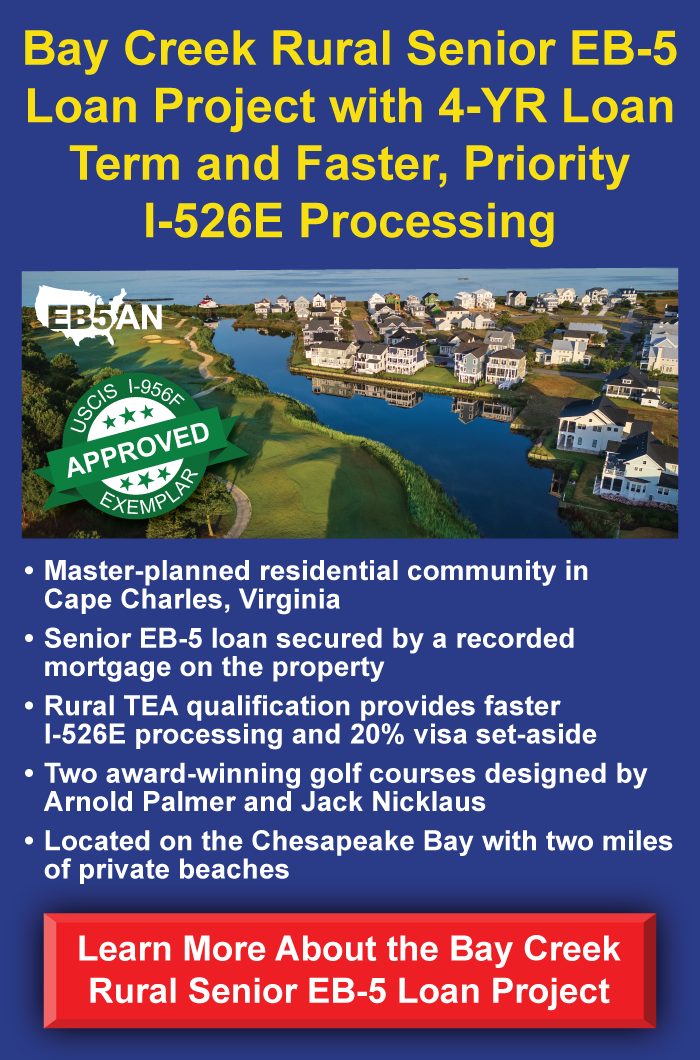
USCIS has approved 28 I-956F applications across 15 of our projects, including Bay Creek (Senior Loan), Grand Park (Senior Loan), Spring Haven (Loan), Terra Ceia Multifamily (Loan and Equity), Rocky River (Loan), Twin Lakes Georgia (Loan), Siena Valley Club (Preferred Equity), and others that are now closed. This breadth shows our ability to structure compliant projects across different asset types and geographic locations.
Our processing times have also been strong. Some of our Form I-956F approvals were granted in under three months, with the fastest approval coming in just 1.6 months. Our last 20 Form I-956F approvals were all processed in seven months or less. These timelines compare favorably to broader industry averages and reflect our careful preparation before filing.
Critically for investors, Form I-956F signals lower immigration risk. When a project has already been reviewed and approved by USCIS, the agency does not need to re-evaluate the project’s compliance when an individual files their Form I-526E. In that case, USCIS focuses primarily on the investor’s personal eligibility, including their source of funds and admissibility.
Put simply, a “pre-approved” project simplifies the review process and can result in a faster I-526E approval—and a faster Green Card.
In fact, investors in EB5AN projects have received I-526E approvals in less than five months.
740+ I-526E Approvals Under the RIA
Since the RIA was enacted in 2022, more than 740 investors in EB5AN-sponsored projects have received Form I-526E approval. Achieving over 740 approvals under the current regulatory framework demonstrates that our projects meet USCIS’s compliance and documentation standards.
Nearly all recent rural I-526E approvals in our projects have been received in less than one year, with some processed in as few as three months.
The priority processing of rural targeted employment area petitions has played a major role in these timelines. USCIS has approved substantially more rural petitions than urban petitions during this period, and our focus on rural projects has positioned investors to benefit from that priority.
Behind every approved I-526E for EB5AN investors, there is a family that can begin to enjoy the freedoms of conditional permanent resident status. Form I-526E approval qualifies investors and their eligible family members for their initial Green Cards. With conditional permanent residence, they can live, work, and study in the United States with few restrictions—and escape the uncertainty of H-1B and similar temporary visas.
15,000+ Qualifying EB-5 Jobs Created
Job creation is central to the EB-5 program and to the Form I-829 petition that removes conditions on permanent residence. Creating at least 10 jobs is the key requirement for an EB-5 investor to receive his permanent U.S. Green Card.
Across our projects filed since the RIA, development activity has already created more than 15,000 qualifying EB-5 jobs.
This level of job creation supports the requirements for 1,187 investors across these projects, with additional job creation expected as construction continues.
For projects still under construction, job totals are projected to increase as more capital is deployed and more work completed.
Because job creation is a required element of Form I-829 approval, these numbers matter directly to investors’ long-term immigration outcomes. Strong job creation reduces the risk of shortfalls and positions investors for a smooth I-829 approval.
Strong Developer Partners
EB5AN diligently screens each developer before sponsoring their projects.
Our long-standing partnership with The Kolter Group exemplifies this process. We have partnered with Kolter, one of the largest private developers in the United States, on multiple EB-5 projects. Over its 25+ years of operation, Kolter has invested in real estate projects totaling more than $37 billion in value, borrowed billions of dollars, and never failed to repay a loan.
All EB-5 investments in Kolter projects are in good standing or have been repaid. This performance reflects disciplined underwriting, conservative capital structures, and experienced development management.
A Regional Center You Can Trust
Taken together, our 28 Form I-956F approvals, 740+ I-526E approvals, 15,000+ jobs created, and history of successfully funded and executed projects demonstrate our ability to deliver immigration approvals and repayments to our investors.
For EB-5 investors, numbers alone do not tell the full story. What matters is whether a regional center can guide projects from filing through construction, job creation, petition approvals, and capital repayment. Our history shows that we have done exactly that, repeatedly and under the current EB-5 policies.
Combined with our commitment to transparency and investor resources, our track record shows that we at EB5AN are a regional center you can trust with your family’s future.
For a Successful EB-5 Investment, Choose a Strong Regional Center
It’s crucial for EB-5 investors to work with a regional center that enjoys an established track record of success across multiple projects. If a regional center has repeatedly protected its investors’ immigration and financial interests, it is likely to do so with future investors.
“Any regional center can make claims about what it plans to do,” concludes EB5AN managing partner Sam Silverman. “But what really matters to investors is what it’s already done—and whether those results are consistent, transparent, and repeatable.”
For more information on getting your EB-5 journey off to a successful start, schedule a free consultation with EB5AN.