
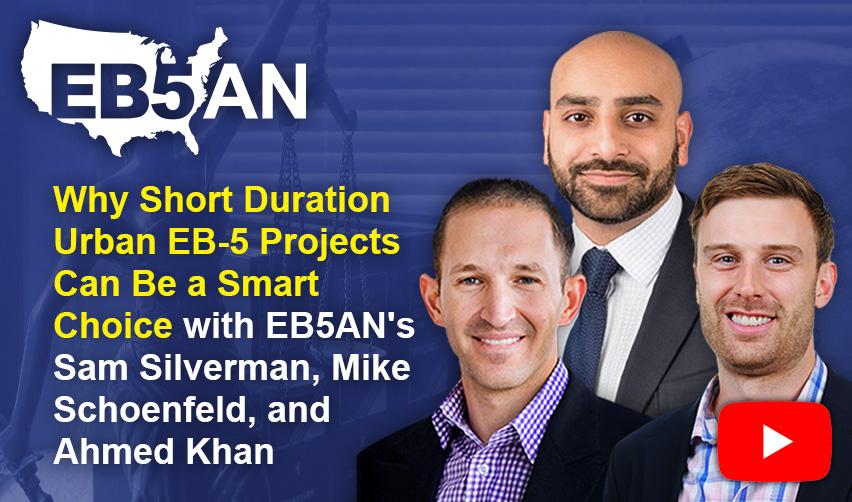
EB5AN recently hosted a webinar featuring EB5AN’s Managing Partners Sam Silverman and Mike Schoenfeld alongside Senior Vice President Ahmed Khan to provide clarity on one of the most important decisions facing EB-5 investors today: whether to pursue a rural project with priority processing or a high-unemployment area (urban) project offering shorter investment durations and familiarity.
The discussion focused on Visa Bulletin strategy, the advantages of concurrent filing, the practical realities of rural versus urban development, and how investors can align immigration timing with financial comfort. Rather than presenting a one-size-fits-all answer, the webinar offered a structured framework for evaluating risk, processing speed, and investment design under the EB-5 Reform and Integrity Act (RIA).
Watch Webinar Highlights:
Watch Full Webinar:
Visa Bulletin Strategy and the Advantage of Concurrent Filing
Urban Projects Bring Stability and Predictability
Rural Projects’ Priority Processing and Timing Considerations
Balancing Speed and Comfort in EB-5 Decision-Making
Loan vs. Equity and Understanding Investment Structure
A Strategic Approach to Immigration and Capital Planning
Visa Bulletin Strategy and the Advantage of Concurrent Filing
Ahmed began by addressing a central concern for many prospective investors: visa backlogs in other employment-based categories. For individuals reviewing the Visa Bulletin and facing extended waiting periods, EB-5 can present a meaningful alternative.
He explained that both the rural and urban EB-5 set-aside categories are currently listed as “current.” This designation allows eligible investors to file their immigrant petition and adjustment of status application concurrently.
Concurrent filing offers practical and immediate benefits. Investors may apply for employment authorization and advance parole travel permission at the same time as their adjustment of status application. These interim benefits are typically issued within a few months and remain valid until the applicant receives conditional permanent residence.
Although urban projects do not receive priority processing like rural projects, they remain current under the Visa Bulletin. This enables urban project investors to file concurrently and secure work and travel flexibility while their I-526E petition is pending.
For individuals navigating uncertainty in other visa categories, the ability to regain control over employment and mobility provides meaningful stability during the immigration process.
Urban Projects Bring Stability and Predictability
Mike then discussed why urban high-unemployment TEA projects have historically represented the majority of EB-5 investments.
A key factor is market density. In major metropolitan and established secondary markets, developers often have extensive experience completing similar projects in the same area.
Investors can evaluate comparable properties within a close radius, review rental performance, occupancy rates, and prior exits, and develop a grounded understanding of projected outcomes.
This level of comparability contributes to predictability. Urban infill projects, particularly multifamily developments, frequently follow repeatable models with experienced builders and established demand patterns.
Execution is another consideration. Construction in major cities typically benefits from greater labor availability, established infrastructure, and streamlined permitting processes. By contrast, rural projects may face logistical challenges, including limited labor supply and higher infrastructure costs, which can extend development timelines.
Urban projects also tend to be located where people already live and work. Demand is embedded within the surrounding community, rather than dependent on destination-based activity. For many investors, this familiarity and built-in market activity enhance overall comfort.
Rural Projects’ Priority Processing and Timing Considerations
While urban projects offer stability, rural projects provide a distinct immigration advantage: priority processing under the Reform and Integrity Act.
For investors whose primary objective is speed, this benefit can be decisive. Ahmed emphasized that both rural and urban projects can ultimately lead to permanent residence. The key distinction lies in timing.
Families facing time-sensitive circumstances such as children approaching age-out limits, career transitions requiring permanent residence, or other personal deadlines may prioritize faster adjudication above all else. For these investors, rural designation can meaningfully accelerate the path to a Green Card.
However, rural projects are often unique developments in less familiar markets. They may be more difficult to compare to existing projects, and investors may need to rely more heavily on the developer’s track record and the strength of the business plan.
Balancing Speed and Comfort in EB-5 Decision-Making
The webinar underscored that the choice between rural and urban projects is fundamentally strategic.
If the primary goal is obtaining a Green Card as quickly as possible, rural projects may offer the strongest alignment with that objective due to priority processing.
If an investor seeks predictability, comparability, and faster capital repayment, then urban projects can offer a compelling alternative. Under the new rules, certain urban projects are structured to target repayment within approximately three to four years, allowing investors to recover capital while continuing through later stages of the immigration process.
Loan vs. Equity and Understanding Investment Structure
The webinar also addressed a fundamental financial distinction: loan versus equity investment structures.
In a loan model, EB-5 capital is provided to the developer as debt. Developers typically offer some form of collateral or repayment guaranty. Because this structure prioritizes capital protection, projected returns are generally lower.
In an equity model, investors participate directly in the project’s ownership. While there may be no specific collateral securing repayment, investors share in the project’s performance and therefore may receive higher returns.
In the example discussed, investors participating in an equity structure were offered a 5% preferred return that accrues annually and is paid upon project completion and sale. Over a three-year investment period, this structure could result in a meaningful increase in total capital returned, reflecting the higher risk-reward profile.
Understanding this distinction is essential. Investment structure affects not only potential financial return but also the overall risk profile of the EB-5 strategy.
A Strategic Approach to Immigration and Capital Planning
The webinar concluded with a broader perspective on today’s EB-5 environment. Investors are no longer evaluating projects solely on location or return. Instead, they are building integrated strategies that align immigration timelines with financial objectives.
Rural projects may offer accelerated processing. Urban projects may provide familiarity, repeatability, and market comparability. Loan structures may emphasize capital preservation, while equity structures may enhance return potential.
By carefully evaluating these factors and aligning them with personal priorities, investors can structure an EB-5 pathway that supports both permanent residence and long-term financial planning.
As immigration policies continue to evolve and employment-based backlogs remain a concern for many families, proactive education and thoughtful decision-making are more important than ever.
More than 2,700 families from over 70 countries have selected EB-5 projects sponsored by EB5AN regional centers. Our expert team has more than a decade of experience and offers clients high-quality, low-risk EB-5 regional center projects with a 100% USCIS project approval rate.
If you would like to know more about your EB-5 investment options, book a free call with our expert team today.
