
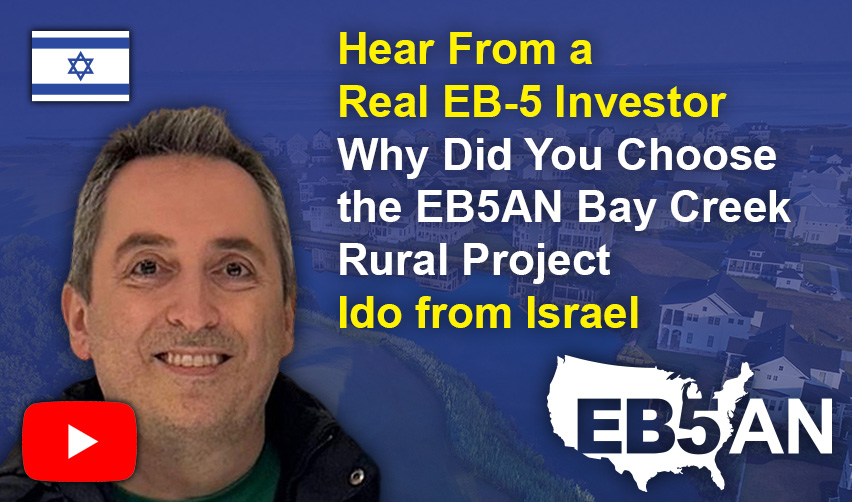
My name is Ido. I’m 48 years old, from Tel Aviv, Israel, and I recently made an EB-5 investment in EB5AN’s Bay Creek rural project. For years now, my family and I have been planning a move to the United States.
We want our children to experience the United States’ unparalleled safety, educational, and career opportunities, and EB-5 was really the only viable way for all of us to move to the U.S. as residents.
While it took some planning, I have no doubt we found the best EB-5 project on the market in Bay Creek.
I know many individuals around the world would also like to move to the U.S. but don’t know where to start. In this post, I’ll explain my strategy for navigating the EB-5 process at each step.
I’m confident my experience will help both Israeli nationals and people from other countries to get a solid start on EB-5 and make the process as efficient as possible.
Watch Ido’s Full Interview
Watch Ido’s Interview Highlights
Read the Full Transcript of Vinodh’s Interview
My Background and Looking into U.S. Visa Options
Finding the Right Immigration Attorney and the Source of Funds Process
Researching Regional Centers
Why EB5AN
Choosing the Bay Creek Rural Project
Working with EB5AN and My Advice to Other Investors
My Background and Looking into U.S. Visa Options
I’m married with three kids, ages eight to three. I’ve lived in Israel all my life, except for a few short stints abroad, including a year as a high school exchange student in Philadelphia. So I had some early exposure to life in the U.S., which made the idea of relocating a little more familiar.
For a long time, my family and I had a general interest in the U.S.—we’d been there several times as tourists, and like most Israelis, we grew up immersed in American media and culture. But it was more than that. Over the last few years, the political and security situation in Israel became harder to ignore. Even when things seemed relatively quiet, the overall sense of uncertainty made me start thinking more seriously about other options.
I wasn’t just thinking about myself—I was thinking about my kids, their safety, their education, and their long-term opportunities. That’s when I started looking into different immigration paths and weighing whether we should pursue a plan to relocate permanently.
I have a background in software engineering and have worked for several U.S.-based companies, including Meta (formerly Facebook) and Google. So at one point, I could have pursued a work-based visa through one of those companies. But I passed on that opportunity at the time, probably five or six years ago.
Later on, once my wife and I decided we wanted to explore relocating more seriously, I took a closer look at all the available visa types. I went pretty deep on the E-2 visa. I even started building out a business plan and got pretty far down that path. The appeal of the E-2 was that I could set up a business and move the family without fully committing to long-term residency right away.
But the deeper I got into it, the more uncomfortable I became with tying the family’s immigration status directly to a business. If the business failed or needed to pivot, it could jeopardize our ability to stay in the U.S. I didn’t want to be in a position where I had to prove ongoing metrics just to remain in the country, with no flexibility. So I decided to decouple those two things—business and residency—and that’s what led me to explore EB-5.
Finding the Right Immigration Attorney and the Source of Funds Process
Once I knew that EB-5 was the right path, I focused on finding an attorney who really understood the process. At first, I leaned toward an attorney I’d already been working with for the E-2 application. I liked him personally, but he didn’t specialize in EB-5, and I started to realize that I needed someone who had seen many cases and understood the nuances, especially post-reform.
I came across AIIA, an organization for EB-5 investors, and found that they had a short list of recommended attorneys—only six, if I remember correctly. At the same time, I was also speaking with several of the top regional centers, and I asked them who they recommended.
One name kept coming up: Dennis Tristani. So that’s when I decided to focus in on Dennis.
There were a few reasons I ultimately chose Dennis. First, he clearly understood the whole EB-5 landscape—different types of projects, regional centers, and especially the complexities that have come up since the 2022 reform. He wasn’t just reciting the regulations; he had practical experience and could explain how different scenarios might play out.
I tend to be pretty detail-oriented. I had a lot of questions, a lot of edge cases I wanted to run through, especially since I was going through this process alongside my brother, who is also applying for EB-5. We were both investing, and we wanted to be sure we’d thought through everything. Dennis didn’t dismiss any of our concerns. He gave us honest, thoughtful answers. He didn’t pretend to know everything, but he showed that he had the experience to handle anything that might come up.
The source of funds process was the most intensive part of the whole application. I knew early on that if this part wasn’t handled correctly, the entire application could fall apart. In Israel, by law, we’re only required to keep records going back seven years. So I knew that anything older than that might be hard to track down, and I was worried about whether USCIS would expect more.
Dennis’s team gave me a very detailed list of what I’d need to collect. It was tailored to my specific situation, and that helped a lot. I went through everything line by line and tracked down as many documents as I could—some going back 16 or 17 years. I couldn’t get everything, but I got enough to clearly show the source and path of the funds, and I made sure to back everything up with at least two types of documentation.
Most of the documents were in Hebrew, so I translated many of them myself. Later on, tools like Gemini got good enough to help with that, but at the time, I was doing most of it manually to make sure nothing got lost in translation.
Once I submitted everything, Dennis’s team reviewed it thoroughly and even found a few errors I had missed—some numbers I had pasted incorrectly. That attention to detail gave me a lot of confidence. From start to finish, the whole process took about two to three months, factoring in holidays and the translation work.
If someone asked me today what to look for in an EB-5 attorney, I’d say three things. First, they should have nationwide experience. Not just regional or state-specific knowledge, but a broad view of how different projects and regional centers operate across the country.
Second, they should have handled a good number of cases since the 2022 reform. That’s a major dividing line. You want someone who understands how USCIS is interpreting and enforcing the new rules.
Third, it helps if they’ve worked with investors from your country before. In my case, I wanted someone who had handled Israeli petitions. And ideally, they should already have a working relationship with the regional center you want to work with. That streamlines everything.
Researching Regional Centers
Initially, I wasn’t sure whether I even needed to use a regional center. I looked into the direct investment path, thinking maybe I could use my own business as the EB-5 vehicle. But once I looked at the risks and spoke with attorneys, it was clear that the regional center path was safer and more predictable, especially since I didn’t want to tie the family’s immigration status to the success of a new venture.
At first, I assumed I needed to find a regional center in Florida, since that’s where we hope to relocate. So I looked at a few based there, and also some that had Florida projects but weren’t based in the state. I didn’t like what I saw. A lot of the projects felt too small, with only a handful of investors, or the regional centers themselves didn’t seem very experienced. It just didn’t feel right.
That’s when I widened the search and started asking AI tools like Gemini and ChatGPT for help. Once I dropped the geographic filter, I saw that there were three regional centers that kept coming up as the leaders in the field. EB5AN was one of them—sometimes even the top one mentioned.
I reached out to all three at once and started having serious conversations. Pretty quickly, my brother and I felt that EB5AN was the right fit.
Why EB5AN
There were a few reasons we chose EB5AN. First, we felt you were being straightforward with us from the beginning. We’d already done a lot of homework, and you respected that. You weren’t trying to “sell” us. You just answered our questions directly.
Second, your portfolio of EB-5 projects stood out. You had a good variety of projects—different types, different locations, different structures. Some of your competitors had only a few projects, and many of them were very niche. We didn’t want niche. We wanted something stable and in the sweet spot of what EB-5 was meant to be.
Your transparency was also a major factor. Before we even spoke with anyone, we found detailed project info on your website—no NDAs, no hidden materials. Other regional centers made us sign NDAs just to see basic project data. You didn’t do that. Everything was open and clear.
And once we did speak with you, the communication was excellent. Everything was available immediately. You weren’t asking us to wait for a future project or delaying responses. It felt like we could move at our own pace, and you’d be ready when we were.
Choosing the Bay Creek Rural Project
When we got to the point of comparing specific projects, we had a few key concerns we were trying to address. Job creation was one of them—we wanted to be confident that the project would meet the USCIS job creation requirements. Bay Creek had already received I-956F approval, which helped us feel more comfortable. And even in projects that hadn’t yet, we could tell that the structure was solid.
We also wanted to work with a regional center that would act in good faith if anything went wrong—especially if there were source of funds issues that might block our petition. EB5AN was clear about how that would be handled. That mattered to us.
Redeployment was another concern, though we learned that rural projects reduce the risk of redeployment. That was one of the reasons we started considering rural options more seriously.
We also wanted a residential project—not a commercial one. We’re more comfortable with residential, especially in a time where so many people in the U.S. are relocating and looking for housing. We felt like demand would stay strong.
And of course, we were drawn to the shorter processing times that rural TEA projects can offer. After going through research, attorney interviews, and months of planning, we really wanted to get our application filed and move forward.
Once we settled on Bay Creek, we wanted to move quickly. It was a solid project—residential, already under construction, many other investors already in. We had a strong developer and clear documentation. We did an exhaustive comparison using spreadsheets, but everything kept pointing to Bay Creek.
Toward the end, it looked like the project might sell out before we finished the source of funds documentation. That’s when I pushed hard to get everything done quickly—and thankfully, we made it in time.
We used AI in a few ways throughout the process. Early on, it helped us discover regional centers and compare project options. Later, we used it to enrich our spreadsheets and look up real estate trends in specific areas. For document analysis, Gemini helped us summarize offering documents and pull out specific information.
The tools improved a lot during our research period. A year earlier, they weren’t very helpful. But by the time we were deep into the project comparison stage, they had become pretty useful.
Working with EB5AN and My Advice to Other Investors
From the first meeting with Keith from EB5AN, the experience felt different. It didn’t feel like a sales pitch. It felt like we were speaking with professionals who were genuinely trying to help us make a good decision.
You front-loaded a lot of the communication—sent detailed project info right away, set up meetings promptly, answered all our questions. That approach carried through the whole process. It was collaborative, responsive, and professional.
If you’re thinking about EB-5, don’t wait too long. I’ve been telling people to act sooner rather than later. The grandfathering clause expires in September 2026, and no one knows what will happen after that. The program could change in unpredictable ways.
Choose a regional center that has a real track record—not just one project, not just a small local operation. Look for volume, experience, and responsiveness. Make sure your attorney has done post-reform EB-5 cases and understands how USCIS is interpreting the new rules. And make sure they’ve worked with the regional center before. It makes the whole process smoother.
Lastly, know what you’re getting with EB-5. It’s not a temporary visa. It’s a direct path to residency and citizenship. That mattered to me and my family. We wanted to have that long-term security—not just the option to test the waters, but the ability to build a life in the U.S. if we choose to. EB-5 gave us that option.
