EB-5 Investor Testimonial:
Ido from Israel
Rural and Urban TEA Regional Center EB-5 Projects at $800K.
Adjust Status and Receive Work Permit (EAD) in as Fast as 90 Days and Receive Green Card Within 12 Months.
My Background and Why I Chose EB-5
Yeah, okay. Sure thing, Sam. I’m happy to be here. So my name is Ido. As you mentioned, I’m from Tel Aviv, Israel. I’m 48 years old, father of three, married. And I’ve been living in Israel for my entire life, excepting for a couple of periods, rather short periods of time, where I was living elsewhere. One of those periods actually was in the U.S. I was an exchange student in Philly previously. So I had a bit of an earlier experience of living there, so I have an idea of what to expect. So that’s pretty much the basic background.
Right. So it’s been kind of building up to it over the years. So I’ve always been fond of the U.S., as has my family, and we’ve visited as tourists now and then. Also, in Israel, we’ve all been exposed to American culture since childhood—I mean American media. Most of Israel is an English-speaking country, even though it’s not the primary language here, and grew up with American culture, kind of immersed in it.
But anyway, it kind of built up to it. It’s life circumstances. It’s the circumstances of Israel as a country. Most people are pretty well aware of what’s been going on over the last few years here, the war. And even though right now it’s kind of peaceful, there are a lot of considerations to take into account. And I have young kids, as I mentioned, the oldest one being eight years old and the youngest one being three years old. So I have to think of their future, and I’m trying to mitigate uncertainty and some other risk factors.
And also in terms of business potential, in terms of the ability to make a living and the quality of life and the cost of living and all of those things, they came into sync—the stars aligned. And a while ago, we decided that we’re going to do it. We’re going to try to relocate. Initially, we weren’t sure that we want to be residents necessarily, but we ended up settling on this specific plan.
Right. Previously, in previous years, I was working as a software engineer, employed by several large corporations, international corporations, actually American, U.S.-based corporations, such as Facebook, currently known as Meta, and Google and others. And some visa types were available to me had I wanted to relocate. I kind of passed on that at the time. That was around five, six years ago.
And then once we really did decide that we want to relocate, I took a very deep look at all the types of visas available, and it looked like I was eligible for several of them. And I was looking into an E-2 path without necessarily committing to residency, just to test the waters and to see if I can set up a business in the U.S. and get started that way. So we were looking into that, and I actually got pretty far along with that and was working on a business plan.
But then I decided I didn’t want to tie in the business with the future of my family. I didn’t want the family to have to leave if the business failed. I didn’t want to constantly be on a path where I have to kind of prove again and again that the business is meeting some milestones without the ability to pivot, which would also limit me in the business capacity. So at the end, I decided that I should decouple those, and that’s when I got to think about EB-5.
Choosing an Immigration Attorney and Source of Funds Documentation
All right. Yeah. As I was doing my initial research and trying to figure out how to approach EB-5, I realized that, of course, an important early step in the process should be to pick an attorney who is experienced with it. And actually, since I was already in touch with some attorneys, since I had already researched and tried to seek attorneys around the E-2 visa application that I was exploring, I defaulted to an attorney who was already helping me with my E-2. And also, I was in touch with a couple of other attorneys.
I was actually simultaneously approaching regional centers and attorneys. So each regional center is kind of like part of the intake or onboarding experience, some of them at least. So they also involved their own attorneys or third-party attorneys in the pitch process. And then I had meetings with several of those attorneys who were introduced to me by other regional centers, not necessarily to represent me, but just to wrap my head around various types of projects and regional centers. And I kept going back to my E-2 attorney, who actually doesn’t specialize necessarily in a single type of visa but in several types of visas.
At some point realizing that that specific attorney, even though I liked him a lot, he didn’t necessarily have a lot of experience with EB-5, didn’t necessarily have a lot of experience with the specific challenges that may be related to my life circumstances, to all the things that I was looking for in a project, in a regional center, and ended up trying to find another lawyer.
So then I took a long look at the internet, and I found an association by the name of AIIA, which is an association of EB-5 investors. You might be familiar with them. And they have a very short list actually of attorneys that they recommend, something like six.
And then I also, at the time, was already in touch with three of the top nationwide regional centers, present company included. So I also sought recommendations from you guys and from a couple of your competitors.
And then once I got a hit, somebody that was both on the AIA list and recommended by yourselves—which was Dennis Tristani—that’s when I kind of homed in on him and his firm.
Okay, so that’s a good question, and it breaks down into a few things. First, I wanted to know that the lawyer that I would be working with is familiar with the entire landscape of regional centers and the types of projects that exist in this market and also the types of risks involved, the kind of intricacies related to the reform that happened several years ago and post-reform, and all the questions I had gathered throughout my research.
And I quickly saw that Dennis is familiar with all of it—not just the theory of it, but actually the practice of it. He has a lot of relevant experience, and also not only has the knowledge but also can suggest solutions to the problems that I was foreseeing. I just wanted to make sure that some edge cases were addressed, and I tend to be a bit more thorough and careful than I think most other people that I know at least.
So I, along with my brother, by the way—we undertook this process together. He’s also a petitioner, or will be shortly. He’s lagging a bit behind me. So we thought of a lot of edge cases that we wanted to make sure that were addressed and that we prepared for those, because it’s quite a bit of money, especially if you multiply by two.
So we were confident. He looked like he knew what he was doing and not overconfident either, which is something we don’t like. I mean, his heart and his mouth were on par with each other. I don’t know if I’m translating this idiom correctly. So that’s when we decided to engage his services.
So yeah, the source of funds thing, I quickly realized early on that it was the crux of the whole thing and that it had to be done right. And I had a lot of questions surrounding that, because in Israel, we have a law that says that you have to keep records of everything seven years, going back seven years, and that applies to everybody, to me, to my bank, and to other relevant institutions. So I knew that I can only confidently say that I can obtain documents going seven years back. And I was a bit wary of that, because I read everywhere that USCIS likes to go as far back as they want to indefinitely, and then if I can’t provide documents to accommodate their request, that can be construed as non-compliance. So I wanted to make sure that we can actually prepare it and be compliant and have everything ready and not reach a point in the process where we can’t provide something that we are required to.
So then they gave me a very thorough list. I mean, Tristani’s firm gave me a very thorough list of the documents that should be prepared, tailored to my specific set of circumstances. And then I set out to prepare those and obtain those from the various sources. Actually, I was able to obtain some older documents—in my case, some of them going back as far as 16, 17 years back. I couldn’t obtain everything, but enough to present a very clear source of funds path tracing and cross-reference everything with at least two different supporting types of documents.
And then I set about having those translated. Some of those were in English. Most of them were in Hebrew. I ended up translating many of them myself. And actually, just right around the time when I was actually coming to the end of this daunting task, Gemini got really good at translating documents end to end. Just provide the scanned PDF and it’ll translate it pretty well. But most of the work I did back when it was earlier versions of all the big AI language models, which did a terrible job at that. And also, some translators that I tried also did a pretty bad job. I wanted to make sure that I get it right, so I did it myself for the most part. So that was that.
And once all of that was completed, they reviewed it very thoroughly and then actually gave me feedback. They found a couple of typos and especially numbers that were pasted and I forgot to update them, which surprised me because it was much. It was much. But they reviewed it very well, and they found a couple of important errors, which I then corrected, which is when we went back to you guys.
I’d say it was around two to three months. We had a couple of holidays, both here and over there. So yeah, two to three months.
Right. So I’d say a couple of things, a couple of advices that I would give right now to whoever asks me. So first, I’d say it has to be somebody who has ideally nationwide experience and is not necessarily strictly dealing with a specific region of the country. I think that gives an important perspective.
Also somebody, of course, that has a lot of experience with many cases, particularly post-reform. I think the reform was in 2022—correct me if I’m wrong. So that’s important to have somebody who dealt with a lot of cases since then.
And ideally, also somebody that at least some of those cases were Israelis and also at least has a preexisting relationship with the regional center with which that person would want to work. I think that’s important. Wouldn’t want the attorney to be working with the regional center for the first time when dealing with my case.
Why I Chose EB5AN and the Bay Creek Rural EB-5 Project
Yeah. All right. So first off, I was aware that there is another option for EB-5 that does not involve regional centers. And initially, I wanted to explore that as well. So I was looking into whether I should even use a regional center or not, or opt for … How is it called? Direct investment, is that the correct term?
Right. So then I was looking into that, because I am currently in the process of setting up a business, as you may have already realized because I was looking into the E-2 visa. Currently, I’m setting up a site for my new business in the EU, but eventually, I also want to establish one in the U.S. So I was looking into that, and maybe I would be able to invest in my own business and then somehow count that as a direct investment.
Very quickly, I realized after consulting with a few relevant people and also a couple of attorneys that this is a bad idea and is inferior to the regional center path in almost every perceivable way. And again, as I said previously, I had looked at E-2, and then I decided that I do not want to couple my business success or failure with my relocation prospects, because we decided to relocate regardless of what happens professionally. So then that option went off the table.
Then once I decided that I want to work with a regional center, I had a misconception that I have to necessarily select a project that was in Florida, which is the place that I have my eyes set on in terms of where I would like to relocate to. And therefore, I looked at regional centers which are in Florida. And then I got in touch with a few of those and looked at a few of the projects which are in Florida. And actually, I was even in touch with a couple of regional centers that were not in Florida, but their projects were, but they were local to another state, some odd options.
And then I did not like any of those options, neither the projects nor the regional centers. I can give a couple of examples without naming them. But generally speaking, I felt that something was off. It was kind of small-time regional centers, small-time projects where there was only like a handful of investors, and I felt that this type of thing is quite risky. And that’s when I started to use the AI engines just to do a bit more thorough research, without narrowing down as I had previously done. I said, “Okay, not necessarily Florida, not necessarily a Florida-based regional center nor a project,” and then I just kind of asked them what’s out there.
And then I discovered that there are several nationwide, cross-state regional centers. And three kind of stood out as the leaders, regardless of whether I was asking Gemini about it or ChatGPT or … I don’t remember. It was either Claude or Grok. So it became clear that there are three market leaders, yourselves being one of them—and actually, if I remember correctly, the top option, at least in one of the engines.
So then I reached out in parallel to the three of you, and I started a dialogue. I said, “Look, I favor Florida,” because that’s a state where I see myself living, and also, I believe that it’s a very popular destination right now, both for businesses and for new residents. So I think projects there will do well, generally speaking. So I said, “Okay, but that’s not a hard requirement, and I have some other preferences as well.” And then we had a very nice, very thorough dialogue with both yourselves, Keith specifically.
So anyway, and a couple of others, a couple of competitors. And then pretty soon, my brother and I began to feel very confident with you guys compared to the other two. It became clear almost immediately that we’re going to work with you, and I’ll try to recount why that is.
So I would say one important factor was that we felt that you’re being honest with us from day one. You weren’t trying to handle us or talk down to us. You realized that we did quite a thorough way. We researched EB-5 generally, and we researched a lot of the surrounding aspects of it, and we went around the block a couple of times before getting over to you. So you realized that. And then we felt that you were being honest with us. We felt that you knew what you were talking about.
And also, one more very important thing to us is that we felt that you had a very well-rounded portfolio of projects as opposed to some of your competitors, even the notable ones, which seem to favor an approach where they have much fewer projects and some of them very, very niche types of projects, which we don’t necessarily feel comfortable with. So they didn’t seem to be suited to our sweet spot as investors.
Right. Yes, as you say, these are all aspects in which you excel compared to your competitors. Transparency, even just without even speaking with you guys, we went on your website. We saw a list of projects. Each one of the projects had a lot of detail to it that was openly available—no NDAs or anything. We had previously signed a couple of NDAs for some of the other regional centers that we were in touch with just for basic information. We saw the details. We saw the transparency. We saw that you have a nice portfolio where you have several different types of projects in different locations around the country.
And then once we started the dialogue with you, we saw that you very freely provide us with answers, provide us with information that we need. Everything was readily available. We weren’t told to wait for a few more months because there’s another project around the corner. No, everything was at hand. Everything was available.
And we felt that it was up to us, that the ball’s in our court, that we can move forward at our leisure, and we have somebody on the other side which is ready to go, which was important to us and was not necessarily the case with the other regional centers that we were in touch with or had been in touch with.
Okay, so let me break it down. So we had a few considerations. We had a few preferences and we had a few apprehensions that we were trying to balance out. So one of our …
I’ll start with the apprehensions, the things that we were worried about, the things that we wanted to mitigate and protect against. So we wanted, first of all, to be sure that job creation, that the requirements set out by the USCIS are met. And we like the fact that many of your projects have already been cleared. I want to make sure I’m using the correct terminology here. They already have—what is it, I-956F approval? Is that the right one?
Right. So that put our mind at ease regarding … And even the ones that weren’t, so we looked at the material, and we were very quickly assured that … Also in terms of which developers it is that you’re working with, also in the way that you built the legal engagements with the developers, we got under the impression that we can rest assured and be confident that the requirements will be met, and in many of the projects already have been met. So that was one thing that was very important to us.
Another thing that was important to us was that we would have a good-faith partner in you guys for an eventuality where our initial request would be rejected, because as I previously mentioned, we were worried about not being able to provide all documents required by the USCIS and then to be labeled as non-compliant or something along those lines. We wanted to make sure that if and when such a thing happens, we would be able to … or at least you would make a good-faith attempt to refund our money before the loan matures. So we were assured of that as well.
Then we were also apprehensive about the risk of … What is that? Not redistribution. What’s the word I’m looking for? Redeployment. But that was before we started considering rural. So I think in rural that doesn’t happen very often. But we were worried about redeployment, so we wanted to know how you guys handle that. And we liked the answers that we received from you better than we liked the answers that we received from some other regional centers.
So we knew early on that we wanted a TEA project for several reasons, but we never gave serious consideration to rural projects until you actually suggested those. But then we really liked the shortened timeline for processing. And then personally, for me, since I’ve really been at it for a while, and my family has been at it for a while, and the E-2 and all the other steps that we went through before getting to where we are now, we really did feel that we would like to expedite things.
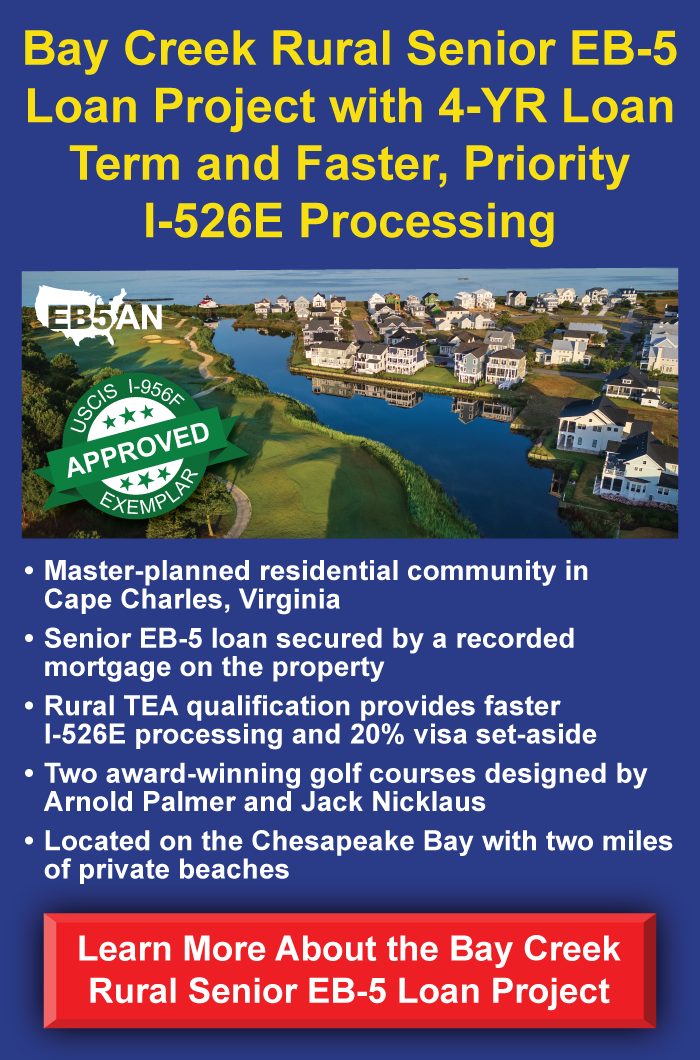
And then once we realized that rural is available and once we understood the differences, and once we were also assured that we could find a project where the developer was a serious developer and the prospect seemed not so risky—because rural, it sounds risky at first, sounds really risky. But then once we found a project to our liking, we said, “Okay, we have to go with rural, because we really do want to get the Green Card as soon as we can.” That’s when we landed on Bay Creek.
One more thing that we liked about Bay Creek is that it’s a residential project, because a lot of the other projects, we felt that if you’re investing in a commercial project, you have to be somewhat familiar with other aspects of the business with which we’re not necessarily familiar. And residential is something that we believe is safer in terms of demand, especially right now when so many people are on the move within the U.S. So they’re seeking high-quality housing and high-quality projects.
And we like the developer. We like the guaranties offered by yourselves and the developer. So a lot of things fell into place with this project.
Yes, we liked the fact that the project is already ongoing. I mean, it’s not a project that’s only hitting the ground right now. We liked the fact that many other investors had already joined before us. We liked the location. We took a look at the market, the real estate market, in that region.
To tell you the truth, we looked at so many projects, so I don’t even remember all the specifics right now. But we did it very thoroughly. We had Excel spreadsheets where we were comparing the different aspects of it.
And as I said, a lot of things fell into place, so much so that when the source of funds check took longer than anticipated, and then at some point it looked like it was going to be sold out … So as you know, I really leaned into it, and we managed to actually get in, even though it was kind of like at the last moment.
Yes. So of course, yes, it was very useful when analyzing the market. Once we had everything summarized in our own spreadsheets, we also had … I think it was Gemini. At some point, we were using mainly Gemini, because it just got very good at those kinds of things. We got Gemini to take a look at that sheet and also enrich it with some other pertinent information that we wanted to have, researched the real estate market and the kind of demand that the various regions are seeing.
Also specifically, yes, for the legal documents, we were also using AI to summarize or seek some specific answers that we wanted to dig out of them, just to try to assess the exposure. So yes, it did come in handy.
But as I said, actually, it’s funny, but initially, as recently as maybe one year ago, those tools were pretty useless, at least for these kinds of tasks. That was my personal experience. And then it really improved as we were looking into these things, and recently, it became very, very proficient with them. The last version of Gemini, for example, came in very useful. But by that time, most of the work had been done.
Right. Basically, I would say it exceeded my expectations almost immediately as we hit the ground and we had that first meeting with Keith. I think once I reached out to you guys, so you were the one who responded initially. I liked that you provided a lot of information, front-loaded the whole process by providing a lot of information upfront, and then you set up the meeting with Keith for me.
And then once that was done … It was the first time when I interacted with the regional center where I didn’t feel that I’m interacting with a salesperson, and Keith wasn’t trying to sell me, wasn’t trying to pitch me, wasn’t trying to close me. I felt that I’m dealing with a professional who wants to work alongside me to make sure that I’m getting the best answers and the best solution to what I was seeking. I felt no pressure. I felt no push in one particular direction in terms of a specific project or a specific type of project. And that was very reassuring, I must say. And then ever since then as well, that attitude has persisted, and I didn’t look back, so to speak.
Final Thoughts
Right. So first off, I like to tell people to be wary of the timeline because … Now I’m not sure I’m using the correct terminology, but something pretty bad is going to happen in September of ’26. If memory serves, something called the grandfathering clause or the grandfathering protection is going to expire, and then that’s not … Or sorry, is that the grandfathering or is that the regional center clause? Something is going to expire September of ’26. Something else is going to expire in ’27, right? And one of those is the regional center program, and the other is the grandfathering clause. Correct me if I’m wrong.
So whoever discovers that I’m in the process of applying for EB-5 and asks me whether or not and how and when they should approach it, I generally tell them to put a rush on it—because the window may be not exactly closing, but things are about to change in an unpredictable way. So that’s one thing that I like to say to people who are asking me.
But of course, in terms of selection of regional centers, I share my findings. In terms of selection of a lawyer, I also share my findings. In terms of considerations, I share why I went rural and why I went TEA and what types of things I look at when I try to assess a project. So the first of those being the developer and secondly what kind of guaranties there are. But of course, guarantee is not exactly the right word, because it has to be at risk by definition. But what kind of risk mitigation programs are available for that project and with that regional center?
And in terms of source of funds, I can’t say that I’m an expert, because everything that I’ve researched is tailored to my own source of funds. So that can be very different for a different person.
And of course, EB-5, one big difference that sets it apart from E-2, for example, which is the previous visa I was looking at, is that it’s an immigrant visa. So you’re on a path to citizenship, and you’re on a path to residency. You’re not losing time—because if you are a non-immigrant and then at some point you decide to become an immigrant, that’s a non-trivial endeavor. And then only once you do convert, if you do, only then the clock starts ticking in terms of how soon you can be eligible for citizenship. And that’s measured in many years, as we know. We would like to have at least the option of becoming citizens eventually if we already do relocate. So that’s an immigration intent, so it’s good to have an immigrant visa rather than a non-immigrant visa.
That’s pretty much the outline of the advice that I would give a person who is seeking my advice.
I would say that I’m kind of a trailblazer. I have a couple of other friends and neighbors and acquaintances who are in an early stage of considering EB-5 or something similar to EB-5. Some of them are toying with ideas of non-immigrant visas or other paths. But I am urging those people to really make those decisions on a short time frame, because as I said, and as I say to them, the EB-5 option is going to undergo some unpredictable changes soon, and if you are interested, better to do it sooner rather than later.
Right. So yes, I would definitely, on both counts. I believe I’ve already provided most of the answers as to why, but just to summarize, I would say both Dennis and yourselves … and also having a preexisting relationship with each other, which is also a benefit from my point of view, because you know how to get things done with each other on a short time frame, and you’ve done it before. So each one of you is a professional, also a trustworthy entity as far as I was able to assess, and I went about it pretty thoroughly, I believe. So yes, I would recommend it.
And I believe that also in terms of volume and your ability to onboard many investors on an expedited time frame, I think you’re set up for it, and you’re one of the only regional centers I’ve been able to glean who are set up for working with multiple projects in multiple states at the same time and onboard dozens of investors. I don’t know. If I had to guess, dozens of investors per month or something, that order of magnitude. You’re not small-timers. You know your way around the whole process, and that’s important, especially in light of what I said, the September deadline and next year’s deadline. You’re all set to go. You can hit the ground running with them. And also, you have a nice well-rounded variety of projects that I believe most people will find something to their liking within your portfolio at any given moment.
Also, even though I believe that you are pretty busy currently—because I believe currently a lot of people are going for EB-5 at the current period of time—you’re very responsive, very agile. And that’s not something I can take for granted, because a lot of others, they just disappear at times for weeks on end. So that’s not something that I encountered.
For all those reasons, and probably a couple of others that I’m forgetting, I would definitely go ahead with that endorsement.