At EB5AN’s recent live “Office Hours” session on February 11, Ahmed Khan, Senior Vice President of EB5AN, addressed two of the most important questions investors face:
- How do I choose the right EB-5 project?
- How long will the process actually take?
For both prospective and current EB-5 investors, these questions go to the heart of the decision-making process. While every investor’s situation is different, several clear themes emerged from the discussion. In this article, we will take a closer look at them.
Choosing the Right EB-5 Project
Rural vs. Urban TEAs
Why Hiring an Attorney Comes First
What Timeline Should You Expect?
Define Your Goal, Then Build the Plan
Watch February 11 Session Highlights:
Watch the Full February 11 Session:
Choosing the Right EB-5 Project
During the live Q&A session, one investor asked a very practical question: “You have six projects currently. How can I evaluate which project is good for me?”
Ahmed answered this question by clarifying that the first step is simple but critical: start with a conversation. Our team’s job is to understand investors’ priorities and help them match those priorities to the right project. There is no universal “best” project. If there were one option that delivered the fastest immigration timeline, the quickest capital return, the highest financial return, and the lowest possible risk all at once, every investor would choose it.
The reality is that every EB-5 project has trade-offs.
Some projects are structured to prioritize immigration speed. Others may offer a potentially shorter capital return timeline or stronger financial upside. And some are designed to balance both objectives as effectively as possible. But it is impossible to maximize every variable simultaneously.
That is why understanding your goals comes first.
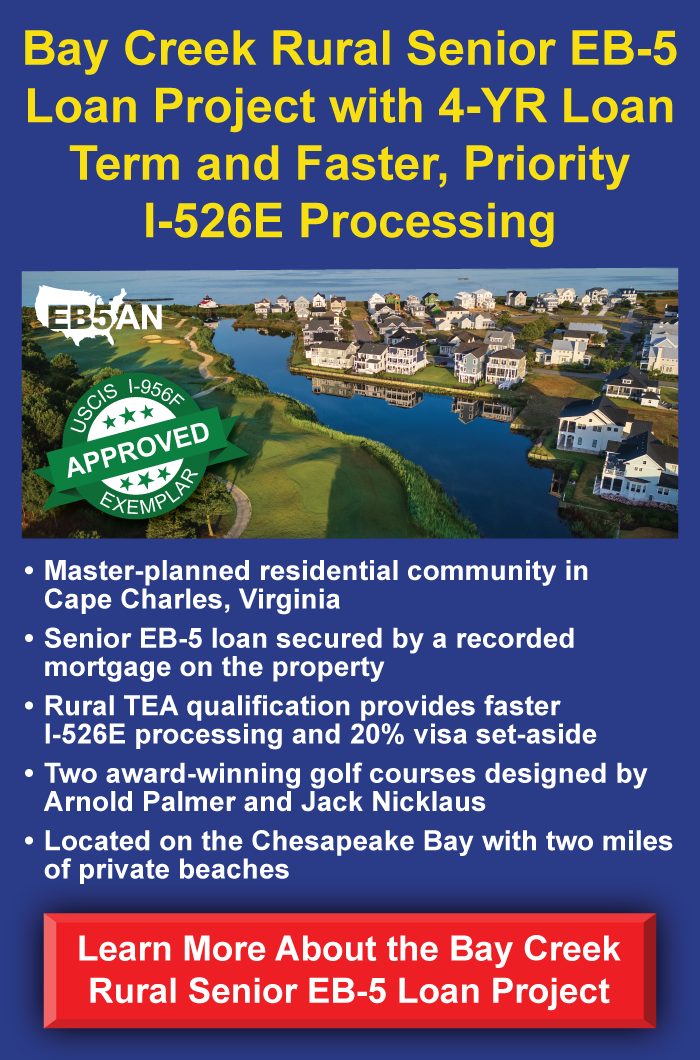
For example, many investors from India and China are primarily focused on securing their Green Cards as quickly as possible. For these investors, rural projects often rise to the top of the list. Under the EB-5 Reform and Integrity Act framework, rural projects benefit from priority processing and a larger allocation of visa set-asides. This combination has made rural investments significantly faster in terms of initial petition adjudication and Green Card issuance.
On the other hand, some investors, particularly younger investors or those who anticipate needing access to their capital sooner, may prioritize financial considerations differently. These investors sometimes choose urban high-unemployment area (urban) projects. In certain cases, these projects may offer shorter capital deployment periods or stronger return structures. The trade-off, however, is typically a longer immigration timeline.
Rural vs. Urban TEAs
During the session, the EB5AN team reviewed recent adjudication trends, and the numbers tell a compelling story.
Through mid-2025, rural I-526E petitions have been adjudicated at a dramatically faster pace than urban filings. A substantial percentage of rural cases have already been reviewed, with approval rates that have been extremely strong. By contrast, only a small fraction of high-unemployment filings have even been looked at during the same period.
The reason is straightforward: rural projects receive priority processing.
From a purely immigration-speed perspective; specifically, getting through the first major hurdle of I-526E approval and into the Green Card queue, rural projects are clearly outpacing urban and infrastructure projects.
Now, does that mean rural is always the best choice? Not necessarily.
It is likely that rural categories may also experience backlog pressure because more investors are being approved faster and moving into the visa queue. However, even if rural becomes backlogged, there are structural advantages that may keep those backlogs shorter than in other categories. Rural projects receive a larger allocation of visa set-asides; double that of high-unemployment areas and significantly more than infrastructure. Combined with priority processing, this continues to support faster movement overall.
That said, urban and infrastructure projects still offer advantages for certain investors. The key is simply being comfortable with a longer immigration timeline.
Why Hiring an Attorney Comes First
Another major topic during Office Hours was timing. One investor asked how long it typically takes to select a project, move funds, and file the petition.
Many investors assume the process begins with gathering their funds. They consolidate capital, identify a project, and then hire an attorney, believing that filing should only take a week or two because the “hard work” is already done.
In practice, it works the opposite way.
The first step should almost always be hiring an experienced immigration attorney. Your attorney will guide you on how to structure your source and path of funds, what documentation is required, how funds may be consolidated, and what may or may not be acceptable from a USCIS perspective.
Nearly every investor believes their source of funds is straightforward. In reality, even the cleanest cases typically take three to four weeks to document properly. Attorneys are also managing multiple cases simultaneously, so building in lead time is essential.
From start to finish, the attorney engagement and source-of-funds preparation process typically takes four to six weeks. During that same time, you can be evaluating projects and determining which one aligns with your goals. Once documentation is complete and a project is selected, subscription, wiring funds, and filing can happen very quickly, often within days.
What Timeline Should You Expect?
Investors consistently want a realistic expectation of when they will actually receive their Green Card.
For a rural filing in early 2026, current trends suggest that I-526E approval may occur within a matter of months. After approval, conditional Green Card issuance could follow within several additional months, potentially placing investors in the first half of 2027 for conditional residency.
Once you receive your conditional Green Card, the timeline becomes more standardized. All investors must hold conditional residency for two years before filing Form I-829 to remove conditions. The I-829 process typically takes about another year. During that time, conditional status is extended.
From initial filing to receiving a permanent 10-year Green Card, a rural investor today might expect approximately four to five years in total.
Importantly, the biggest hurdle in the EB-5 process is securing I-526E approval and receiving the conditional Green Card. Once that milestone is reached, particularly in projects already under construction, the I-829 stage is generally far less eventful.
For high-unemployment or infrastructure projects, the primary difference lies in the I-526E stage. Instead of several months, approval may take 16 to 20 months or longer. That additional year to year-and-a-half shifts the entire immigration timeline forward. In practical terms, an investor filing in early 2026 under a non-rural category might not receive a conditional Green Card until 2028. That is the real-world impact of priority processing.
Define Your Goal, Then Build the Plan
The most important takeaway from the Office Hours session on February 11 is that EB-5 is not a one-size-fits-all decision.
If your primary objective is securing your Green Card as quickly as possible, rural projects currently offer a meaningful advantage. If your financial timeline or capital planning is more flexible, urban or infrastructure projects may still make strategic sense.
What matters most is clarity. For this, you are recommended to define your priorities first, engage experienced counsel early, evaluate projects carefully, and understand the trade-offs involved in every path.
The EB-5 process is complex, but with the right preparation and guidance, it becomes manageable, and ultimately predictable. For many investors, that predictability is what makes the journey worthwhile.
More than 2,700 families from over 70 countries have selected EB-5 projects sponsored by EB5AN regional centers. Our expert team has more than a decade of experience and offers clients first-rate, low-risk EB-5 regional center projects with a 100% USCIS project approval rate.
If you would like to know more about your EB-5 investment options, book a free call with our expert team today.