

Making an EB-5 investment requires taking a broad approach to due diligence.
Investors are not weighing just one issue. They are trying to improve their chances of a smooth immigration process while also protecting their capital and planning for repayment. Those two goals are closely connected, and both depend on the overall strength of the project and the regional center behind it.
On the immigration side, investors want a project that gives them a strong path toward I-526E approval and, ultimately, permanent Green Cards. On the financial side, they want to reduce risk and have confidence that their funds can be repaid on time
A wide range of factors can affect those outcomes, including the developer’s experience, market demand for the project, the regional center’s track record, the number of jobs expected to be created, the project’s location, and the exit strategy.
“The best investment decisions are made when investors look at the full picture,” explains Sam Silverman, managing partner of EB5AN. “A project may sound attractive in one area, but what matters is how all the key pieces work together to support both the immigration goal and the return of capital.”
As a result, no single factor reveals an EB-5 project’s overall risk profile.
“In other words,” Silverman concludes, “a single benefit should not be enough to motivate you to invest in an EB-5 project. First, get an overall picture of the project’s risk profile, then make an informed decision.”
That is where many investors face a real challenge. Some focus heavily on immigration history and overlook the financial side of the offering. Others pay close attention to repayment terms or project economics but do not look deeply enough at the factors that support USCIS approval.
Investors need to keep multiple variables in view at the same time, even when those items are complex or seem difficult to compare.
In this post, we will walk through 12 factors that EB-5 investors should consider when choosing an EB-5 project and regional center. Looking at these issues together can help investors make more informed decisions and choose an investment that is positioned to secure them both a Green Card and the timely repayment of their funds.
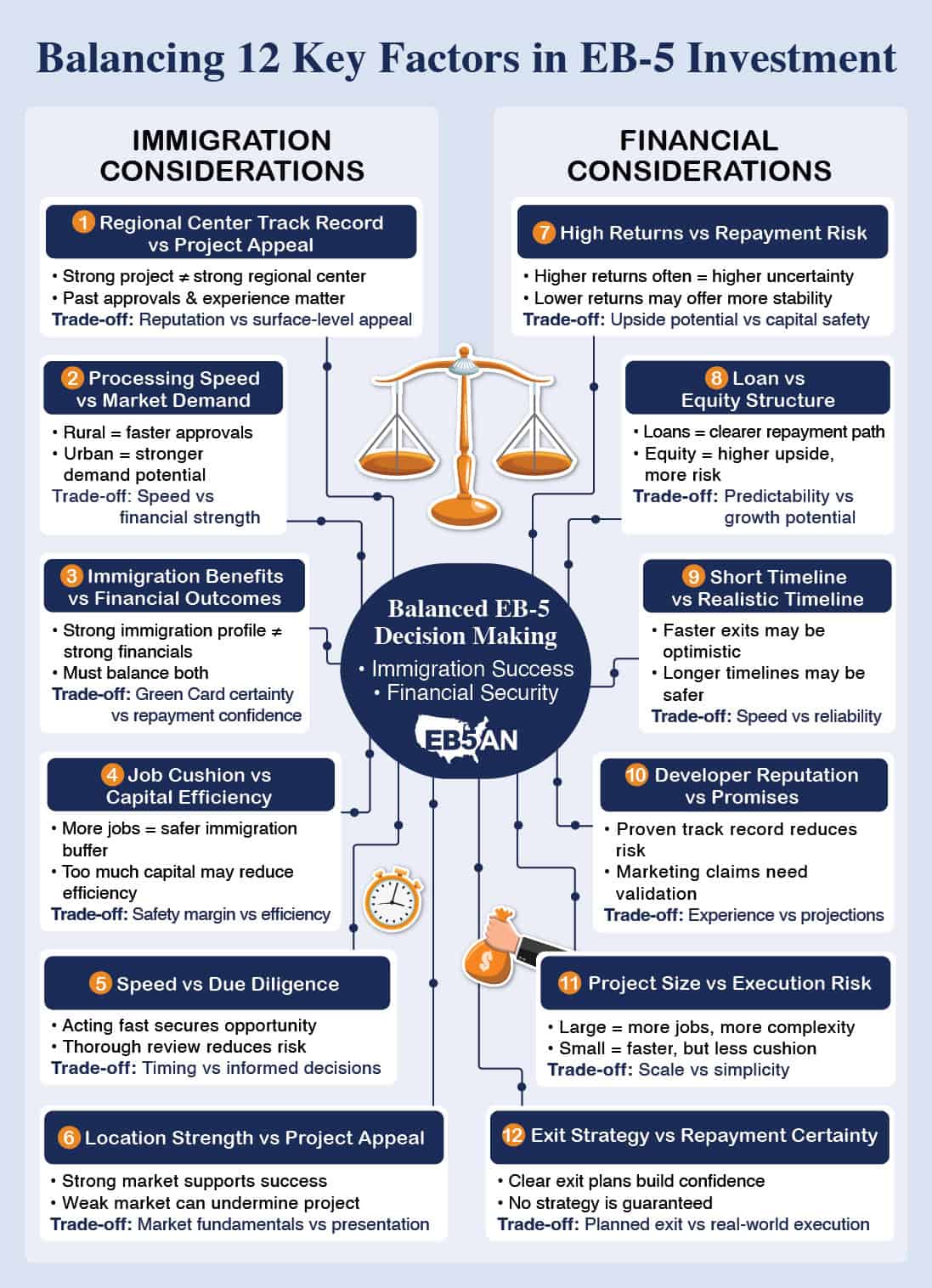
Regional Center’s Track Record vs. Project Appeal
High Returns vs. Repayment Risk
I-526E Processing Speed vs. Local Market Demand
Immigration Benefits vs. Financial Outcomes
EB-5 Investment Structure
Investment Timelines
Does the Developer’s Reputation Match Its Claims?
Scope of an EB-5 Project
How Fast to Go About the EB-5 Diligence Process?
Project Location
Job Creation Cushion vs. Capital Efficiency
Exit Strategy vs. Repayment Certainty
Consider Multiple Factors for a Successful EB-5 Journey
1. Regional Center’s Track Record vs. Project Appeal
A project can look attractive on paper. The market may seem strong, the business plan may look sensible, and the job creation numbers may appear more than enough to support investors’ Green Cards. But EB-5 investors should look beyond the project itself and examine the regional center behind it.
If a regional center has a history of USCIS denials, whether at the investor level or the project level, that is a serious warning sign. A strong-looking project does not erase a weak or troubled regional center track record.
This is why investors should ask basic but important questions about the regional center’s history: How many EB-5 projects has it sponsored before? How many of those projects has it successfully completed? Has it worked in this same real estate sector before, or is this its first project of this kind?
Experience matters. A regional center that has already guided multiple projects through the EB-5 process may be better prepared to structure offerings carefully, document job creation properly, and respond to USCIS requirements in a clear and consistent way.
By contrast, a regional center with limited experience or a poor record may introduce avoidable immigration risk, even if the underlying project seems appealing.
Investors should also look at more recent indicators of execution and compliance. For example, does the regional center have a record of securing I-956F approvals for its projects? Has it shown that it can prepare and file strong project applications under the current EB-5 framework?
In the end, project appeal by itself is not enough, and these questions help investors judge whether a regional center can actually deliver on what the offering promises.
2. High Returns vs. Repayment Risk
Some EB-5 projects, especially urban projects, may offer higher potential returns. In some cases, those projects may also be financially strong.
But investors should remember a basic rule: Higher returns usually come with higher risk. A project offering a more attractive financial upside may also carry a greater chance of delay, repayment uncertainty, or loss.
That does not mean such a project is weak. It means the investor needs to understand what tradeoff is being made.
When comparing projects, investors should think carefully about their own risk tolerance. Some may be comfortable accepting more risk in exchange for the possibility of a higher return. Others may place more value on capital preservation and a higher likelihood of timely repayment, even if that means a lower return.
In EB-5, this is an important balance to strike. A return figure by itself does not tell investors whether a project is the right fit. They need to look at how that return is being generated and what level of repayment risk comes with it.
3. I-526E Processing Speed vs. Local Market Demand
Rural EB-5 projects offer a clear immigration advantage because they benefit from priority processing and increased visa set-asides. As a result, rural investors can often see I-526E approvals much faster, and EB5AN’s own rural projects have received approvals in as little as 2.7 months.
For investors from China and India, this can be especially important given these countries’ high demand for EB-5 visas and the risk of future backlogs. In many cases, that makes rural projects the stronger option from an immigration timing standpoint.
But processing speed is still only one part of the decision. Investors should also look at local market demand for the project itself. An urban project may have stronger demand for its real estate asset class than a project in a rural area, where population density is lower by definition. That can affect the project’s financial strength and repayment outlook.
As with the other factors in this post, the key is to weigh both sides carefully and evaluate each case on its own merits.
4. Immigration Benefits vs. Financial Outcomes
No EB-5 project with a near-perfect immigration profile will also have a near-perfect financial profile—and the reverse is also true. Investors have to weigh both sides at the same time.
The goal is not just to secure Green Cards for your family, but also to improve your chances of getting your $800,000 investment repaid on time.
That is why, when examining a project, investors should look carefully at both its immigration and financial risk and decide whether each is at a level they are comfortable with.
There is little value in choosing a project that seems financially safer but creates significant immigration risk or one that looks stronger for immigration purposes but raises too many concerns about repayment. The right choice is usually the one that offers a reasonable balance of both.
5. EB-5 Investment Structure
A project’s investment structure can have a major effect on repayment risk and potential return. EB-5 projects come in two main forms: loan and equity.
Loan-based EB-5 projects often offer a clearer path to repayment because the loan usually has a set maturity date and defined repayment terms. That structure can give investors more visibility into how and when their capital may be returned, assuming the project performs as expected.
Conversely, equity structures usually involve more risk, but they can also offer meaningfully higher returns. Because repayment is tied more directly to the project’s overall success, the outcome may be less predictable than in a loan model.
Investors should look closely at their own financial goals and risk tolerance when comparing these structures, rather than assuming one is always better than the other.
6. Investment Timelines
While the sustainment period rule dictates that investors’ funds must be “at risk” for at least two years, actual investment periods can vary significantly from one EB-5 offering to another.
Some projects may promise a shorter investment term and faster repayment, which can sound very appealing. But investors should always compare that promise against the project’s actual financial strength, business plan, and market potential. A shorter timeline is only meaningful if the project is realistically positioned to meet it.
On the other hand, projects with longer repayment timelines may in some cases carry lower risk and be more likely to repay investors within the stated time frame. A longer term is not automatically a negative. In many cases, it may reflect a more realistic schedule tied to the project’s development and exit plan.
Investors should look at whether the timeline makes sense for the project, not just whether it is short.
7. Does the Developer’s Reputation Match Its Claims?
In EB-5, developer experience matters.
Investors want to know their project is led by a developer that has succeeded repeatedly in the project’s specific asset class, whether that is single-family housing, hospitality, condominiums, or another type of development.
It is also important to ask whether the developer has successfully repaid investors before and whether this is its first EB-5 offering. A longer and more relevant track record usually gives investors more confidence.
Developers may make strong claims about both a project’s financial performance and immigration outcomes, but those claims should be supported by real results. If a developer says a project is low risk, well positioned in the market, and likely to support successful EB-5 outcomes, its past work should back that up.
In the end, investors should give more weight to proven execution than to marketing language.
8. Scope of an EB-5 Project
Investors should also consider the size and scale of a project and whether these align with their goals.
A larger EB-5 project can offer certain advantages. Bigger developments typically support a larger EB-5 capital raise, and developers are often more willing to use EB-5 funding for projects of greater scale. One of the benefits of this size is an increase in the total number of jobs created.
In many cases, a large project also reflects a better-capitalized and more sophisticated developer that has the capacity to structure and manage a more complex offering.
Conversely, larger projects tend to have longer construction timelines, which would in turn mean a later repayment of your funds. These comparatively longer timelines also increase the chances of encountering potential delays.
A smaller project, on the other hand, may move faster. Because its smaller size means fewer bureaucratic hurdles and less overall planning, a small project may reach completion sooner and create the required jobs for investors more quickly than a large development with a longer buildout.
The smaller scale of these projects, however, frequently results in lower overall job creation, lessening any buffer from which investors may benefit. Additionally, smaller projects may be led by smaller—and less experienced—developers.
Ultimately, size alone is not the key issue. What matters is whether the project’s scale supports both timely job creation and a realistic path to completion.
Once a project clears these benchmarks, investors should then check whether its timeline and projections align with their goals. If you want to get your funds back as quickly as possible, then a smaller project may be the better choice. But if you can wait for your funds and prefer a more secure investment, a larger project might better match your preferences.
9. How Fast to Go About the EB-5 Diligence Process?
Moving quickly on an EB-5 investment can give investors a real advantage, especially with the September 30, 2026, grandfathering deadline approaching. Getting started early gives families more time to review projects, prepare documents, and move toward filing without unnecessary pressure. In that sense, speed matters.
At the same time, investors should not rush through the diligence process without understanding what they are doing. An $800,000 investment is significant, and a family’s immigration goals are at stake.
Investors must therefore strike the right balance between moving quickly to ensure they get all their paperwork done but carefully to safeguard their funds and their future. And the easiest way to achieve this balance is to get started as soon as possible.
10. Project Location
An EB-5 project may appear strong in many respects. It may have a solid regional center, an experienced developer, and offering documents that look well prepared.
But investors still need to look closely at where the project is located. If the local economy is weak or the real estate market for that asset class is declining, the chances of the project being successful shrink.
No matter how promising a project may seem on paper, weak market support can undermine its performance. If there is not enough market support for the project in that area, it may struggle to generate the revenue needed to complete the business plan, create the required number of jobs, and repay investors.
That is why project location should always be evaluated as a core part of EB-5 due diligence, not treated as a secondary detail.
11. Job Creation Cushion vs. Capital Efficiency
As hinted at above, investors should also look at how much job creation cushion a project has.
A job creation cushion is the number of jobs a project expects to create above that required for each investor. For instance, if a project has 10 EB-5 investors and expects to create 150 jobs, then each investor would have a job creation cushion of five jobs:
150 jobs / 10 investors = 15 jobs per investor; 15 jobs – 10 required = 5 extra jobs.
A project may technically project enough jobs for each investor, but a thinner margin leaves less room for delays, cost changes, or lower-than-expected spending. Conversely, a stronger job cushion can give investors more confidence that the project will still create the required jobs even if conditions change.
At the same time, investors should understand how that cushion is being created. If a project is structured inefficiently or raises more EB-5 capital than makes sense for the business plan, that can create other concerns.
The goal is not just to see a high job number. It is to see a project with a reasonable capital structure and a comfortable job buffer that supports every investor’s immigration requirements without weakening the development itself.
12. Exit Strategy vs. Repayment Certainty
Investors should also pay close attention to a project’s exit strategy.
Every EB-5 offering will describe how investor funds are expected to be repaid, whether through sale proceeds, refinancing, cash flow, or another source. That plan should make sense based on the project itself, its financial documents, and the market around it. A vague or overly optimistic exit strategy can be a major warning sign, even if the rest of the offering looks strong.
At the same time, investors should understand that no exit plan is guaranteed. What matters is whether the repayment strategy is realistic, well supported, and flexible enough to hold up if market conditions change. A project with a clear and credible path to repayment will usually give investors more confidence than one that promises a quick exit without a solid basis for it.
Consider Multiple Factors for a Successful EB-5 Journey
As the list of factors above shows, choosing an EB-5 project is not about chasing one standout benefit. A project may offer faster processing, stronger market demand, a shorter timeline, or a higher return, but none of those factors should be weighed in a vacuum.
The real challenge is finding a project that makes sense as a whole, one that entails a level of both immigration and financial risk that you find reasonable.
As Sam Silverman puts it, “A successful EB-5 investment comes from looking at the full picture. Investors should feel confident that a project is positioned to support both their Green Card goals and the return of their funds.”
To get started on a successful EB-5 investment—from both financial and immigration perspectives—we invite you to schedule a free consultation with EB5AN.