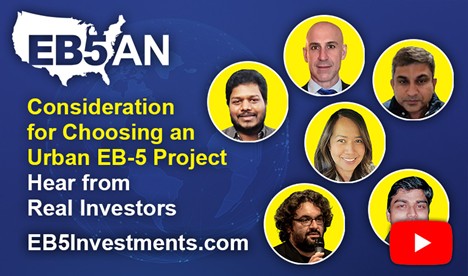
Many EB-5 investors favor urban projects for practical reasons. Urban developments are often located in strong, growing markets with deep demand drivers—jobs, population growth, and real estate activity that is easier to measure. In some cases, urban projects also offer higher target returns or a shorter projected investment term. But the upside that draws investors in can also attract weaker deals, which is why an urban EB-5 investment calls for a careful strategy.
For most investors, the goal is simple: a project that can support a successful I-526E petition and a credible path to return of capital. In urban markets, that means looking beyond a good location and a polished brochure. The project still has to work as a real investment. The market thesis must be believable, the budget and timeline must be realistic, and the repayment plan must be tied to clear sources of funds. The reality is that not every urban EB-5 offering will lead to an approval or a repayment.
That is exactly why learning from successful investors is so valuable. When you hear how real investors evaluated urban opportunities—what they asked, what they verified, what they avoided—you get practical insight that is hard to find anywhere else. You also start to see patterns: how investors judged market strength, how they weighed construction and financing risk, how they thought about job creation support, and how they evaluated whether the regional center and project team could execute.
EB5AN built its investor testimonial library to make that learning easy. We have published over 20 full-length interviews with EB-5 investors from around the world, sharing the specifics of how they made decisions and what they learned along the way. No other EB-5 firm has invested this much effort into putting investor experience front and center, in a format that new investors can actually use.
This article is the 10th installment of our new series revisiting some of the most compelling interviews in that library, each focused on one of the most important parts of the EB-5 process. Here, the focus is: considerations for choosing an urban EB-5 project. The investor excerpts that follow highlight the concrete questions and decision points that helped them choose urban deals they could trust—for both immigration outcomes and capital repayment.
Terra Ceia Urban EB-5 Project (Loan and Equity)
Spring Haven Urban EB-5 Project (Loan and Equity)
Watch All EB-5 Investor Testimonials
Choose Your Regional Center Carefully
Choose Your Project Developer Carefully
Check the Project’s Market Potential
Check Both Job Creation and Financial Strength
Regular Project Updates
Read Project Offering Terms Carefully
EB5AN’s Urban Investors Find Success
Finding Success Through Your Own Urban EB-5 Investment
Choose Your Regional Center Carefully
“I actually started with a different EB-5 company that had multiple projects. And the truth is my faith was more in the EB-5 company than it was in the project, because I have very little control on that project, which is something I’m not used to. I’m used to getting involved in these projects and kind of influencing outcomes. So at the end of the day, step one is picking the right EB-5 company versus the project. And I thought I had made the right pick, and I’m sure it was the right pick, but at some point, the responsiveness was not to the level that I’m used to and that I require. And I connected with you, Sam, and I connected with Jordan and other members of your team. And I got to tell you, everyone was on the same page in terms of responsiveness, in terms of goals, in terms of just getting us the proper data and coaching us through it, and I was really, really impressed. So I shifted gears, switched to EB5AN.” — Mike from Canada (ONE Tampa Urban)
Urban projects can look strong on paper across the board. Once you invest, you have limited control and you depend on the regional center for answers, documents, and real updates. Mike focused on responsiveness and the ability to get data quickly. That matters early, before you wire funds, and it matters later when timelines shift, filings move forward, or you need clarity on what happens next.
“Well, I personally feel the [EB5AN] team is quite transparent. Other regional centers, I could question their transparency actually. And secondly, whenever I needed help, they were always available. Maybe it’s some investment decision, some project-related decision—the moment I tried to get in touch with the team, they were promptly available. They were always ready to get on the phone, and things were never on hold dealing with your team. And even because of the funding got delayed in our case, we had to approach the regional center to seek some extension, and they were flexible enough to provide that extension.” — Vipul from India (Boynton Beach Urban)
Vipul ties confidence to access and follow-through. Fast responses, clear communication, and flexibility during funding can keep a case moving. In urban deals, where underwriting depends on milestones and timing, investors want a team that stays engaged and solves problems instead of disappearing behind email delays.
Choose Your Project Developer Carefully
“I looked at about 4, 5, 6 different regional centers, and the main reason why I went with the Saltaire project was, of course, the builder. I think this is the most important part. Because if the builder defaults, everything could be gone. With Kolter being in business since 1997, there were a lot of old projects from them to examine. Not only EB-5 projects but also regular real estate projects. I think Kolter is one of the most reliable [developers] currently.” — Michael from Germany (Saltaire St. Petersburg Urban)
Michael’s filter starts with execution risk. In an urban market, demand can be real and the location can be prime, but the outcome still depends on the developer finishing the job. Investors looked for a track record they could verify across many projects, not a single deal story.
Like many other EB5AN investors, Michael was impressed by the long, flawless track record of the Kolter Group. Kolter regularly partners with EB5AN on EB-5 projects.
“The most important thing for me when picking a project is the quality and the track record of the developer. Kolter has a perfect track record over more than 20 years and has not had a single failed project or a loan that hasn’t been repaid. So, I’m very happy that I went with Kolter because this project was a hotel that opened right in the middle of COVID, and given Kolter’s financial strength, they were able to make it through a very difficult economic period.” — Lorrie from the Philippines (Hyatt Fort Lauderdale Urban)
Lorrie points to resilience under pressure. Urban projects can face sudden shocks—rates, demand, operating costs, lender posture. A developer with financial strength and a history of repayment gives investors more confidence that the project can stay on track through a difficult period.
“I went with Saltaire and Kolter’s project because of their success story, because I see that there was another condominium complex which was already built successfully around five plots away from the St. Petersburg project. So I thought it would be the best investment because they already have succeeded in multiple EB-5 projects, and the St. Petersburg project I chose because it was giving me 6% equity on it. So I thought at that time, back in 2019, this was one of the highest equity projects that I have seen, and I was pretty sure that, based on their success stories—Kolter—I was pretty sure that they will be finishing off this project within the provided time. And they did finish the project, and when I invested, the project didn’t even start. I was fortunate to go to St. Petersburg, and I visited the place. The place was not even started at that time when I invested, but I was very confident that the project will start and it’ll finish off in a proper time. Even though Covid and everything affected, the project did not stop, and all the houses, all the flats were sold in time, and I got my 6% investment, the—what do we call—the interest that I have to receive, that I have received within the time as promised.” — Ravi from India (Saltaire St. Petersburg Urban)
Ravi connects two practical checks: proven performance and clear terms. He invested before construction started, so developer credibility carried the weight. He also paid attention to the return terms and the time frame, then watched whether the project kept moving during COVID.
Check the Project’s Market Potential
“Then it was a matter of picking the project. And both Jordan and Sam, you held my hand quite well. It’s a matter of evaluating probability of getting the investment back, return on investment, probability of project actually getting completed. All these projects sound great, and we’re in the middle of it, so I’d love to have a follow-up interview once my son gets the Green Card and tell you that it went according to plan. But at the end of the day, the ONE Tampa project, I like the fact that it was 47% sold at that point that I was evaluating, and I liked that there was a high sales of units. I actually called the project. I was going to go visit it. I didn’t go visit it. But the project managers there were very responsive as well. I just felt, after evaluating, it had the highest probability of getting built, getting done, and returning my investment within the time that’s promised.” — Mike from Canada (ONE Tampa Urban)
Mike looked for traction he could measure. In urban projects, demand is often visible early through sales, reservations, deposits, and buyer behavior. He also tested responsiveness at the project level. That helped him judge whether the deal was moving in real time, not just “planned.”
“Another really important thing is that Saltaire, at the time we invested, already had 100% of all the apartments sold. Every one of the buyers had already put down the 30% non-refundable deposit, and all jobs have already been created at this time. I think the first closings are planned to happen in the fall of this year, so this project is already very, very advanced. It’s mostly a great project for us because… of course there are risks, but I think the risks are pretty low.” — Michael from Germany (Saltaire St. Petersburg Urban)
Michael favored advanced construction progress and committed buyers. Full sellout and meaningful non-refundable deposits reduce uncertainty around revenue and closings. He also cared that job creation was already in place, which lowers immigration risk when the investor reaches the I-829 stage.
Check Both Job Creation and Financial Strength
“I think the most important part about a regional center is whether it can create the jobs. When you file the I-829, does it qualify you for the restrictions to be removed? On the other hand, do you trust the regional center? Will it be able to repay your investment? I think these are the most important things you should look at.” — Michael from Germany (Saltaire St. Petersburg Urban)
“I think the worst thing that can happen is that a regional center won’t be able to create the jobs, you are unable to get your restrictions removed, and your investment funds are gone. I heard about an EB-5 investment in New York where friends of mine invested, and this exact scenario happened: they didn’t get back their investment, and the project was stopped. I think you should take a look at both things. Jobs creation, does it lead to the goal of the green card? And, of course, what are the odds that you’ll get your investment back?” — Michael from Germany (Saltaire St. Petersburg Urban)
Investors treated job creation and repayment as two key factors. The project needs a clear job creation plan that holds up at I-829. It also needs a repayment plan tied to credible sources of funds and a realistic timeline.
“As we are from Germany and not from India or China, we are not backlogged, so it doesn’t make any huge difference to us if it is an urban or a rural area. We didn’t really consider this factor, to be honest. It was more important for the builder to be stable, the whole project to be stable and well-financed; the jobs were already created. These are the things we did take a look at.” — Michael from Germany (Saltaire St. Petersburg Urban)
For investors without visa backlogs like those in China and India, Michael’s approach is useful. Investors from low-demand countries like Germany may not prioritize faster rural processing; instead they may favor an urban project with higher returns.
Regular Project Updates
“Soon after I signed up, I started getting these emails from EB5 Affiliate Network regarding the progress or regarding the updates of the project. That made me so comfortable where I’m right now, because I stay in Austin or I stay in different places. I was in Philadelphia. Then the next year I moved to Austin. The next year I moved to California. So I keep moving. Due to my job, I keep moving different places. So it’ll be really tough for me personally to go and look at the project myself. But EB5 Affiliate Network did send me regular updates on when the project is going to start and what is blocking it, because that was a time when Covid was at the peak stage, and EB5 Affiliate Network made sure that, okay, the project has received all the approvals and the project is going to start or the project has already started.”
“All those updates I’ve been getting. And the best part about the updates that I’ve been getting is I was provided with the links of what the status of the project is, and also I was provided with the pictures of how it was being constructed. And the best part about the updates were how many flats were sold and how much of investment did the Kolter project invest in and how much is the investment of all the EB-5 included in that project. So these are some of the best parts. Which I found out that it’s best because I got a clear-cut idea of what’s the project investment and what’s the EB-5 investment and how we are affecting the project and how the project made sure that it had progress continuously respective of the amount we were investing.”
“So that made me so comfortable, and that made me choose this project when compared to the others, because the others I did not feel so confident. I did go to other places like North Carolina and Ohio and New Jersey, but I didn’t find any project that was already successful or any developer that was already successful and kept doing multiple EB-5 projects. So that’s one of the only reasons I chose EB5 Affiliate Network and this particular project, the Saltaire St. Peterburg project.” — Ravi from India (Saltaire St. Petersburg Urban)
Ravi wanted visibility after investing, with clear progress updates, and details that connect to the project’s ability to finish and repay. He also valued transparency around unit sales and the split between developer funds and EB-5 funds, since that affects alignment and downside protection.
“So it’s not: I send the money and I’m blank as to what’s happening, I don’t know for four years. Instead, I can see every quarter emails coming from EB5AN, quarterly updates, and that has a whole detail about what’s going on in the project in different stages. That makes me comfortable” — Shuaib from India (Saltaire St. Petersburg Urban)
Shuaib describes the benefits of ongoing traceability. Investors want regular, detailed reporting that tracks construction and sales progress and keeps the job creation story in view. In urban projects, those updates often matter because the business plan depends on steady execution.
Read Project Offering Terms Carefully
“When you actually decide you need to go ahead, you need to compare the projects available at that point of time. And this regional center, I personally was very convinced with the project. I talked to other regional centers. I didn’t find their project very convincing. One person was offering me 35% return, but I found that a little fishy. It is practically impossible. It may not be 100% inaccurate, but the chances you will achieve that doesn’t sound very appropriate” — Vipul from India (Boynton Beach Urban)
Vipul values credibility. High return claims can distract investors from the real questions: who is executing, what assumptions drive repayment, and what happens if the market softens. Investors in these interviews leaned toward terms that made sense under conservative assumptions.
“One reason is the terms. Some projects were proving to be very expensive. And some of the projects—sorry, I’m not very technical—but their documentation was still in the approval stage. So there could be a possibility you would’ve invested in the project and they might not get the approval. Your overall process would have been put at a standstill. So of course, my lawyers helped me to understand that. But this is one reason which convinced me to go ahead for this one. And then, of course, being an accountant myself, I did my own mathematics, like how much this would cost me, how much the return I’m getting, and how much is my affordability. So doing all this analysis made me go ahead. And of course, I would say at every stage, EB5AN’s team, it’s really, really very helpful.” — Vipul from India (Boynton Beach Urban)
He also paid attention to process risk. If key approvals or documentation are uncertain, the investor can end up stuck. He compared costs and returns against his own affordability, and he relied on guidance to understand where the real risks were, especially when documentation was still in the approval stage.
EB5AN’s Urban Investors Find Success
“Your funds were invested for about four years roughly and we made distributions fairly recently. What amount of money did you receive over that roughly four-year period? Right, so roughly I can say the money I got back in my account is roughly $118,000 which is very good. $500,000, you put it four years, then $118,000. It’s good money.” — Shuaib from India (Saltaire St. Petersburg Urban)
“And exactly at the end of the three years, the project was successfully almost completed, and all the flats were sold—completely sold—and I was provided with the investment return of $95,000. When I invested, getting a $95,000 within a span of three years of the project start is a very good investment I would feel. That’s one of the reasons I still support and I still choose EB5 Affiliate Network, is because they made sure that they’re very adamant with their promises, and they did return back the returns that I happily received.” — Ravi from India (Saltaire St. Petersburg Urban)
Multiple investors in EB5AN projects, like the ones above, already have both U.S. Green Cards and significant financial returns.
Finding Success Through Your Own Urban EB-5 Investment
When comparing urban EB-5 projects, look for the following: a developer with a real track record, a project with visible demand and credible financing, a job creation position that holds up at I-829, and a regional center that stays responsive before and after funding.
EB5AN’s managing partner, Sam Silverman, gives the following advice: “Investors should expect clear answers, real data, and consistent updates throughout the process. When an urban project has strong sponsorship, proven demand, and a realistic path to completion and repayment, it can deliver both the immigration result and the investment outcome investors are aiming for.”
For personalized guidance, and to learn more about our portfolio of urban EB-5 projects schedule a free consultation with EB5AN.