
As an EB-5 investor, the most up-to-date I-526E processing data can shed light on how USCIS will adjudicate your own submission. Understanding how USCIS is adjudicating EB-5 filings worldwide has become especially important as petition volumes rise and the difference in processing speeds between rural and urban projects becomes more pronounced.
Adjudication trends matter even more with the September 2026 EB-5 grandfathering deadline approaching. Any I-526E filed before that date will remain protected under today’s EB-5 rules—even if Congress allows the EB-5 program to lapse in the future. Investors who plan to file before the deadline therefore need a clear view of how EB-5 demand is building and how USCIS is responding to it.
In January 2026, USCIS released a large dataset covering I-526E processing from early 2022, when the EB-5 Reform and Integrity Act took effect, through mid-2025. We thank the American Investors Immigration Alliance (AIIA) and the Galati Law Firm for pursuing the release of this data through Freedom of Information Act (FOIA) requests.
Notably, the data shows a sharp rise in new filings—especially in rural projects—over the past year, paired with signs of faster adjudications.
To help investors understand these trends, EB5AN hosted a detailed webinar reviewing the new processing data. The session, led by managing partners Sam Silverman and Mike Schoenfeld and joined by Senior Vice President Ahmed Khan, covered the most important patterns emerging from USCIS’s release and what they mean for investors planning to file in the current environment.
Here are the key takeaways for EB-5 investors:
- The sharp rise in I-526E filings since 2022—especially as the September 2026 grandfathering deadline approaches—shows a growing petition backlog. Current EB-5 visa supply will not be enough to meet this demand. Investors born in China or India should expect a future visa backlog in both rural and urban categories, even if neither category is close to retrogression yet.
- Because most of the market has shifted toward rural projects—and because USCIS is adjudicating these applications so quickly, resulting in more visas being granted—the rural set-aside is the category most likely to enter a backlog first for Indian and Chinese investors. The timing is uncertain, but rising demand makes this outcome increasingly likely.
- Processing times continue to vary widely by country. A noticeably higher number of I-526E approvals have been issued for Indian investors compared with Chinese investors, likely due to the higher use of mandamus litigation among Indian applicants.
- Investors already living in the United States on H-1B, F-1, E-2, or other non-immigrant visas can still benefit from concurrent filing. Soon after submitting their I-526E, they can receive work and travel permits and remain in the country, even if their category later enters a backlog and Green Card wait times grow.
- A major surge in I-526E filings is expected as the September 2026 grandfathering deadline draws closer. Investors should act early, retain an immigration attorney, begin source-of-funds preparation, and then select a strong project and regional center.
We now present a summary of the key points discussed in the webinar, along with the full recording. If you are planning your EB-5 investment, keep these insights in mind—they will help you avoid potential backlogs and processing delays.
Post-RIA, Global EB-5 Demand Shifts Toward Rural
Filing Volume by Country and Project Category
USCIS I-526E Adjudication Trends
Will EB-5 Visa Categories Enter a Backlog?
Our Advice to Potential EB-5 Investors
Unique Insights From EB5AN’s Internal I-526E Processing Data
Act Now to Safeguard Your Immigration Benefits
Post-RIA, Global EB-5 Demand Has Shifted Toward Rural
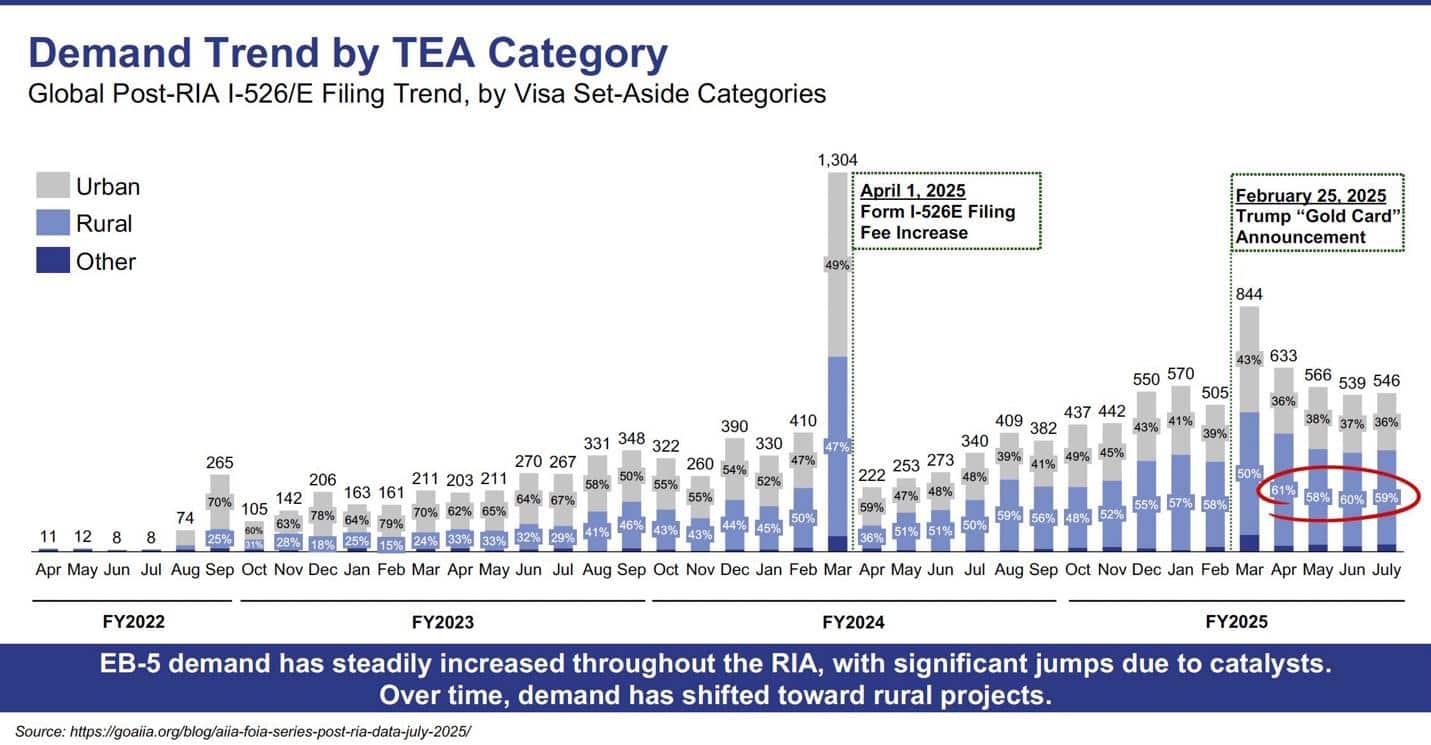
Post-RIA filing volumes have shown a steady rise in overall EB-5 demand, with sharp month-to-month spikes tied to major catalysts.
Two surges in I-526E submissions stand out in the filing trend: a surge to 844 filings around late February 2025 due to the Trump administration’s “Gold Card” announcement and a larger surge to 1,304 filings just before the April 1, 2024, Form I-526E filing-fee increase. These filing spikes largely reflect investors who were already preparing to file and chose to submit earlier rather than later.
The composition of I-526E filings has also changed, and this change will likely affect future processing times for the rural and urban categories.
In the earlier part of the RIA period, a large share of filings went into high-unemployment (HUA) projects, also known as urban. Over time, the market moved toward rural projects as investors placed greater importance on the faster adjudication times through rural priority processing. By fiscal year 2023, rural filings commonly represented roughly 25% to 30% of total monthly filings.
In the most recent five to six months shown on the trend chart, however, rural filings sit around 60% of total filings, with monthly rural shares shown at 61%, 58%, 60%, and 59% across that recent stretch.
This shift also reflects how EB-5 regional centers are also moving toward rural. Early in the RIA period, many of the available offerings on the market were urban projects. In comparison, the rural supply was more limited, and it was unclear how fast priority processing would be for investors in rural projects.
Then, as more rural projects came to market and more investors received fast I-526E approvals, rural filings increased. Over the last year and a half, rural has now become the category of choice for many investors who prioritize adjudication speed.
At the same time, while urban demand has relatively decreased, demand in these projects still exists. Many investors, especially from lower-demand countries such as Vietnam, South Korea, and Taiwan, continue to file into urban projects for reasons unrelated to adjudication speed, such as perceived financial safety.
Evidently, the EB-5 market is no longer dominated by urban filings, and rural demand has moved from a minority share to roughly the leading share in recent months.
Filing Volume by Country and Project Category
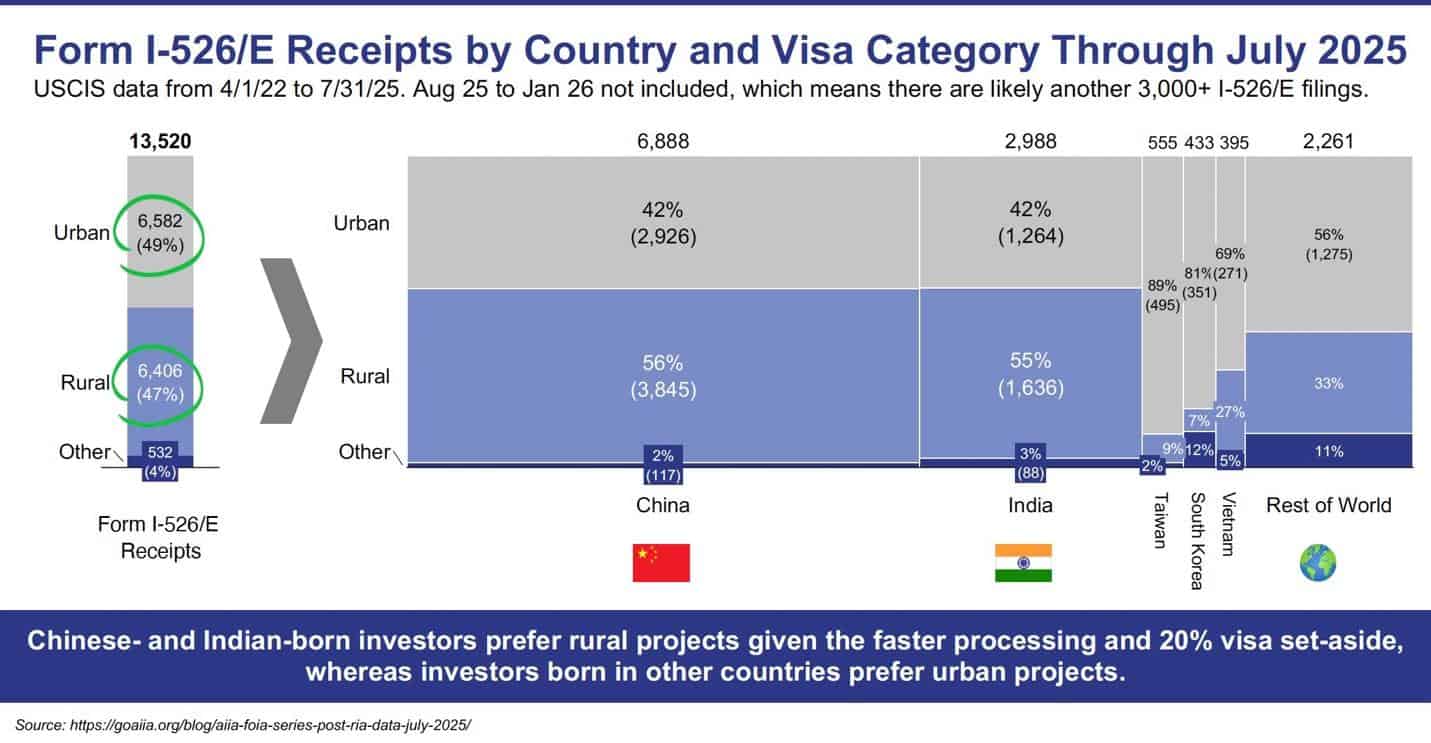
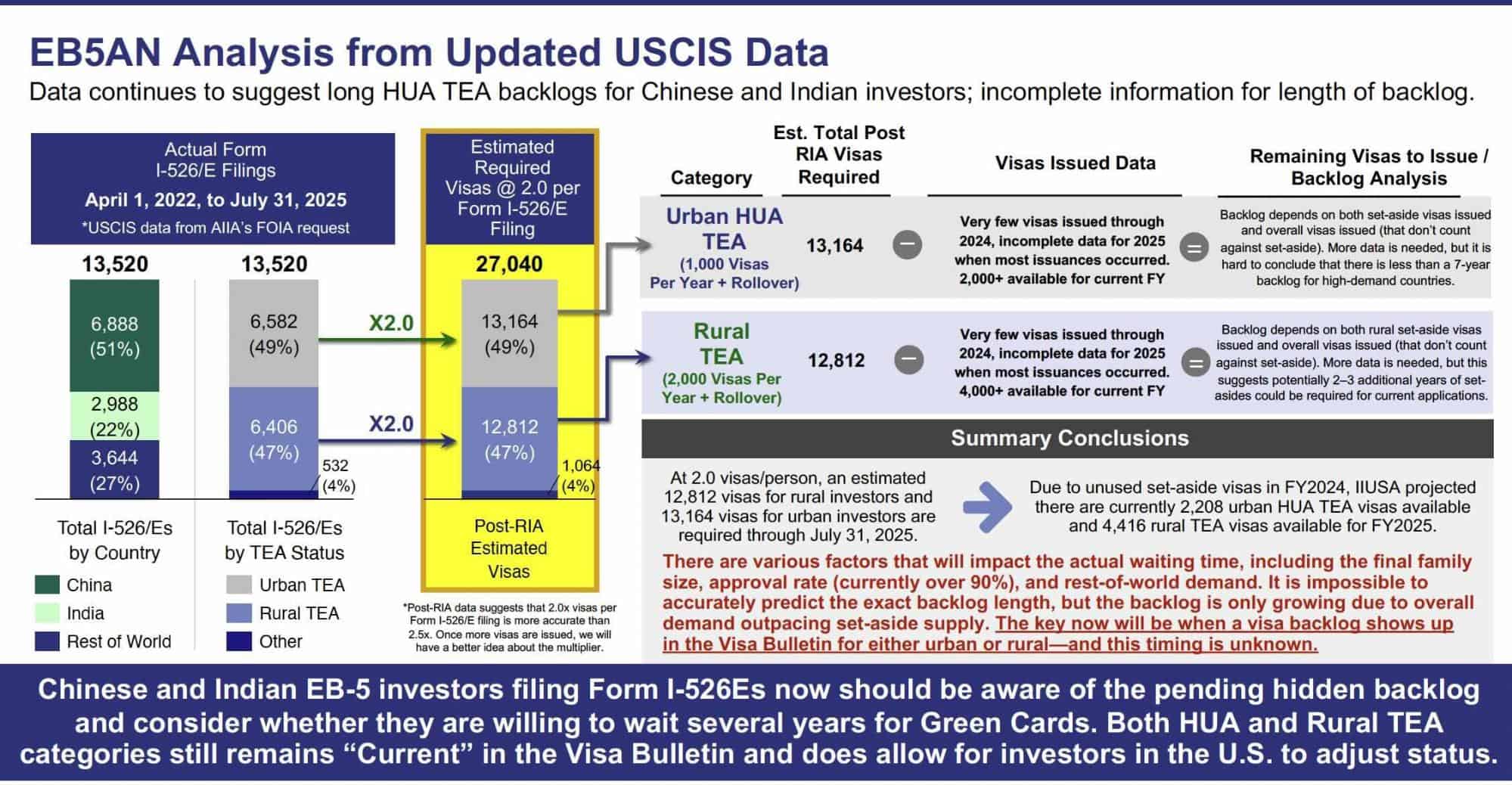
USCIS receipt data from April 1, 2022, through July 31, 2025, shows 13,520 Form I-526/I-526E receipts. The category split is close to even: 6,582 receipts (49%) in urban, 6,406 (47%) in rural, and 532 (4%) in other.
The same dataset shows a gap in coverage from August 2025 to January 2026. As a result, we estimate that there are likely another 3,000+ I-526E filings that have not been captured in the charted totals.
By country, the filing concentration remains heavy in the largest two markets, but “rest of world” has become a much larger share than many investors assume. Of the 13,520 receipts, China accounted for 6,888 (51%), India for 2,988 (22%), and rest of world for 3,644 (27%).
Country-level category choices differ sharply, with China and India looking similar while standing in stark contrast to the rest of the world.
China’s total of 6,888 breaks down as 56% rural (3,845), 42% urban (2,926), and 2% other (117). India’s 2,988 similarly breaks down as 55% rural (1,636), 42% urban (1,264), and 3% other (88).
In contrast, several other markets show strong preference for urban: Taiwan totals 555 with 89% urban (495), South Korea totals 433 with 81% urban (351), and Vietnam totals 395 with 69% urban (271).
Overall, rest of world totals 2,261, with 56% urban (1,275) and the remainder split between rural and other.
Of course, EB-5 visa availability and any future backlogs depend on the full pool of investors competing for set-aside numbers, not only the top two high-demand countries (China and India). When rest-of-world demand grows, increased filings absorb visa numbers that otherwise would flow to the highest-volume countries, thus contributing to a growing backlog for China and India.
USCIS I-526E Adjudication Trends
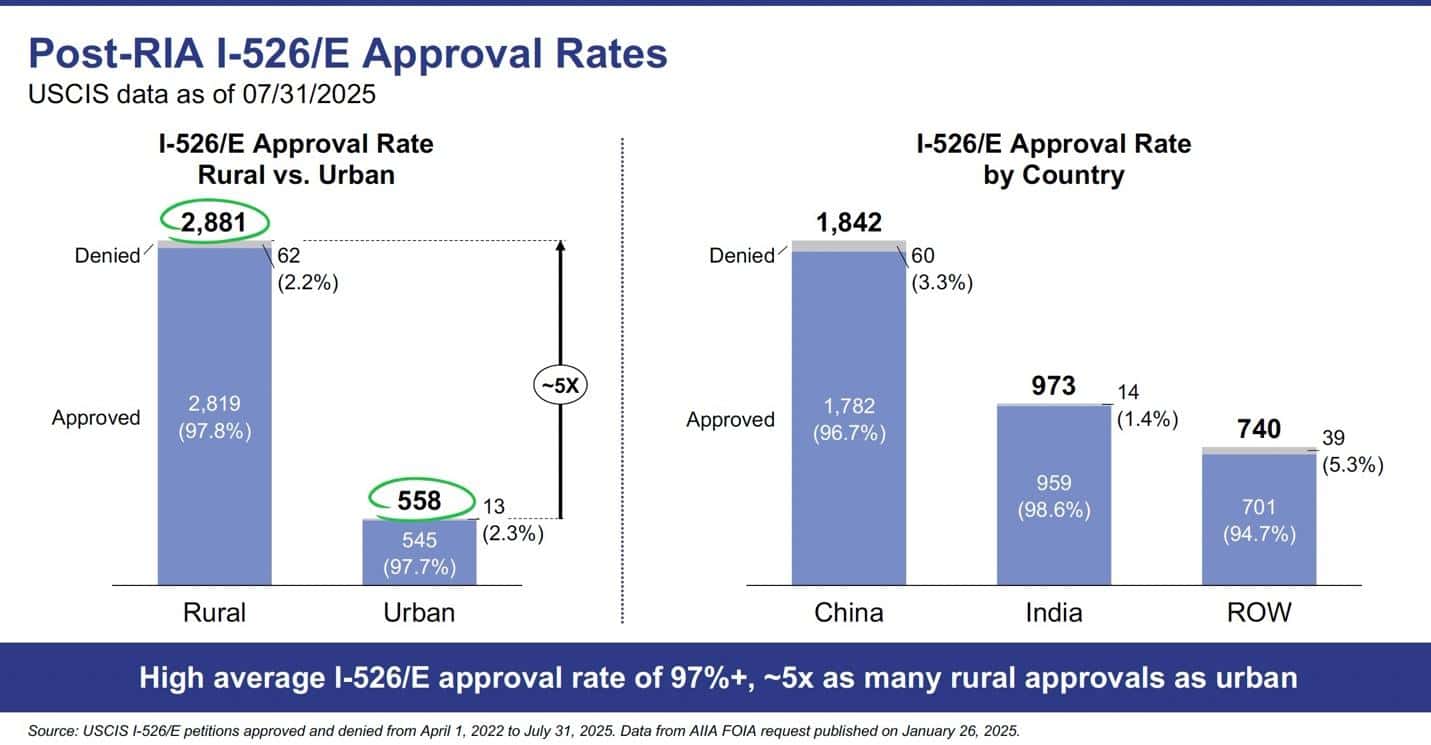
Adjudication results through July 31, 2025, show a clear imbalance in how quickly cases have been processed across rural and urban categories. Over this period, the dataset shows 2,881 rural petitions adjudicated—compared with 558 urban petitions adjudicated.
This difference is especially notable because total filings across the period are close to half urban and half rural. In other words, despite the same number of petitions being filed in both categories, around 5x as many rural petitions have been approved.
USCIS is clearly adjudicating rural I-526E filings with a much higher priority than urban filings.
There is also positive news for investors with pending I-526Es: Approval rates remain very high across both categories. Of the 2,881 rural adjudications, 2,819 were approved (97.8%) and 62 denied (2.2%). Of the 558 urban adjudications, 545 were approved (97.7%) and 13 denied (2.3%).
By country, approval rates remain high as well: China shows 1,842 adjudications with 1,782 approved (96.7%) and 60 denied (3.3%), India shows 973 adjudications with 959 approved (98.6%) and 14 denied (1.4%), and rest of world shows 740 adjudications with 701 approved (94.7%) and 39 denied (5.3%).
A month-by-month analysis shows the same overall conclusions.
In the rural category, late-2024 and early-2025 filings show meaningful adjudication progress, while the urban side shows very low adjudication percentages for more recent filing months.
For Indian nationals, the rural adjudication speed is even more pronounced. Roughly three quarters of Indian investors who filed in November 2024 have already been adjudicated.
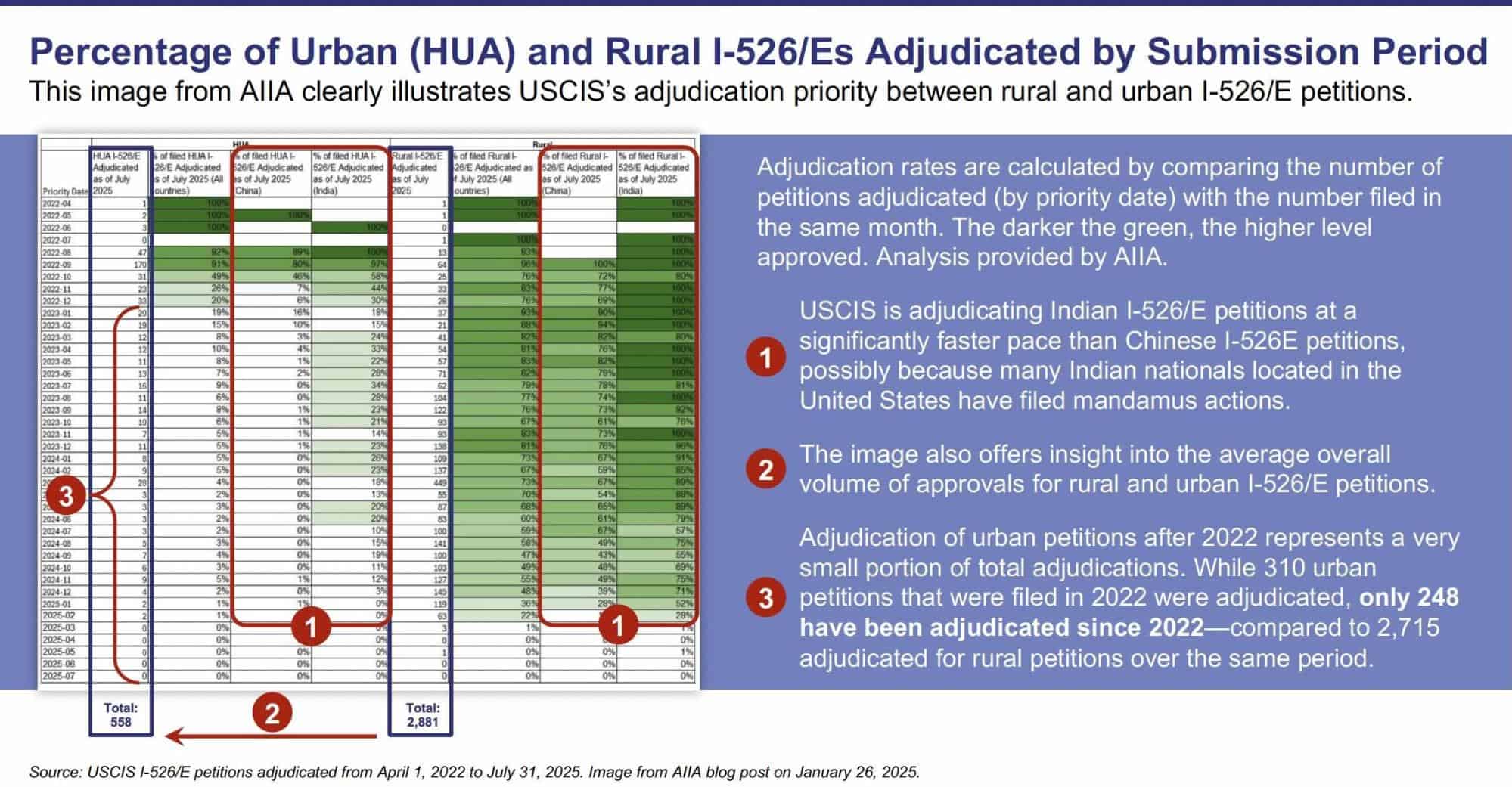
Notably, the urban adjudication volume has remained small since the RIA was enacted in 2022. The urban total of 558 includes 310 adjudications tied to petitions filed in 2022, while only 248 urban petitions have been adjudicated since 2022.
In contrast, over the same period, 2,715 rural petitions have been adjudicated. Again, this statistic shows that rural I-526E cases are moving efficiently through USCIS, while urban cases have moved much more slowly in general, aside from a few outliers.
Country differences are also present in the urban category. The data suggests that Indian petitions have been adjudicated at a faster pace than Chinese petitions. We attribute this trend to the use of mandamus actions by Indian nationals located in the United States.
While filing a writ of mandamus to “force” USCIS to adjudicate an I-526E petition can work, we are seeing the U.S. government push back against mandamus cases more aggressively. Additionally, a mandamus case can be dismissed if the court agrees there has not been an unreasonable delay—and as urban processing times continue to grow, it becomes harder to argue that your petition has faced an unreasonable delay.
Will EB-5 Visa Categories Enter a Backlog?
Based on the above data and the clear surge in I-526E filings, it’s reasonable to conclude that the EB-5 visa supply is gradually being exhausted.
The data supports the view that there is a growing “invisible” backlog even while the Visa Bulletin remains “Current” for the set-aside categories.
A simple way to examine the data is to compare how many EB-5 visas are needed based on I-526E filing volume against how many are actually available in each set-aside category.
Using a conservative assumption of two visas required per I-526E applicant, we estimate that 27,040 total visas are required based on the 13,520 filings through July 31, 2025.
More specifically, 13,164 visas (49%) would be tied to urban filings, 12,812 visas (47%) to rural filings, and 1,064 visas (4%) to other filings.
Keep in mind that our assumption of two visas per I-526E applicant is quite conservative: Real-world family sizes are often higher, and historical multipliers for China and India have commonly been in the 2.5 to 3.0 range.
What is the key takeaway of this estimate? Based on this data, we believe that EB-5 visa demand already far exceeds supply. Consequently, it’s only a matter of time until this “hidden” backlog is reflected in cut-off dates on the Visa Bulletin.
Consider the limited supply of EB-5 visas compared to this significant demand.
The rural set-aside category is allocated approximately 2,000 visas per year (plus rollover), and urban set-aside allocation is 1,000 visas per year (plus rollover).
We have also included IIUSA’s projection based on the unused set-aside visas in FY2024: 2,208 urban TEA visas and 4,416 rural TEA visas available for FY2025.
Now let’s compare the number of visas available to the estimated number needed based on filings: 2,208 urban visas available vs.13,164 tied to filings and 4,416 rural visas available vs. 12,812 tied to filings.
Even with rollover visas, the data clearly suggests that I-526E filings have accumulated faster than visas can be issued over time.
So, when could backlogs be reflected on the Visa Bulletin? This is a harder question to answer. A backlog shows up on the Visa Bulletin when visa issuances near the annual limits.
Based on this latest data, neither rural nor urban “looks” like it will retrogress in the short term if consular issuance remains slow or if USCIS approvals are not matched by a corresponding pace of Green Card issuance.
Another possibility is that, if the government begins looking more directly at approvals and Green Cards in queue (rather than only at issued Green Cards), cut-off dates could appear sooner. The queue can continue to grow while the Visa Bulletin stays current and then change quickly once more Green Cards are issued.
These trends will affect investors from different countries and project categories in different ways.
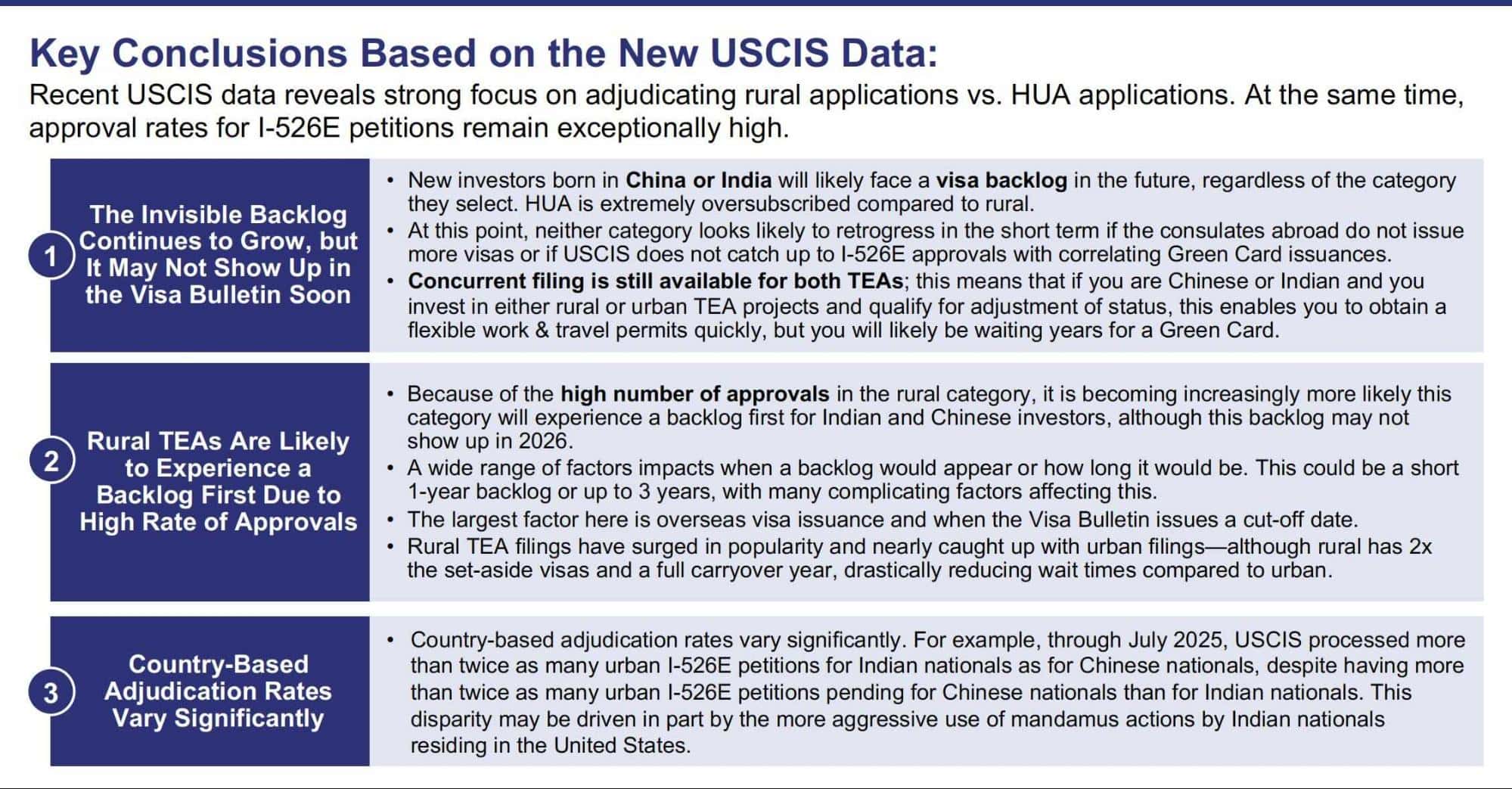
- New investors born in China or India are likely to face a backlog in the future, regardless of whether they invest in rural or urban. Still, urban is extremely oversubscribed relative to rural
- Given the high volume of fast approvals for rural, this category could experience a backlog first for Chinese and Indian investors.
- The length of any backlog is uncertain, but the urban category is likely to experience a longer backlog than rural.
- The duration of any backlog largely depends on when the Department of State decides to issue cut-off dates and the pace of consular visa processing overseas.
There is also a practical point for EB-5 investors already in the United States: Concurrent filing remains available for both rural and urban projects while both categories remain “Current” in the Visa Bulletin.
For Chinese or Indian investors who qualify to adjust status, concurrent filing can allow them to quickly gain work and travel permits and remain in the U.S.—even if they later face an extended backlog wait for their Green Cards.
Our Advice to Potential EB-5 Investors
In September of 2026, the EB-5 regional center program will reach its “grandfathering” deadline.
The grandfathering rule means that all EB-5 investors in regional center projects will have their petitions processed so long as they submit their I-526Es before the September deadline. Put simply, even if the EB-5 program is not renewed, these petitions will still be processed.
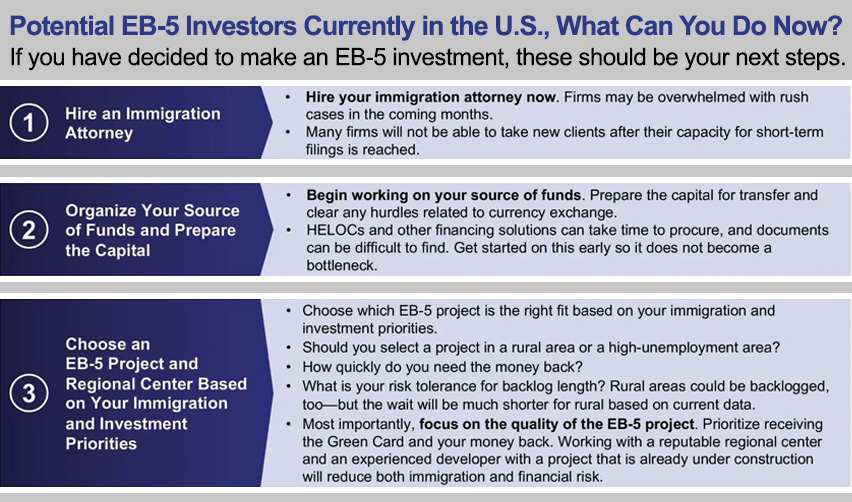
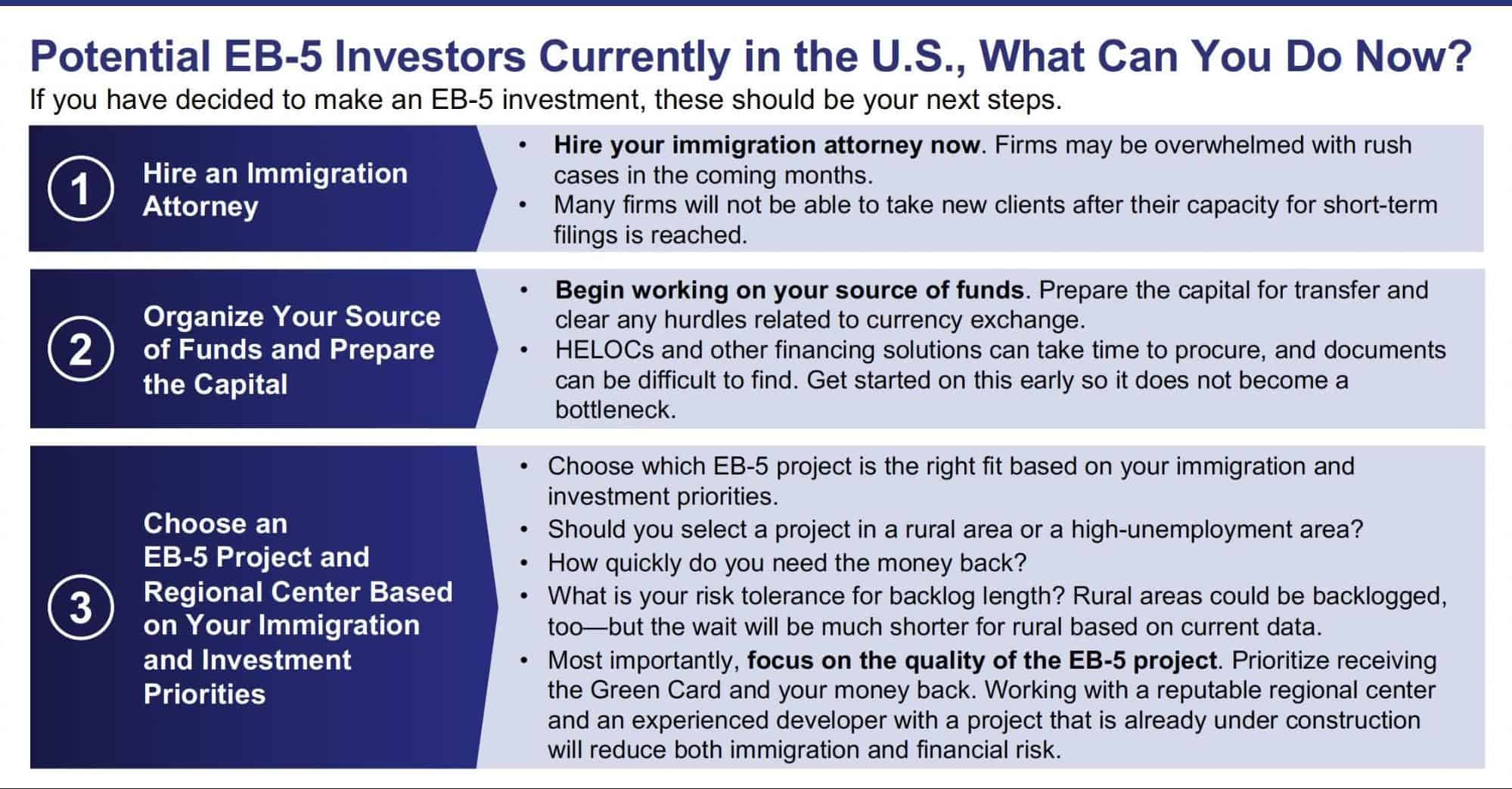
Given this important turning point in the EB-5 program, we encourage potential EB-5 investors to begin planning their investments as quickly as possible. Immigration attorneys and law firms are sure to face a surge of clients and I-526E filings as we get closer to September, and as the deadline approaches, they’ll likely have less availability to work with new clients.
Beyond hiring an attorney as soon as possible, it’s also critical that you start working on your immigration documentation.
While many investors dedicate most of their energy to project selection, the most time-consuming step of the filing process is typically documenting one’s source of funds. Source of funds packages can take many weeks to compile, and they’re one of the most frequent reasons for petition denials.
Therefore, we advise EB-5 investors to find an attorney first, begin working on their source of funds immediately, and then evaluate EB-5 projects.
Besides choosing a high-quality EB-5 project, it’s also important to consider the reputation of the regional center you invest with. This is the entity responsible for ongoing oversight, investor protections, and execution across both immigration and financial aspects of your EB-5 investment. Even if your EB-5 project encounters difficulties, a good regional center will act to protect its EB-5 investors.
Unique Insights From EB5AN’s Internal I-526E Processing Data
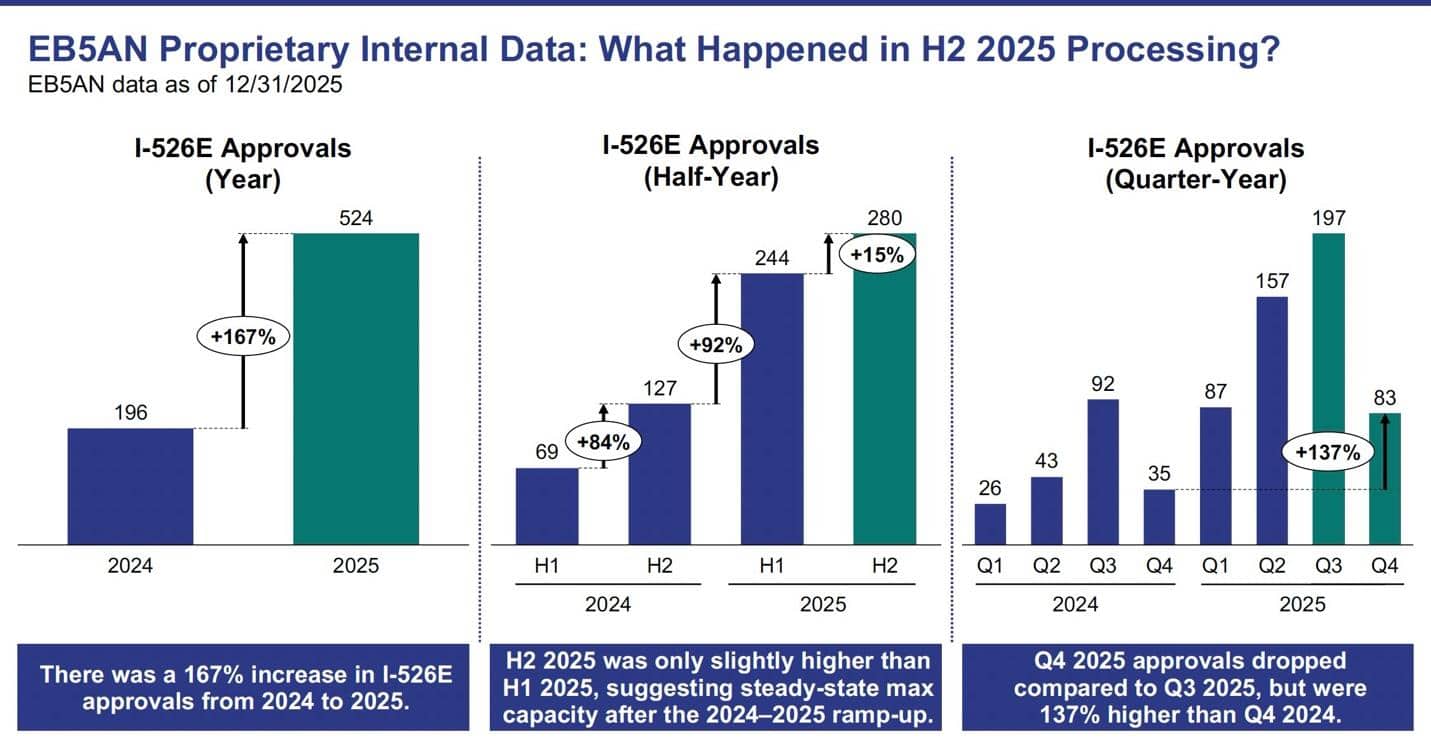
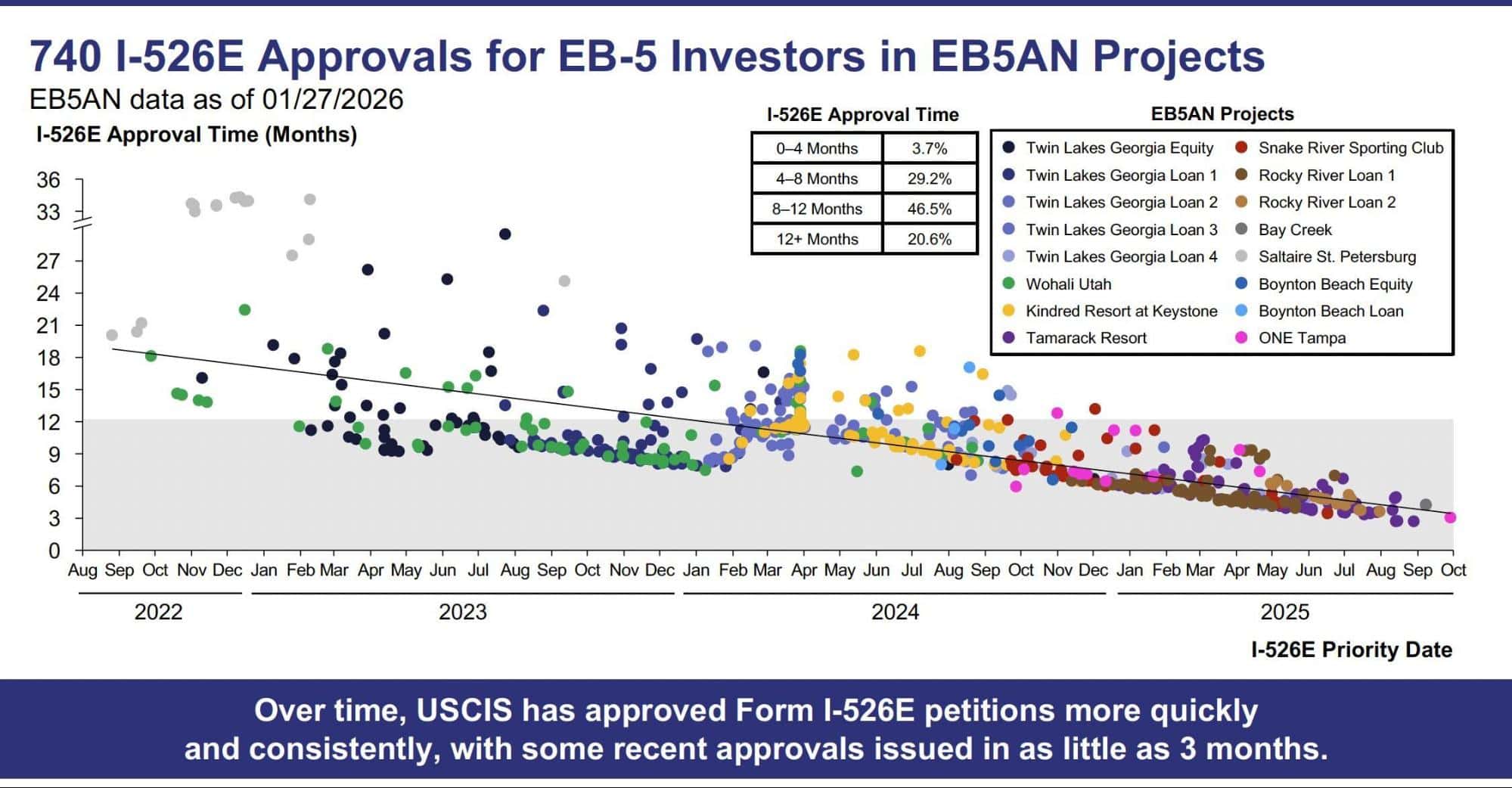
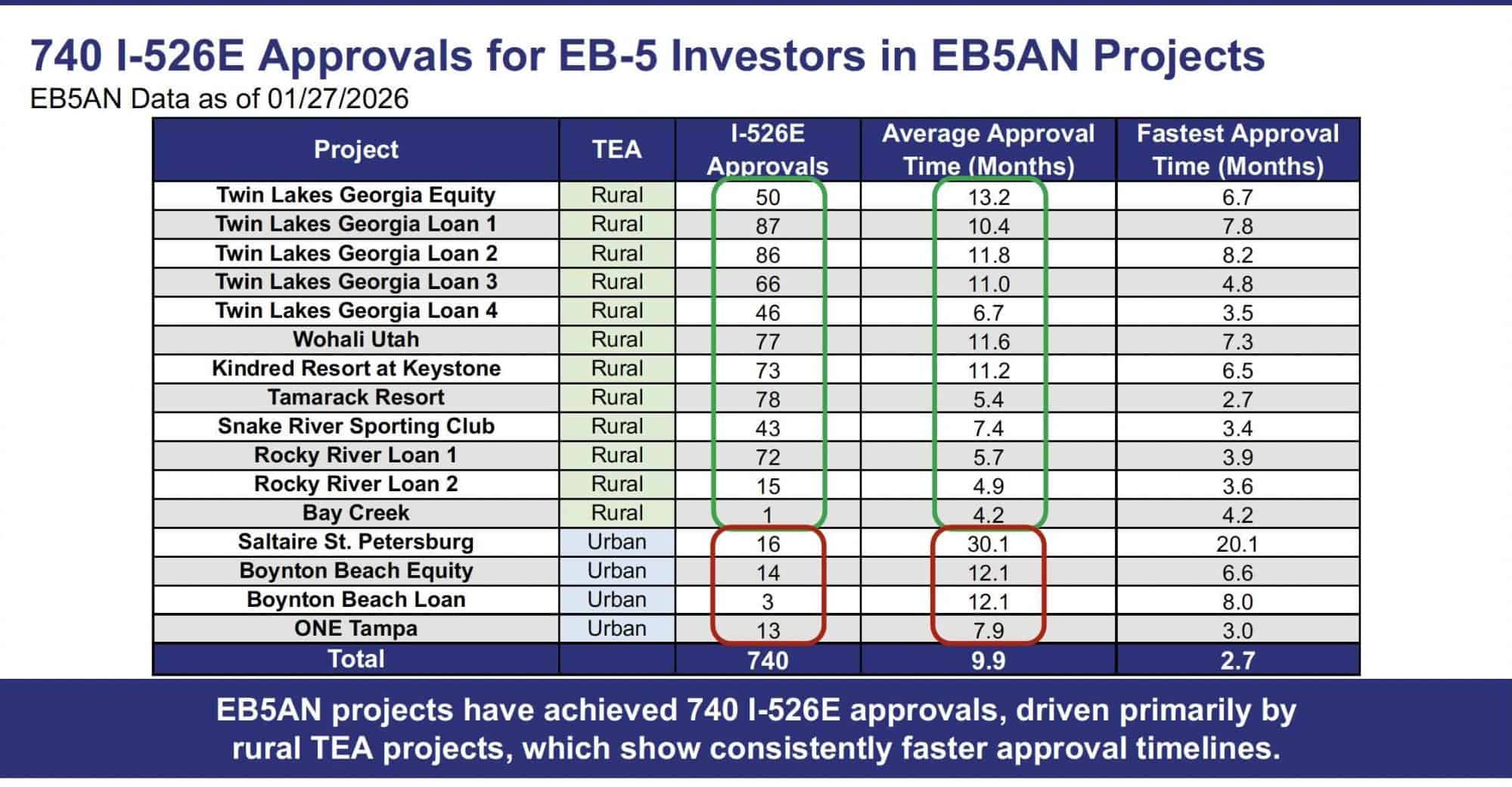
By sharing our internal processing data, we provide investors with a clearer, data-backed picture of how USCIS has actually been adjudicating I-526E petitions.
While publicly available USCIS data offers high-level insights, this internal view—based on 740 I-526E approvals as of January 27, 2026—lets investors see granular, real-world trends that reveal how long adjudications are taking and how USCIS performance is evolving over time.
From 2024 to 2025, EB5AN saw a 167% increase in I-526E approvals—from 196 to 524. That jump reflects both the spike in adjudications under the RIA and an apparent improvement in USCIS’s processing capacity.
Interestingly, approvals totaled 244 in H1 2025 and 280 in H2 2025. That 15% rise suggests that USCIS has reached its maximum processing capacity. In other words, this appears to be the agency’s operational ceiling.
Looking at approvals by quarter, the third quarter of 2025 was the peak, seeing 197 approvals. That was followed by a drop to 83 in Q4. This drop is not cause for concern, however. Q4 typically sees a slowdown due to the December holiday season, and this lower number is consistent with prior patterns and still represents a 137% increase over Q4 2024.
The key conclusion from this data is that USCIS’s current adjudication rate will likely remain consistent in the short term.
This brings up another concern, though: If I-526E filing volumes continue to increase while USCIS capacity remains flat, a new backlog is inevitable.
So if demand spikes again—especially ahead of the September 2026 grandfathering deadline—USCIS won’t be able to keep pace without longer delays.
EB5AN’s data also shows that the adjudication speeds for individual I-526E approvals has gotten faster and more consistent over time. A visual analysis of all 740 approvals reveals that in 2022 and early 2023, most approvals were clustered in the nine- to 12-month range. By mid-to-late 2024 and into 2025, many were processed in six to eight months, with some as quickly as three.
These gains are largely driven by rural projects, which dominate EB5AN’s approval data. For example, Tamarack Resort had an average approval time of just 5.4 months, and Bay Creek was even faster at 4.2 months. The fastest individual approvals for these projects were just 2.7 and 4.2 months, respectively.
By contrast, urban projects like Saltaire St. Petersburg and Boynton Beach had far fewer approvals and significantly longer timelines—Saltaire’s average was 30.1 months. Rural filings are clearly being adjudicated faster and more consistently.
Another trend investors should be aware of is that once the first I-526E approval is issued for a project, subsequent approvals tend to come faster. We have observed this pattern in both rural and urban projects.
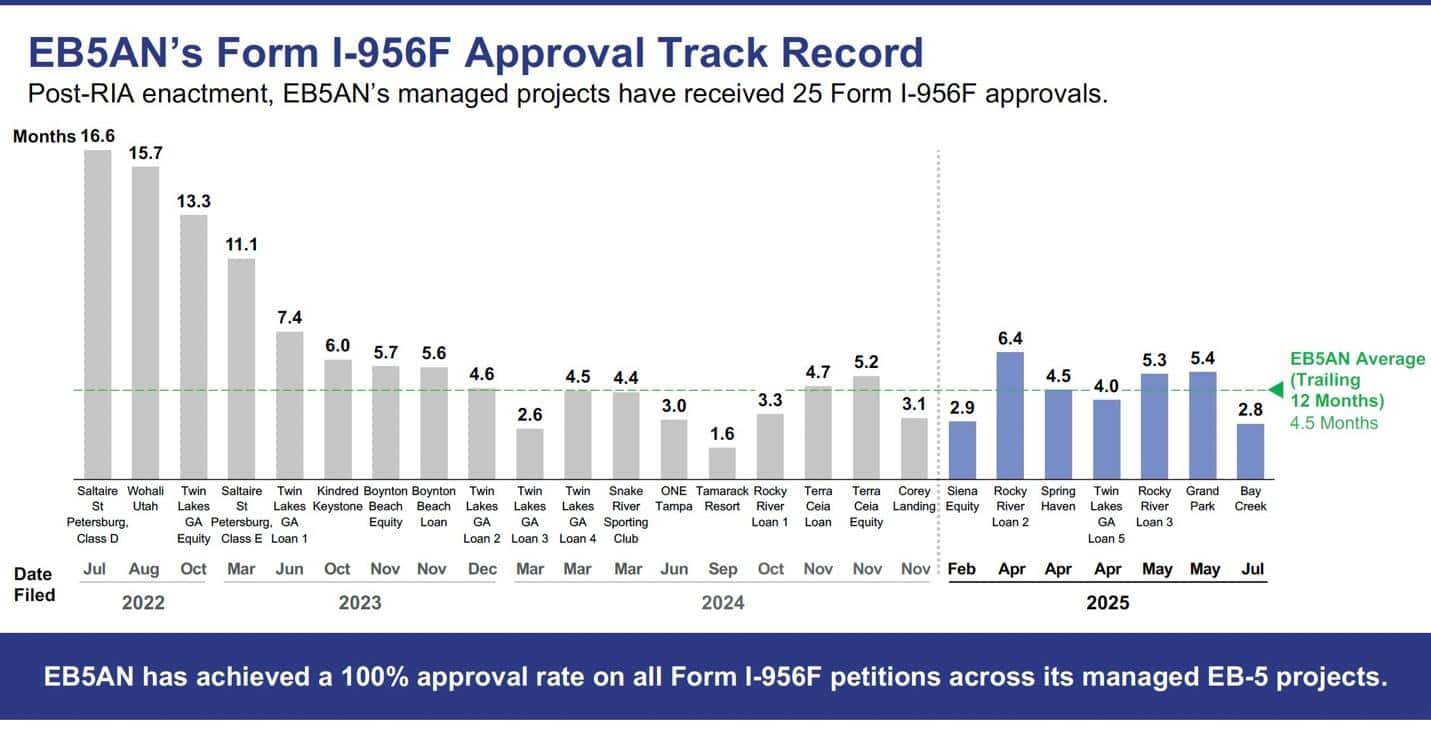
Projects with Form I-956F approval also have faster adjudication times. EB5AN currently has 25 I-956F approvals with a trailing 12-month average of 4.5 months. The fastest I-956F approval times have been as low as 1.6 to 3.0 months, depending on the project.
Since USCIS cannot approve any I-526E until the project’s I-956F is adjudicated, investors should keep this in mind when selecting projects.
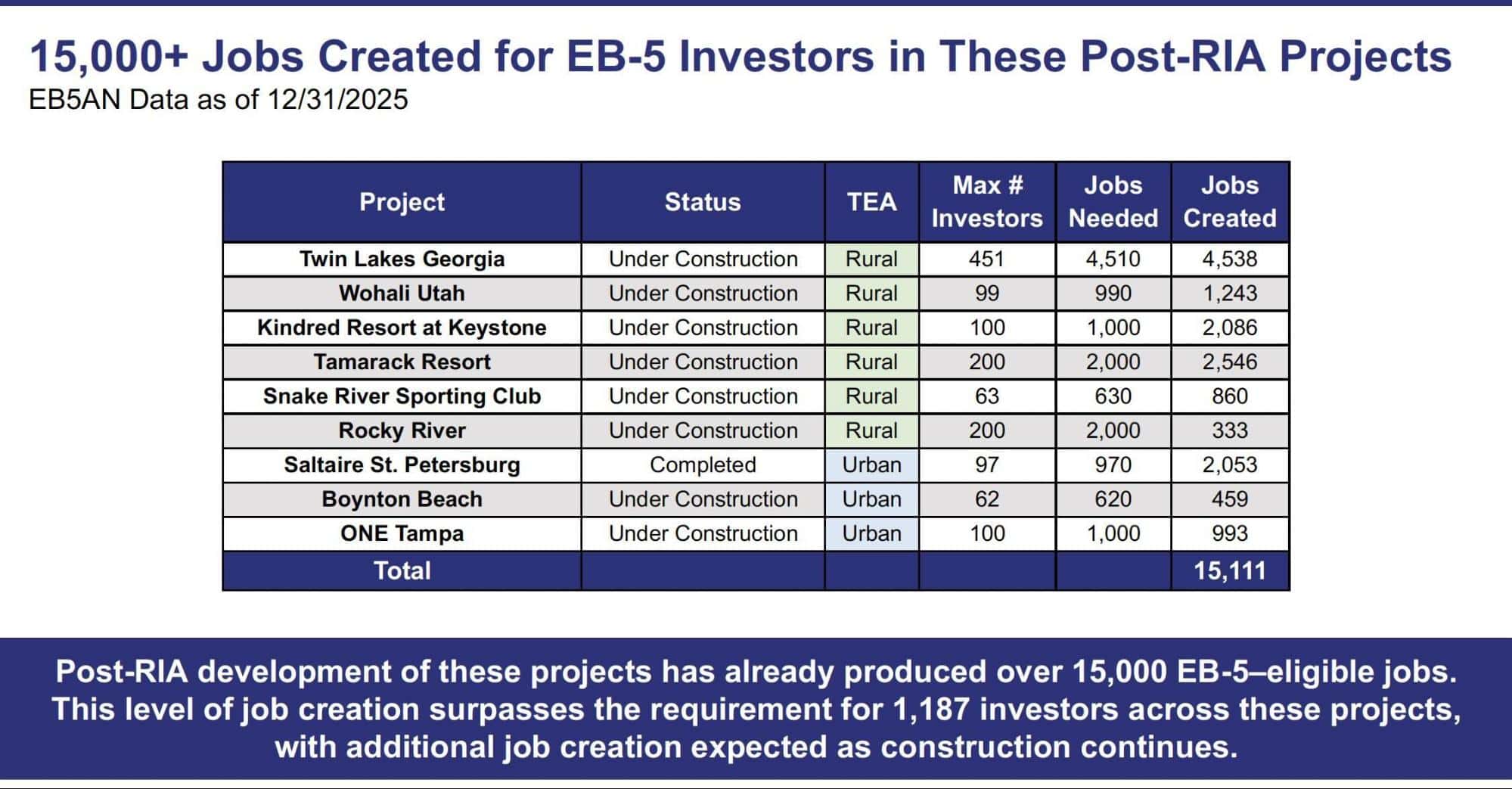
Finally, significant job creation across our EB-5 offerings also makes them especially safe from an immigration standpoint. This is the key requirement for obtaining a permanent U.S. Green Card through EB-5, so a project’s job creation should always be an investor’s main concern when choosing a project.
Act Now to Safeguard Your Immigration Benefits
EB-5 investors now face a period of rising demand, limited visa supply, and clear differences in adjudication speed between rural and urban filings.
The latest USCIS dataset, combined with EB5AN’s internal results, shows that rural petitions are moving far faster than their urban counterparts, that approvals remain strong across all categories, and that overall filing volume has accelerated well beyond the annual visa limits. These conditions point to upcoming backlogs for China and India.
With the September 2026 grandfathering deadline approaching, investors who plan to file should move early, start compiling their source of funds without delay, and choose a project with a strong record of approvals and I-956F approval.
In sum, while processing capacity at USCIS appears to have reached its ceiling, I-526E filings are still climbing. It is therefore unlikely that we will continue to see processing times decrease. Acting before filings surge in the coming months of 2026 can help you get your Green Cards faster—and, if you live in the U.S., work and travel permits in a matter of weeks.
To help you get started on the EB-5 process and navigate the current adjudication environment, we invite you to schedule a free consultation with EB5AN.