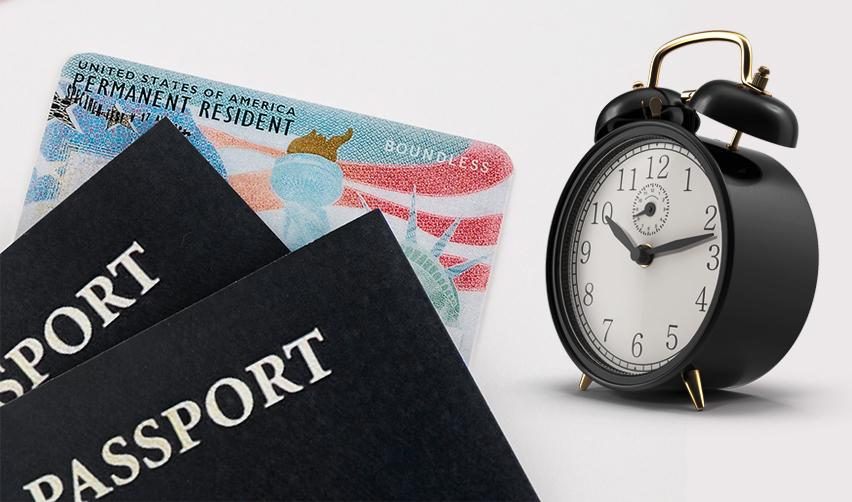
How long does it take for a Green Card to arrive? Green Card processing times differ depending on the type of visa you apply for and the applicant.
For instance, Green Card processing for a Family-Based Green Card or Marriage-Based Green Card is faster than for an immigrant investor visa.
The average processing time for an immigrant visa can be as little as six months for refugees or as much as ten years for those applying for oversubscribed visa categories.
This article details Green Card processing times for the four main categories, along with the application requirements and steps for each.
What Is a U.S. Green Card?
What Types of U.S. Green Cards Can You Get?
What Are The Processing Times For The U.S. Green Card?
Green Card Pathways: What Are the Different Requirements?
- Employer-Sponsored Green Cards
- Family-Based Green Cards
- Refugee and Special Immigrant Green Cards
- Investor Green Cards
How Can You Track the Progress of Your U.S. Green Card?
Minimize Your EB-5 Processing Times With EB5AN
What Is a U.S. Green Card?

A U.S. Green Card is a lawful permanent resident card granting a foreign national legal immigration to the United States. Green Card holders may live, work, and study anywhere in the United States permanently.
Foreign nationals with U.S. permanent resident status can travel both domestically and internationally, change jobs, or move states. Green card holders may receive social security and other welfare benefits.
Children with Green Cards can attend U.S. public schools for free and have a higher chance of getting into top U.S. universities over international students without a green card.
What Types of U.S. Green Card Can You Get?
There are four main types of U.S. Green Cards:
- Employer-Sponsor Green Cards
- Family-Based Green Cards
- Refugee and Special Immigrant Green Cards
- Investor Green Cards
The eligibility requirements, supporting documentation, and petitions differ between the various Green Cards in these categories. Immigration attorney or lawyer fees will also apply.
We’ll take a look at these factors later in the article. First, let’s take a look at approximate processing times for the main Green Card forms.
What Are the Processing Times for the U.S. Green Card?

Processing times for U.S. green cards differ depending on the type of green card being applied for, as well as the individual applicant’s situation.
| Employer Sponsor Green Card |
|
| Family-Based Green Card |
|
| Special Immigrants and Refugee Green Card |
|
| Investor Green Card |
|
Green Card Pathways: What Are the Different Requirements?
Let’s take a look at the eligibility requirements, forms, and costs for each visa pathway.
Employer-Sponsored Green Cards

EB-1 Green Card: Exceptional Ability
- Eligibility: Workers with extraordinary ability, outstanding foreign researchers or professors, multinational managers, and executives.
- No labor certification required. Workers of extraordinary ability file themselves. Professors, researchers, managers, and executives must have an employer sponsor.
- Petition: Form I-140, Petition for Alien Worker
- Filing Fee: $700.
EB-2 Green Card: Workers with Advanced Degrees
- Eligibility: Workers with exceptional ability or professionals with an advanced degree.
- Labor certification and a permanent job offer are required. The U.S. employer must petition the U.S. Department of Labor on the worker’s behalf.
- Petitions: Form I-140, Petition for Alien Worker; Form ETA-9089, Application for Permanent Employment Certification.
- Filing Fees: $700 for an I-140 petition. There is no filing fee for labor certification.
EB-3 Green Card: Professionals and Skilled Workers
- Eligibility: Professionals and skilled workers whose jobs require a U.S. baccalaureate degree or equivalent, or at least 2 years of training.
- Labor certification and a permanent job offer are required. The U.S. employer must petition the U.S. Department of Labor on the worker’s behalf.
- Petitions: Form I-140, Petition for Alien Worker; Form ETA-9089, Application for Permanent Employment Certification.
- Filing Fees: $700 for an I-140 petition. There is no filing fee for labor certification.
Family-Based Green Cards

Family-Based Immigrant Visas are for family members of U.S. citizens or legal permanent residents. This is often called a “Marriage-Based Green Card” for spouses.
- Eligibility: Spouses, children, parents, and siblings of U.S. citizens, as well as spouses and unmarried children of lawful permanent residents.
- Petitions: Form I-130, Petition for Alien Relative, and Form I-485 to adjust immigration status.
- Filing Fees: $535, you might also be charged $85 for biometric fingerprinting services.
Refugee and Special Immigrant Green Cards
EB-4 Green Card: Religious Workers and Special Immigrants
- Eligibility: Religious workers, medical physicians, broadcasters, employees of the U.S. Armed Forces, the Panama Canal, or other U.S. interests.
- Religious workers may sponsor themselves. Eligibility and sponsorship requirements differ between eligible special immigrant types. Please consult USCIS for more guidance.
- Petition: Form I-360, Petition for Amerasian, Widow(er), or Special Immigrant.
- Filing Fee: $435.
Refugee and Asylum Green Cards
- Eligibility: Applicants must have been granted asylee or refugee status more than one year ago and have been physically present in the United States for more than one year.
- Petitions: Form I-485 to adjust status.
- Filing Fee: $0.
Investor Green Cards

EB-5 Green Card: Immigrant Investors
- Eligibility: Accredited foreign investors who invest a minimum of $800,000 in a new commercial enterprise (NCE) that creates or sustains at least 10 full-time permanent jobs in the United States. No employer sponsor or job offer is required.
- Investment capital must be lawfully sourced and financially “at risk” for at least two years.
- Petitions:
- Form I-526/I-526E: After making the qualifying investment, foreign nationals file an EB-5 immigrant petition. Form I-526 is for direct investors. Form I-526E is for regional center investors.
- Form I-485: Foreign nationals residing in the U.S. may concurrently file Form I-485 for adjustment of status at the same time as Form I-526/I-526E. Foreign nationals outside the U.S. must file Form DS-260 and go through consular processing in their home country after receiving I-526/I-526E approval.
- Once approved, the investor and their family will be granted two-year conditional permanent resident status in the United States.
- Form I-829: In the last 90 days of conditional permanent residency, investors apply to remove conditions from their green cards and become full permanent residents.
- Filing Fees:
- EB-5 Investment: $800,000 minimum for projects located in targeted employment areas (TEAs).
- Form I-526/I-526E: $3,675.
- Form I-485: $1,140 for adults, $750 for children applying with a parent. For applicants outside of the U.S., Form DS-260 has a filing fee of $345.
- Form I-829: $3,750.
- Each applicant might also be charged $85 for biometric services.
- $1,000 fee to support the EB-5 Integrity Fund.
USCIS filing fees and Integrity Fund fees are subject to change and should be confirmed on the USCIS website at the time of filing.
How Can You Track the Progress of Your U.S. Green Card?

This section will provide foreign nationals with a guide to help track the progress of their Green Card application.
USCIS sends Form I-797, an applicant’s approval notice, via postal mail. Form I-797 is also known as the applicant’s welcome notice. Visa applicants do not need to fill out any information on Form I-797.
To track a Green Card by mail, foreign nationals both inside and outside the United States can register for Informed Delivery with the United States Postal Service (USPS).
Premium processing is available only for certain petition types and does not apply to most Green Card categories.
How to Track the U.S. Green Card from Inside the U.S.
Foreign nationals living within the United States can track their Green Card processing with USCIS’s “Case Status Online” tool.
Applicants can find their receipt number on Form I-797C, the USCIS filing receipt for their I-485 petition. Enter this alphanumeric receipt number on the Case Status Online tracker and click “Check Status”.
How to Track the U.S. Green Card from Outside the U.S.
Foreign nationals residing outside the United States can track their Green Card through the National Visa Center (NVC), the government organization that processes and delivers visas for foreign applicants.
After USCIS accepts a green card application, NVC sends applicants a notification email or letter containing an alphanumeric case number.
Foreign nationals can then click “Check My Visa Application Status” on the NVC’s online Consular Electronic Application Center (CEAC), choose their visa type from the dropdown menu, and enter their individual case number to check their visa processing.
Applicants must follow National Visa Center instructions to avoid case termination due to inactivity.
Minimize Your EB-5 Processing Times With EB5AN
There are multiple pathways to a U.S. Green Card, but they do not move at the same pace.
Processing times can vary widely depending on the visa category, visa availability, and whether an applicant is affected by backlogs. Understanding these differences is critical for anyone who needs permanent residency on a defined timeline.
EB5AN has helped more than 2,700 families from 70+ countries become lawful permanent residents of the United States. Our expert team has more than a decade of experience and offers clients first-rate, low-risk EB-5 regional center projects with a 100% USCIS project approval rate.
We can advise you on the fastest way to get an EB-5 Green Card. If you would like to know more about your EB-5 investment options, book a free call with our expert team today.