

This article was written by EB5AN founders and managing partners Sam Silverman and Mike Schoenfeld, as well as Senior VP Ahmed Khan, Esq.
It has now been nearly four years since Congress introduced a number of modifications and new policies for the EB-5 program in March 2022. Indeed, under the EB-5 Reform and Integrity Act of 2022 (the RIA), EB-5 visa applicants have enjoyed unprecedentedly fast processing times and an important new benefit: the ability to obtain work and travel permits quickly, even before receiving their EB-5 Green Cards.
These conditions have resulted in significant growth for the global EB-5 market after a period of decreased activity.
“It’s difficult to overstate,” explains Sam Silverman, managing partner of EB5AN, “how beneficial the RIA has been to our EB-5 investors. Where it was previously common for investors to wait several years for I-526E approvals, EB5AN investors are commonly seeing approvals in less than 12 months.
“Our investors have even received approvals in as little as 3 months. This allows entire families to receive their Green Cards quickly and enjoy the benefits of conditional permanent residency—potentially in only months, not years.”
But in September 2026, the EB-5 program will have arrived at a critical point in its history.
The EB-5 Regional Center Program, the investment model used by the vast majority of EB-5 applicants, must be renewed periodically by Congress. Under the RIA, the regional center program was revalidated until September 2027.
Only investors who file their regional center Form I-526E petitions on or before September 30, 2026, are expressly protected by the RIA’s grandfathering provision if regional center authorization later expires.
In practical terms, this means that EB-5 investors can secure their immigration goals only if they file by the September 30 deadline. By filing early, EB-5 investors can avoid being exposed to a potential lapse in the regional center program and further political or legislative risk.
Filing before the deadline legally protects EB-5 investors from such risks, and USCIS will be required to continue adjudicating their petitions and cannot deny them solely because regional center authorization later expired.
“The next few months of 2026,” cautions Mike Schoenfeld, managing partner of EB5AN, “will be a narrow window to secure a fast, legally protected path to U.S. permanent residence under current law.”
“Moreover, filing before the deadline allows you to invest at the current required amounts, as well as preserve flexibility for your dependent family and children—which can be invaluable for long-term academic and career plans.”
What do potential EB-5 applicants need to know about the fast-approaching grandfathering deadline? What will it mean for existing investors? And how can you seize the opportunity to secure your EB-5 Green Cards—and potentially work and travel documents in only weeks?
In this article, we will delve into each of these points, providing an analysis of current EB-5 policies and immigration law, as well as actionable advice for preparing a new I-526E filing—before the deadline and without compromising the quality of your submission.
If you are pursuing an immigration solution to live and work in the U.S. along with your family, the information in this article can help you plan a successful investment.
Legal Background Behind the September 2026 EB-5 Grandfathering Deadline
- History of the EB-5 Regional Center Program
- The Regional Center Program Requires Reauthorization By Congress
Why It’s Crucial to File Before September 30, 2026
How To Plan Your EB-5 Investment: A Practical Investment Strategy for 2026
EB5AN’s Portfolio of EB-5 Projects: Consistently Fast EAD, AP, and I-526E Green Card Approvals
Next Steps for EB-5 Investors
Further Reading
Legal Background Behind the September 2026 EB-5 Grandfathering Deadline

History of the EB-5 Regional Center Program
The EB-5 Immigrant Investor Program was created in 1990 when Congress passed the Immigration Act of 1990, which amended the Immigration and Nationality Act (INA) to add a new employment-based immigrant category for investors (INA § 203(b)(5)). This investment-based program would require investors to create at least 10 jobs with their capital and to contribute funding to new commercial enterprises (NCEs) in the U.S. To this day, these continue to be the basic goals of the EB-5 program.
At this early stage of the EB-5 program, all investments were direct—that is, EB-5 applicants invested directly into new commercial enterprises (NCEs) without an intermediary like a regional center. There was no provision for regional centers written into existing legislation.
This changed in 1992, when Congress created the “Immigrant Investor Pilot Program” in § 610 of the Departments of Commerce, Justice, and State, the Judiciary, and Related Agencies Appropriations Act. This investment model, which we now know as the EB-5 Regional Center Program, set aside part of the EB-5 visa supply for investments sponsored through approved regional centers.
This legislation resulted in two investment models for the EB-5 program: regional center and direct.
Particularly since the EB-5 program first gained wide popularity following the 2008 crisis, the EB-5 Regional Center Program has been the investment model of choice for the vast majority of EB-5 investors.
Notice how Invest in the USA (IIUSA), an EB-5 trade organization, explains the role of the regional center program.
The EB-5 Regional Center Program (Regional Center Program) is a component of the EB-5 Program that allows investments to be made through entities designated by USCIS as EB-5 Regional Centers (Regional Centers). A Regional Center is an entity approved by USCIS to sponsor capital investment projects for EB-5 investors. […] Regional Centers are permitted to sponsor NCEs that pool EB-5 investor capital and use reasonable economic methodologies to demonstrate both direct and indirect job creation, offering a level of flexibility not available in the direct EB-5 model.
Let’s break down the benefits of the regional center investment model described above.
Under current EB-5 law, a direct EB-5 offering can only raise funds from a single EB-5 investor. Direct EB-5 investors often take a more active role than investors in a standard regional center project. And all 10 jobs must be direct, typically full-time jobs that appear on the company’s payroll.
In contrast, EB-5 applicants who invest through a regional center can enjoy not only a more straightforward investment process but also often higher chances of immigration and financial success.
Regional centers can pool funds from multiple EB-5 investors, making possible larger, institutional-quality offerings in significant real estate developments. Top real estate developers—who can offer institutional-quality projects—are more inclined to raise EB-5 funding from a larger pool of investors.
In the managerial structure of most regional center investment funds, EB-5 investors are generally “passive”, without the need for significant involvement. To protect investors, USCIS is now very involved in overseeing regional centers and their management, with exacting reporting requirements and periodic audits.
Additionally, regional centers can provide the project documentation investors must submit on Form I-526E.
But the most noteworthy benefit of the regional center program is the ability to use approved methodologies (econometric modeling) to calculate each investor’s job creation. Instead of creating only direct, payroll jobs, EB-5 investors in regional center projects calculate the bulk of their job creation through the project’s construction spending. These are known as indirect jobs.
In practical terms, indirect job creation makes it significantly easier to achieve the 10 required jobs and for investors and their families to qualify for their permanent U.S. Green Cards.
In light of these benefits, it’s no surprise that the majority of EB-5 investors prefer to invest in regional center-sponsored projects. Both thousands of foreign nationals and the U.S. economy have benefitted enormously from the EB-5 Regional Center Program.
According to an economic report published by IIUSA, $75 billion in EB-5 funding was raised between 2016 and 2019 alone. During this period, 1.7 million jobs were created through EB-5, and the program contributed $184 billion to the U.S. GDP. It is estimated that about 90% of EB-5 visas issued in recent years have gone to investors in regional center projects.
The Regional Center Program Requires Reauthorization By Congress
But, for all its success, the EB-5 Regional Center Program is not a permanent component of U.S. immigration law.
In its 2023 report Legislative Changes to the EB-5 Immigrant Investor Program, the Congressional Research Service (CRS) explains the situation this way:
The Regional Center Program was initially authorized as a pilot program and has never been made permanent; it must be regularly reauthorized.
In fact, the regional center program has expired in the past, leaving new EB-5 applicants unable to file I-526 petitions associated with a regional center project. CRS also notes that, “in recent years, reauthorization of the Regional Center Program had occurred primarily through short-term continuing resolutions, typically in consolidated appropriations bills, leading to uncertainty for regional center investors.”
In fact, the regional center program experienced a lapse fairly recently. The CRS report continues:
On June 30, 2021, its authorization expired and the program remained lapsed for nearly nine months, during which time USCIS did not process pending applications and rejected new applications associated with regional center investments.
After this lapse, the RIA was signed into law in March 2022 and revalidated the regional center program, which has enjoyed increasing popularity under the RIA’s numerous immigration benefits for EB-5 investors. The RIA renewed the regional center program only until September 2027, as the law itself states in 8 U.S.C. § 1153(b)(5)(E)(i):
(E) Regional center program
(i) In general
Visas under this subparagraph shall be made available through September 30, 2027, to qualified immigrants (and the eligible spouses and children of such immigrants) pooling their investments with 1 or more qualified immigrants participating in a program implementing this paragraph that involves a regional center in the United States […].
Why It’s Crucial to File Before September 30, 2026

The regional center program’s reliance on legislative renewals raises important questions for anyone considering an EB-5 investment.
If an investor submits his I-526E petition, but the regional center program lapses before he receives his Green Card, will USCIS continue to adjudicate the investor’s filing? Could the investor and his family still receive I-526E approval and their EB-5 Green Cards even if the regional center program has expired?
Once again, we find the answer in the text of the statute governing the EB-5 program (8 U.S.C. § 1153(b)(5)(S)(i)–(iii)):
(S) Protection from expired legislation
Notwithstanding the expiration of legislation authorizing the regional center program under subparagraph (E), the Secretary of Homeland Security—
(i) shall continue processing petitions under sections 1154(a)(1)(H) and 1186b of this title based on an investment in a new commercial enterprise associated with a regional center that were filed on or before September 30, 2026;
(ii) may not deny a petition described in clause (i) based on the expiration of such legislation; and
(iii) may not suspend or terminate the allocation of visas to the beneficiaries of approved petitions described in clause (i).
This is the “grandfathering” clause.
In simple terms, this means that every EB-5 investor who files Form I-526E on or before September 30, 2026 will have his petition processed by USCIS—regardless of whether the regional center program expires or not.
Even if the regional center program were to expire for an extended period, investors who file on or before September 30, 2026, can still receive their U.S. Green Cards and other immigration benefits of EB-5. Their I-526E petitions will be adjudicated based on the rules in force on the date of filing, regardless of future changes to EB-5 immigration law or regulations.
But if an investor files after the September 30, 2026, deadline, they face the risk of USCIS rejecting their petition. Even though there is significant lobbying from the EB-5 industry, as well as bipartisan support, for renewal of the regional center program, there is no guarantee such legislation will be passed in time.
Investors who file after the deadline could potentially have their applications “frozen” in processing for months or years.
As Ahmed Khan, Esq., senior vice president at EB5AN, puts it, “The September 2026 deadline is really about certainty—investors who file in time are protecting their case under current law, while those who wait may be forced to plan around political timing instead of their family’s goals.”
“What is more, EB-5 investors with dependent children on their application can preserve more flexibility for academic and career planning by filing early.”
Silverman adds, “The EB-5 program could see significant changes after the September 30 deadline. The requirements for EB-5 investors could be modified, and USCIS could eventually raise the current investment thresholds to adjust for inflation.”
“There’s really only one way to secure your EB-5 investment under the current policies and investment amounts: filing your I-526E on or before September 30.”
How To Plan Your EB-5 Investment: A Practical Investment Strategy for 2026
For new EB-5 investors, the key is to follow the right sequence and start early. First, hire an immigration attorney. Do this before you spend weeks comparing projects. As the filing rush builds, many firms will be handling a high volume of short-term cases, and some will stop taking new clients once they reach capacity. Starting with immigration counsel now gives you time to map out your filing plan, identify issues early, and avoid losing time at the front end of the process. As Khan explains, “The investors who move fastest are usually not the ones who pick a project first—they are the ones who get legal counsel in place first and start preparing their case.”
Second, begin your source-of-funds work and prepare the capital right away. This is often the slowest part of the process, even when investors expect it to be simple. Documents can take time to collect, bank records may need follow-up, currency exchange steps can create delays, and financing tools such as HELOCs may take longer than expected to arrange. The safest approach is to have your attorney start reviewing source of funds while you continue your project diligence simultaneously.
Only after those first two steps are underway should investors move to choosing the EB-5 project and regional center based on their immigration and investment priorities. This includes questions like whether a rural or high-unemployment project is the better fit, how quickly repayment is needed, and how much backlog risk you are willing to accept.
Investors should also focus on the quality of the regional center, because the regional center plays an ongoing role in oversight, compliance, and investor protection. A reputable regional center, an experienced developer, and a project already under construction can help reduce both immigration risk and financial risk as the September 30, 2026 deadline approaches.
EB5AN’s Portfolio of EB-5 Projects: Consistently Fast EAD, AP, and I-526E Green Card Approvals
“At this point, the EB-5 market is largely shifting demand toward rural EB-5 projects that can provide fast approval times for investors’ I-526E petitions,” explains Silverman. “Other investors prefer urban projects, which, like rural, allow investors to apply for work and travel permits and remain in the U.S. under these documents.”
“We’re pleased,” Silverman continues, “to offer both institutional-quality rural and urban projects to meet our investors’ varying needs. Our record of fast USCIS approvals for both our projects and our investors’ I-526E petitions is growing by the month.”
EB5AN’s Internal USCIS Processing Data
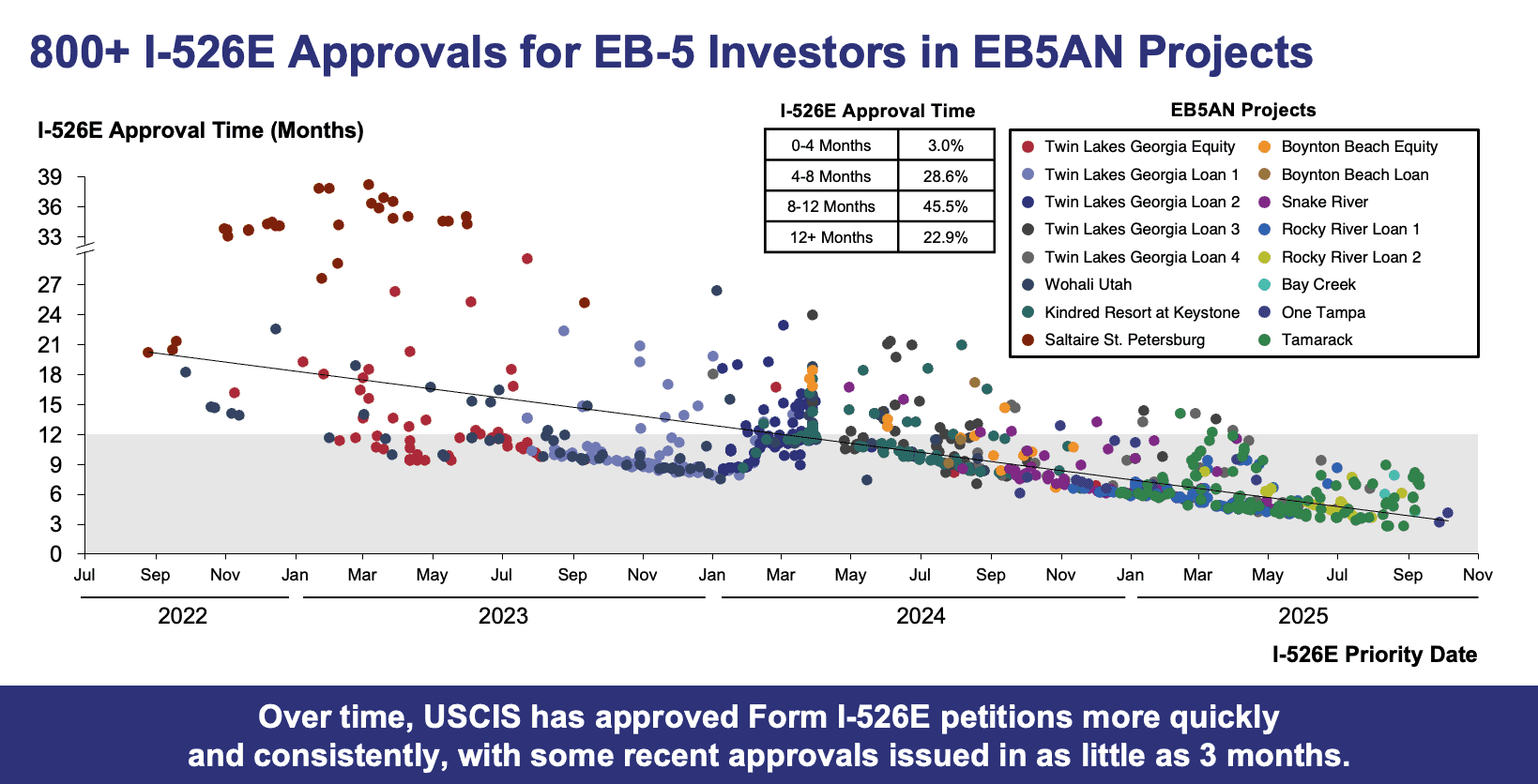
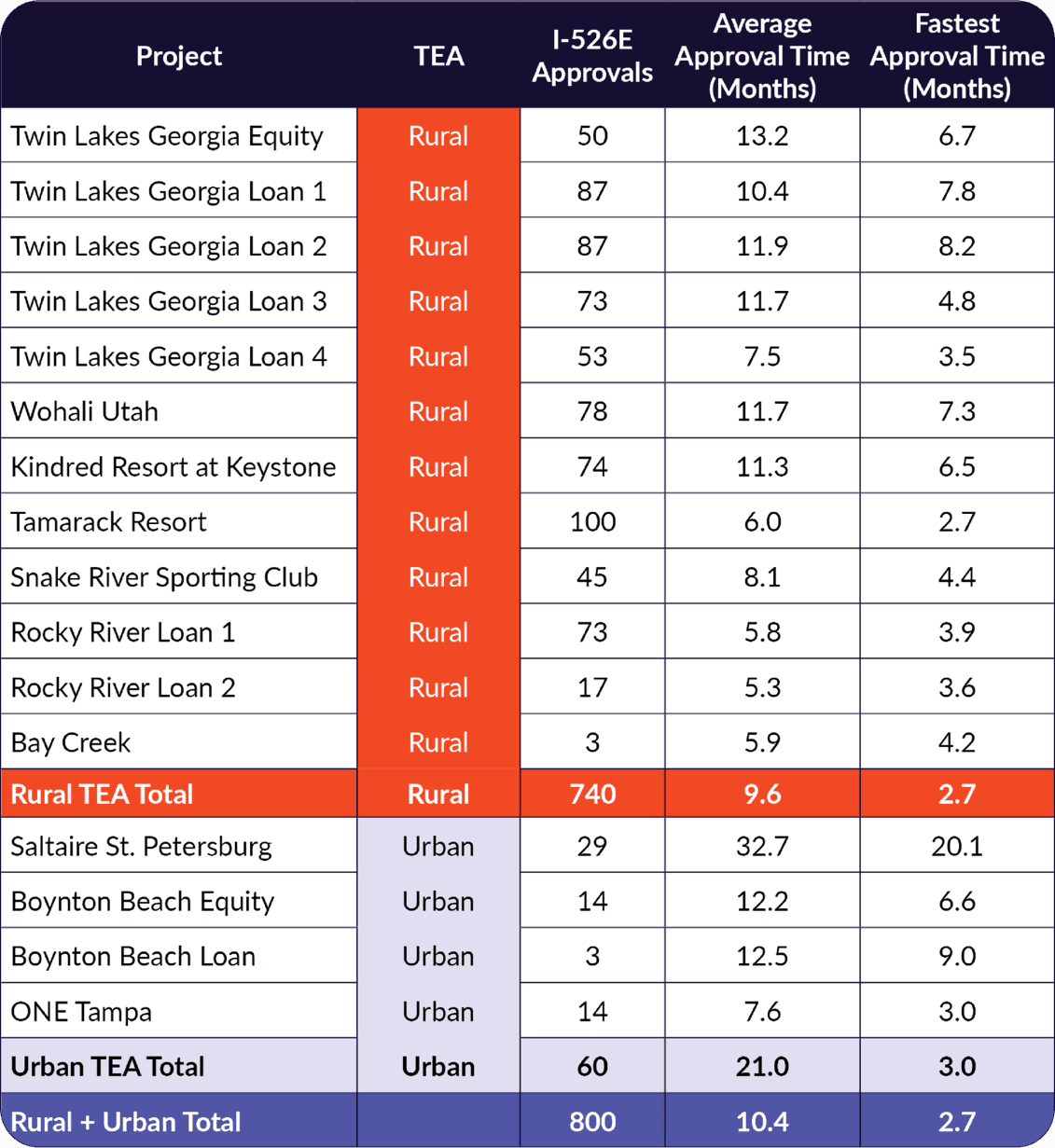
EB5AN’s internal data shows a clear pattern: its projects have been seeing fast I-526E adjudications, and those timelines have become faster and more consistent over time. Since 2022, EB5AN has recorded 800+ I-526E approvals, with an overall average approval time of 9.6 months for rural EB-5 projects. Among all rural TEA projects, over 80% of I-526E approvals were issued in less than 12 months, with an average processing time of only 9.6 months and the fastest approval completed in just 2.7 months.
The trendline in the approval-time chart is also important. In 2022 and early 2023, approvals were more often clustered around the 9- to 12-month range, with a number taking much longer. By mid-2024 and through 2025, the pattern shifted downward. Many approvals were landing in roughly 6 to 8 months. This consistency suggests that USCIS is not just moving some cases faster at random. It indicates a broader improvement in adjudication speed across I-526E filings.
The rural projects account for most fast approvals. EB5AN’s data shows that rural TEA projects account for the large majority of approvals and, in many cases, the shortest timelines.
Additionally, EB5AN saw I-526E approvals rise from 196 in 2024 to 524 in 2025, a 167% increase. Even with that larger volume, the data still shows improving speed. H1 2025 produced 244 approvals, and H2 2025 rose to 280, with Q3 2025 alone reaching 197 approvals. That suggests USCIS has been processing EB5AN petitions at a high and fairly steady rate. It also explains why investors are paying close attention now: if filings rise sharply ahead of the September 2026 grandfathering deadline while USCIS capacity stays flat, wait times could grow again.
USCIS is also issuing fast approvals for Form I-956F, which each EB-5 project is required to submit.
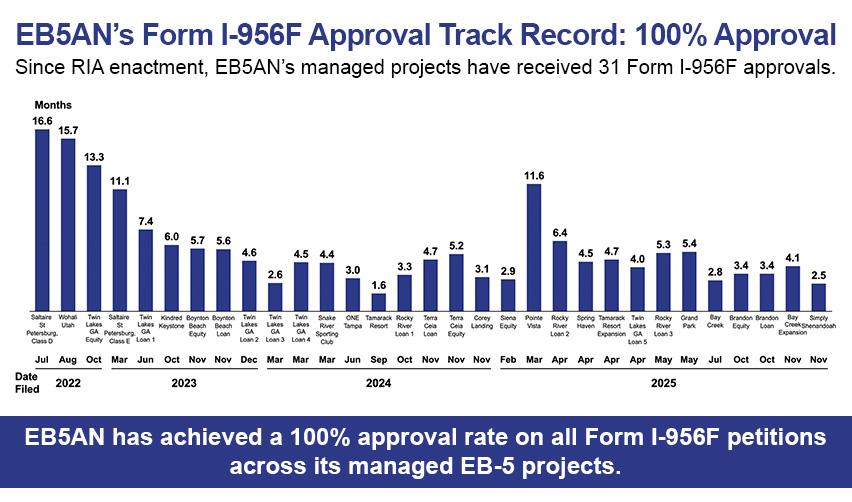
The project-level I-956F data helps explain why some EB5AN projects have moved so quickly. EB5AN has received 31 Form I-956F approvals across its managed projects, with some of those approvals coming in under three months. Since USCIS cannot approve an I-526E petition until the project’s I-956F has been adjudicated, this matters directly. It also fits another pattern in the data: once a project receives its first I-526E approval, later approvals for that same project often come faster. Taken together, the numbers show why EB5AN projects, especially rural ones with approved I-956Fs, have been producing consistently fast I-526E approval times.
Our Portfolio of EB-5 Projects
We are pleased to offer a varied portfolio of both rural and urban EB-5 projects to meet our investors’ needs. Our rural EB-5 projects under the RIA have seen I-526E approvals in as few as 3 months, as well as EAD and AP approvals in only 90 days.
- Simply Shenandoah (Rural) — $800K (Senior Loan)
- Currahee Club (Rural) — $800K (Senior Loan)
- Hard Rock Pointe Vista (Rural) — $800K (Senior Loan)
- Lakeview Landing (Rural) — $800K (Equity)
- Lakeview Landing (Rural) — $800K (Loan)
- Spring Haven (Urban) — $800K (Loan)
- Brandon Multifamily (Urban) — $800K (Equity)
- Brandon Multifamily (Urban) — $800K (Loan)
Learn More About EB5AN’s EB-5 Projects
Next Steps for EB-5 Investors
Next Steps for EB-5 Investors
The September 30, 2026, deadline is approaching quickly, but that doesn’t mean you won’t be able to secure your family’s Green Cards in a safe EB-5 project. If you start the process promptly with a reliable immigration attorney, you can focus on finding a safe EB-5 project and regional center to invest with.
As Mike Schoenfeld puts it, “In EB-5, the investors in the strongest position are usually the ones who prepared before the pressure set in. Filing before the September 2026 deadline can help you get your Green Cards faster in the short term. And in the long term, doing so protects your family’s immigration goals while the rules are still clear.”
For personalized guidance, schedule a free consultation with EB5AN.
