
In hospitality and residential real estate, the brand on the door shapes demand, pricing, and absorption, not just the guest experience. For an EB-5 investor evaluating project fundamentals, a globally recognized flag is more than a marketing asset. It supports the underlying conditions that determine whether a project creates the required jobs, performs financially, and returns investor capital on schedule.
EB5AN’s Hard Rock Pointe Vista pairs one of the world’s most recognized hospitality brands with a rural EB-5 structure (priority processing, reserved visas, and the $800,000 investment threshold) at an amenity-rich destination that draws millions of visitors annually.
This post examines what the Hard Rock brand brings to this opportunity and how it fits into the broader investment case.
What the Hard Rock Brand Brings to a Real Estate Investment
Why Brand Strength Is Relevant to EB-5 Specifically
Why Branded Residences Carry a Pricing and Sell-Through Advantage
How a Recognized Brand Reduces Execution Risk From Day One
Hard Rock Pointe Vista: The Project
The EB-5 Structure: Rural Designation and What It Means
How Brand, Structure, and Location Combine
Evaluating the Opportunity
What the Hard Rock Brand Brings to a Real Estate Investment
Hard Rock International was founded in London in 1971 and has grown into one of the most widely distributed hospitality and entertainment brands in the world, with more than 300 venues (hotels, cafes, casinos, and live entertainment spaces) across nearly 80 countries. The brand holds the world’s largest collection of authentic music memorabilia, with more than 89,000 pieces displayed across its properties globally.
Hard Rock International is owned by the Seminole Tribe of Florida, a well-capitalized owner with a long investment horizon. That ownership structure matters: the brand is not subject to the short-term pressure of a publicly traded hospitality company, and the Seminole Tribe has consistently reinvested in expanding and protecting the Hard Rock name.
For real estate investors, recognized hospitality flags typically translate into measurable advantages: higher occupancy rates, stronger average daily room rates, faster residential absorption, and brand-driven pricing premiums on attached residences. The brand also activates a demand engine from day one. Hard Rock’s global loyalty program, Unity by Hard Rock, gives the property access to a built-in base of brand-loyal travelers before a single local marketing dollar is spent.
Why Brand Strength Is Relevant to EB-5 Specifically
EB-5 investors are not passive capital providers in the traditional sense. Under the EB-5 Immigrant Investor Program, administered by U.S. Citizenship and Immigration Services (USCIS), a foreign national invests in a U.S. commercial enterprise that must create at least ten full-time jobs for qualifying U.S. workers. The investor’s immigration outcome, and ultimately their capital, depends on whether the project performs well enough to generate and sustain those jobs.
That dependency makes project fundamentals central to the EB-5 evaluation. A branded hotel and residential development benefits from demand-side credibility that an unbranded project does not have. Stronger occupancy projections, higher rate potential, and faster residential absorption all support the financial performance that keeps a project on schedule, which puts it in a better position to meet its job creation obligations and return investor capital.
Brand strength does not guarantee investment returns or immigration approval. USCIS adjudicates each petition on the basis of documented job creation and program compliance, not on the strength of a brand license. But a globally recognized brand reduces one layer of the uncertainty that comes with execution.
Why Branded Residences Carry a Pricing and Sell-Through Advantage
Branded residences—privately owned homes or condominiums that carry a hotel brand’s name, design standards, and service infrastructure—have grown into a distinct category within luxury real estate over the past two decades. Buyers pay for more than the unit itself: they pay for the brand’s reputation, the managed-service experience, and the resale recognition that a known flag provides. Across global markets, branded units consistently command pricing premiums over comparable unbranded product in the same location.
Hard Rock Pointe Vista will be Oklahoma’s first branded residential community. In a market with no competing branded product, the development defines the category locally rather than competing for position within it. That combination—an established global brand entering a market with no branded comparable—supports both the prices the residences can command and the speed at which they sell.
Sell-through velocity matters to an EB-5 investor for a specific reason. Faster residential absorption brings revenue into the project sooner and reduces the period during which the development carries unsold inventory. A project that sells through its residential component on or ahead of schedule is better positioned financially, which in turn strengthens its capacity to sustain operations and meet its job creation obligations. For investors evaluating how a project’s commercial design connects to their immigration outcome, the branded residential component is one of the clearer links between brand strength and underlying performance.
How a Recognized Brand Reduces Execution Risk From Day One
Execution risk—the chance that a project underperforms its projections during the critical early operating period—is one of the variables an EB-5 investor weighs most heavily. A new, unbranded hotel typically opens into a slow ramp, building awareness and occupancy from a standing start. A Hard Rock property opens with recognition already established in the minds of millions of travelers, which shortens that ramp and supports occupancy from the first season.
The brand also lends credibility during financing and construction, not only during operations. Lenders, contractors, and residential buyers treat a recognized flag as a signal of seriousness and staying power, which can help the project secure favorable terms and move through its build phase.
Hard Rock Pointe Vista: The Project
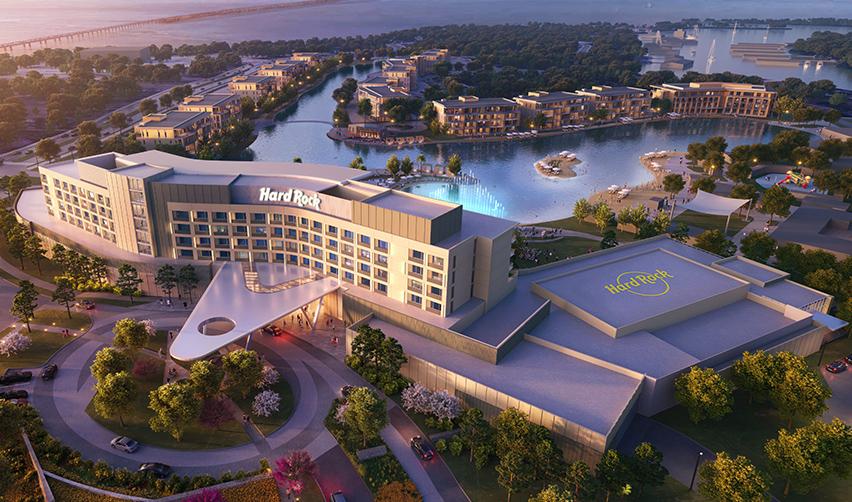
Hard Rock Pointe Vista is located within Pointe Vista, a 2,700-acre master-planned resort community on Lake Texoma, on the Oklahoma-Texas border, about 100 miles north of Dallas. The Dallas-Fort Worth metroplex is the fourth-most populous metropolitan area in the United States, with roughly 7.5 million people. Lake Texoma is one of the most visited lakes in the country, drawing approximately 7 million visitors per year.
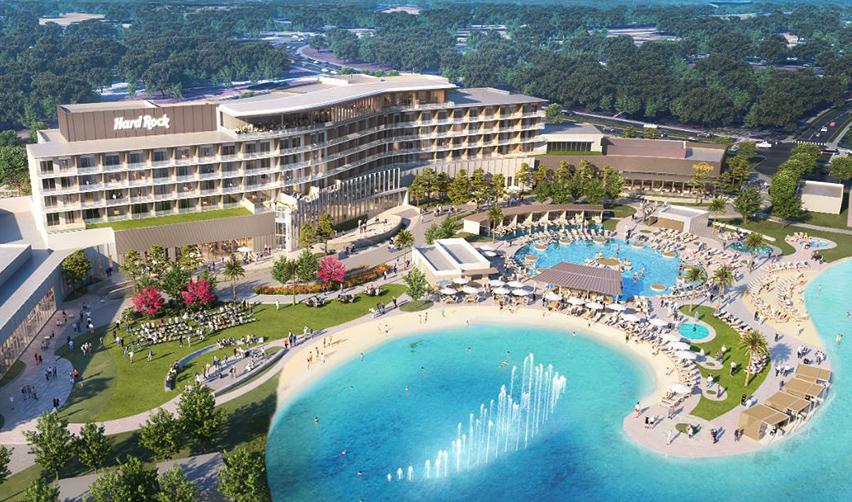
The EB-5 capital supports a 217-room Hard Rock-branded hotel, 131 Hard Rock-branded condominiums across seven buildings, an 18,000-square-foot conference center, and an 11-acre lagoon with white-sand beaches, water activities, dining, and a floating concert stage. The project has received Form I-956F exemplar approval from USCIS, which means the agency has reviewed the offering’s rural targeted employment area (TEA) qualification, job creation methodology, and investment structure and found them compliant with current EB-5 program requirements.
The broader Pointe Vista master plan includes a golf course, an enclosed waterpark, an amphitheater, family entertainment facilities, and more than 19 miles of shoreline. This amenity depth reinforces the hotel’s positioning as a destination property rather than a transit or business hotel, a distinction that typically drives stronger leisure demand and longer average stays.
The developer is Pointe Vista Holding Company, led by CEO Mark A. Fischer, a serial entrepreneur who has founded, acquired, and led companies across several industries. Among them was Dippin’ Dots, which he purchased for $12.7 million in 2012 and sold for $222 million in 2022.
Hard Rock International licenses its brand to the project. Pointe Vista Holding Company is the developer responsible for designing, financing, and building the resort. EB5AN is the EB-5 regional center and fund sponsor for the offering.
The EB-5 Structure: Rural Designation and What It Means
Hard Rock Pointe Vista qualifies as a rural EB-5 project under the EB-5 Reform and Integrity Act of 2022 (RIA), which restructured the program’s set-aside categories and introduced priority processing for rural project types. Rural projects receive two significant benefits.
First, rural investors have access to reserved visa allocations, a separate pool of visas set aside specifically for rural, high-unemployment (urban), and infrastructure projects. These reserved visas currently do not carry the same backlog that affects unreserved-category applicants, which is particularly meaningful for investors from countries with high EB-5 demand. Second, USCIS currently prioritizes the adjudication of petitions filed under rural set-aside categories, which can meaningfully shorten the time from filing to approval.
Both benefits apply at the $800,000 minimum investment threshold established by the RIA for TEA projects, which includes rural designations.
Construction is already underway, and the project has created more than 460 qualifying EB-5 jobs to date, enough to satisfy the job creation requirement for the offering’s first investors. At completion, projected qualifying job creation substantially exceeds the total required across all investors in the offering. The project’s USCIS economic report documents the methodology behind those figures.
How Brand, Structure, and Location Combine
The investment case for Hard Rock Pointe Vista is not built on any single element. The Hard Rock brand brings demand, pricing power, and built-in marketing reach. The rural EB-5 structure provides priority processing and access to reserved visas at the program’s lower investment threshold. The Lake Texoma location anchors the project in a high-visitation destination with an established visitor base. And the broader Pointe Vista community underpins the hotel’s positioning as a destination resort.
Each of these elements reinforces the others. The brand strengthens the financial performance projections. The destination reinforces the brand’s leisure positioning. The rural structure provides the immigration pathway. Together, they form a project where the hospitality fundamentals and the EB-5 structure are aligned rather than in tension.
Evaluating the Opportunity
Prospective investors should review the project’s Private Placement Memorandum (PPM), the offering document that contains the full terms, risks, and financial projections, before making any investment decision. The PPM is the authoritative source for job creation figures, capital structure, repayment terms, and all material facts about the offering.
Beyond the PPM, investors should review the project’s USCIS economic report, which documents the methodology and figures behind the projected EB-5 qualifying job count. They should also assess the brand-license terms, the developer’s track record, and current construction status and timeline.
More than 3,000 families from over 70 countries have selected EB-5 projects sponsored by EB5AN regional centers. Our expert team has more than a decade of experience and offers clients high-quality, low-risk EB-5 regional center projects with a 100% USCIS project approval rate.
If you would like to know more about your EB-5 investment options, book a free call with our expert team today.
This post is not an offer to sell securities. Any offer is made solely through the PPM to accredited investors under Rule 506(c). Past performance is not indicative of future results. Project renderings are representative only and subject to change.