

If you’ve been exploring EB-5 opportunities over the past few years, you’ve probably noticed a pattern: Georgia consistently comes up. And in 2026, that trend hasn’t slowed down. In fact, it’s become more pronounced.
So what is it about Georgia that continues to draw international EB-5 investors, especially at a time when the program itself has become more selective and more structured under the latest regulations?
The answer is a combination of timing, project design, and a shift in how investors are evaluating risk.
A Market That Balances Growth and Stability
Why Georgia’s Housing Demand Is Built on More Than Optimism
The Rise of TEA Advantages
Proven Developer Models Matter More Than Ever
From Projection to Reality
Loan Structures and Capital Stack Clarity
Timing Still Favors Well-Positioned Projects
Why Georgia Isn’t Just a Trend
A Market That Balances Growth and Stability
Georgia, particularly the greater Atlanta area and its surrounding regions, sits in a unique position within the U.S. real estate landscape. It offers something that many traditional EB-5 hotspots struggle to maintain: balance.
On one hand, there’s real population growth and housing demand. On the other, development costs and entry points are still relatively reasonable compared to markets like New York or California. For EB-5 investors, that balance is important. Projects need to be large enough to generate jobs, but not so speculative that repayment becomes uncertain.
This is one reason why residential master-planned communities have become such a dominant EB-5 asset class in Georgia. They naturally generate significant job creation through construction and infrastructure spending, while also responding to genuine end-user demand.
Why Georgia’s Housing Demand Is Built on More Than Optimism
Part of Georgia’s appeal comes down to fundamentals that don’t change with interest rates. The state has been a top destination for domestic in-migration for over a decade, adding more than 100,000 residents annually as people move away from higher-cost coastal markets. That population growth translates into real, sustained housing demand.
For active adult communities like Twin Lakes, there’s an additional factor: Georgia exempts most retirement income from state tax, including Social Security, which makes it a practical choice for retirees. The demand these projects are built on isn’t manufactured by favorable project structures alone; it reflects where people are actually choosing to live.
The Rise of TEA Advantages

Since the EB-5 Reform and Integrity Act reshaped the program, investors have become much more aware of visa set-asides and processing advantages. Rural targeted employment area (TEA) projects, in particular, now offer faster adjudication and access to reserved visa categories.
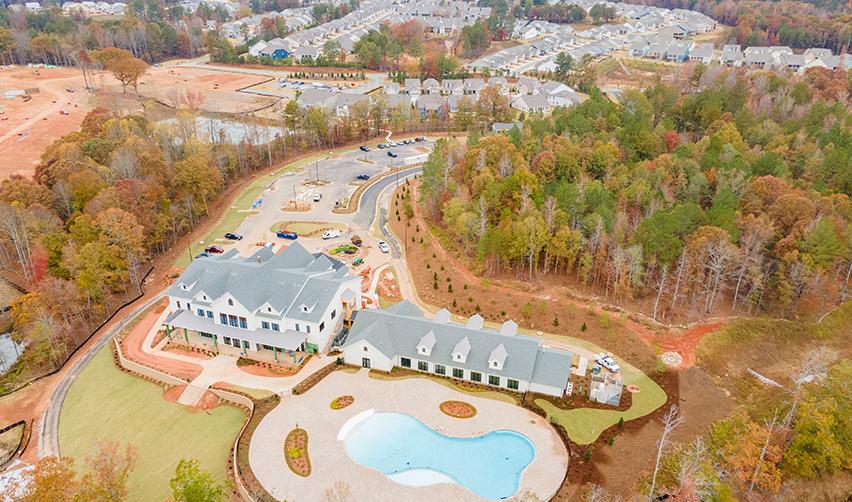
Georgia happens to be rich in qualifying locations. Projects like Twin Lakes Georgia illustrate this well. Located in a rural area outside Atlanta, the development is a large-scale, master-planned community with over 1,300 homes and extensive amenities. As of May 2026, it has already generated all required jobs for all its EB-5 investors while also demonstrating strong sales and construction progress.
Proven Developer Models Matter More Than Ever
If there’s one shift in investor mindset in recent years, it’s that the developer matters just as much as the project.
EB-5 investors in 2026 are no longer just asking whether a project qualifies. They’re asking whether the team behind it has done this before and done it successfully.
That’s where some major Georgia projects have built an advantage. Many of them are backed by experienced developers with repeatable models. Instead of one-off developments, you’re often looking at variations of previously executed communities.
Take the Spring Haven urban EB-5 project. It follows a familiar blueprint: a residential community developed by an established U.S. builder, with EB-5 capital structured as a loan. The project includes features that investors increasingly look for today, such as a repayment guaranty and a job creation guaranty, along with USCIS exemplar approval; an important signal that the project structure aligns with program requirements.
There’s also the fact that construction is already underway and substantial job creation has already been achieved, reducing some of the biggest risks in EB-5 investing.
From Projection to Reality

At its core, EB-5 is about job creation. But the way investors evaluate job creation has evolved. A decade ago, projections were often enough. Today, many investors prefer to see jobs already created or well underway.
EB5AN’s EB-5 projects in Georgia tend to perform well here because of their construction-heavy nature. Large residential developments generate jobs early and consistently as capital is deployed. That’s a key reason why they’re so prevalent in the EB-5 space.
Twin Lakes Georgia is a strong example. The project has already created all required EB-5 jobs for all its investors, backed by hundreds of millions in eligible development spending by Kolter. For investors who want concrete evidence of job creation before committing, that track record is difficult to find in most EB-5 offerings.
Loan Structures and Capital Stack Clarity
Another reason Georgia continues to attract attention is the clarity of deal structures.
In projects like Spring Haven, the presence of a parent company repayment guaranty adds another layer of perceived security. While no EB-5 investment is risk-free, features like this help investors better understand how and when capital might be returned.
At the same time, transparency around the capital stack, how EB-5 funds fit alongside developer equity and senior financing, has become a major decision factor. Georgia projects, particularly those backed by experienced sponsors, tend to present this structure more clearly than many earlier-generation EB-5 offerings.
Timing Still Favors Well-Positioned Projects
There’s also a broader timing element at play. In 2026, demand for EB-5 visas remains strong, especially among investors seeking more predictable immigration pathways. At the same time, the number of high-quality, compliant projects is more limited than it once was.
This has created a kind of filtering effect. Investors are gravitating toward projects that combine immigration compliance, financial structure, and real-world progress. EB5AN’s Georgia projects happen to offer a steady pipeline of exactly those kinds of opportunities.
Why Georgia Isn’t Just a Trend
Looking at the underlying factors such as demographics, development patterns, regulatory alignment, and project design, it’s hard to see Georgia’s EB-5 appeal as a short-term trend.
What Georgia offers is consistency, with EB-5 projects that are easier to understand, and developers with repeat track records. For investors navigating an increasingly complex landscape, that kind of predictability is valuable. And that’s ultimately why Georgia continues to stand out as one of the most dependable EB-5 markets in the United States.
More than 3,000 families from over 70 countries have selected EB-5 projects sponsored by EB5AN regional centers. Our expert team has more than a decade of experience and offers clients high-quality, low-risk EB-5 regional center projects with a 100% USCIS project approval rate.
If you would like to know more about your EB-5 investment options, book a free call with our expert team today.