
In 2026, U.S. immigration policy is moving through one of its most active periods in years. In recent weeks, the U.S. immigration space has witnessed a federal court order requiring USCIS to restart processing for nationals of 39 countries, a Massachusetts federal court decision vacating the $100,000 H-1B fee, new USCIS restrictions on adjustment of status, and the fast-approaching September 30, 2026 EB-5 grandfathering deadline.
For EB-5 investors, these changes are especially important because new USCIS policy shifts can affect their entire immigration timeline.
In this volatile regulatory environment, EB-5 investors and immigration attorneys need to stay informed and adjust their strategies as new developments emerge. A policy announcement may create immediate concern, but it may also face court challenges or later clarification. Investors should understand what has actually changed, what remains uncertain, and what steps they can take to protect their immigration goals.
For this reason, EB5AN hosted a webinar on recent changes to U.S. immigration policy in 2026 and their ramifications for the EB-5 Immigrant Investor Program. The webinar was hosted by EB5AN managing partners Sam Silverman and Mike Schoenfeld. The guest panelist was Kate Kalmykov of Greenberg Traurig, one of the leading immigration attorneys in the EB-5 industry.
Greenberg Traurig is one of the most respected international law firms serving investors, companies, and regional centers in complex immigration matters. Kalmykov co-chairs the firm’s Global Immigration & Compliance Practice. She has represented thousands of investors in obtaining Green Cards through EB-5 projects. She has also structured the largest EB-5 offering in the program’s history and has structured more than $12 billion in EB-5 deals over the course of her career.
The webinar focused on policy updates that EB-5 investors should monitor closely, especially as the September 30 filing deadline approaches. This post summarizes the main issues covered in the discussion, including:
- The federal court decision allowing USCIS processing to resume for nationals of 39 affected countries;
- the federal court ruling vacating the $100,000 H-1B fee policy;
- the recent USCIS memo on adjustment of status and its possible impact on EB-5 investors; and
- the uncertainty surrounding Temporary Protected Status and other temporary immigration benefits.
“Recent immigration announcements can create confusion because they often sound final before the courts, agencies, and attorneys have had time to clarify their real effect,” said Sam Silverman, managing partner of EB5AN. “For EB-5 investors, the key question is how each policy affects USCIS processing in their specific situation. Investors who understand the legal context behind these announcements can make informed decisions and preserve their path to a U.S. Green Card.”
Highlights:
Full Webinar:
Immigration Policy Changes Do Not Always Mean the Law Has Changed
A Federal Court Ordered USCIS to Resume Processing for Nationals of 39 Countries
Writs of Mandamus Are Becoming More Common in Delayed EB-5 Cases
A Federal Court Vacated the $100,000 H-1B Fee Policy
USCIS Has Moved to Treat Adjustment of Status as an “Extraordinary” Benefit
Temporary Protected Status Remains Uncertain
Policy Uncertainty Is Pushing More Investors Toward EB-5
Next Steps for EB-5 Investors
EB-5 Investors Should Begin Their Immigration Journeys Before Policy Changes Create More Delays
Immigration Policy Changes Do Not Always Mean the Law Has Changed
One of the most important points for EB-5 investors to understand is that a new immigration announcement does not necessarily mean the law itself has changed. In 2026, many of the most disruptive developments in immigration have come through executive orders, agency memoranda, and other policy directives.
These actions can affect how cases are processed in the short term—but they do not carry the same legal weight as statutes passed by Congress.
Congress is responsible for determining immigration law. Federal agencies such as USCIS and the Department of State are responsible for administering those laws, but they cannot simply rewrite the rules on their own. When an agency tries to impose a major new restriction without proper legal authority or without following the required process, that action can be challenged in court. That is exactly why several recent immigration policies have already been blocked, vacated, or narrowed after litigation.
The same principle applies when agencies rely on internal memoranda instead of formal regulations. A memo may change how officers are instructed to handle cases, and that can create real disruption for investors and families. But a memo is still not the same as a statute or a properly issued regulation. Formal regulations generally require a public process, including notice and comment, before they take effect.
EB-5 investors should not assume that every headline or policy announcement represents a permanent change in the law.
This uncertain regulatory environment makes it more important than ever for EB-5 investors to work with an experienced immigration attorney. When policy shifts are happening quickly, investors need legal advice based on the underlying authority behind the announcement.
A Federal Court Ordered USCIS to Resume Processing for Nationals of 39 Countries
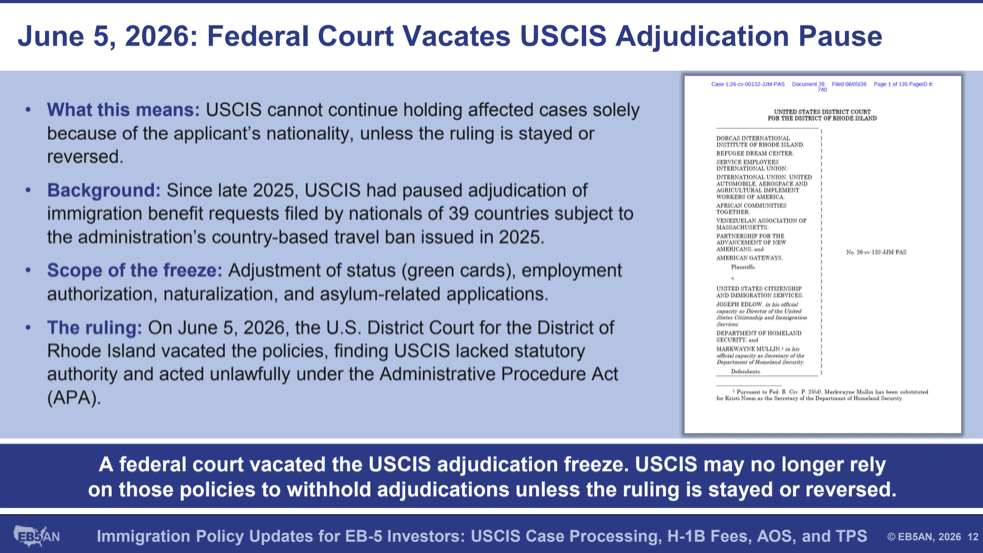
In 2025, the Trump administration imposed a pause on the adjudication of immigration benefits for foreign nationals from 39 countries. The policy was justified on national security grounds and affected nationals of countries including Iran, Nigeria, Venezuela, Afghanistan, and several Caribbean nations. This decision affected domestic USCIS adjudications involving employment authorization documents, adjustment of status applications, investor petitions, asylum matters, and naturalization cases. It also affected visa processing at U.S. consulates abroad, although that part of the issue remains separate.
On June 5, 2026, a federal court vacated the USCIS adjudication pause as it applied to domestic benefit processing. The court argued that USCIS cannot simply stop adjudicating cases indefinitely for entire groups of people based on nationality alone. Congress writes immigration law. Federal agencies administer that law. An agency may apply additional scrutiny where it believes that is warranted, but it cannot create a blanket rule that effectively denies people access to adjudication when Congress did not impose that restriction.
In other words, the adjudication pause treated nationality itself as the basis for an indefinite halt, regardless of a person’s specific facts, background, or eligibility. The court rejected that approach. As a result, affected domestic USCIS cases should no longer be held solely on the basis of nationality, absent a stay, reversal, or other case-specific ground for delay. This includes adjustment of status filings, employment authorization applications, and EB-5 petitions that had been caught in the freeze.
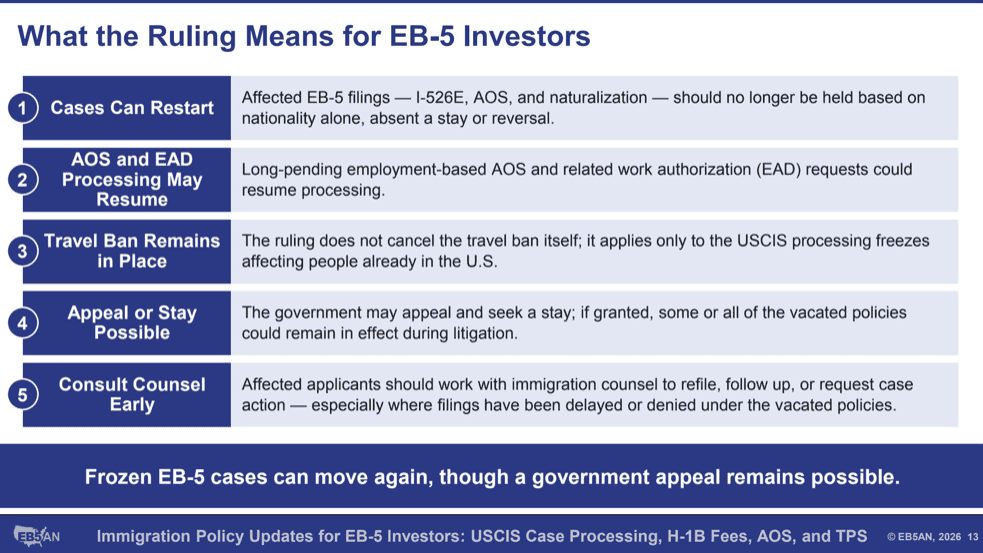
That said, the decision does not automatically resolve every restriction for foreign nationals from these countries. The ruling applies to USCIS, not to consular visa processing abroad. Immigrant visa issues at consulates remain more difficult to challenge because of the doctrine of consular non-reviewability, under which federal courts are generally reluctant to second-guess consular decision-making.
Even so, the June 5 ruling is a significant reminder that immigration agencies cannot use internal policy shifts to suspend rights or procedures that the law itself still provides.
Writs of Mandamus Are Becoming More Common in Delayed EB-5 Cases
This brings us to a legal resource many EB-5 investors turn to when their USCIS cases seem to be delayed: mandamus litigation. As immigration delays have continued, more investors have turned to writs of mandamus to force action on long-pending cases. A writ of mandamus is a federal court filing that asks a judge to require the government to make a decision when a case has been unreasonably delayed.
In the EB-5 context, mandamus actions have often been used in long-pending I-829 cases. Although the I-829 regulatory framework contemplates prompt adjudication, processing times have often stretched into three and four years. In many of those cases, once a mandamus action was filed, the government moved to settle and issue a decision rather than litigate the delay in court.
That same strategy is now being used more often in long-pending I-526 petitions and adjustment of status cases. The legal analysis is somewhat different because those case types do not have the same specific regulatory deadline that applies to I-829 adjudications. Even so, there comes a point where a delay becomes hard to justify, especially when a case is well outside posted processing times and the applicant is not stuck in a visa backlog. In those circumstances, a mandamus filing may be an effective way to force movement.
Mandamus is not appropriate in every case. Filing one too early is unlikely to succeed. A petition that has been pending for only a short time will usually not support a claim of unreasonable delay. But when a case has been sitting for years, and there is no clear explanation for the lack of action, federal litigation may become a realistic option.
There is also an important difference between domestic USCIS delays and overseas consular delays. Mandamus actions are generally more useful when the delay involves USCIS. They are more difficult in consular cases because courts are often hesitant to intervene in visa processing handled by embassies and consulates abroad. That makes the posture of the case especially important. Investors dealing with a delayed filing need to evaluate not just how long the case has been pending, but where it is pending and which part of the government is responsible for the delay.
A Federal Court Vacated the $100,000 H-1B Fee Policy
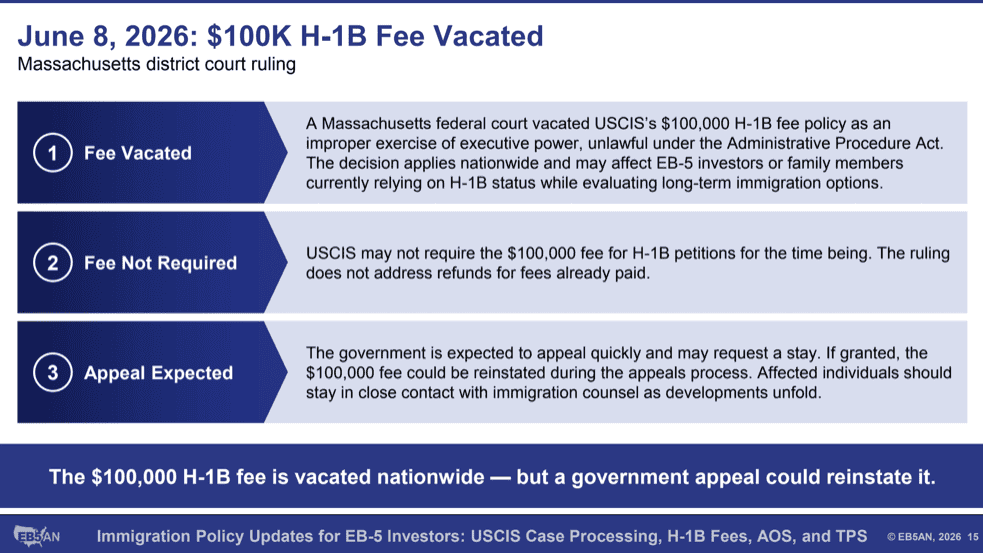
JUNE 12 UPDATE: The Massachusetts district court has temporarily stayed its order while the government seeks appellate relief.
Another major 2026 development involved the Trump administration’s attempt to impose a $100,000 fee on certain H-1B filings. The requirement was announced in a presidential proclamation issued on September 19, 2025, and it applied to certain new H-1B petitions filed on or after September 21, 2025. From the start, it created confusion across the business immigration system. Employers, foreign workers, and attorneys were left trying to determine who would be affected, when the rule would take effect, and whether it applied only to new petitions or more broadly.
The fee was introduced on a Friday and was initially understood to take effect almost immediately. Over the next several days, the government issued multiple clarifications narrowing its scope. First, it appeared to apply to people outside the United States. Then the government clarified that it would apply only to new H-1B petitions, not to extensions or changes of employer. Additional guidance narrowed the apparent scope further, including by distinguishing new filings from extensions and other existing H-1B scenarios. That sequence made clear that the policy had not been carefully developed before it was announced.
On June 8, 2026, a federal district court in Massachusetts vacated the rule. The court concluded that the administration could not use immigration authority to impose what was effectively a tax. The executive branch may charge authorized filing fees through proper statutory and regulatory channels, but the court concluded that this $100,000 charge functioned as an unauthorized tax or penalty rather than a permissible cost-based filing fee. The power to tax belongs to Congress, and that distinction proved decisive.
The disruption caused by the rule extended well beyond large technology companies. It affected hospitals, nonprofits, research institutions, and other employers that rely on H-1B workers. Some employers may have been willing to pay the fee, but many could not. Refunds were also left unclear, which added another layer of uncertainty for employers and applicants already trying to respond to a rapidly changing policy environment.
For investors watching the broader immigration landscape, the H-1B fee dispute was another sign that legal immigration categories remain exposed to abrupt policy shifts, administrative confusion, and litigation.
USCIS Has Moved to Treat Adjustment of Status as an “Extraordinary” Benefit
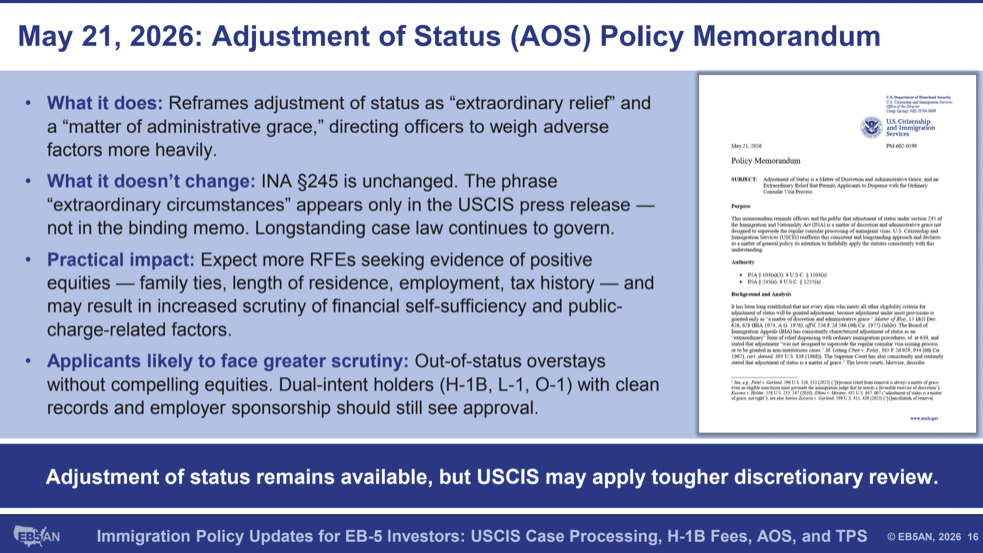
Another major development in 2026 came when USCIS issued a policy memorandum on May 21, 2026, recasting adjustment of status as an “extraordinary discretionary benefit” rather than a routine path to permanent residence for eligible applicants already in the United States.
In a public announcement released the next day, USCIS stated that applicants for Green Cards should generally pursue immigrant visas through U.S. consulates abroad instead of filing adjustment of status applications from within the country.
Adjustment of status has been used for decades by eligible applicants who are already in the United States, and the policy shift immediately raised questions because it appeared to rest on broad agency discretion rather than on any new act of Congress. The memo also created uncertainty by failing to give clear guidance on retroactivity or implementation. It did not clearly explain how pending cases would be handled, how officers should apply the new standard, or how broadly the change would reach across different visa categories.
For EB-5 investors, that uncertainty is especially significant because Congress expressly authorized concurrent filing under the EB-5 Reform and Integrity Act of 2022. That change allowed eligible investors to file an immigrant petition and an adjustment application at the same time while remaining in the United States. The new USCIS memo appeared to cut against that framework by suggesting that most applicants should return abroad for consular processing, even though Congress had already opened a domestic filing path for eligible EB-5 investors.
The immediate concern was not only legal theory but also day-to-day case handling. In the weeks after the memo was issued, adjustment cases reportedly continued to be approved, including cases filed from F-1, H-1B, and L-1 status. At the same time, some applicants began receiving requests for evidence asking why they had filed for adjustment of status rather than consular processing and whether their continued presence in the United States served an economic or national-interest purpose. For EB-5 investors, that question has an obvious answer. An investor who places $800,000 into a qualifying project and must create at least 10 jobs is clearly making an economic contribution tied directly to the U.S. economy.
The policy also created concern about travel. The memo also raised case-specific travel questions, especially for applicants not maintaining H-1B or L-1 status who are considering whether to travel on advance parole. At the same time, the government’s own operational capacity raised serious questions about whether a broad shift to consular processing was even workable. There are hundreds of thousands of pending adjustment cases, and the State Department would have to absorb that volume through already strained consular posts if the policy were applied aggressively. That would likely worsen delays in places where immigrant visa wait times are already long.
Like several other immigration measures introduced in 2026, this policy quickly raised the prospect of litigation.
For EB-5 investors, the adjustment-of-status issue is another reminder that immigration strategy now depends as much on understanding the limits of agency action as on understanding the underlying visa category itself.
Temporary Protected Status Remains Uncertain
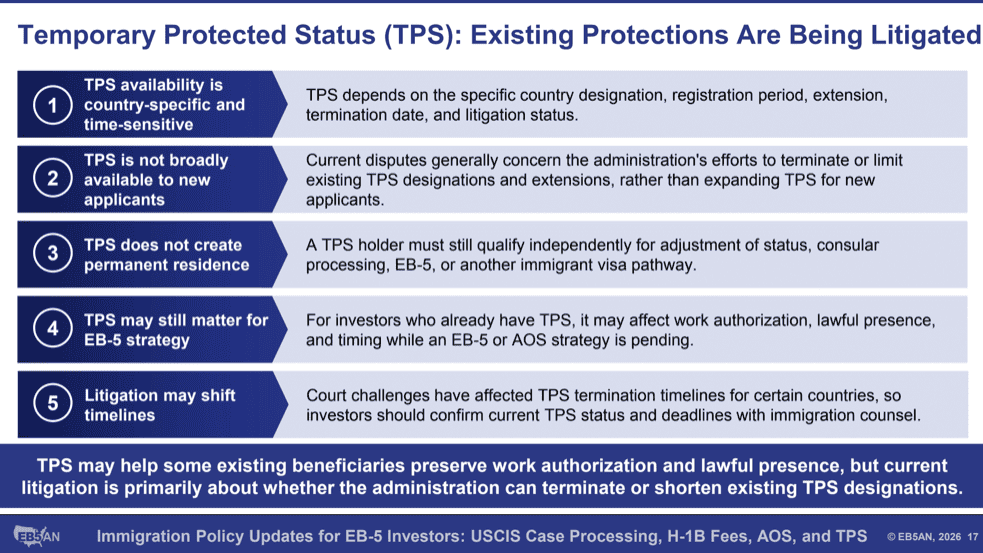
Temporary Protected Status, or TPS, has also become less predictable in the current immigration environment. TPS is a temporary humanitarian protection for people from countries affected by war, natural disaster, or similar crises. It does not provide permanent status in the United States, but it can allow eligible foreign nationals to remain in the country and receive work authorization for a limited period.
The countries affected by TPS issues include Venezuela, Sudan, Cambodia, Burma, Ukraine, and others. Many TPS holders have built lives and employment ties in the United States while relying on temporary protection and related work authorization. That protection can be renewed, extended, narrowed, or placed in doubt depending on government action.
The Trump administration has taken a more restrictive approach to TPS. Rather than simply declining to renew certain TPS designations when they expire, the administration has sought to cancel some protections while they are still in effect and to end the work authorization tied to that status. That has created legal uncertainty for TPS holders and practical problems for employers that depend on workers who are lawfully employed under those protections.
Several affected groups, including Haitians and Venezuelans, have filed class-action lawsuits to stop TPS cancellations. Courts have stepped in in some cases and allowed work authorization to continue while the legal issues are reviewed. That means TPS remains unsettled. Some protections may continue during litigation, but the overall status remains exposed to further agency action, court decisions, and policy changes. Current TPS litigation generally concerns whether the administration can terminate, shorten, or limit existing TPS designations and related work authorization; it should not be read as creating broad new TPS eligibility for new applicants.
For foreign nationals who are relying on TPS, that uncertainty can make long-term planning difficult. A status that can stop, restart, or remain tied up in court does not provide the same stability as permanent residence. That is why some TPS holders have begun looking at EB-5 or other immigration options that may lead to a Green Card.
Policy Uncertainty Is Pushing More Investors Toward EB-5
We’ve observed a recurring pattern in the past few months: a major policy memo, executive order, or agency directive is announced. The announcement causes immediate concern because it appears to affect pending cases, future filings, travel, work authorization, or the availability of a Green Card path. Then, in many cases, the policy is challenged in court, narrowed, delayed, or sent back because the government did not follow the correct procedure or acted beyond its authority.
This back-and-forth has created a difficult environment for foreign nationals in the United States. Many people who are in legal status still feel exposed because their immigration plans depend on agency discretion, employer sponsorship, temporary visa rules, or policies that may change with little warning. A person may be in the United States lawfully and still face uncertainty about whether a case will keep moving, whether a work permit will be renewed, whether travel is safe, or whether a new rule will affect a pending application.
The same uncertainty has affected how people view temporary and employment-based immigration options. H-1B workers, TPS holders, students, and other foreign nationals may all have different legal positions, but many share the same concern: their ability to remain in the United States can depend on forces outside their control. Employers can change plans. Agency guidance can shift. Processing can pause. A policy can be announced one week and challenged the next.
EB5AN has observed increased interest in EB-5 from foreign nationals seeking a more independent path to permanent residence amid uncertainty in temporary and employment-based categories. EB-5 is not tied to a single employer, a job offer, or continued sponsorship by a company. For many investors, that independence is one of the program’s strongest advantages. It gives families a way to pursue U.S. permanent residence through a qualifying investment and job creation, rather than remaining dependent on a temporary visa category that can be affected by changing policy.
The uncertainty around other immigration categories does not mean EB-5 is free from risk. Investors still need to choose a sound project, document the lawful source of their investment funds, and work with experienced immigration counsel. They also need to understand how changes in USCIS policy may affect adjustment of status, processing times, travel, and work authorization. But EB-5 gives investors a defined immigration objective: permanent residence for the investor, a spouse, and qualifying children.
Next Steps for EB-5 Investors
Investors considering a regional center EB-5 filing should pay close attention to the September 30, 2026 grandfathering deadline. Under the grandfathering provisions of the EB-5 Reform and Integrity Act, investors who file by that date may receive statutory protection if the regional center program later lapses or is not reauthorized. Their petitions can still be adjudicated, and their Green Card process can continue under the rules in effect when they filed.
Timing also matters because EB-5 investment amounts are subject to future inflation adjustments. The current lower investment amount is $800,000, but a future adjustment could raise the required minimum investment. Investors who wait may face a higher required investment amount, fewer project options, and a more crowded filing environment.
The first step should be hiring an experienced immigration attorney. Many investors begin by choosing a project, but the legal work should begin before or alongside project review. No matter which project an investor selects, the attorney will need to prepare the source-of-funds analysis and collect the documents required for the petition. That process usually takes longer than investors expect.
Source-of-funds work is rarely as simple as it looks at the beginning. Investors may need to provide bank records, business records, tax documents, gift records, loan documents, sale documents, or other evidence showing where the investment funds came from and how they moved.
If the investor is in the United States and plans to file adjustment of status, additional documents may be required, including medical exam records, birth certificates, marriage certificates, divorce certificates, residence history, and employment history.
Upcoming backlogs are another reason to move early. An investor secures a priority date when the I-526E petition is filed. For countries such as China and India, future retrogression remains a serious concern. If demand creates a quota backlog, even one day of filing difference can affect when an investor is able to move forward. Filing earlier can preserve a better place in line before the rush of petitions expected near the deadline.
The safest approach is to begin the attorney review, source-of-funds work, and document collection as soon as possible. Investors do not need to wait until every project question is resolved before starting the legal preparation.
EB-5 Investors Should Begin Their Immigration Journeys Before Policy Changes Create More Delays
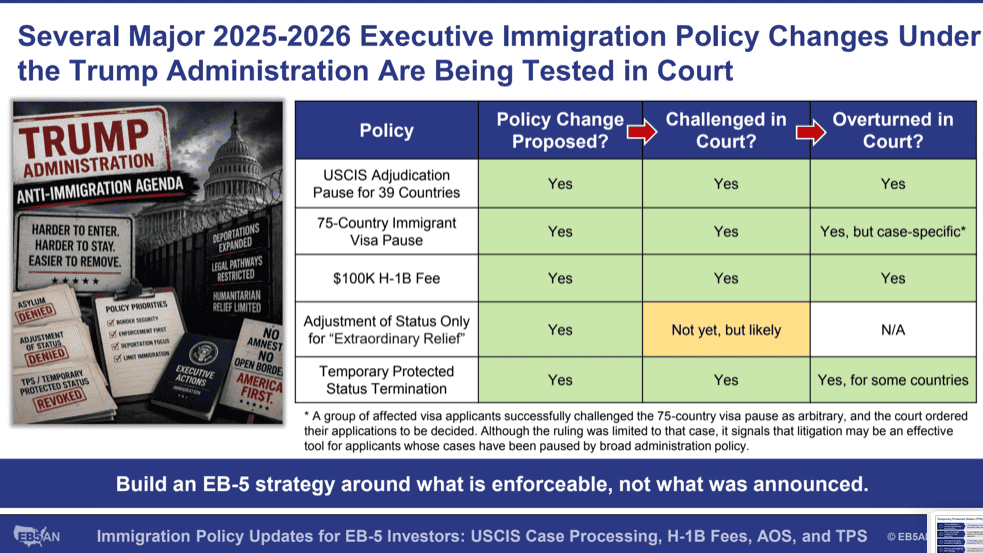
U.S. immigration policy is changing quickly, but not every new announcement changes the law. Some policies will remain in place. Others will be challenged, narrowed, delayed, or struck down. The recent USCIS processing freeze for nationals of 39 countries, the $100,000 H-1B fee, the adjustment of status memo, and the uncertainty around TPS all show the same basic problem: foreign nationals cannot rely on assumptions that were safe even a few months ago.
Through it all, EB-5 remains one of the clearest paths to U.S. permanent residence because it is based on a qualifying investment and job creation, not on employer sponsorship or a temporary status that can change suddenly.
We invite you to seize your opportunity to gain U.S. Green Cards—perhaps in only months—by scheduling a free consultation with EB5AN.