EB-5 investors from Michigan seeking an EB-5 investment should consider the benefits of investing in an EB5AN EB-5 visa project.
Why Do Most EB-5 Investors Use Regional Centers?
EB-5 regional centers streamline the EB-5 investment process for potential EB-5 applicants and make it easier to demonstrate required job creation. Specifically, only regional centers may use the indirect method of calculating jobs through an approved economic methodology. This means that EB-5 investors must show only that their invested funds were spent according to the business plan rather than documenting that full time (W-2) employees were hired and remained employed for at least two full years.
EB5AN maintains multiple USCIS-approved regional centers with broad geographic coverage, enabling it to immediately sponsor strong EB-5 projects across the United States, including Michigan.
The EB5AN State of Michigan Regional Center
Potential EB-5 investors may select EB-5 investments located anywhere in the United States. Those living in Michigan, however, may simply want to invest in projects located within the state, and EB5AN already has a USCIS-approved regional center in Michigan.
The EB5AN Midwest Regional Center is expected to receive USCIS approval in 2023, at which time it will be licensed to sponsor EB-5 investment projects throughout all 83 counties in the state of Michigan, including the largest cities in the state.
With a population of 639,111, Detroit is Michigan’s largest city and largest metro area. Regarded as a major cultural center, Detroit is known for its contributions to music, art, and architecture. Automobile manufacturing continues to be a driving force in Detroit’s economy, as well as the industries of finance, retail, healthcare, and exporting.
Michigan’s second-largest city, Grand Rapids, houses 202,181 people and is the economic and cultural hub of West Michigan. Moreover, it is one of the fastest-growing cities in the Midwest. Grand Rapids is home to five of the world’s leading office furniture companies, earning it the nickname of “Furniture City”. Other major industries include healthcare, information technology, automotive, and aviation.
Housing 139,387 residents, Warren is Michigan’s third-largest city and is one of Metro Detroit’s core cities. Warren is home to several large businesses, such as General Motors Technical Center and the United States Army Detroit Arsenal. The city’s economy is primarily driven by the following industries: retail trade; manufacturing; healthcare and social assistance; education; and finance.
Green Card Benefits for Michigan EB-5 Investors
The direct benefits of making an EB-5 investment in Michigan include the following:
Residency and Citizenship Benefits
- EB-5 is one of the fastest methods to gain permanent residency in the United States for the EB-5 investor, his or her spouse, and their unmarried children under 21 years of age.
- Retired Green Card holders can access their pensions earned abroad and in the United States. They may also qualify for Medicare and other social welfare programs.
- Green Card holders may apply for U.S. citizenship after a minimum of five years of established permanent residency in the United States.
Employment Benefits
- Green Card holders are free to live and work anywhere in the United States, without restriction.
- Live anywhere, from the beaches of California and Hawaii to the mountains of Colorado, from a quiet, rural town to the hustle and bustle of New York City.
- Live in states such as Michigan and Texas with no state income tax.
- The EB-5 program does not require a visa sponsor or employer sponsor
- Green Card holders do not need an H-1B work visa in order to work.
Travel Benefits
- Green Card holders can leave and enter the country without being denied reentry, although some travel restrictions apply.
- Green Card holders are free to travel to any part of the United States.
- In the event of a political change or significant event in the investor’s home country, the investor and his or her family can immediately gain entry to the United States.
Education Benefits
- Green Card holders have free access to public elementary, middle, and high schools and lower-cost in-state tuition at public colleges and universities.
- U.S. residency improves the likelihood of U.S. university admission by as much as 350%.
- Green Card holders qualify for in-state tuition, financial aid, and scholarships.
- Permanent residents can also work while studying, complete internships, and apply for postgraduate positions.
Primary EB-5 Investment Requirements
The primary EB-5 investment requirements can be summarized as follows:
- Investing a minimum of $800,000 for EB-5 investments made in rural or high unemployment areas designated as targeted employment areas (TEAs). Projects outside of TEAs require an investment of $1,050,000, but all of EB5AN’s EB-5 investment projects are located in TEAs and qualify for the lower investment threshold of $800,000.
- Creating or preserving at least 10 full-time jobs for qualifying U.S. workers that last a minimum of two years.
- Investing in a new commercial enterprise or a troubled business.
- Maintaining the at-risk status of the investment and using investment funds that have been lawfully sourced.
How to Evaluate EB-5 Investment Projects
EB-5 investors based in Michigan should evaluate both financial and immigration risk when selecting an EB-5 investment project.
One of the requirements of a successful EB-5 visa investment is that the investment capital must be at risk for the duration of the investment. This is to ensure investors actually invest their capital and are not simply “buying” a U.S. Green Card.
“At risk” does not mean that EB-5 investors are required to invest in “risky” projects. Quite the contrary—EB-5 investors are strongly recommended to conduct thorough due diligence to minimize their exposure to financial and immigration risk.
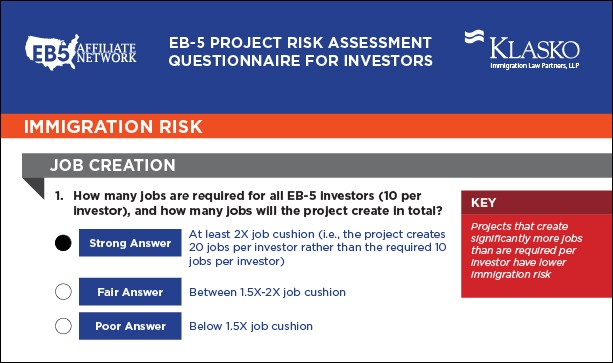
EB5AN, in collaboration with Klasko Immigration Law Partners, has developed an EB-5 Project Risk Assessment Tool for EB-5 investors. This highly functional, easy-to-use tool guides investors through the initial diligence of EB-5 projects from both financial and immigration risk perspectives.
Download our EB-5 Project Risk Assessment Questionnaire
More Information about Michigan
Michigan: Population and Income Demographics
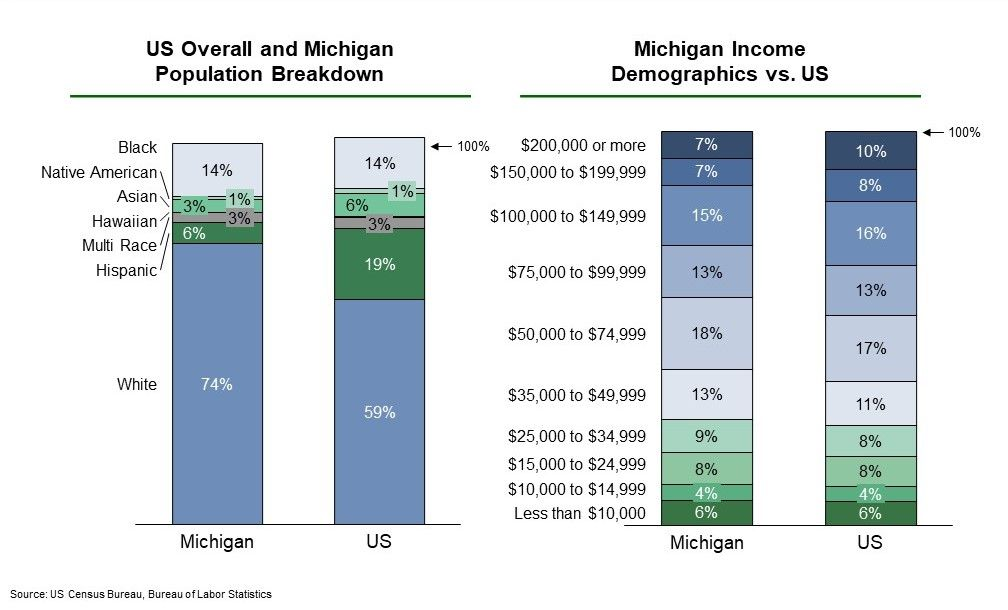
According to the U.S. Census, Michigan has a population of 10,050,811. Of this, approximately 4,960,466 people are in the labor force, with 4,617,618 employed and 342,848 unemployed.
Michigan: General Economic Outlook
Michigan covers an area of 99,716 square miles, with an approximate width of 386 miles and a length of 456 miles. This implies a population density of 174 people per square mile.
The capital of Michigan is Lansing, and the largest city and largest metro area is Detroit. Michigan’s 2021 gross domestic product (GDP) was $473.3 billion, implying a per capita GDP of $56,554.
Michigan’s economy is diverse, thriving, and boasts the 14th-largest state GDP in the United States. The most influential industries in Michigan’s economy include the following: manufacturing; real estate, rental, and leasing; and professional, scientific, and technical services. Furthermore, Michigan’s manufacturing industry is especially focused on that of auto parts and automobiles. In fact, the state is home to the country’s three major automobile companies — General Motors, Ford Motor Company, and Stellantis North America.
EB-5 Investors from Michigan
EB5AN has EB-5 investment projects that are available to residents of the state of Michigan. EB-5 investors from Michigan can inquire about EB-5 investment projects that are currently open to investment and are sponsored by an EB5AN EB-5 regional center.
No matter where you live in Michigan, if you are a foreign national considering making an EB-5 investment, the team at EB5AN can help. Click here to schedule a call to learn more about currently available EB-5 investment opportunities.
