

Tech companies are cutting headcount at an accelerating pace, and a significant share of those cuts are tied not to performance, but to AI-driven workflow consolidation. For H-1B visa holders, a layoff isn’t just a job loss. It immediately triggers a clock that, if mismanaged, can unravel years of work toward U.S. residency.
What Happens to H-1B Status the Day You’re Let Go
How a Layoff Affects H-4 Spouses and Children
Finding a New H-1B Sponsor Under Current Conditions
Why Some H-1B Holders Use a Layoff as the Catalyst to Pursue EB-5
What the 60-Day Window Actually Demands
What Happens to H-1B Status the Day You’re Let Go
H-1B status is employer-sponsored, which means it is directly tied to the petitioning employer. When that employment ends — whether through a layoff, termination, or resignation — the visa status technically lapses from that date.
In practice, USCIS has recognized a grace period of up to 60 days (or until the end of the authorized validity period, whichever is shorter) during which the H-1B holder remains in a lawful period of stay. It is not an extension of H-1B status. It is a limited period in which to take corrective action: find a new sponsor, change status, or depart the country.
Sixty days sounds manageable. However, in a tight hiring market shaped by AI-related job displacement across many similar roles at once, it becomes a very tight timeline.
How a Layoff Affects H-4 Spouses and Children
H-4 status is derivative. This means it exists only as long as the primary H-1B holder maintains valid status. When the H-1B grace period begins, dependents enter that same 60-day window. If the primary holder does not secure new sponsorship or change status before the grace period expires, the entire family’s lawful presence lapses together.
For H-4 spouses who hold an Employment Authorization Document (EAD), the work authorization tied to that EAD also becomes unusable once the underlying H-4 status lapses. This is a detail that gets overlooked: the EAD card may still have a future expiration date printed on it, but if the status it derives from is no longer valid, the authorization it represents is not.
Children in H-4 status face the same timeline. For families with children approaching the age-out threshold of 21, a gap in status can create complications that are difficult to unwind. This is why acting quickly protects the entire household.
Finding a New H-1B Sponsor Under Current Conditions

The most straightforward path is finding a new employer willing to file an H-1B transfer petition before the grace period expires. H-1B portability rules allow the worker to begin new employment once the transfer petition has been filed. They do not need to wait for approval, provided they were in valid status when the petition was filed and there are no other issues with the underlying petition.
The practical challenge is pace. An employer must be identified, an offer extended, legal counsel engaged, and the petition filed, all within 60 days. Many employers, particularly larger firms with established immigration programs, can move quickly. Others cannot. Workers in specialized or senior roles may have more leverage; workers in functions that AI is actively displacing may find the market slower.
One factor worth tracking is that cap-exempt employers like universities, nonprofit research institutions, and certain government-affiliated organizations can file H-1B petitions year-round without being subject to the annual lottery cap. For those open to a shift in sector, these employers can represent a faster and less competitive path to new sponsorship.
Why Some H-1B Holders Use a Layoff as the Catalyst to Pursue EB-5
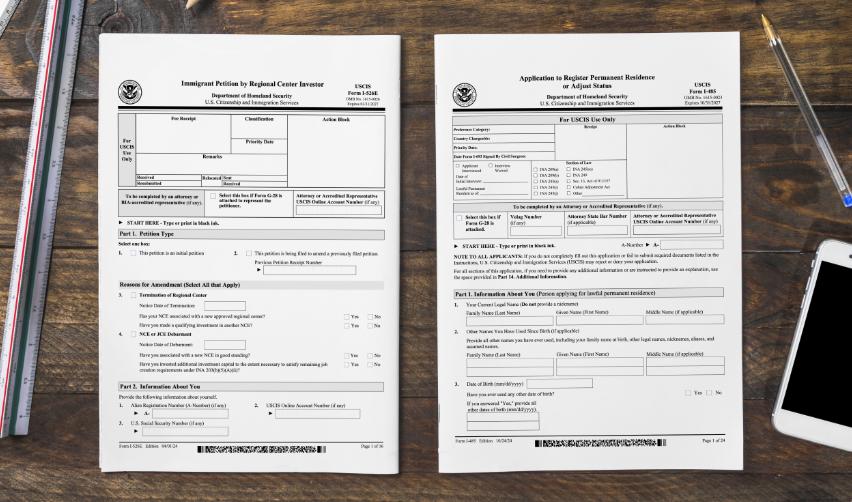
The EB-5 immigrant investor program offers a path to U.S. permanent residence that does not depend on employer sponsorship. For H-1B holders who have accumulated savings or have access to capital, a layoff can clarify what was previously a theoretical question: how long am I willing to remain dependent on employment-based sponsorship?
The EB-5 path requires a qualifying investment — currently $800,000 in a targeted employment area (TEA) or $1,050,000 outside one — and results in a conditional Green Card upon visa availability, followed by permanent residence after the conditions are lifted. It does not require a job offer, a sponsoring employer, or participation in the annual visa lottery.
For nationals of countries without significant visa backlogs, the timeline from investment to conditional Green Card can be relatively direct. For Chinese and Indian nationals, per-country demand means the visa queue is longer in the unreserved categories. But set-aside visa options introduced under the EB-5 Reform and Integrity Act allow for a much more streamlined visa process.
H-1B holders considering EB-5 should understand that the two paths are not mutually exclusive in the short term. An H-1B transfer to a new employer can stabilize immigration status while an EB-5 application is being prepared and filed. The investment and case preparation process takes time regardless, so there is no benefit to waiting for a crisis to begin evaluating the option.
One recent change is worth factoring in. On May 21, 2026, USCIS issued a memo reaffirming that adjustment of status for applicants already residing in the U.S. is discretionary rather than guaranteed, and directing officers to scrutinize an applicant’s intent and immigration history more closely on Form I-485. The heaviest scrutiny falls on single-intent categories such as F-1 and E-2. Dual-intent visas like H-1B are explicitly recognized as compatible with pursuing adjustment, which leaves H-1B holders better positioned than most under the new framework. However, a clean status record still matters, since holding a dual-intent visa does not by itself guarantee a favorable decision.
What the 60-Day Window Actually Demands
The 60-day grace period is not a period of rest. It requires immediate decisions about whether to pursue new employment, file for a change of status to another nonimmigrant category, or depart and re-enter under a different visa category. Doing nothing and allowing the grace period to expire without taking action results in a period of unlawful presence, which carries bars on future admission.
Anyone in this situation should engage an immigration attorney within the first week, not the last. The options available on day five are materially different from the options available on day fifty.
For those who were already contemplating a transition away from employment-based immigration, a layoff removes the inertia that keeps many H-1B holders in a holding pattern. The question of whether to continue on the employer-dependent path becomes sharper and more answerable when the sponsoring employer is no longer in the picture.
More than 3,000 families from over 70 countries have selected EB-5 projects sponsored by EB5AN regional centers. Our expert team has more than a decade of experience and offers clients high-quality, low-risk EB-5 regional center projects with a 100% USCIS project approval rate.
If you would like to know more about your EB-5 investment options, book a free call with our expert team today.