
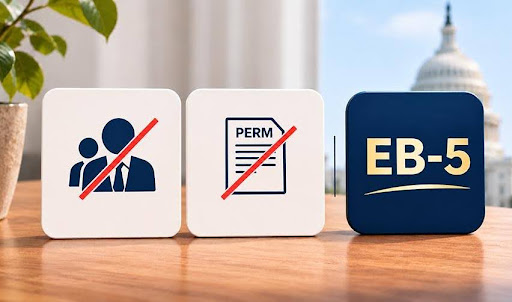
October 2026 brought three developments for foreign professionals whose U.S. immigration plans depend on an employer. The U.S. Department of Labor (DOL) suspended Microsoft, Adobe, and six IT services firms from the Program Electronic Review Management (PERM) labor certification program. A proposed overhaul of PERM cleared White House review. And the Department of Homeland Security (DHS) proposed ending the rule that tells U.S. Citizenship and Immigration Services (USCIS) officers to defer to earlier approvals when they review H-1B extensions.
This post explains each development in plain terms and then describes the EB-5 Immigrant Investor Program, a separate route to a Green Card that requires no employer sponsor and no labor certification.
What PERM Is and Why It Matters
The October 8 PERM Suspension of Microsoft, Adobe, and Six IT Firms
The Proposed PERM Rule Clears OMB Review
The Proposal to End USCIS Deference on H-1B Extensions
How EB-5 Works Without an Employer or Labor Certification
What EB-5 Offers H-1B Professionals
Timing and Risk Factors to Weigh
What PERM Is and Why It Matters
PERM is the labor certification process that DOL runs for most employment-based Green Cards in the EB-2 and EB-3 categories. The employer files the application. To succeed, the employer must test the U.S. labor market and show DOL that not enough qualified U.S. workers are available for the job, and that hiring the foreign national will not harm the wages and working conditions of comparable U.S. workers.
Once DOL certifies the application, the employer files a Form I-140 immigrant petition with USCIS. Every step belongs to the employer, so the worker’s timeline depends on the employer’s choices and on the employer’s standing with the government. The events of October show why that second point matters.
The October 8 PERM Suspension of Microsoft, Adobe, and Six IT Firms
On October 8, 2026, Vice President JD Vance and Labor Secretary Keith Sonderling announced at a White House press conference that DOL had suspended eight employers from PERM: Microsoft, Adobe, Cognizant, Infosys, Tata Consultancy Services, Wipro, HCL Technologies, and Capgemini. DOL said it would refuse new PERM applications from these companies and stop processing the applications they already had pending.
Officials cited multiple active federal investigations as the reason for the Microsoft and Adobe suspensions and pointed to the high volume of labor certification filings by the six IT services firms. These are allegations, and no final finding of wrongdoing has been made.
No end date has been set. Vice President Vance said the suspension would last as long as needed. DOL did not publish a written notice at the time, so details remain unclear, including the status of PERM cases already approved.
The Proposed PERM Rule Clears OMB Review
DOL is also moving to change PERM itself. On September 14, 2026, it sent a proposed rule titled Modernizing the Labor Market Test and Improving Protections for U.S. Workers in the PERM Immigrant Visa Program to the Office of Management and Budget (OMB). The Office of Information and Regulatory Affairs, which sits within OMB, concluded its review on October 23, 2026.
The next step is publication in the Federal Register as a proposed rule, which opens a public comment period. As of early November, DOL had not published the proposal, and its full text was not public. The regulatory record indicates the rule addresses recruitment, layoffs, nondiscrimination, and recordkeeping. If finalized, it would be the first comprehensive rewrite of PERM since 2004.
Current PERM regulations continue to govern every application until a final rule takes effect. The rule’s title and early reporting point toward a stricter labor market test for employers.
The Proposal to End USCIS Deference on H-1B Extensions
On October 14, 2026, DHS published a proposed rule titled Removing Deference to Prior USCIS Determinations of Eligibility. It would delete 8 C.F.R. 214.1(c)(5), the regulation that tells USCIS officers to generally defer to an earlier approval when an extension involves the same parties and the same facts, unless there was a material error, a material change, or new adverse information.
The proposal covers every petition filed on Form I-129, including the H-1B, L-1, O-1, TN, E, and P classifications. Officers could still consider a prior approval, but they would no longer begin from a position of deference to it. DHS estimates that deference applies to about 208,429 petitions a year and projects roughly 6,044 additional Requests for Evidence (RFEs) each year under the change.
The effect would fall most heavily on Indian professionals. USCIS data reported in early November shows that Indian-born workers received about 79 percent of H-1B approvals for continuing employment, the category that includes extensions, in fiscal year 2024.
Comments are due November 13, 2026.
How EB-5 Works Without an Employer or Labor Certification
The EB-5 Immigrant Investor Program has no PERM step, no Form I-140, and no employer sponsor. The investor is the petitioner. An investor in a regional center project files a Form I-526E petition directly with USCIS. The case rests on the investor’s capital and the project’s job creation, so an action against a technology employer has no bearing on it.
Under the EB-5 Reform and Integrity Act of 2022 (RIA), the minimum investment is $1,050,000, or $800,000 for a project in a targeted employment area (TEA) or an infrastructure project.
TEAs include rural areas and high-unemployment areas. The capital must be at risk and must create at least 10 full-time jobs for U.S. workers. Regional center projects can count indirect jobs, such as positions at suppliers, while direct investments must create the jobs inside the business itself.
After USCIS approves the I-526E, the investor obtains conditional permanent residence through adjustment of status or consular processing and later files Form I-829 to remove the conditions. When USCIS approves the I-829, the investor and the family members in the case receive 10-year Green Cards.
What EB-5 Offers H-1B Professionals
Two RIA provisions are especially useful to H-1B holders already in the United States.
Concurrent Filing
When a visa is available in the investor’s category, the investor can file Form I-485 to adjust status together with the I-526E, or while it is pending. This makes it possible to apply for an Employment Authorization Document (EAD) and an advance parole travel document. Once the I-485 is pending, the applicant is lawfully present on that basis and does not need to maintain nonimmigrant status. Because no employer is part of the case, a job change does not end the Green Card process.
Reserved Visa Categories
The RIA reserves 32 percent of annual EB-5 visas: 20 percent for rural projects, 10 percent for high-unemployment areas, and 2 percent for infrastructure projects. In the November 2026 Visa Bulletin, all three reserved categories are current for every country, including China and India, while the unreserved category has cutoff dates for those two countries. The RIA also directs USCIS to prioritize rural petitions. Visa availability can change, so investors should check the bulletin when they file.
Timing and Risk Factors to Weigh
The regional center program is authorized through September 30, 2027. Minimum investment amounts are scheduled to adjust for inflation on January 1, 2027, the first change since the RIA set the current figures. DHS has not published the new amounts yet.
EB-5 is an investment, and the capital must be at risk. Investors should study the project, the developer, the regional center’s record, and the documentation for their own source of funds, and should work with experienced immigration counsel. An EB-2 or EB-3 priority date also cannot be transferred to an EB-5 petition; the EB-5 filing starts its own priority date.
For professionals watching employer-based options tighten, EB-5 offers a Green Card path built on decisions the investor controls.
More than 3,000 families from over 70 countries have selected EB-5 projects sponsored by EB5AN regional centers. Our expert team has more than a decade of experience and offers clients high-quality, low-risk EB-5 regional center projects with a 100% USCIS project approval rate.
If you would like to know more about your EB-5 investment options, book a free call with our expert team today.