
The Microsoft and Adobe PERM freeze has given many H-1B workers a reason to reconsider their next career move. Staying may mean waiting for a Green Card process with no confirmed restart date. Leaving may mean finding an employer willing to sponsor permanent residence and beginning important parts of that process again.
Neither choice is as simple as accepting or declining a job offer. A worker with a pending labor certification faces different consequences from someone with an approved I-140 or a long-pending adjustment application. An immigration attorney can explain those differences before a job decision changes the case. The broader question is whether another employer-sponsored application offers a workable route to permanent residence.
EB-5 gives qualified investors another option: pursue a Green Card through an investment while making career decisions separately. Rural projects receive priority processing, and an investor in EB5AN’s Grand Park project recently received I-526E approval in only 10.7 months.
This post looks at several options for H-1B workers today: changing employers, alternatives based on professional qualifications, and the reasons EB-5 may provide the clearest direct route to permanent resident status.
The Latest on the Microsoft and Adobe PERM Freeze
Your Green Card Options After the Freeze
EB-5: Pursue Permanent Residence Without Another Employer Sponsor
The Latest on the Microsoft and Adobe PERM Freeze
On October 8, 2026, administration officials announced that the Department of Labor would stop accepting new applications and processing pending applications under the Permanent Labor Certification program, known as PERM, involving Microsoft, Adobe, Cognizant, Infosys, Tata Consultancy Services, Wipro, HCL Technologies, and Capgemini. As Reuters reported, officials linked the action to investigations into the companies’ use of immigration programs. The announced restrictions concern these employers, rather than a nationwide suspension of PERM.
Officials alleged that companies had harmed American workers through their hiring practices. Microsoft disputed the criticism, saying it pays H-1B employees comparably to other employees doing similar work.
As of November 3, 2026, no publicly confirmed date for restoring the affected employers’ PERM processing had been announced. It’s important to note that this action did not cancel workers’ existing H-1B status or previously approved I-140 petitions. Its immediate effect is therefore different for an H-1B worker awaiting labor certification and one whose case has already passed that stage.
H-1B remains a temporary work classification, usually subject to a six-year limit. Certain labor certification filings or immigrant petitions can support extensions beyond that limit. A freeze can be especially challenging for employees who still need the filings that would make those extensions possible. Simply continuing to work under the H-1B visa does not establish eligibility for another extension.
Your Green Card Options After the Freeze
Changing Employers After the PERM Freeze
A move to an employer outside the suspension can allow a PERM-based Green Card process to proceed. The immigration result depends on whether the new employer will sponsor the position, when it will begin, and what can be preserved from the existing case.
The H-1B job change and the Green Card process require separate filings. Under H-1B portability rules, an eligible worker can generally begin employment after the new employer properly files a nonfrivolous H-1B petition, or on the requested start date, whichever is later. That permission to work does not transfer a PERM application to the new company.
Starting Again at the PERM Stage
If your case is still at the prevailing wage, recruitment, or pending PERM stage, an unrelated new employer generally must begin its own labor certification process. The existing application concerns a particular job opportunity and area of intended employment. Labor certification validity rules do not turn it into a certification that follows an employee to any new job.
For example, an engineer who leaves while the original employer’s PERM is pending may start the new job under H-1B portability. The new company may still need its own prevailing wage determination, recruitment, and PERM application before filing an I-140. The worker’s ability to start work can therefore move much faster than the new permanent residence case.
A new employer’s sponsorship policy also affects the timeline. A company may transfer an H-1B promptly but postpone Green Card sponsorship until after an internal waiting period. An offer to sponsor eventually gives the employee less certainty than an agreed start date for the process. A higher salary or better role does not answer that immigration question.
Keeping a Priority Date After I-140 Approval
An approved I-140 can preserve something valuable: the priority date that determines a worker’s place in the visa queue. Under priority date retention rules, an earlier date can generally be used with a later qualifying EB-1, EB-2, or EB-3 petition. Exceptions include revocations based on fraud, material error, or invalidation of the underlying labor certification.
Keeping that date does not automatically let a new employer use the old petition to obtain your Green Card. Unless a portability exception applies, the new sponsor generally needs a new PERM and I-140 for a PERM-based case.
If the I-140 has been approved for at least 180 days, the original employer’s withdrawal generally does not, by itself, revoke that approval. The regulations also protect an approved petition when the associated I-485 has been pending for at least 180 days.
These withdrawal protections do not preserve the old job offer.
Changing Jobs After Filing for Adjustment
H-1B workers further along the process may have greater flexibility. If a qualifying employment-based I-485 adjustment application has been pending for at least 180 days, the applicant may be able to move to a permanent job in the same or a similar occupational classification under INA Section 204(j). The underlying I-140 must be approved or ultimately approvable. U.S. Citizenship and Immigration Services (USCIS) explains the requirements in its Supplement J instructions.
This can allow an eligible applicant to continue the existing Green Card case without a fresh PERM. The 180-day rule concerns the pending I-485; an I-140 approval by itself does not create the same right. Someone who cannot yet file adjustment because of a visa cutoff date may be unable to use this protection.
Changing employers also does not automatically restart the usual six-year H-1B allowance. Time already used still counts, although qualifying extensions and time recaptured from periods abroad can affect the calculation.
Applying Without PERM Based on Your Professional Qualifications
An EB-2 national interest waiver allows a qualifying professional to self-petition, but it requires more than an advanced degree or employment at a prominent company. The applicant must establish the proposed endeavor’s substantial merit and national importance, demonstrate that they are well positioned to advance it, and justify waiving the job offer and labor certification requirements. USCIS’s national interest waiver guidance explains that assessment.
EB-1A also permits self-petitions for people who meet the extraordinary ability standard. These routes deserve an individual assessment, but a successful technology career does not automatically qualify someone for either. A national interest waiver remains in the EB-2 visa category, so approval does not remove its country-specific visa wait. For workers who do not meet these professional standards, an investment-based application, such as EB-5, may be a more practical option.
Pursuing EB-5 as an H-1B Worker Without Changing Jobs
EB-5 allows an H-1B professional to pursue permanent residence through a qualifying investment while continuing in an existing job. EB-5 does not require employer sponsorship.
The current minimum investment is $800,000 in a qualifying rural or high unemployment targeted employment area (TEA), or an eligible infrastructure project. The standard minimum is $1,050,000. The investment must satisfy USCIS requirements, including supporting at least 10 qualifying full-time U.S. jobs.
An EB-5 investor must document the lawful source and movement of the capital and keep the investment at risk under the program’s rules. An EB-5 project’s financing and ability to create the required jobs still need careful review. A USCIS Green Card approval does not guarantee repayment of the investment.
An H-1B worker can pursue EB-5 while remaining at their current job. Alternatively, an H-1B worker offered a better role can evaluate the move and still pursue EB-5. A job change does not require a replacement PERM or employer-sponsored I-140 for the EB-5 case.
Work Authorization While Your EB-5 Case Is Pending
Eligible applicants in the United States can file Form I-485 with their I-526E when a visa is available and the adjustment requirements are met. EB-5 concurrent filing allows the adjustment process to begin before USCIS approves the investor petition. Applicants can also request an Employment Authorization Document and advance parole.
An approved adjustment-based EAD can allow employment without an H-1B sponsor, including at a company that does not offer visa sponsorship. The worker must continue using valid work authorization until the EAD is approved.
An H-1B worker can prepare an EB-5 case while maintaining H-1B status. Workers who already have an employer-sponsored case can also discuss maintaining that route while pursuing EB-5, rather than assuming they must abandon it.
Rural Processing and Available EB-5 Visas
Rural EB-5 investor petitions receive priority processing under the EB-5 Reform and Integrity Act of 2022. This can shorten the petition stage compared with a process that first requires a new employer to obtain labor certification. Priority processing does not impose a guaranteed approval deadline, but it gives qualifying rural investments a statutory processing benefit.
The November 2026 Visa Bulletin lists the rural, high unemployment, and infrastructure EB-5 set-asides as current for all countries, including China and India. These set-asides are a separate allocation from EB-2 and EB-3. Changing employers within one of those categories does not eliminate its visa queue; a qualifying EB-5 investment gives access to a different category.
Current availability can change as demand increases. Our recent analysis of rural demand and dual TEA projects explains why rural may face a cutoff before high unemployment. Chinese and Indian investors can discuss projects qualifying in both categories with their attorneys.
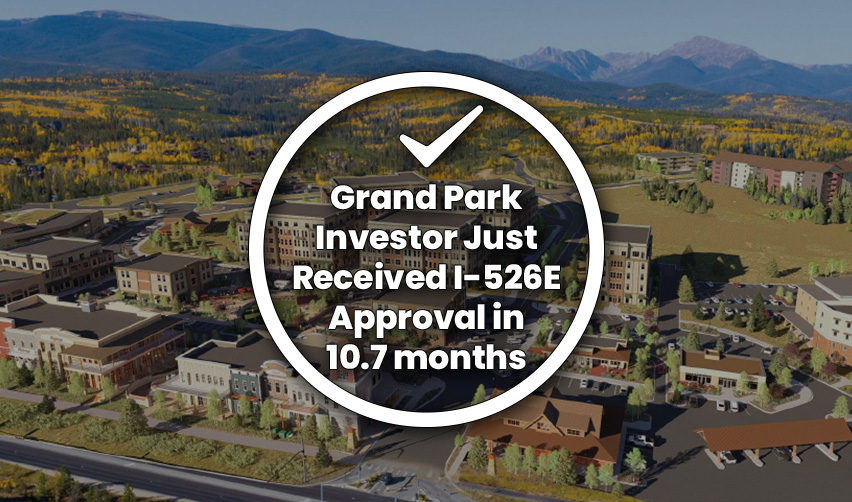
Grand Park Receives Its First I-526E Approval in 10.7 Months
As we recently announced, an investor in EB5AN’s Grand Park rural project received the project’s first I-526E approval in only 10.7 months. Grand Park had already received I-956F approval for its project application. The individual approval provides evidence that the approved project documents have supported a successful investor petition.
These approvals reflect EB5AN’s commitment to full compliance with EB-5 requirements, from the investment structure to the job creation methodology. EB5AN’s investors can proceed with confidence that USCIS has accepted Grand Park’s project documentation and approved an individual petition based on it. With rural priority processing, that approval history gives new investors a strong foundation for timely I-526E adjudication and progress toward their Green Cards.
Grand Park is a 264-acre master-planned development next to Winter Park Resort in Fraser, Colorado, combining for-sale homes, rental apartments, lodging, commercial space, and year-round recreation. Its EB-5 offering uses a secured senior loan backed by a senior mortgage and a 100% equity pledge in the project company.
EB-5: Pursue Permanent Residence Without Another Employer Sponsor
A job change can help some H-1B workers resume Green Card sponsorship, particularly when their existing case qualifies for portability. Others will have to start the process over.
But for H-1B professionals who can meet the investment requirements, EB-5 offers a direct path to a Green Card without depending on another employer’s willingness to sponsor them.
Initial I-526E filing charges rise from $4,675 to $8,950 on November 30, 2026, with an increase in minimum investment amounts scheduled for January 1, 2027. Starting the EB-5 process now gives you time to prepare your funds documentation and file before these higher costs take effect.
To explore EB5AN’s projects and how to begin, schedule a free consultation with EB5AN.