
The EB-5 landscape is changing significantly as 2026 draws to a close. Higher USCIS filing fees take effect on November 30, followed by an inflation adjustment to the minimum investment amounts on January 1, 2027. Meanwhile, rising demand for rural projects is raising questions about when visa backlogs could develop, particularly for investors born in China and India.
These changes will affect how much EB-5 applicants will need to invest, when they can file, and how they should compare EB-5 projects.
For someone considering EB-5 today, the challenge is preparing a strong I-526E petition before costs rise. Other considerations include the family’s immigration timeline, the risk of children aging out, and the financial strength of the EB-5 investment. How can an EB-5 investor account for all of these concerns and choose an EB-5 project that fits their circumstances?
To address these questions, EB5AN held a webinar with Ron Klasko, founder and chairman of Klasko Immigration Law Partners, whose firm maintains one of the country’s largest EB-5 practices. A former national president of the American Immigration Lawyers Association, Klasko has practiced immigration law for more than four decades and represented thousands of EB-5 investors. His distinctions include Band 1 recognition from Chambers Global and two AILA Founders Awards for his contributions to immigration law.

EB5AN managing partners Sam Silverman and Mike Schoenfeld, together with senior vice president Ahmed Khan, joined the discussion. The webinar covers the upcoming cost increases, recent filing and adjudication trends, and practical decisions facing EB-5 investors now. We invite you to watch the full webinar or the highlights, or read our summary below to help plan your investment and prepare for the changes ahead.
HIGHLIGHTS
FULL WEBINAR
What the November 30 Fee Increase Means for Investors
Higher Fees May Take Time to Improve Processing
The January 1 Investment Adjustment Has a Larger Financial Impact
A Complete I-526E Filing Is More Beneficial Than a Last-Minute Submission
Rural I-526E Filings Have Grown Faster Than Adjudication Capacity
Why Rural Could Face a Visa Backlog Before High Unemployment
China and India Face the Greatest Backlog Risk
EB-5 Project Quality Is Still Crucial
Plan Your EB-5 Investment Before Costs Rise
What the November 30 Fee Increase Means for Investors
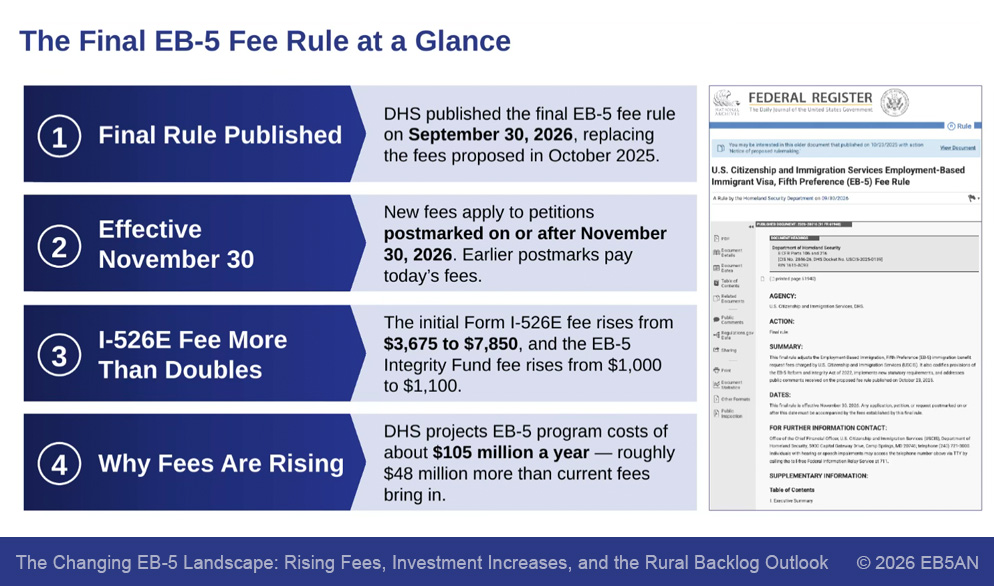
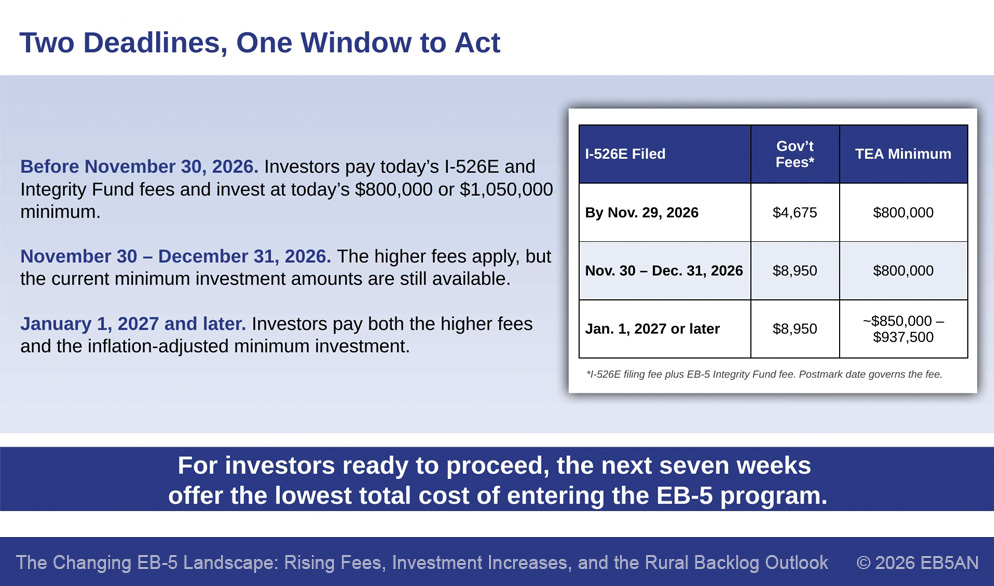
The final EB-5 fee rule raises the combined USCIS fees for Form I-526E from $4,675 to $8,950. That $4,275 increase consists of a higher Form I-526E fee and a separate increase to the EB-5 Integrity Fund fee. The new charges apply to petitions postmarked on or after November 30, 2026. The replacement schedule follows litigation that halted an earlier EB-5 fee increase over compliance with the RIA’s fee-study requirements.
| Government charge | Current amount |
From November 30, 2026 |
|---|---|---|
| Form I-526E | $3,675 | $7,850 |
| Separate Integrity Fund fee | $1,000 | $1,100 |
| Combined initial investor charges | $4,675 | $8,950 |
| Form I-829, filed later to remove conditions | $3,750 | $5,000 |
These amounts exclude the actual investment capital, project administrative fees, legal fees, and other immigration applications. Filing an I-526E petition before the increase also does not preserve the current fee for a future I-829 petition. That later filing will use the fee schedule applicable when it is submitted.
Regional centers face substantial increases as well. The initial Form I-956 regional center application rises from $17,795 to $44,115, while the Form I-956F project application rises from $17,795 to $42,675.
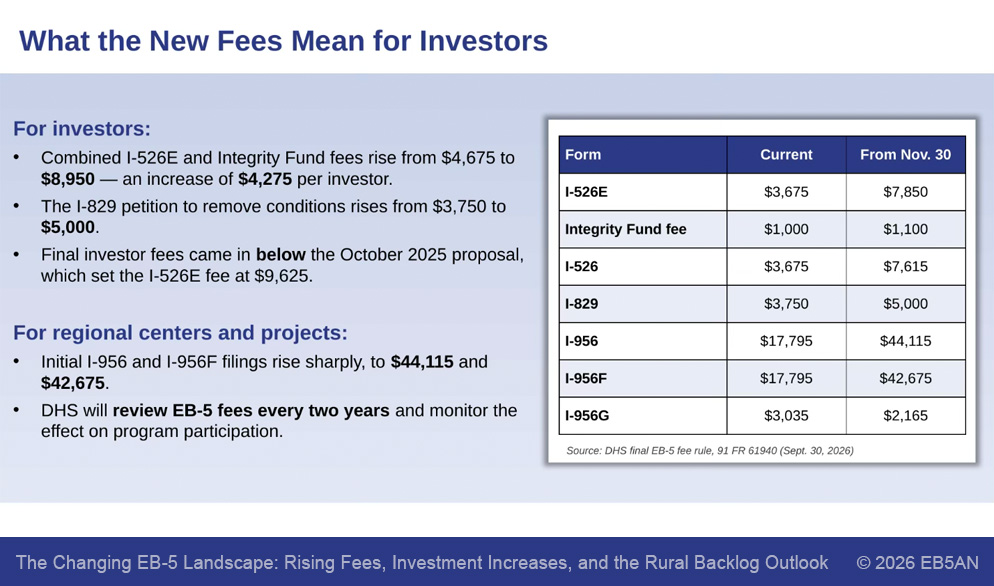
The increases therefore affect the cost of bringing new offerings to market as well as the investor’s own petition.
Higher Fees May Take Time to Improve Processing
USCIS relies largely on filing fees to fund its operations. Additional revenue could support more staff and resources at the Immigrant Investor Program Office. However, hiring and training take time, and the recent surge in filings adds to the workload those employees would need to address. Investors should allow for continued delays when assessing their expected EB-5 timeline.
It’s possible that EB-5 adjudication times will grow this fiscal year, despite higher fees.
The processing goals underlying the fee framework include 240 days for investor petitions generally and 120 days for targeted employment area investor petitions. For project applications, the goals are 180 days generally and 90 days for TEA projects. These are useful benchmarks, but they do not guarantee a decision within those periods. Substantial delays may warrant a conversation with counsel about mandamus litigation; passing a target date alone does not establish that a lawsuit will succeed.
Requests for evidence, notices of intent to deny, and contested issues can also cause delays. Therefore, preparing a strong I-526E filing remains especially important in an environment of closer scrutiny of I-526E and I-829 filings.
The January 1 Investment Adjustment Has a Larger Financial Impact
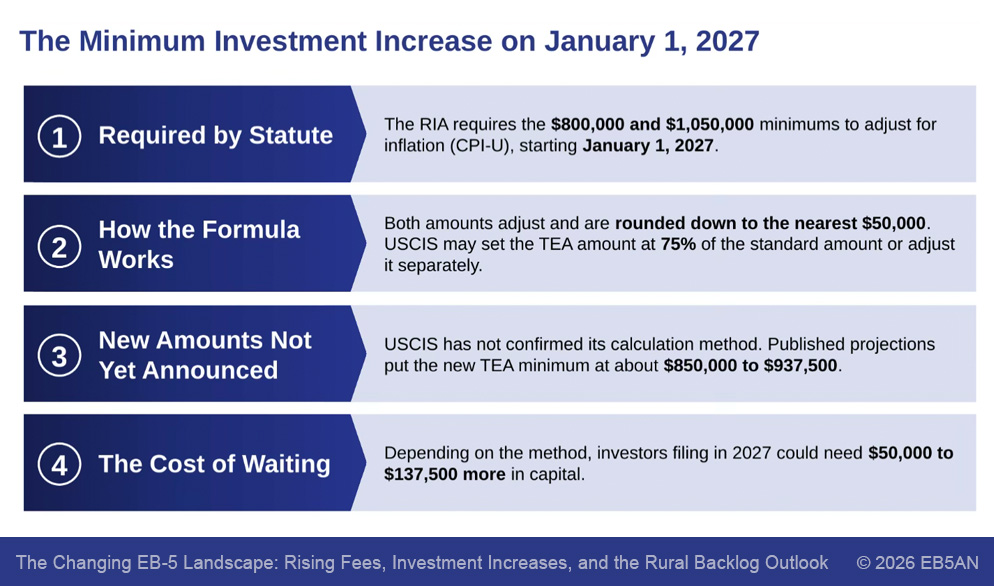
The scheduled increase in EB-5 investment amounts could have a much greater effect on an investor’s budget than the filing fee change. The Reform and Integrity Act requires an inflation adjustment beginning January 1, 2027. Today’s minimums are $800,000 for qualifying TEA or infrastructure investments and $1,050,000 for other investments.
The final adjusted amounts have not yet been announced. Published projections place the new TEA minimum between approximately $850,000 and $937,500, depending on the calculation method. That would require an additional $50,000 to $137,500 in investment capital.
For investors who want to file under today’s lower investment amounts, the time to act is now. Investors need to coordinate the investment and petition preparation so that a properly filed I-526E petition reaches USCIS before January 1.
A higher minimum also means more capital to document. Someone with sufficient wealth to invest $925,000 may still need additional records to establish the lawful origin and movement of the extra funds. Property sales, gifts, business distributions, and international transfers can each add work to the source-of-funds documentation.
The adjustment will also require regional centers to review their offerings. Subscription agreements, securities disclosures, and immigration filings may need amendments to reflect the new amount.
EB-5 investors beginning the process in January 2027 should expect to review updated documents from EB-5 projects rather than assume an existing $800,000 offering will continue on identical terms.
A Complete I-526E Filing Is More Beneficial Than a Last-Minute Submission
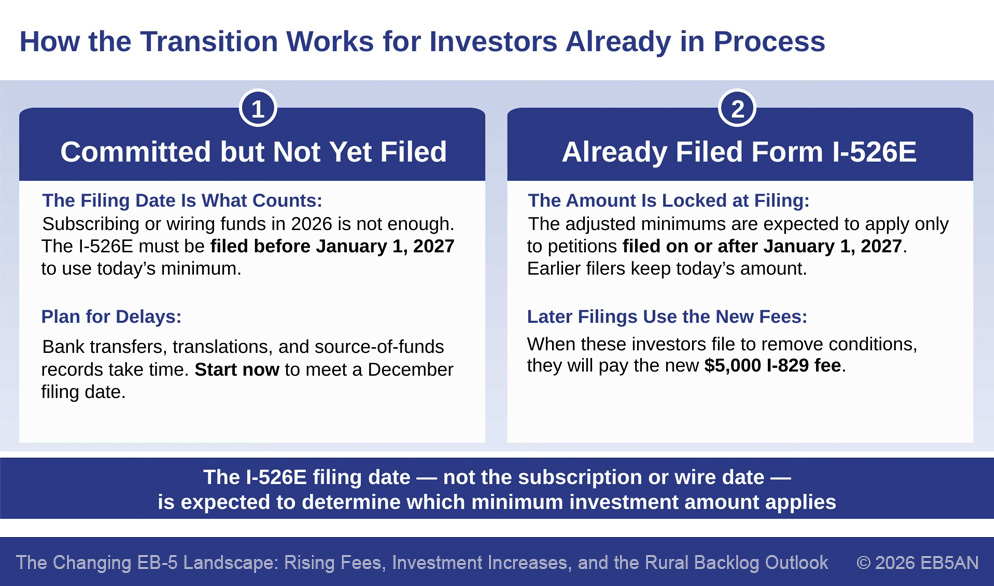
An investor who submits an incomplete I-526E petition shortly before year-end could face a costly problem if USCIS rejects it and the corrected filing occurs in January. A rejected I-526E petition generally does not retain a filing date. The later submission could therefore fall under the higher investment requirement, even if the investor had already transferred $800,000. Avoiding I-526E filing mistakes should be part of the filing plan from the outset.
The final review should cover signatures, fees, form responses, supporting evidence, and consistency across the submission. Blank answers and missing records can create questions about completeness or eligibility. Required tax records also need attention, including the seven-year documentation requirements under the RIA where applicable.
Your immigration attorney should address missing or unavailable documents before filing, with an explanation and appropriate supporting evidence.
Allow several weeks for final review and delivery whenever possible. A rejection may be issued quickly, but the investor and attorney still need to receive the notice, identify the problem, correct the package, and submit it again. Even a two-week cushion cannot guarantee enough time. Holiday schedules and delivery disruptions make the last week of December particularly difficult.
A rejection also differs from a denial after adjudication. There is generally no appeal of a rejection to the Administrative Appeals Office. An improperly rejected filing may be challenged in federal court, and counsel may consider requesting an earlier effective filing date through a nunc pro tunc submission. Still, neither approach offers a dependable way to recover the lower investment amount after the January 1, 2027, deadline.
Partial EB-5 investments can appeal to investors who cannot transfer the full amount before year-end. But a partial investment is risky in today’s EB-5 environment. Investing the full required capital before filing is the safer approach. Any arrangement for partial funding should receive a detailed legal review.
If a partial investment is used, the documentation should address the entire required amount. That includes the lawful source of the funds already invested, evidence that the remaining capital is available, documentation of its lawful source, and an irrevocable commitment to invest it. An expectation of earning or obtaining the balance later is not enough.
Rural I-526E Filings Have Grown Faster Than Adjudication Capacity
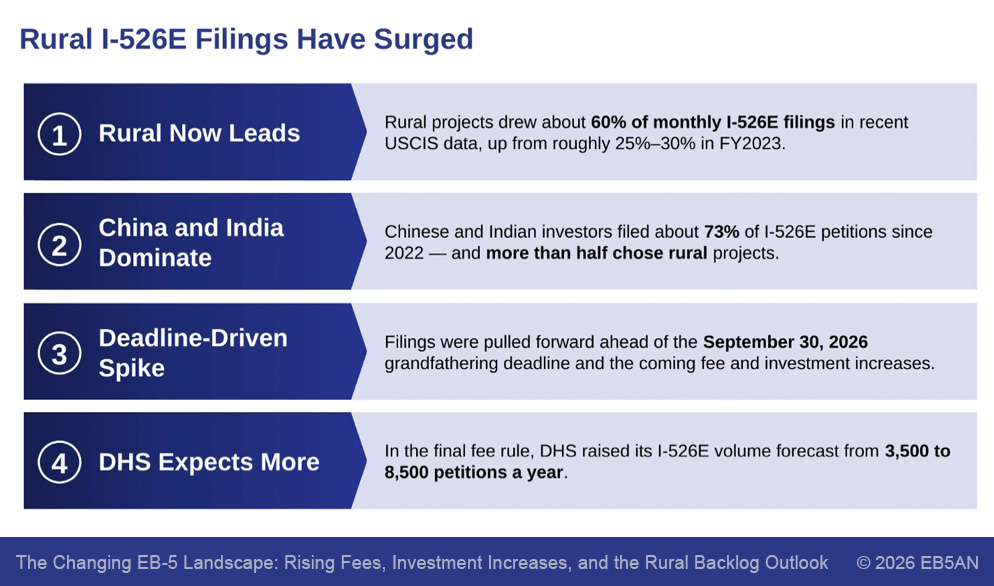
Rural projects have become a much larger part of EB-5 demand. Recent monthly data placed rural investments at roughly 60% of I-526E filings, compared with approximately 25% to 30% in fiscal year 2023. Rural priority processing helped drive that shift, and subsequent USCIS quarterly data also shows rural classifications accounting for the largest share of new investor filings.
USCIS data obtained through an AIIA Freedom of Information Act request provides a useful picture of the outstanding workload. Across post-RIA I-526 and I-526E petitions filed from April 2022 through May 31, 2026, 11,947 of 19,179 petitions remained pending—approximately 62% of the total.
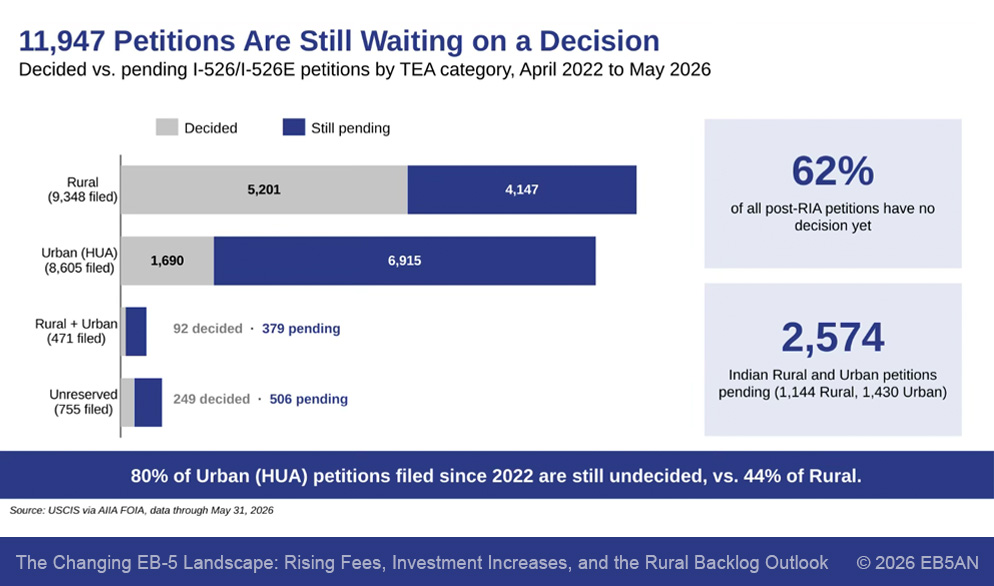
Approximately 80% of high unemployment petitions remained pending, compared with 44% of rural petitions. Those percentages show how differently the two categories have moved through adjudication.
Earlier approvals in three to six months are no longer the standard for rural filings.
The May cutoff for this data leaves out the summer filing wave preceding the September 30 grandfathering deadline. It also excludes any subsequent increase before the November fee change or January investment adjustment.
Therefore, we expect the volume of pending rural I-526Es to continue to grow.
Why Rural Could Face a Visa Backlog Before High Unemployment
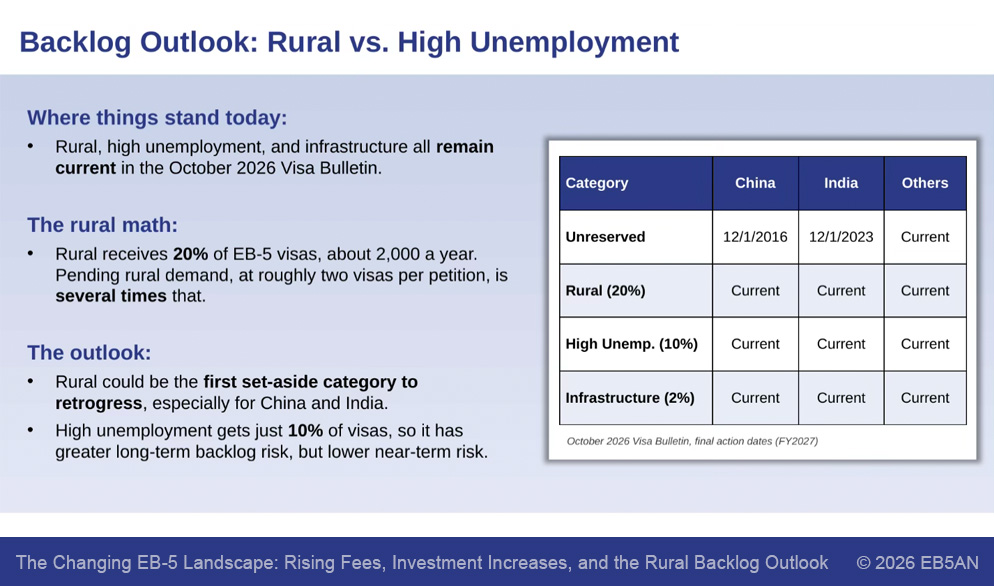
All reserved EB-5 categories (rural, high unemployment, and infrastructure) remain current for every country in the October 2026 Visa Bulletin. That means there is currently no priority-date cutoff in those categories. However, this does not mean there is no accumulated demand or that every pending investor can receive a Green Card immediately.
If I-526E adjudications remain slow, the reserved categories could remain current during fiscal year 2027 even with substantial pending inventory. Faster adjudications could result in an earlier backlog. Therefore, visa availability estimates need to account for this possibility.
Rural priority processing may produce more visa-ready applicants sooner, making rural likely to enter a backlog before high unemployment. That would not necessarily mean a new rural investor faces a longer overall wait than a high unemployment investor. A high unemployment petition could remain pending at USCIS while a rural petition receives I-526E approval and then waits for an available visa.
Any backlogs will also depend on visa supply for the rural and high unemployment categories. Rural receives 20% of annual EB-5 visas, while high unemployment receives 10%. On a roughly 10,000-visa annual baseline, those shares represent about 2,000 and 1,000 visas, before carryovers or other annual variations.
Spouses and children use up visa numbers too.
The smaller high unemployment visa supply could deplete that category quickly, even if its backlog appears later.
China and India Face the Greatest Backlog Risk
Chinese and Indian investors accounted for approximately 73% of post-RIA petitions in the data. India’s rural demand has also moved closer to China’s: from January through May 2026, Indian investors filed 560 rural petitions, compared with 645 from China.
This concentration makes the country of chargeability, generally based on birthplace, particularly important when assessing EB-5 adjudication times.
Investors from countries with lower demand generally face less immediate exposure to country-specific reserved backlogs. They still need to account for petition processing and the later Green Card stage. For Indian investors facing very long EB-2 or EB-3 waits, EB-5 may still remain attractive even if the timeline lengthens.
Waiting for a backlog announcement will not improve an EB-5 investor’s position. Filing your I-526E petition now establishes a priority date, which becomes particularly important when a category is oversubscribed. EB-5 investors who can file now should consider doing so before any backlogs approach.
Children’s Ages Can Affect Your Rural-versus-High Unemployment Decision
Under the Child Status Protection Act, a child’s immigration age in an employment-based case is generally calculated by subtracting the petition’s pending time from the child’s age when a visa becomes available.
Other requirements also apply, including generally seeking to acquire permanent residence within one year of visa availability.
A longer I-526E adjudication period can therefore help some children remain eligible when visa backlogs exist. In contrast, a faster I-526E approval may leave more time exposed to a subsequent visa wait. This makes investing in a high unemployment project potentially useful for some families with children.
Your immigration attorney should calculate the child’s position under different approval and visa-availability scenarios before recommending a project category.
Dual TEA Qualification May Be Useful
Some projects qualify as both rural and high unemployment. This can give investors access to two reserved categories, each with a separate visa allocation. If one develops a cutoff while the other remains current, dual TEA qualification may provide a valuable alternative without requiring a different underlying EB-5 project.
During consular processing, an investor with an approved I-526E petition may have an opportunity to select the applicable category at the National Visa Center stage.
But for concurrent adjustment of status cases, a dedicated USCIS procedure for changing between the two TEA categories has not been set out.
EB-5 Project Quality Is Still Crucial
As EB-5 processing times become less predictable, investors need to give equal attention to the return of their capital. A project’s rural or high unemployment designation—or dual qualification—does not establish its financial strength. An investor’s research should cover the developer’s experience, funding commitments, construction progress, job creation, investment terms, and realistic sources of repayment.
Ask for the documents needed to evaluate those claims. Relevant materials may include project financial statements, evidence of developer equity, loan agreements, collateral information, and the complete project filing package. Where a guaranty supports the EB-5 loan, the guarantor’s financial position and contractual obligations deserve close review.
A regional center’s repayment track record can inform that review, while each new offering still requires its own assessment.
Immigration processing, the required investment sustainment period, and the project’s contractual repayment schedule can also run on different timelines. Investors should understand when capital may be returned under both the immigration rules and the offering documents. A projected repayment date depends on the investment’s terms and financial performance.
Indeed, the repayment process is one of the most important factors in an EB-5 offering.
Preparing for the Remaining 2026 EB-5 Deadlines
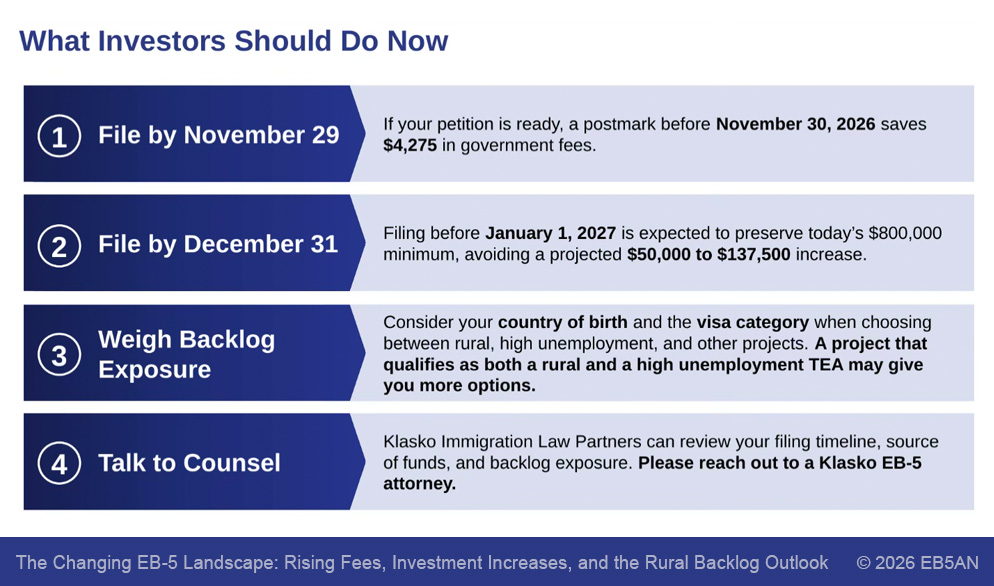
Start by retaining an experienced immigration attorney and crafting a realistic filing schedule for your I-526E submission. Identify the source of the full investment amount, collect records, trace transfers, and resolve documentation gaps. Review EB-5 projects in parallel once that work is underway.
The goal is to leave enough time to compare investments and complete legal review before the final submission, with room to address problems discovered along the way.
Investors able to file before November 30 can avoid the higher I-526E fees. Those filing from November 30 through December 31 will pay the higher fees while the current investment minimum remains available.
Beginning January 1, the inflation-adjusted minimum will apply as well. The savings can be substantial, but your I-526E’s quality and investment’s risk profile need to be considered as well.
Plan Your EB-5 Investment Before Costs Rise
EB-5 continues to offer one of the most direct paths to U.S. Green Cards, including for families facing difficult alternatives in other categories. The coming cost increases make early preparation worthwhile, while growing demand calls for realistic expectations about processing and visa availability.
Your EB-5 investment strategy should address both your family’s immigration needs and the investment’s financial prospects. To discuss available EB-5 projects and the next steps for your investment, schedule a free consultation with EB5AN.