

U.S. Citizenship and Immigration Services (USCIS) has finalized a new fee rule for the EB-5 Immigrant Investor Program. Starting November 30, 2026, the Form I-526 and I-526E petition fees will more than double, Integrity Fund fees will rise, and a new form will be available for certain investors who filed before 2022.
This post explains each fee change, why USCIS made it, and how it fits with the other EB-5 deadlines that matter for anyone planning an investment in the coming year.
New EB-5 Fees Take Effect November 30, 2026
New Form I-527 for Pre-2022 Investors
Updated I-829 Rules for Family Members
When Each Fee Is Paid in the EB-5 Process
Three EB-5 Dates to Track Over the Next 12 Months
- November 30, 2026: New Fees Begin
- January 1, 2027: Minimum Investment Adjusts for Inflation
- September 30, 2027: Regional Center Program Reauthorization Date
What These Changes Mean for Prospective Investors
New EB-5 Fees Take Effect November 30, 2026
The final rule was published in the Federal Register on September 30, 2026, and takes effect on November 30, 2026. Any EB-5 application, petition, or request postmarked on or after that date must include the new fee.
Investor Petition Fees
| Form | Current Fee | New Fee |
|---|---|---|
| I-526 (standalone investor) | $3,675 | $7,615 |
| I-526E (regional center investor, initial) | $3,675 | $7,850 |
| I-526E (amendment) | $3,675 | $7,775 |
| I-829 (removal of conditions) | $3,750 | $5,000 |
| I-527 (amendment to legacy I-526) | New form | $10,330 |
Regional center investors, including those in EB5AN projects, begin the process with Form I-526E, Petition by Regional Center Investor. Form I-829, Petition by Investor to Remove Conditions on Permanent Resident Status, comes later, near the end of the two-year conditional Green Card period. The new I-526 and initial I-526E amounts already include a $75 EB-5 technology fee, which the RIA allows USCIS to use for improvements to its case processing systems.
The rule does not set new fees for Form I-485 (the application to adjust status for investors already in the United States) or Form DS-260 (the immigrant visa application for investors processing abroad).
EB-5 Integrity Fund Fees
The EB-5 Reform and Integrity Act of 2022 (RIA) created the EB-5 Integrity Fund, which the law designates for compliance work, fraud investigation, audits, and site visits. The new rule raises all Integrity Fund fees by about 10% to reflect inflation from 2022 through 2025. For regional center investors, the fee paid with Form I-526E rises from $1,000 to $1,100. The rule also writes the RIA’s late-payment penalties for regional centers into USCIS regulations.
Regional Center and Project Fees
Investors do not pay these fees directly, but they raise the cost of sponsoring EB-5 projects. Form I-956, Application for Regional Center Designation, rises from $17,795 to $44,115. Form I-956F, Application for Approval of an Investment in a Commercial Enterprise, rises from $17,795 to $42,675. Some fees fall: a Form I-956 amendment drops to $9,835, and the Form I-956G annual statement drops from $3,035 to $2,165. Two filings that previously had no fee now carry one: Form I-956K, used to register promoters, will cost $2,165, and Form I-956H, the bona fides filing for people involved with a regional center, will cost $65.
New Form I-527 for Pre-2022 Investors
The rule creates Form I-527, Amendment to Legacy Form I-526, with a $10,330 filing fee. It is meant for certain investors who filed before the RIA took effect in 2022 and need to protect their eligibility after their regional center is terminated or their new commercial enterprise (the investment fund) or job-creating entity (the business that uses the capital) is debarred.
USCIS states that a Form I-527 filing will not count as a new immigrant petition, so these investors may keep their original priority date.
Updated I-829 Rules for Family Members
The final rule also clarifies how family members handle Form I-829. In specified circumstances, certain spouses, former spouses, and children may file their own Form I-829 petitions separately from the principal investor. Dependents may also continue pursuing removal of conditions if the principal investor does not file or has died, provided they meet the statutory requirements.
The filing deadline for these family members is still tied to the principal investor’s timeline: Form I-829 is generally due within the 90 days before the second anniversary of the investor obtaining conditional permanent residence. Families who may need to file separately should review their options with an immigration attorney before that window opens.
When Each Fee Is Paid in the EB-5 Process
EB-5 government fees are spread across the full process, and the new rule affects some stages more than others.
Stage 1: Form I-526E Petition
A regional center investor pays the Form I-526E filing fee, which now includes the $75 technology fee, plus the $1,100 Integrity Fund fee, when filing the initial petition. This is the stage with the largest increase under the new rule, and it is the fee most directly affected by the November 30, 2026 effective date.
Stage 2: Conditional Green Card
Investors in the United States file Form I-485 to adjust status, either with their Form I-526E or later, depending on visa availability. Investors outside the United States file Form DS-260, the immigrant visa application, instead. The new EB-5 rule does not change the fees for either form.
Stage 3: Form I-829 Petition
Within the 90 days before the second anniversary of obtaining conditional residence, the investor files Form I-829 to remove conditions and receive a permanent Green Card. That fee rises from $3,750 to $5,000. The fee that applies is the one in effect on the date the petition is postmarked.
Three EB-5 Dates to Track Over the Next 12 Months
Stage 3: Form I-829 Petition
Filings postmarked on or after this date pay the new fees. For a regional center investor, the Form I-526E fee alone rises by $4,175.
January 1, 2027: Minimum Investment Adjusts for Inflation
Today, the minimum EB-5 investment is $800,000 for TEA and qualifying infrastructure projects and $1,050,000 for other projects. Under the RIA, these amounts adjust automatically on January 1, 2027, based on cumulative consumer price inflation since January 1, 2022. The adjusted amounts apply to petitions filed on or after that date. Published projections of the new figures vary, and investors should rely only on the official USCIS amounts. EB5AN has covered how this adjustment is calculated.
September 30, 2027: Regional Center Program Reauthorization Date
The regional center program is authorized through September 30, 2027, unless Congress reauthorizes it. Investors filing now can still participate while the program is authorized.
What These Changes Mean for Prospective Investors
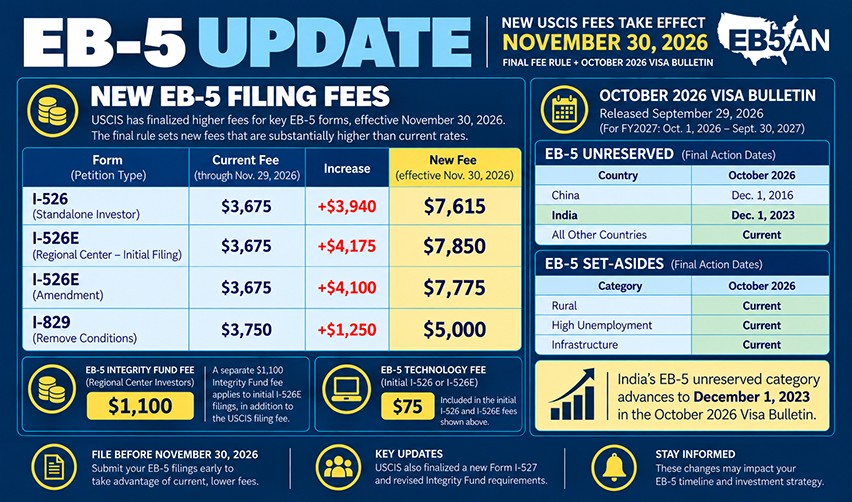
Two cost increases are coming within five weeks of each other. Filing before November 30, 2026, avoids the higher USCIS filing fees, and filing before January 1, 2027, preserves the current minimum investment amounts. The investment threshold is by far the larger of the two numbers.
The new fees also affect projects. Higher Form I-956F fees and formal late-payment penalties raise the cost of sponsoring and maintaining an EB-5 project. When comparing regional centers, investors can ask how long a sponsor has operated, whether its projects have received USCIS approval, and whether it has met its Integrity Fund and annual reporting obligations on time.
More than 3,000 families from over 70 countries have selected EB-5 projects sponsored by EB5AN regional centers. Our expert team has more than a decade of experience and offers clients high-quality, low-risk EB-5 regional center projects with a 100% USCIS project approval rate.
If you would like to know more about your EB-5 investment options, book a free call with our expert team today.