
For EB-5 investors, visa availability can matter as much as project quality. This is especially true for investors from countries like China and India, where demand for EB-5 visas is high. When demand exceeds the number of visas available, the visa category becomes backlogged. Such backlogs often add years to the immigration process.
EB-5 investors can often avoid these backlogs by investing in projects located in targeted employment areas (TEAs). Investing in TEA projects gives investors access to set-aside visas, also known as reserved visas. Because visa availability is such a major concern, most EB-5 projects offered today are in TEAs.
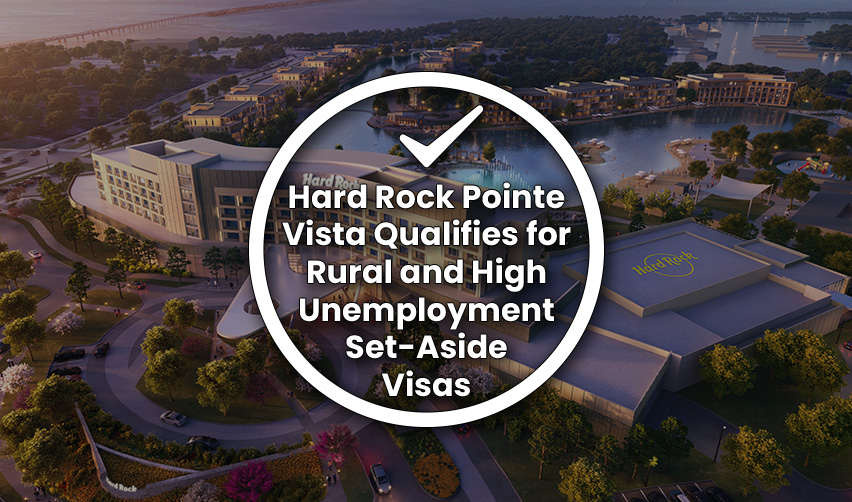
Hard Rock Pointe Vista goes a step further. The project site qualifies as both a rural TEA and a high unemployment TEA, giving its investors access to two reserved visa categories rather than one.
Below, we briefly explain how reserved EB-5 visas work and why dual TEA status is a meaningful advantage for Hard Rock Pointe Vista investors.
Understanding Reserved EB-5 Visas
Why Dual TEA Status Matters
Hard Rock Pointe Vista Offers More Than Dual TEA Status
Understanding Reserved EB-5 Visas
The EB-5 Reform and Integrity Act of 2022 created three reserved EB-5 visa categories. Nearly one-third of annual EB-5 visas are reserved:
- 20% for rural TEA projects.
- 10% for high unemployment TEA projects.
- 2% for infrastructure projects.
Each EB-5 category has its own pool of visas. As a result, one category can have visas available even when another is backlogged.
As of the September 2026 Visa Bulletin, the unreserved EB-5 visa category is backlogged for China and unavailable for India. All three reserved EB-5 categories, however, remain current for all countries, including China and India.
Why Dual TEA Status Matters
Most EB-5 projects qualify under only one TEA category. Hard Rock Pointe Vista’s dual qualification is uncommon, and it meaningfully expands investors’ visa options.
Dual TEA status gives investors access to two pools of reserved visas instead of one. If one category becomes backlogged for an investor’s country, the other may remain current. While dual qualification does not guarantee visa availability, it does reduce backlog risk. That added flexibility is likely to become more valuable as demand for reserved EB-5 visas grows.
Additionally, because Hard Rock Pointe Vista is in a rural TEA, its investors qualify for priority processing of their Form I-526E petitions. As a result, investors may benefit from faster adjudication times, and the project’s high unemployment designation provides a second reserved visa option.
Investors from China and India, who face existing backlogs in the unreserved EB-5 category, stand to benefit the most. For them, access to two reserved categories is especially valuable.
Hard Rock Pointe Vista Offers More Than Dual TEA Status
Hard Rock Pointe Vista is under development on Lake Texoma in southern Oklahoma, about 100 miles north of Dallas, Texas. The project includes a 217-key Hard Rock–branded hotel, 131 Hard Rock–branded condominiums, and a 10.3-acre “oasis” amenity called Caribbean Bay. The EB-5 fund will make a senior secured loan to help finance project costs.
The project has already reached several milestones that reduce both financial and immigration risk:
- USCIS has approved the project’s Form I-956F.
- Construction is underway.
- More than 480 qualifying EB-5 jobs have been created.
The Hard Rock Pointe Vista EB-5 project also offers best-in-class features, including several guaranties, designed to protect EB-5 investors. Dual TEA status further sets the project apart by reducing visa backlog risk.
To learn more about Hard Rock Pointe Vista and how its dual TEA status may benefit you, schedule a free consultation with our team today.