

USCIS has released EB-5 petition data for FY2026 Q2, covering January 1, 2026, through March 31, 2026. The numbers give investors a clearer picture of how EB-5 demand, adjudications, and pending petition inventory are developing as the September 2026 grandfathering deadline approaches.
The data shows that EB-5 demand remains strong. Rural projects, which qualify for priority processing from USCIS, continued to attract the largest share of new filings.
In FY2026 Q2, USCIS received 1,699 Form I-526E petitions from regional center investors and 73 Form I-526 petitions from standalone direct investors. Together, these filings added up to 1,772 new investor petition receipts for the quarter.
During the same period, USCIS completed 980 I-526E adjudications, with 781 approvals and 199 denials. By the end of the quarter, the pending I-526E inventory had grown to 10,453 petitions, with another 776 standalone I-526 petitions still pending.
With a consistently strong demand for the EB-5 visa, the most important consideration for new investors is timing. New filings continue to arrive faster than USCIS is clearing the post-RIA pool of pending I-526E petitions. Rural investors qualify for priority processing, but the aggregate quarterly data does not establish a rural-specific processing time.
Even so, the September 30, 2026, grandfathering deadline is only weeks away. Project category, source-of-funds preparation, and project quality remain important for every new I-526E filing. Filing on or before that date preserves statutory protection if regional center program authorization expires; it does not guarantee approval or eliminate visa waiting times.
I-526E Demand Remains High Even Without a New Filing Spike
Rural Has Become the Leading EB-5 Filing Category
India Remains Close to China in New EB-5 Demand
USCIS Is Approving Many I-526E Petitions, but Denials Are Now More Visible
Project-Level Approval Remains a Major Factor
Direct EB-5 and Pre-RIA Filings
I-829 Processing Remains a Positive Sign for Investors With Strong Projects
Investors Should Focus on Preparing a Strong I-526E Filing Before September 30, 2026
I-526E Demand Remains High Even Without a New Filing Spike
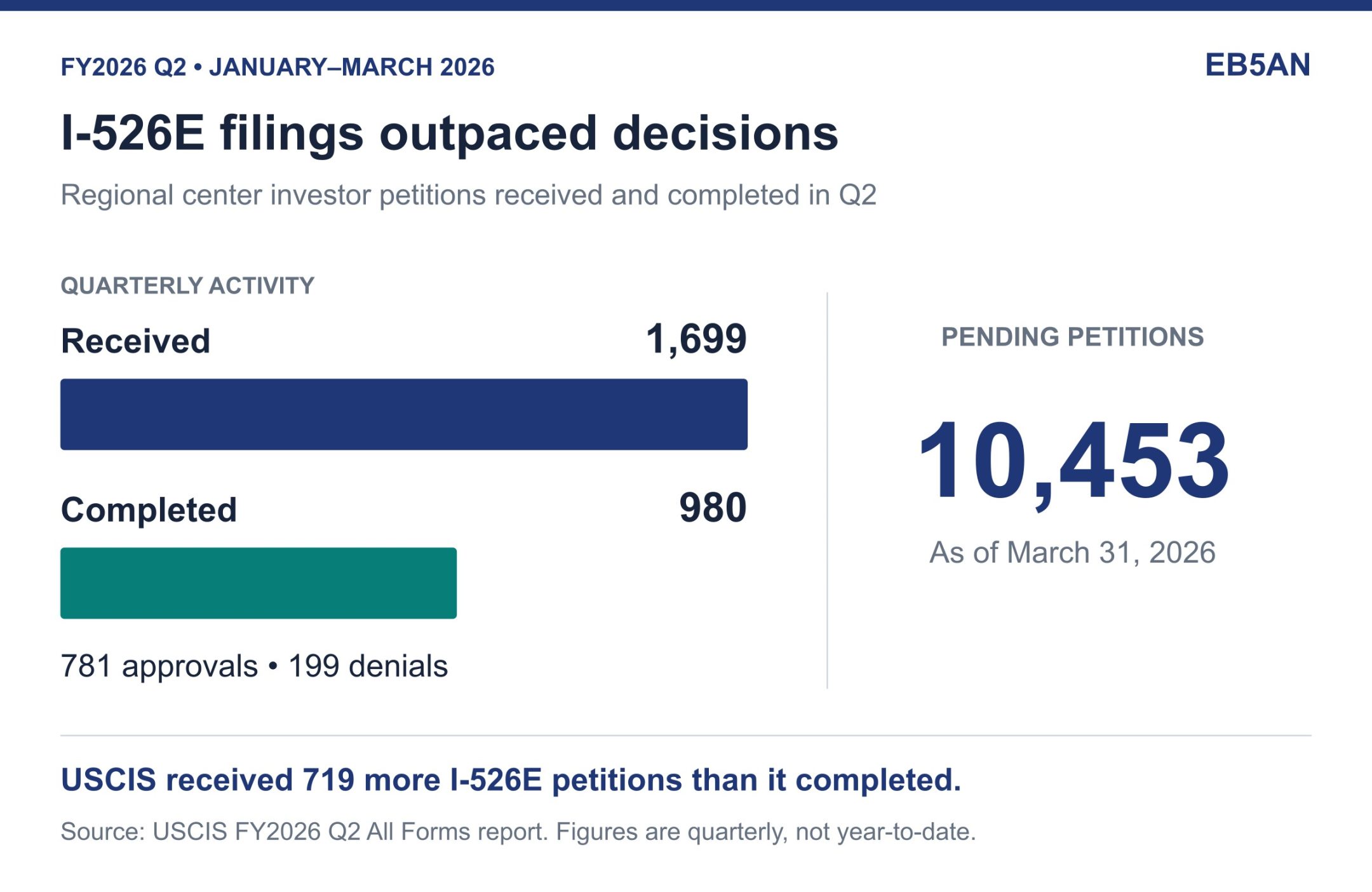
FY2026 Q2 brought steady I-526E demand rather than a pronounced filing surge. USCIS received 1,699 regional center investor petitions, compared with 1,688 in Q1 as revised in the Q2 release—an increase of less than 1%. Elevated EB-5 filing activity remains part of the program’s operating environment.
USCIS received 1,699 I-526E petitions in FY2026 Q2. During the same period, USCIS completed 980 I-526E adjudications. Receipts exceeded completions by 719, while the reported pending I-526E inventory reached 10,453. USCIS cautions that pending totals cannot always be reconciled using receipts and completions alone.
Investors should be aware of this growing repository of pending petitions. A Visa Bulletin category can remain current while pressure is still building beneath the surface. Petition volume, approval volume, and future visa demand do not always appear in the Visa Bulletin immediately.
The set-aside visa categories may remain current on the Visa Bulletin, while demand is accumulating in the petition pipeline. By the time a cutoff date appears, many investors may already be behind those who filed earlier.
This makes it especially important for Chinese and Indian nationals to file Form I-526E promptly before any backlogs materialize.
Rural Has Become the Leading EB-5 Filing Category
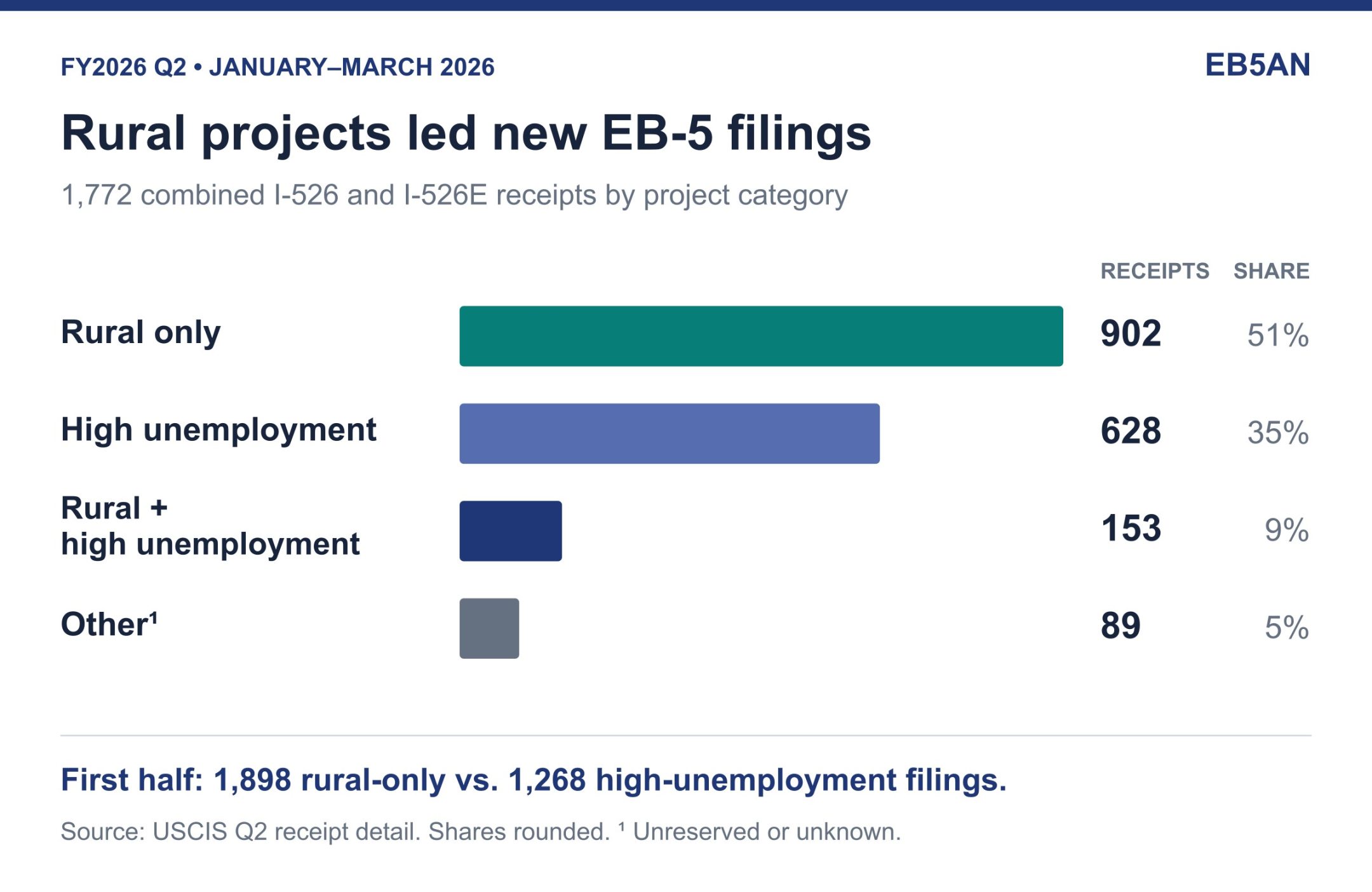
The new data shows that rural EB-5 projects continued to attract the largest share of filings in Q2.
In FY2026 Q2, 902 I-526/I-526E receipts were classified as rural area only. That represented 51% of total receipts for the quarter. High-unemployment area projects accounted for 628 receipts, or 35%. Another 153 receipts, or 9%, were classified as both rural and high-unemployment area. The remaining 89 receipts, or 5%, were unreserved or unknown. Percentages are rounded.
The first-half numbers show the same pattern. From October 2025 through March 2026, USCIS recorded 3,559 I-526/I-526E receipts. Of these, 1,898 were rural-only, or 53%, while 1,268 were high-unemployment area only, or 36%. Another 244 receipts, or 7%, were classified as both. Rural-only filings led high-unemployment-only filings by 630.
That is a major change from the early days of the RIA. At first, many investors and regional centers were more familiar with urban high-unemployment projects. Rural offerings were less common, and many investors were still learning how the new reserved visa categories would work. Over time, rural projects became more attractive because they are eligible for priority processing and because investors began seeing faster I-526E approvals in rural offerings.
Rural is no longer a narrow part of the EB-5 market. It is now the leading category for new filings.
That does not mean every investor should choose a rural project automatically. Rural priority processing is a major immigration advantage, but project quality still has to come first. Investors still need to evaluate job creation, capital structure, repayment terms, developer experience, financial transparency, and regional center oversight. A weak rural project does not become a strong EB-5 investment simply because it qualifies as rural.
For investors focused on I-526E adjudication speed, however, the market’s direction is clear. Rural projects continue to attract the largest share of new filings.
For Chinese and Indian nationals, rural priority processing can be an important advantage, although the time to a U.S. Green Card also depends on visa availability and the investor’s individual case.
India Remains Close to China in New EB-5 Demand
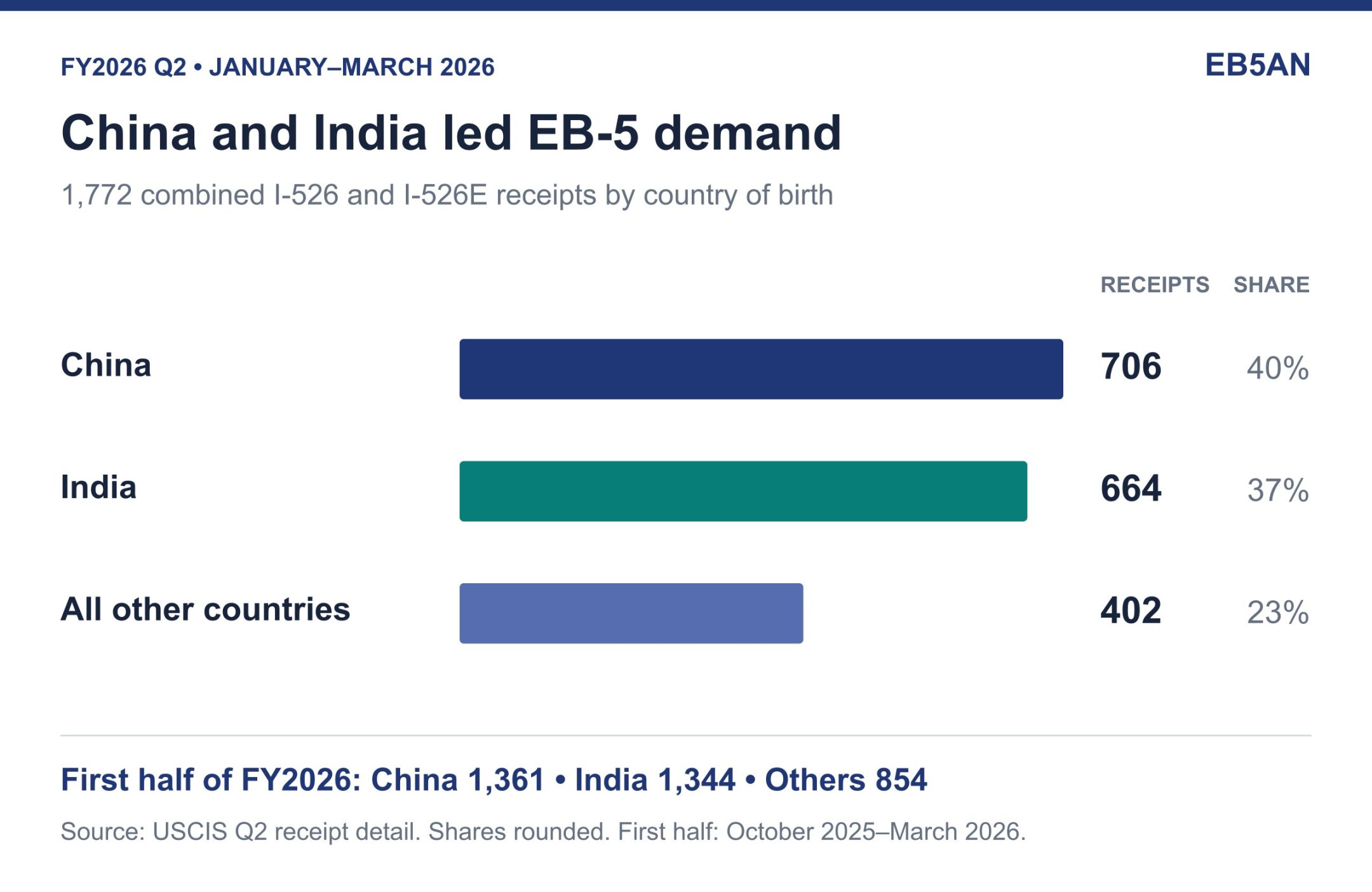
The country-level numbers are just as notable.
In FY2026 Q2, investors born in India accounted for 664 I-526/I-526E receipts, or 37% of the quarter’s total. Investors born in China accounted for 706 receipts, or 40%. All other countries combined accounted for 402 receipts, or 23%.
China and India were also close in total filings during the first half of FY2026. From October 2025 through March 2026, China accounted for 1,361 receipts, or 38% of the total. India accounted for 1,344 receipts, also about 38%, while all other countries combined accounted for 854 receipts, or 24%.
The quarterly data shows that India remains one of the largest sources of new EB-5 demand, although China led in Q2. Many Indian nationals living in the United States on H-1B, F-1, L-1, or other temporary visas are looking for a more stable path to permanent residence. For many of these investors, EB-5 is attractive because it does not depend on employer sponsorship or the H-1B lottery, although EB-5 remains subject to visa limits and potential waiting periods.
The September 2026 Visa Bulletin highlights this issue. India is unavailable in the EB-5 unreserved category for the remainder of FY2026, while all EB-5 set-aside categories—rural, high-unemployment, and infrastructure—remain current for all countries. The Visa Bulletin also explains that 32% of annual EB-5 visa numbers are reserved for set-asides: 20% for rural, 10% for high-unemployment, and 2% for infrastructure.
For Indian investors, this creates a sharp distinction between unreserved EB-5 and reserved EB-5. The unreserved category is already showing the effects of high demand. The set-aside categories remain current for now, but the new filing data shows why investors should be careful about assuming that this availability will last indefinitely.
USCIS Is Approving Many I-526E Petitions, but Denials Are Now More Visible
The FY2026 Q2 data also shows that I-526E denials are becoming more visible in the post-RIA adjudication environment.
USCIS completed 980 I-526E adjudications during the quarter. Of those, 781 were approvals and 199 were denials. Denials represented about 20% of completed I-526E adjudications in FY2026 Q2. The reported median processing time was 11.7 months for cases completed during the quarter; this is not a forecast for a new filing.
These figures show that denials are a material part of post-RIA I-526E adjudications. The aggregate report does not identify denial reasons or establish that USCIS has changed its scrutiny of source of funds or personal background.
This shows how important it is for EB-5 investors to retain an experienced immigration attorney and prepare a strong I-526E filing.
A strong I-526E petition usually depends on two separate sections. The investor’s personal source-of-funds documentation must be complete, consistent, and well organized. At the same time, the project and regional center must provide credible documentation on job creation, capital structure, securities compliance, and project eligibility.
Many investors spend most of their time comparing projects and begin source-of-funds work too late. That can create problems. Source-of-funds packages often take weeks or months to prepare, especially when funds come from business income, gifts, loans, property sales, or multiple bank accounts. We advise investors to retain an immigration attorney early, begin source-of-funds work immediately, and then evaluate projects.
Project-Level Approval Remains a Major Factor
The FY2026 Q2 data also includes new numbers for Form I-956F, the project approval application for regional center investments.
USCIS received 91 I-956F applications during the quarter. It approved 47, denied 12, and completed 59. The pending I-956F inventory stood at 186, and the reported median processing time was 8.1 months.
These numbers matter because Form I-956F approval can affect investor timelines. USCIS cannot approve an investor’s I-526E petition until the project’s I-956F has been adjudicated.
A project’s I-956F approval can directly affect how quickly investors receive their I-526E approvals and subsequent Green Cards.
For investors, project selection should include a close review of I-956F status. A project with an existing I-956F approval offers more safety than a project still awaiting USCIS review. If a project does not yet have I-956F approval, investors should understand the expected timeline, the documentation supporting the filing, and the regional center’s experience with prior project approvals.
The I-956F denial number also deserves attention. USCIS denied 12 I-956F applications in FY2026 Q2. The report does not explain the reasons for those denials, reinforcing the importance of reviewing each project’s documentation and approval status.
Direct EB-5 and Pre-RIA Filings
The new data also shows how heavily the EB-5 market now depends on regional center filings.
In FY2026 Q2, USCIS received 73 direct, or standalone, Form I-526 petitions. During the same quarter, it completed only 23 standalone I-526 adjudications: 11 approvals and 12 denials. The standalone I-526 pending inventory ended the quarter at 776, and the reported median processing time was 23.7 months.
This is a very small processing volume compared with regional center I-526E activity. It also shows that direct EB-5 investors may face a different adjudication environment than regional center investors. Direct EB-5 can still work for certain investors who want to operate or closely control a job-creating business. But the data suggests that direct petitions are not receiving the same level of processing attention as regional center I-526E petitions.
For most investors seeking a passive immigration investment, the regional center model remains the best path. Regional center projects also allow investors to rely on indirect and induced job creation through economic modeling, which can make the I-526E petition easier to approve.
The pre-RIA legacy I-526 numbers show another contrast.
In FY2026 Q2, USCIS completed only 72 legacy I-526 adjudications. Of these, 15 were approvals and 57 were denials. The reported median processing time was 94.1 months, and 1,030 legacy I-526 petitions remained pending at the end of the quarter.
These legacy cases should not be used as the main benchmark for post-RIA rural I-526E investors. They come from a different legal and market environment. Many are extremely old. Some may involve projects or investors affected by long delays, program lapses, changing policy, or outdated documentation.
The legacy data still provides useful context. It shows why the EB-5 Reform and Integrity Act of 2022 changed the EB-5 market so significantly. Investors no longer evaluate EB-5 only through the old pre-RIA backlog. Rural priority processing, reserved visa categories, concurrent filing, and project-level filings have created a different structure for new investors.
I-829 Processing Remains a Positive Sign for Investors With Strong Projects
Form I-829 is filed near the end of an investor’s two-year conditional residency period to remove conditions from the Green Card. In FY2026 Q2, USCIS received 1,136 I-829 petitions and completed 806. Of those completions, 742 were approvals and 64 were denials. The pending I-829 inventory stood at 7,171, and the reported median processing time was 10.9 months.
USCIS continued to process a meaningful number of I-829 petitions, with approvals representing about 92% of completions. However, completions fell from 1,005 in Q1 to 806 in Q2. For investors, the data is a useful reminder that EB-5 does not end with I-526E approval or even conditional permanent residence. The final immigration goal is removal of conditions and permanent Green Cards for the investor and eligible family members.
At the I-829 stage, job creation is the key requirement. Investors must show that the required jobs were created, or that they can be expected to be created within the required timeframe under applicable rules. This is why job creation should be reviewed before investing, not after I-526E approval.
A project with a large job cushion can give investors more protection from construction delays, cost changes, sales volatility, or other business developments.
Investors Should Focus on Preparing a Strong I-526E Filing Before September 30, 2026
The new FY2026 Q2 data does not point to a single answer for every investor. Rural projects may offer faster I-526E adjudication, but rural demand also remains substantial. Urban high-unemployment projects may still make sense for certain investors, especially those from lower-demand countries or who have a clear path to adjustment of status.
The right strategy depends on the investor’s country of birth, U.S. immigration status, family goals, timing needs, source-of-funds complexity, and risk tolerance.
Overall, EB-5 demand remains strong. Rural-only projects led new filings in Q2, while India and China remained the largest country markets. USCIS completed fewer I-526E petitions than it received, and pending inventory exceeded 10,000. The set-aside categories remain current in the September 2026 Visa Bulletin, even as petition demand points toward future pressure.
As the September 30, 2026, deadline draws near, time is limited to prepare and file a strong I-526E petition with the benefit of statutory grandfathering protection.
To evaluate your current EB-5 opportunities and determine whether a rural or high-unemployment project is better suited to your immigration goals, we invite you to schedule a free consultation with EB5AN.