

No EB-5 investment is risk free. United States immigration law requires every investor’s capital to remain “at risk,” so no project can guarantee the return of your money. Some EB-5 investments, however, carry far less risk than others.
This article explains which types of EB-5 investments are generally considered the safest: the two kinds of risk every investor faces, the structures and locations that reduce each one, and the timing factors that matter in 2026.
The Two Risks Every EB-5 Investor Faces
Regional Center Investments With Indirect Job Counting
Rural TEA Projects With Reserved Visas
Loan-Model Investments With a Senior Secured Position
Projects With Jobs Already Created or Construction Underway
Structural Protections That Reduce Risk Further
Why Filing Before September 30, 2026, Matters
How to Compare Projects on Safety
The Two Risks Every EB-5 Investor Faces
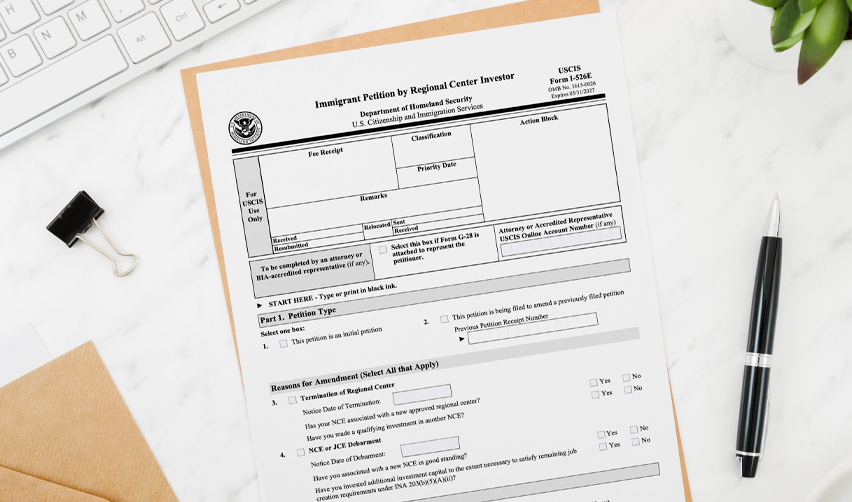
The first is immigration risk: the risk that you and your family do not receive Green Cards. This depends on whether U.S. Citizenship and Immigration Services (USCIS) approves your Form I-526E (the initial petition for regional center investors), whether the project creates the required 10 full-time jobs per investor, and whether a visa number is available for your country of birth.
The second is financial risk: the risk that you do not get your capital back. This depends on the project, the developer, and the position your investment holds in the capital structure.
The safest EB-5 investments reduce both risks together.
Regional Center Investments With Indirect Job Counting
Congress created two paths: direct investment and investment through a USCIS-designated regional center. For most investors, the regional center path is safer on the immigration side.
The reason is job counting. A direct investor must create 10 full-time W-2 positions within their own business. A regional center investor can count direct, indirect, and induced jobs calculated through USCIS-accepted economic models based on project spending. A large construction project routinely generates far more jobs under these models than its investors need, creating a job cushion. If a project forecasts more than 10 jobs per investor, job creation, a common reason petitions fail at the Form I-829 stage (the petition to remove conditions on the Green Card), is very unlikely to be the problem.
When reviewing a project, ask for the job creation study and check how many jobs come from construction spending alone rather than from future revenue, which is less certain.
Rural TEA Projects With Reserved Visas
A targeted employment area (TEA) is a location that qualifies for the reduced $800,000 minimum investment, compared with $1,050,000 for a standard project. There are two TEA types: rural areas, and high-unemployment (urban) areas where unemployment is at least 150% of the national average.
The EB-5 Reform and Integrity Act of 2022 (RIA) reserves a portion of all EB-5 visas each year: 20% for rural projects, 10% for high-unemployment projects, and 2% for qualifying infrastructure projects. These reserved categories have their own visa queues.
That structure matters enormously in 2026. In a recent Visa Bulletin, the unreserved EB-5 category became unavailable for India for the rest of the fiscal year, while the unreserved category for China still carries a cutoff date in 2016. Every reserved category remains current for every country, including India and China. For an investor born in a backlogged country, a reserved-category project is the difference between waiting years for a visa number and having one available now.
Rural projects carry an additional advantage: USCIS is required to prioritize rural petitions, and rural I-526E filings have generally moved faster than other categories since the RIA took effect. For investors already in the United States in a valid status, current visa availability also supports concurrent filing of an adjustment of status (AOS) application, with work authorization and travel permission while the case is pending.
Loan-Model Investments With a Senior Secured Position
On the financial side, the safest common structure is the loan model. Here, the new commercial enterprise (the EB-5 fund you invest in) lends the pooled capital to the project developer rather than taking an ownership stake. Loans sit above equity in the capital structure, so lenders are repaid before owners receive anything.
Within loan-model projects, the details determine the actual level of safety. Ask whether the EB-5 loan is senior debt, repaid first and typically secured by a mortgage on the project real estate, or mezzanine debt, which ranks behind it. Ask what the collateral is worth relative to the loan, what share of the total budget EB-5 capital represents, and whether the developer guarantees completion. A senior secured loan to an experienced developer who has committed significant equity of their own is the most conservative financial position available in EB-5.
Projects With Jobs Already Created or Construction Underway
Timing within a project’s life also affects safety. A project already under construction, or one that has already created all required jobs through documented spending, removes much of the uncertainty from your petition. The jobs are no longer a forecast; they are a fact supported by expenditure records.
Earlier investor I-526E approvals in the same offering add further comfort: they are one of the strongest signals that the project’s structure and paperwork are sound.
Structural Protections That Reduce Risk Further
The RIA introduced mandatory safeguards for all regional center projects, including fund administration or audit requirements, annual compliance filings, and an EB-5 Integrity Fund that pays for oversight. The safest projects add protections of their own: an I-526E denial repayment guarantee that returns your capital if USCIS denies your petition, escrow arrangements that hold funds until defined milestones are met, and full disclosure of the budget and loan documents for your attorney to review.
Why Filing Before September 30, 2026, Matters

The regional center program is authorized through September 30, 2027, but the RIA’s grandfathering protection applies only to petitions filed on or before September 30, 2026. A petition filed by that date must continue to be processed by USCIS even if Congress later allows the program to lapse. A petition filed after that date carries no such protection.
Filing before the deadline also locks in the current $800,000 TEA minimum. The RIA schedules inflation adjustments, with an expected one to be due in January 2027. The same investment, in the same project, is legally better protected if the petition is filed before September 30, 2026.
How to Compare Projects on Safety
The safest EB-5 investment available today generally looks like this: a rural TEA project sponsored by an established regional center, structured as a senior secured loan, with substantial developer equity, a large job cushion, prior investor approvals, an I-526E denial repayment guarantee, and a petition filed before September 30, 2026.
Few projects check every box, and safety involves trade-offs against return and timeline. Review offering documents with an experienced immigration attorney, and treat any project that resists full disclosure as disqualified.
More than 3,000 families from over 70 countries have selected EB-5 projects sponsored by EB5AN regional centers. Our expert team has more than a decade of experience and offers clients high-quality, low-risk EB-5 regional center projects with a 100% USCIS project approval rate.
If you would like to know more about your EB-5 investment options, book a free call with our expert team today.