
For many EB-5 investors already living in the United States, a permanent U.S. Green Card is no longer their only goal. It is also whether they can file for adjustment of status, apply for work and travel documents, and begin the Green Card process from inside the United States.
The released I-485 data gives investors a clearer picture of how many EB-5 applicants are already using this petition to adjust status. The numbers show strong overall EB-5 visa usage, thousands of pending EB-5 adjustment applications, and heavy participation from Indian nationals, especially in the rural set-aside category.
This does not mean every EB-5 investor in the United States can file Form I-485, Application to Register Permanent Residence or Adjust Status. Eligibility for adjustment of status depends on the investor’s immigration history, current status, country of chargeability, visa availability, and many other factors.
But the data confirms that adjustment of status has become one of the main practical advantages of EB-5 for investors—especially those who are already in the United States on visas such as H-1B or L-1.
For these investors, the right filing strategy can help them stay in the United States while their EB-5 case is pending, apply for work and travel authorization, and reduce their dependence on a temporary employment-based visa.
(The data analyzed in this article was sourced from the Office of Homeland Security Statistics and USCIS.)
USCIS AOS Policy Has Put I-485 Trends at the Center of EB-5 Planning
I-485 Filing Data Analysis: Adjustment of Status Is A Major Benefit For EB-5 Investors
A Significant Volume of Pending I-485 Submissions
Indian Nationals Are a Major Part of Current EB-5 AOS Demand
Recent Employment-Based I-485 Data Remains Strong
Why AOS Can Be Valuable for H-1B and L-1 Visa Holders
AOS Eligibility Requires a Legal Review
EB-5 Project Selection Remains Crucial
Waiting Can Reduce the Value of AOS
How U.S.-Based EB-5 Investors Should Move Forward
AOS Remains a Major Benefit for EB-5 Investors
USCIS AOS Policy Has Put I-485 Trends at the Center of EB-5 Planning
The latest I-485 numbers are also worth reviewing because adjustment of status has become a more closely watched issue under the Trump administration’s 2026 immigration policies.
On May 21, 2026, USCIS issued a policy memorandum describing adjustment of status as a discretionary form of relief rather than an automatic benefit. The memo does not eliminate Form I-485. It does not change the basic statutory rule that eligible applicants may seek adjustment of status from inside the United States when an immigrant visa is available. It also does not target EB-5 investors specifically.
But it does restrict who can apply for adjustment of status through Form I-485.
USCIS officers are now being directed to look more closely at whether an applicant merits a favorable exercise of discretion. In practice, this may mean greater attention to the investor’s immigration history, conduct after entering the United States, maintenance of status, timing of immigrant intent, family circumstances, employment record, and reasons for pursuing adjustment of status instead of consular processing.
This is especially true for investors in the United States on nonimmigrant visas. Some visa categories, such as F-1, E-2, TN, B-1/B-2, and other nonimmigrant-intent classifications, may face more difficult questions about when the applicant decided to immigrate and whether adjustment is appropriate. By contrast, H-1B and L-1 are dual-intent visa categories, meaning they are generally more compatible with pursuing permanent residence while maintaining temporary status.
Still, H-1B or L-1 status does not guarantee approval of Form I-485. USCIS will still consider the full facts of the case.
The decision to file Form I-485, pursue consular processing, maintain H-1B or L-1 status, travel internationally, or rely on work and travel authorization should be made with experienced immigration counsel.
The current policy environment has made one point clear: investors who are already in the United States need to understand both their legal eligibility for AOS and the broader adjudication trends affecting I-485 applications.
I-485 Filing Data Analysis: Adjustment of Status Is A Major Benefit For EB-5 Investors
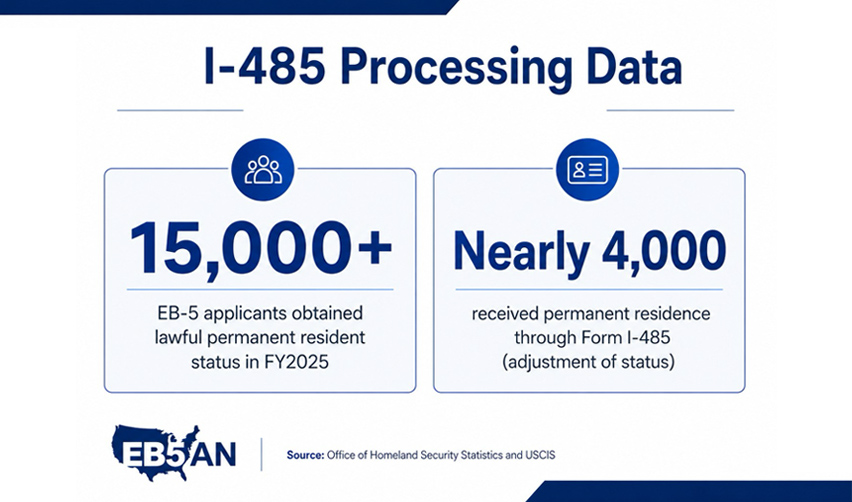
In FY2025, more than 15,000 EB-5 applicants obtained lawful permanent resident status. Of that total, nearly 4,000 received that permanent residence through Form I-485 rather than through consular processing abroad.
That is a large share of the EB-5 market. It shows that investors already inside the United States are not a small secondary group. They are a major part of current EB-5 demand.
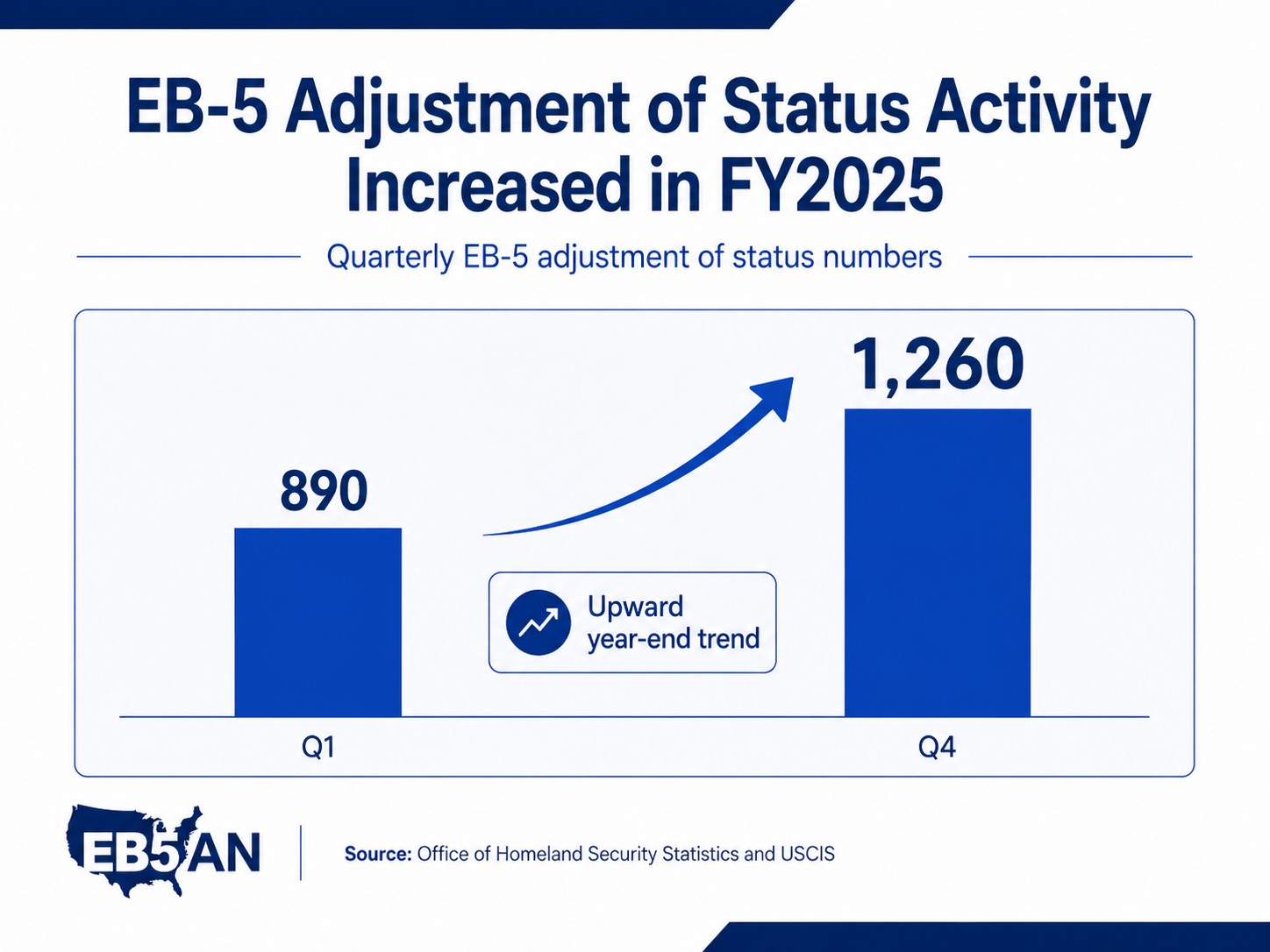
The quarterly data also shows that adjustment of status remained active throughout FY2025. EB-5 adjustment of status numbers rose from 890 in the first quarter to 1,260 in the fourth quarter. This year-end increase fits a familiar pattern: when consular visa use does not absorb all available numbers, adjustment of status can help use visas before the end of the fiscal year.
An investor outside the United States typically moves through consular processing abroad after the I-526E petition is approved and a visa is available. But an investor already in the United States may be able to file Form I-485, either concurrently with Form I-526E or after the I-526E filing, if a visa is immediately available. That can allow the investor and eligible family members to remain in the United States while the Green Card process moves forward.
That difference can be especially valuable for families with children in U.S. schools, workers tied to an H-1B employer, or executives in the United States on L-1 visas.
A Significant Volume of Pending I-485 Submissions
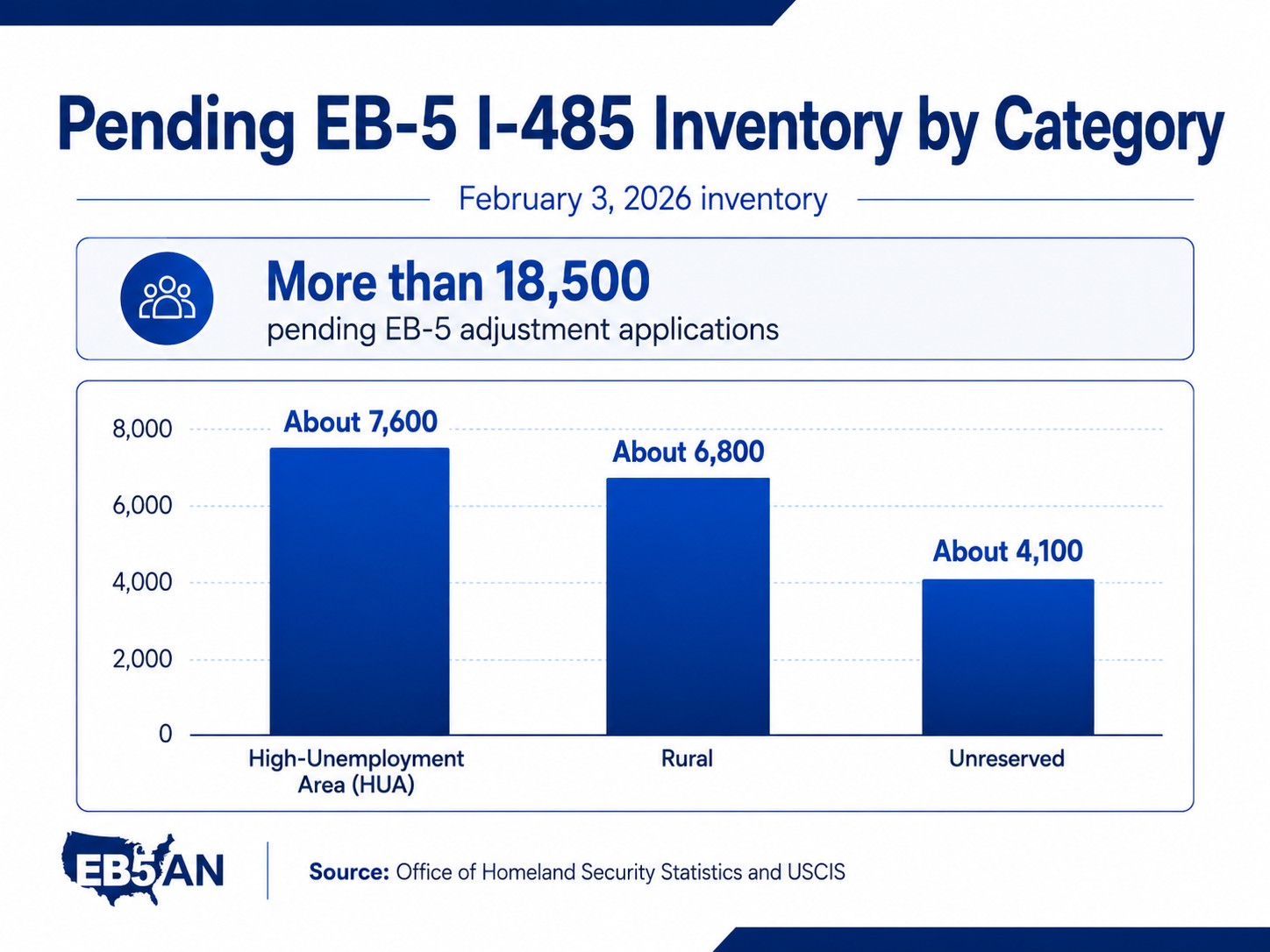
The February 3, 2026 I-485 inventory shows more than 18,500 pending EB-5 adjustment applications. This is the clearest sign that a large group of EB-5 investors and family members are depending on adjustment of status as their path to conditional Green Cards.
The pending inventory is spread across multiple EB-5 categories. The high-unemployment-area set-aside category had about 7,600 pending EB-5 I-485 applications. The rural set-aside category had about 6,800. The unreserved category had about 4,100.
These figures matter because they show where current demand is concentrated. Many EB-5 investors focus heavily on rural projects because rural petitions have received priority processing and have produced fast I-526E approvals in many cases. But the pending I-485 data shows that HUA demand is also significant.
In fact, the HUA pending inventory was larger than the rural pending inventory as of February 2026. Of course, this can be attributed to the far longer processing times for HUA applicants, who do not enjoy the benefit of priority processing granted to rural EB-5 petitions.
That should make investors more careful, not less interested. A set-aside category may offer visa advantages, but it is not immune from demand. If too many investors enter the same category, visa availability can change. Once a category retrogresses, investors who did not file while visas were available may lose the ability to submit Form I-485 right away.
This is one reason timing should be reviewed with immigration counsel before an investor selects a project, wires funds, or assumes that concurrent filing will be available.
Indian Nationals Are a Major Part of Current EB-5 AOS Demand
The pending I-485 data also shows strong demand from Indian nationals. As of February 3, 2026, India-born applicants accounted for more than 5,500 pending EB-5 I-485 applications—about 30% of the total EB-5 adjustment of status inventory.
The category breakdown is telling. India-born applicants had about 3,000 pending rural I-485 applications and about 2,100 pending HUA I-485 applications. They also had 440 pending unreserved EB-5 I-485 applications.
The rural movement data is even more striking. In FY2026 year-to-date data through the February inventory, India accounted for 462 of 622 net deductions from the rural I-485 inventory. That is about 74% of the rural inventory movement shown in the data.
For HUA cases, India accounted for 180 of 380 net deductions, or about 47%. China and the rest of the world also had meaningful HUA movement, but India remained the largest single share.
These numbers point to a clear trend: many India-born EB-5 investors in the United States are already using adjustment of status, especially in the rural category.
For Indian nationals on H-1B visas, this is not surprising. Many have faced long waits in other employment-based Green Card categories. EB-5 can offer a separate path that is not tied to an employer-sponsored labor certification or an employer-filed immigrant petition. If a set-aside visa is available, and if the investor qualifies for adjustment of status, EB-5 may allow the investor to move forward on a Green Card strategy without waiting through the same backlogs that often affect EB-2 and EB-3 India.
But this opportunity depends on timing and eligibility. An investor should not assume that being in H-1B status automatically makes adjustment of status available. The best practice is to retain an experienced immigration attorney.
Recent Employment-Based I-485 Data Remains Strong
The February 2026 I-485 processing data also gives useful context. In that month, USCIS approved more than 12,000 employment-based I-485 applications. That was higher than February 2025, when employment-based approvals were under 9,000.
During the same comparison period, family-based approvals were lower, and refugee and asylum adjustment approvals dropped sharply. The data does not prove how future months will look. It also does not remove concerns about changing USCIS policy. But it does show that employment-based adjustment cases continued to move in early 2026.
Why AOS Can Be Valuable for H-1B and L-1 Visa Holders
H-1B workers often depend on one employer to remain in the United States. A layoff, change in corporate strategy, denial of an extension, or difficulty with visa stamping can create sudden pressure. L-1 executives and managers may face similar concerns if their role, company structure, or overseas affiliation changes.
EB-5 does not eliminate every immigration risk. But for investors who qualify for AOS, it can create a much safer way to remain in the United States.
When an EB-5 investor files Form I-485, the investor may also be able to apply for employment authorization and advance parole. These interim benefits can allow the investor and eligible family members to work and travel while the Green Card application is pending, subject to the rules that apply to their case.
This can be a major advantage for families. A spouse may gain work authorization. Children may have a clearer path to remain in the United States as derivatives. The family may be able to continue living, studying, and planning in the United States while USCIS reviews the EB-5 petition and adjustment application.
For some H-1B and L-1 holders, immigration counsel may also recommend maintaining the underlying nonimmigrant status while the EB-5 case is pending. That can provide additional stability. But this is a case-specific decision. Investors should not quit a job, change employers, travel internationally, or rely on pending benefits without legal advice.
AOS Eligibility Requires a Legal Review
The recent I-485 data may encourage more U.S.-based investors to consider EB-5. That is reasonable. But adjustment of status is not available to everyone in the United States.
The investor must generally have been lawfully admitted or paroled into the United States. A visa must be immediately available in the investor’s EB-5 category and country of chargeability. The investor must also satisfy the legal requirements for adjustment and avoid inadmissibility issues.
An investor’s eligibility can be threatened by factors such as a short status gap, unauthorized employment, prior visa refusal, old immigration violation, criminal issue, or family member’s separate status problem that may affect the filing strategy. Some issues can be addressed. Others may require a different path, such as consular processing. The only safe approach is to have an immigration attorney review the full facts before filing.
The Visa Bulletin is another important source of information. EB-5 investors must know whether the relevant category is current at the time of filing. This is especially true for investors from high-demand countries such as India and China.
That is why the question should not be, “Can EB-5 investors file I-485?” The right question is, “Can this investor file I-485 now, in this category, with this immigration history, and with this family situation?”
EB-5 Project Selection Remains Crucial
An investor filing Form I-485 still needs a strong EB-5 petition. The I-526E filing must show that the investor made a qualifying investment, that the source and path of funds are lawful and well documented, and that the project meets EB-5 requirements.
A weak project can undermine an investor’s immigration goals. If the I-526E petition is denied, pending AOS benefits cannot solve the underlying problem. If job creation is not credible, project documents are incomplete, or the regional center lacks transparency, the investor may face delays or denial even after filing I-485.
This is why investors should evaluate immigration timing and project risk together. A fast filing is useful only if the filing is strong. A project that offers rural or HUA visa advantages should still be examined for job creation, construction progress, capital structure, repayment strategy, sponsor experience, and USCIS compliance.
EB-5 investors should also ask how the project supports their USCIS filings. Does the project provide clear documentation? Has it received Form I-956F approval? Has it created enough jobs, or does it have a credible path to do so? Are investor funds handled transparently? These questions can affect both the immigration petition and the investor’s financial outcome.
Waiting Can Reduce the Value of AOS
The February 2026 inventory shows thousands of EB-5 investors already in the AOS pipeline. It also shows that certain categories, especially rural and HUA, are attracting substantial demand.
An investor who waits may face a changed Visa Bulletin. A set-aside category that is current may become limited. Attorney capacity may tighten as more investors try to file before the September 30, 2026, deadline. Source-of-funds preparation may take longer than expected. Documents may need translations, bank records, tax records, gift documents, loan documents, or explanations of older transactions.
For H-1B and L-1 holders, waiting can also increase dependence on the temporary visa. If a job changes or a visa issue arises before the EB-5 filing strategy is ready, the investor may have fewer options.
How U.S.-Based EB-5 Investors Should Move Forward
This analysis of I-485 filing data leaves EB-5 investors with a practical takeaway: investors in the United States should speak with immigration counsel before deciding how and when to file.
That review should answer several questions.
First, the investor needs to know whether adjustment of status is legally available. This depends on current status, admission history, visa availability, and personal background.
Second, the investor needs to know whether concurrent filing is possible. If a visa is immediately available for their country of birth, the investor may be able to file Form I-526E and Form I-485 together. If not, the timing will be different.
Third, the investor needs a source-of-funds plan. EB-5 source-of-funds documentation can be time-consuming, especially when funds come from business income, property sales, gifts, loans, inheritance, or assets outside the United States.
Fourth, the investor needs a project that supports the immigration strategy. A project should not be selected only because it fits a visa category. It should also have strong documentation, credible job creation, and a clear explanation of investor risks.
AOS Remains a Major Benefit for EB-5 Investors
The latest I-485 data confirms that adjustment of status is now a major part of the EB-5 market. Nearly 4,000 EB-5 applicants obtained permanent resident status through AOS in FY2025. More than 18,500 EB-5 adjustment applications were pending as of February 2026. Indian nationals represent a large share of this demand, particularly in rural cases.
For qualified investors already in the United States, this creates a meaningful opportunity. EB-5 may allow H-1B and L-1 holders to pursue Green Cards without remaining fully dependent on an employer-sponsored path. It may also provide access to work and travel authorization while the Green Card process is pending.
Investors who are considering EB-5 should begin with an attorney review of their adjustment options, then select a project that fits both their immigration goals and their risk tolerance. For those who qualify, acting before visa availability changes can make the difference between moving forward with a U.S.-based Green Card filing and facing a longer, more uncertain path.
EB5AN is offering free consultations to those interested in exploring immigration options in the United States. We invite you to schedule a call today and get started on the path to U.S. Green Cards for yourself and your family.