

The EB-5 program lets foreign nationals earn U.S. permanent residency by investing in a job-creating U.S. new commercial enterprise. The concept is simple, but the details raise questions for almost every prospective investor: how much money, which forms, how long, and what happens if the rules change.
This post answers the questions investors ask most often, based on the program rules in effect as of August 2026.
What Is the EB-5 Visa Program?
How Much Do I Need to Invest?
What Is a Targeted Employment Area?
What Is the Difference Between Direct and Regional Center Investment?
Which Forms Will I File?
How Long Does the EB-5 Process Take?
Can My Family Get Green Cards Too?
Can I Live and Work in the U.S. While My Petition Is Pending?
What Are Reserved Visa Categories, and Why Do They Matter?
What Is the Source of Funds Requirement?
Is My Investment Guaranteed?
What Is the September 30, 2026 Grandfathering Deadline?
What Is the EB-5 Visa Program?
The EB-5 Immigrant Investor Program grants U.S. permanent residency to foreign nationals who invest in a new commercial enterprise that creates at least 10 full-time jobs for U.S. workers.
Congress created the program in 1990 to attract foreign capital and stimulate employment. The EB-5 Reform and Integrity Act of 2022 (RIA) modernized the program, adding investor protections, oversight requirements, and reserved visa categories, and reauthorized the regional center model through September 30, 2027.
How Much Do I Need to Invest?
There are two minimums. An investment in a targeted employment area (TEA) or a qualifying infrastructure project requires $800,000. An investment anywhere else requires $1,050,000. Because of the $250,000 difference, most investors choose TEA projects. The RIA allows these amounts to adjust for inflation over time, so today’s minimums are not permanent.
What Is a Targeted Employment Area?
A TEA is either a rural area or a high-unemployment (urban) area. A rural area is any location outside a metropolitan statistical area and outside any city or town with a population of 20,000 or more, based on the most recent decennial census. A high-unemployment area is a census tract, or a group of adjacent tracts, where the weighted average unemployment rate is at least 150% of the national average.
What Is the Difference Between Direct and Regional Center Investment?
A direct investor starts or buys a business and must create 10 jobs on that company’s own payroll. A regional center investor places capital into a USCIS-designated regional center project, usually a large real estate development, and can count direct, indirect, and induced jobs calculated through an economic model. Because the job creation requirement is far easier to satisfy through economic modeling, almost all EB-5 investors choose the regional center route.
Which Forms Will I File?
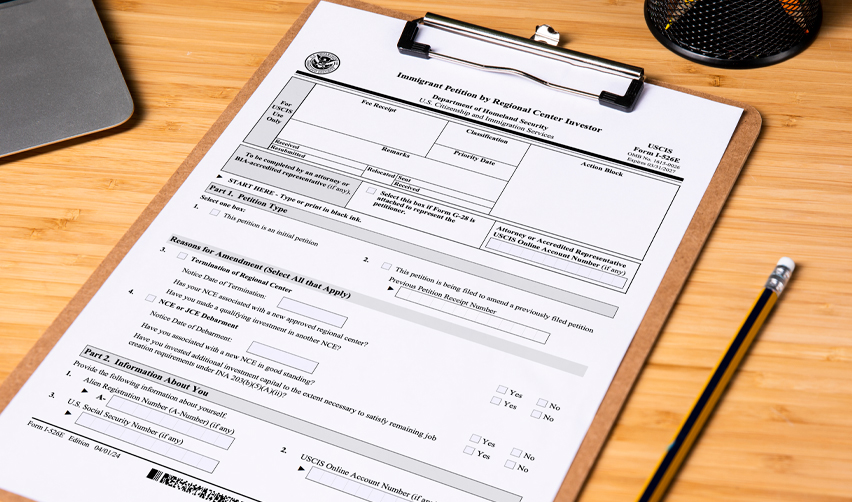
Three filings define the process. Form I-526E (Immigrant Petition by Regional Center Investor) is the initial petition proving your investment and lawful source of funds. Direct investors file Form I-526 instead. After petition approval, investors abroad complete consular processing with Form DS-260, while investors already in the United States file Form I-485 to adjust status. Finally, Form I-829 is filed near the end of the two-year conditional residency period to remove conditions and obtain the permanent 10-year Green Card.
How Long Does the EB-5 Process Take?
It depends heavily on the project category and your country of birth. USCIS gives rural petitions priority processing, so rural I-526E filings are adjudicated significantly faster, with most approvals issued in under a year. Unreserved petitions commonly take a few years or longer. After I-526E approval, adjustment of status or consular processing typically adds several months to a year. I-829 adjudication currently takes well over a year, though conditional resident status extends while the petition is pending. Investors from backlogged countries in the unreserved category may also wait years for a visa number, which is why category selection matters so much.
Can My Family Get Green Cards Too?
Yes. One qualifying investment covers the investor, their spouse, and all unmarried children under 21. Each family member receives their own Green Card. The Child Status Protection Act can freeze a child’s age at certain points in the process, which helps some families whose children are approaching 21, though the rules are technical and worth reviewing with an immigration attorney early.
Can I Live and Work in the U.S. While My Petition Is Pending?
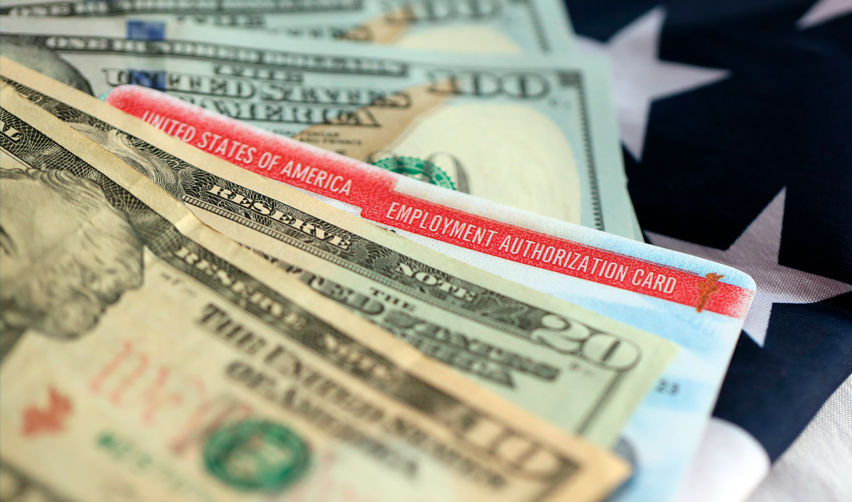
Often, yes. If you are in the United States in valid status and a visa number is available in your category, the RIA permits concurrent filing: you submit Form I-485 together with your I-526E. While the I-485 is pending, you can apply for an employment authorization document and advance parole travel permission. This has made EB-5 especially popular with H-1B professionals and F-1 students who want to work and travel without depending on employer sponsorship. In May 2026, USCIS issued a policy memorandum treating adjustment of status as a closely reviewed discretionary benefit, so concurrent filings should be prepared thoroughly with experienced counsel.
What Are Reserved Visa Categories, and Why Do They Matter?
The RIA sets aside 20% of annual EB-5 visas for rural projects, 10% for high-unemployment area projects, and 2% for infrastructure projects. The rest are unreserved. The Visa Bulletin shows why this matters: the unreserved category is unavailable for India for the rest of the fiscal year and carries a cutoff date of December 1, 2016 for China, while all three reserved categories remain current for every country. For investors born in China or India, a reserved category project is currently the only way to file with a visa immediately available and to qualify for concurrent filing.
What Is the Source of Funds Requirement?
You must prove that your investment capital, and the funds used to pay fees, came from lawful sources. Acceptable sources include salary, business profits, real estate sales, gifts, inheritance, and loans not secured by the EB-5 investment itself. USCIS traces the full path of the money, and gifted funds require documentation of the donor’s original source as well. Weak source of funds documentation is the most common reason for delays and denials, and assembling the paperwork often takes two to three months. Start early.
Is My Investment Guaranteed?
No, and it cannot be. The law requires EB-5 capital to remain at risk, meaning there can be no guaranteed repayment arrangement. This is why project selection is the most important financial decision in the process. Investors should examine the developer’s track record, the capital structure, the job creation cushion, and the repayment plan before committing. A well-structured project cannot eliminate risk, but it can reduce it substantially.
However, reputable developers and regional centers frequently offer specific investor guarantees—such as I-526E approval or job creation guarantees—that fully comply with the ‘at-risk’ requirement.
What Is the September 30, 2026 Grandfathering Deadline?
Although the regional center program is authorized through September 30, 2027, the RIA protects only petitions filed on or before September 30, 2026. A petition filed by that grandfathering deadline will continue to be processed even if Congress later allows the program to lapse. Petitions filed after the deadline carry no such protection. Given the time needed to select a project and document source of funds, investors who want this protection should begin the process now.
More than 3,000 families from over 70 countries have selected EB-5 projects sponsored by EB5AN regional centers. Our expert team has more than a decade of experience and offers clients high-quality, low-risk EB-5 regional center projects with a 100% USCIS project approval rate.
If you would like to know more about your EB-5 investment options, book a free call with our expert team today.