
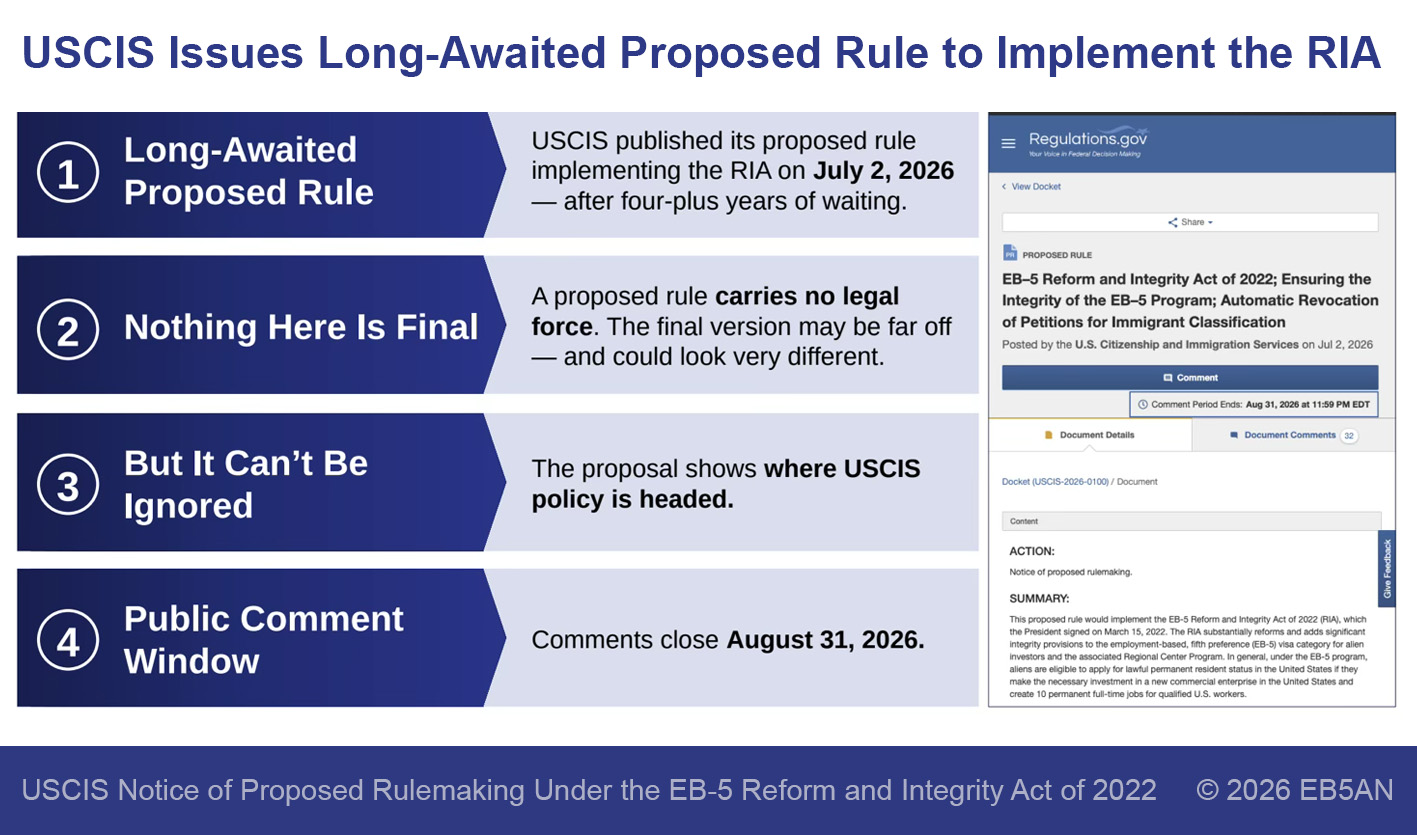
More than four years after Congress enacted the EB-5 Reform and Integrity Act of 2022, USCIS has published proposed regulations explaining how it intends to implement these new policies.
The long-awaited Notice of Proposed Rulemaking (NPRM) was published on July 2, 2026. It addresses a wide range of key EB-5 policies, including targeted employment areas, job creation, bridge financing, redeployment, and source of funds.
Some of the proposed changes could directly benefit investors and other members of the EB-5 industry. Others could create challenges for EB-5 stakeholders.
As written, the proposal would restrict commonly used project-financing structures, substantially expand some compliance obligations, and give USCIS broader authority in several areas. At the same time, it leaves important questions unanswered.
The NPRM is not a final rule and does not currently have legal force. DHS must first complete the public-comment process, review the comments it receives, and decide what to include in a final rule. Comments are due by August 31, 2026.
Still, the NPRM provides the clearest indication yet of how USCIS may interpret and enforce the RIA.
To examine the proposal, EB5AN held a webinar hosted by Senior Vice President Ahmed Khan. Ahmed is an immigration attorney with nearly 15 years of EB-5 experience, including previous work at Fragomen and Klasko Immigration Law Partners.
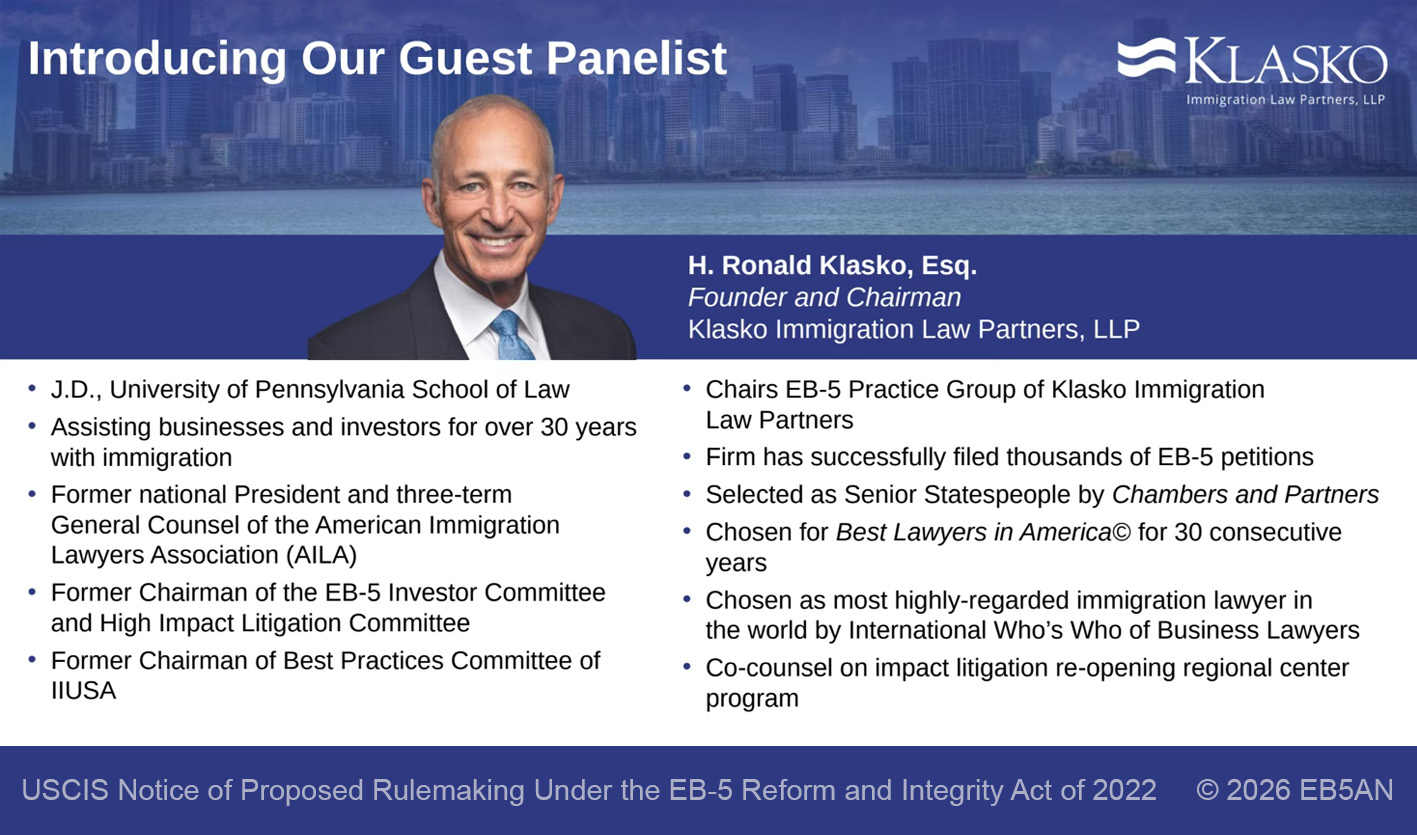
Our guest panelist was Ron Klasko, chairman of Klasko Immigration Law Partners and one of the leading voices in the EB-5 industry. Frequently ranked as one of the most important immigration attorneys in the U.S. and globally, Klasko brings valuable insights to our discussion of the NPRM.
Additionally, Klasko Immigration Law Partners has one of the largest EB-5 practices in the United States, with 15 professionals focused on EB-5. Its work includes investor petitions, regional center compliance, project approval applications, federal litigation, and I-829 cases in immigration court.
We invite you to read our summary of the webinar below—or watch the full webinar or highlight videos. These unique insights can help you prepare for future changes to the EB-5 program and preserve your path to a U.S. Green Card.
Highlights:
Full Webinar:
How the NPRM Could Benefit EB-5 Investors
Restrictions on Bridge Financing
Stricter Job Creation Criteria
A 90-Day Redeployment Period Could Be Unworkable
The Definition of “Persons Involved” Could Become Far Too Broad
Investors Challenging I-829 Denials Could Lose Work Authorization
Source-of-Funds Requirements Could Expand Beyond the EB-5 Investment
Pre-RIA Regional Centers Could Be Required to File Form I-956
The Two-Year Sustainment Period Still Needs Clearer Policy
National-Interest Decisions Could Apply Retroactively
Important Guidance Is Still Missing
EB-5 Stakeholders Should Submit Comments Before August 31
The NPRM Could Reshape Major Parts of the EB-5 Program
How the NPRM Could Benefit EB-5 Investors
TEA Designations Could Remain Valid for Defined Two-Year Periods
An EB-5 investor can qualify for the reduced investment amount by investing in a targeted employment area, or TEA. A TEA may be a rural area or an area with qualifying levels of unemployment.
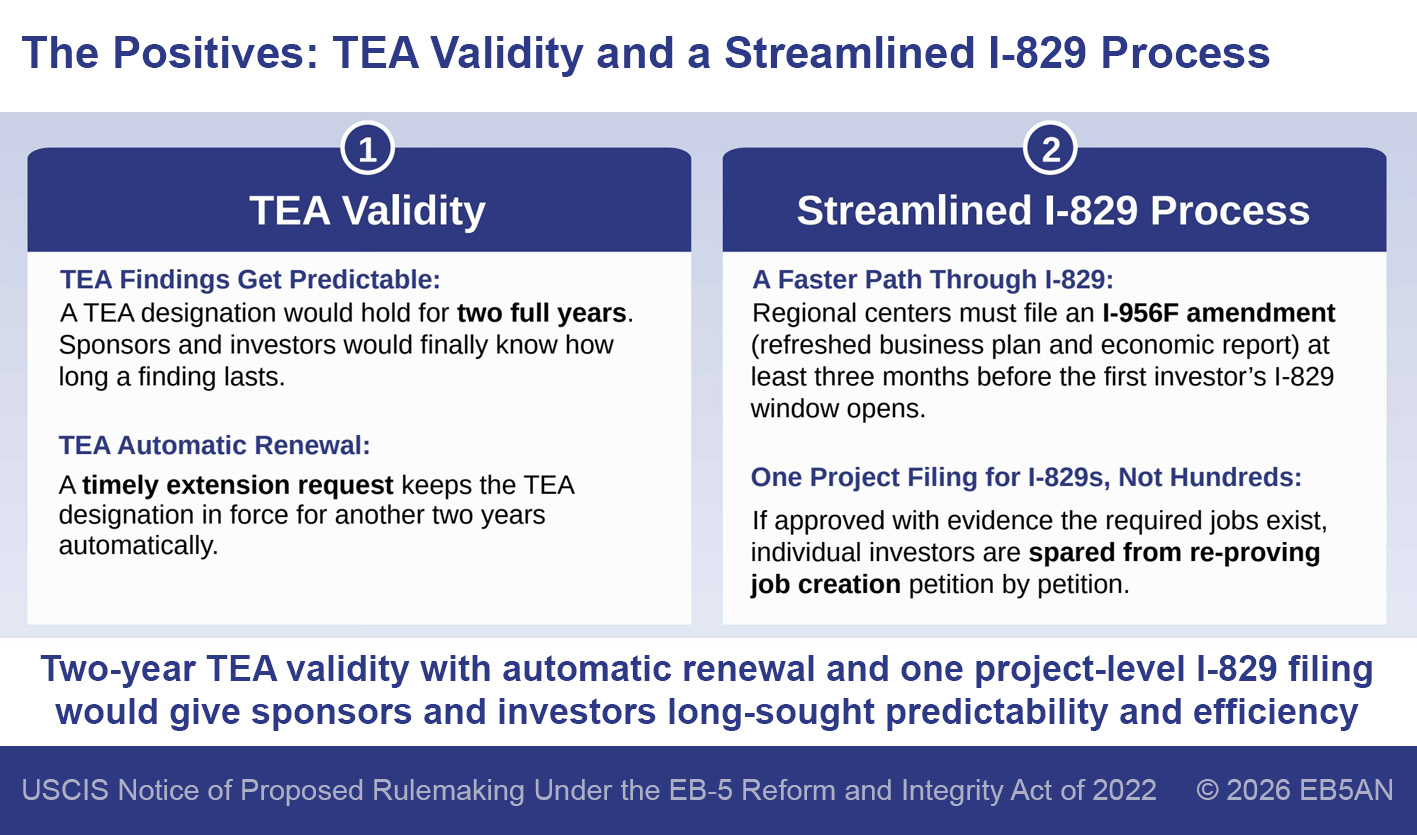
The proposed rule would clarify that a TEA designation obtained through Form I-956F would remain valid for two years. If a timely extension request were filed before that period expired, the filing would provide another two years.
This would resolve an issue that has caused uncertainty under the RIA and give regional centers and investors a more predictable period for relying on the designation.
It would also make the duration of the TEA designation clearer at the outset of an EB-5 offering.
Project-Level I-829 Evidence Could Be Reviewed Once
The proposal would also create a more efficient process for reviewing project-level evidence at the Form I-829 stage.
Under the current process, each investor must submit evidence showing that the project created the required jobs and that the investment satisfied applicable EB-5 requirements. If a project has 100 investors, USCIS may receive essentially the same business plan, economic report, construction records, and job-creation evidence 100 separate times.
The proposal would instead require the regional center to submit an amendment to the project’s Form I-956F filing at least 90 days before the first investor becomes eligible to file Form I-829.
The amendment would include a business plan, an economic report, and the project-level evidence needed to prove job creation and sustainment. USCIS would review that package before the first investor files Form I-829.
If the amendment were approved, individual investors would not need to resubmit the project-level job-creation evidence. Each investor would instead prove that the investor’s own capital was sustained through the conditional permanent residence period.
This approach could reduce duplicative filings, produce more consistent decisions, and give investors earlier confirmation that the project has satisfied its responsibilities.
Restrictions on Bridge Financing
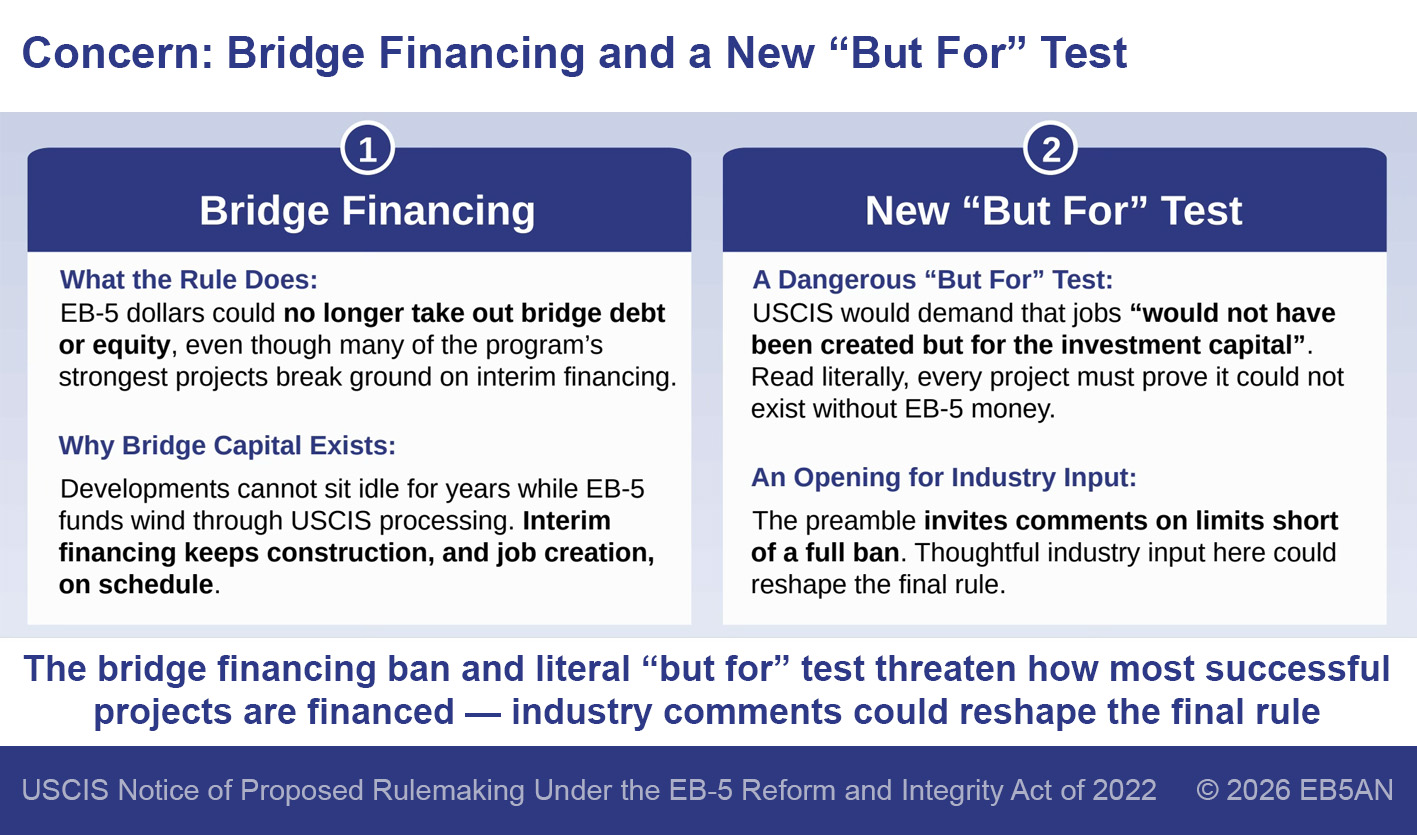
One of the most consequential provisions in the NPRM concerns bridge financing.
EB-5 capital is rarely available on the first day of a project. Before a developer can receive investor funds, the regional center generally must prepare and file Form I-956F, market the offering, identify investors, and allow each investor to complete source-of-funds work and file Form I-526E.
This process can take many months. A project may therefore use temporary debt or equity to begin construction while the EB-5 offering is underway. Once the EB-5 funds become available, they replace some or all of that bridge financing.
USCIS has historically permitted investors to receive job-creation credit from work funded initially by bridge capital when EB-5 funds were later used to repay or replace that financing.
The proposed rule would generally eliminate job-creation credit when EB-5 funds are used to repay or replace bridge debt or bridge equity.
Importantly, the NPRM states that this change would apply prospectively only. Investors who file Form I-526E before a final rule takes effect could continue to rely on USCIS’s existing bridge-financing policy.
This restriction could make otherwise viable projects less suitable for EB-5 financing. Developers may be unable to delay construction while waiting for the EB-5 raise. Construction schedules, permits, land contracts, lender requirements, and other obligations often require work to begin before all EB-5 funds are available.
The proposed restriction could therefore penalize projects for moving forward on time. It could also favor weaker projects that cannot begin without EB-5 capital over stronger projects with enough financing to start construction independently.
The preamble to the proposed rule indicates that USCIS is uncertain how best to address bridge financing and expressly solicits public comments. A more workable approach could preserve legitimate bridge financing while placing reasonable limits on how long after a project begins EB-5 funds can replace it.
Stricter Job Creation Criteria
Job creation would also be more closely scrutinized under the policies of the NPRM.
Under the proposal, the claimed jobs would have to be tied to the investor’s capital. USCIS would apply a “but for” test, meaning the jobs would not have been created but for the EB-5 investment.
The concern is how USCIS might apply that standard in practice.
Strong EB-5 projects are usually structured so they can be completed even if the offering raises less EB-5 capital than expected. A project seeking $80 million from 100 investors should have a plan for completing construction if it raises only part of that amount.
This protects investors. An investor should not depend on every other expected investor entering the offering before the project can move forward.
A strict “but for” test could produce the opposite incentive. A project might have to show that it would fail without the full EB-5 raise to receive credit for the jobs. That would make dependence on EB-5 capital an advantage rather than a risk.
The better approach would recognize a sufficient connection between EB-5 capital and job-creating expenditures without requiring proof that the entire project would have collapsed without the investment. EB-5 funds can contribute meaningfully to a project even when the developer has contingency financing available.
A 90-Day Redeployment Period Could Be Unworkable
Redeployment may be required when a project repays EB-5 capital before an investor has completed the applicable investment period.
The capital generally cannot remain unused in the new commercial enterprise’s bank account. It must remain at risk in a qualifying commercial activity until the investor has satisfied the sustainment requirement.
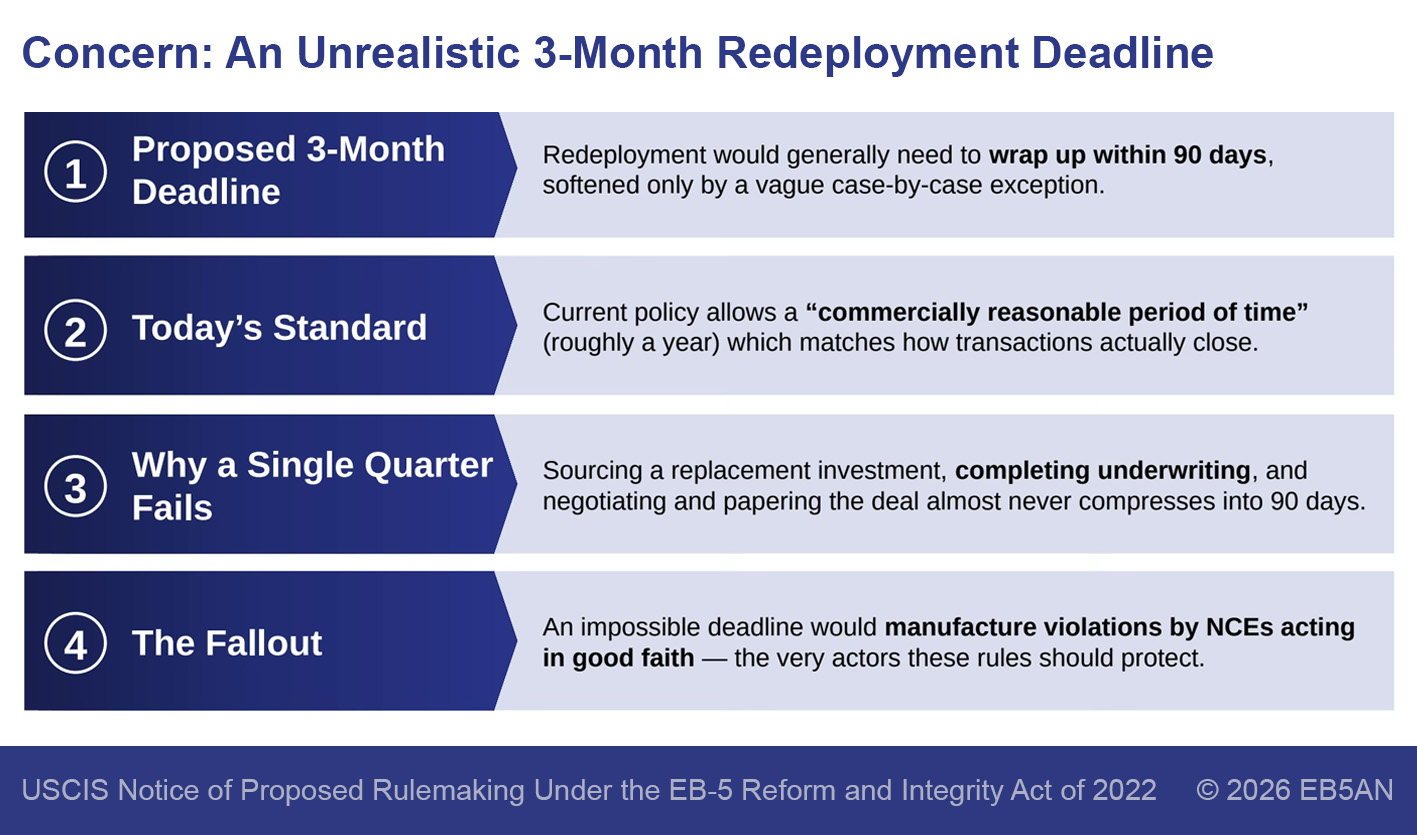
Current USCIS policy has used a commercially reasonable period for completing redeployment. In practice, approximately one year has often been treated as reasonable.
The proposed framework would generally require redeployment to be completed within 90 days.
The NCE may need to identify a suitable project, negotiate the terms, complete underwriting, prepare the transaction documents, and make the opportunity available for investors to vote on.
Completing all of those steps in 90 days could force an NCE to choose between missing the deadline and entering a poorly evaluated investment.
A rushed redeployment could increase financial risk for investors and make it harder to select a commercially viable project.
A realistic rule should give regional centers enough time to locate and evaluate an appropriate commercial investment while preventing funds from remaining idle indefinitely.
The Definition of “Persons Involved” Could Become Far Too Broad
The RIA requires certain people involved with a regional center, NCE, or affiliated job-creating entity to establish that they are eligible to participate in the EB-5 Regional Center Program.
These individuals generally submit Form I-956H, which includes identifying information and requires biometric screening.
The statutory concept appears directed primarily at people who are substantively involved in investment decisions.
The proposed rule would define the group much more broadly. It could include administrators, board members, general partners, limited partners, managers, officers, owners, and other people in similar positions.
This could transform a requirement intended for a limited number of decision-makers into an obligation affecting a large group of individuals. Depending on how USCIS applies the definition, even investors could be required to complete Form I-956H and attend biometric appointments.
The proposal would also require amendments when covered individuals join, leave, or change their roles. Even a relatively small ownership change could require an amendment and prevent USCIS from adjudicating applications for the regional center while the change is under review.
The result could be a substantial administrative burden for regional centers, projects, investors, and USCIS itself. A more workable rule would focus on people with actual control, authority, or substantive responsibility for EB-5 investment decisions.
Investors Challenging I-829 Denials Could Lose Work Authorization
The proposed rule also raises serious concerns for investors whose I-829 petitions are denied.
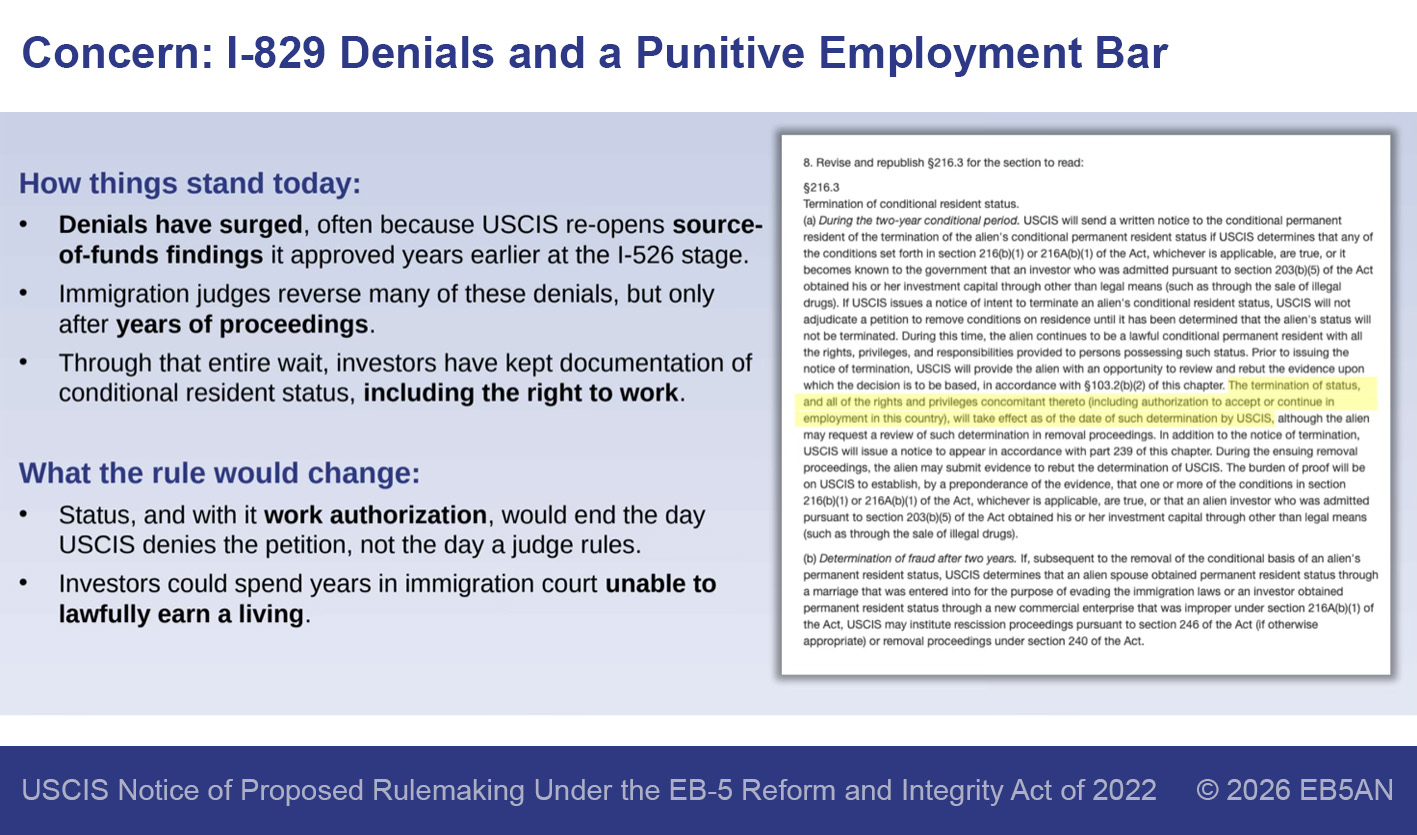
An I-829 denial does not necessarily end the case immediately. USCIS may issue a Notice to Appear and place the investor in removal proceedings. The investor can then seek de novo review before an immigration judge, with the government carrying the burden of proof.
Under current practice, investors can continue receiving I-551 stamps and working while the case is pending.
The proposal could remove that protection. An investor challenging an I-829 denial could be prevented from working during the two, three, or four years it may take for an immigration court to decide the case.
For an investor, losing work authorization during a multi-year immigration-court process would create serious practical and financial hardship.
The underlying denial may also involve conduct outside the investor’s control. USCIS may deny an I-829 because of project-level misconduct or because the agency has decided to revisit a source-of-funds determination it approved years earlier.
Preventing the investor from working while exercising the legal right to challenge the denial would create severe financial pressure before a court has determined whether the denial was correct.
Source-of-Funds Requirements Could Expand Beyond the EB-5 Investment
The proposal would also expand source-of-funds, obligations in ways that could affect investors, developers, and other participants in a project.
USCIS Could Review Capital From Non-EB-5 Sources
An EB-5 investor must establish that the invested capital was obtained through lawful means. It is also reasonable for USCIS to require evidence tracing EB-5 capital from the NCE to the JCE.
But the proposed language could be read to require source-of-funds documentation for capital sources beyond the EB-5 money flowing from the NCE to the JCE.
For a large hotel financed with multiple sources of capital, that could mean documenting the origin of every dollar used to finance the development, even when most of that money has no connection to the individual EB-5 investor.
The problem may be even greater in a direct EB-5 business. An EB-5 investor who owns 20% of a company could be required to obtain source-of-funds evidence from the company’s other owners, including U.S. citizens who are not seeking immigration benefits.
Those parties may be unwilling to provide personal financial records to USCIS. The additional burden could discourage developers and business owners from accepting EB-5 capital at all.
The final rule should clearly limit the obligation to capital that has a meaningful connection to the EB-5 investment and the job-creating transaction.
Currency Exchangers Could Face Separate Source-of-Funds Review
Investors from countries with currency-transfer restrictions frequently use currency exchangers, money-service businesses, friends, or other intermediaries to convert local currency into U.S. dollars.
The investor may transfer lawfully earned local currency to the exchanger. The exchanger then provides an equivalent amount of U.S. dollars for the EB-5 investment.
The proposed rule could give USCIS regulatory authority to require a separate source-of-funds analysis for the currency exchanger. The proposal does include an exception for exchangers that are licensed, regulated, and authorized by a U.S. or foreign government authority.
That requirement could create substantial practical problems. A third-party exchanger may refuse to provide detailed financial records to an investor. The exchanger is not contributing additional capital to the investment; it is providing the other side of a currency exchange.
Requiring a complete source-of-funds analysis for both the investor’s original money and the exchanger’s corresponding funds can effectively require the same $800,000 transaction to be sourced twice.
USCIS should retain the ability to investigate suspicious transactions. But the final rule should distinguish legitimate currency conversion from situations in which an unidentified third party is actually contributing capital to the EB-5 investment.
Pre-RIA Regional Centers Could Be Required to File Form I-956
Another proposed provision concerns regional centers that were designated before the RIA.
After the RIA took effect, USCIS initially treated previously approved regional centers as no longer authorized. Litigation in the Behring case challenged that position, and a settlement allowed pre-RIA regional centers to continue operating.
The proposed rule could require these regional centers to file Form I-956 to continue conducting business under the RIA.
The proposal does not clearly establish when the filing would be due or what would happen while it remained pending. It is also unclear whether associated project and investor filings could continue to be adjudicated during that period.
Requiring a new filing without clear transition rules could create uncertainty for regional centers that have operated continuously under the settlement. Any final rule should specify the filing deadline, the effect of a pending application, and the treatment of related investor and project filings.
The Two-Year Sustainment Period Still Needs Clearer Policy
USCIS issued policy guidance in October 2023 indicating that the sustainment period would be no less than two years from when the funds are made available to the JCE.
The proposed framework appears to support a two-year period, but it still does not resolve when that period begins.
Clear rules are necessary so regional centers and project sponsors can structure transactions correctly from the beginning. Investors should not face an I-829 issue years later because USCIS applies a different interpretation of when the investment period began.
National-Interest Decisions Could Apply Retroactively
The RIA gives USCIS broad authority to deny an EB-5 case if the agency determines that an applicant or project is contrary to the national interest or violates national security.
The RIA makes such determinations discretionary and not subject to judicial review.
But the proposed rule would apply that authority retroactively to applications filed before the RIA became law in 2022.
Retroactive application is especially concerning because investors made decisions under a different legal framework. They may have invested their capital, immigrated to the United States, and built their lives around an approval issued years before the RIA.
The proposal could allow USCIS to apply a later-enacted discretionary standard to those earlier filings. At a minimum, the final rule should define the circumstances in which this authority can be used and establish meaningful procedural protections for affected investors.
Important Guidance Is Still Missing
The proposed regulations are extensive, but they do not resolve every major post-RIA issue.
Infrastructure Projects Remain Difficult to Evaluate
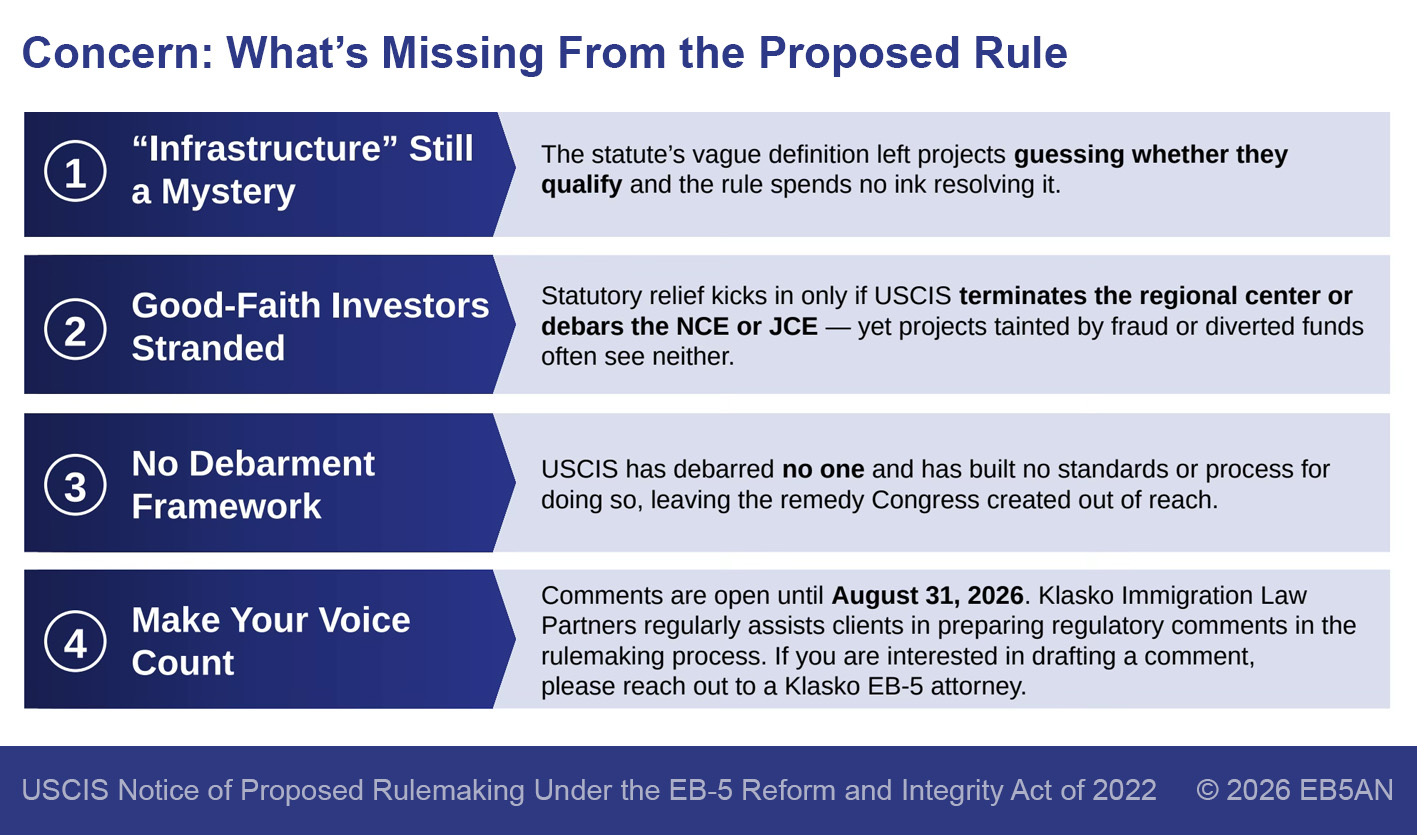
The RIA created an infrastructure-project category, but USCIS has provided little practical guidance on what qualifies.
Investors and project sponsors therefore still lack detailed, practical standards for determining what USCIS will accept as an infrastructure project.
Rural and high-unemployment-area classifications are based largely on geographic and economic data. Although disputes can arise, a project sponsor can generally evaluate the relevant location before filing.
The statutory definition is only a few sentences, and USCIS has issued no policy memoranda or other guidance explaining how it will review infrastructure projects.
Until USCIS establishes clearer standards, investors may have difficulty relying on an infrastructure classification before Form I-956F approval.
The Debarment Process Is Still Not Operationally Clear
The RIA created protections for good-faith investors harmed by regional center termination or the debarment of an NCE or JCE.
These protections can allow an NCE to affiliate with another regional center or allow an innocent investor to make an additional investment and continue with the EB-5 case.
However, some protections depend on USCIS first formally debarring the NCE or JCE.
The proposed rule does not establish standards for when USCIS will debar an NCE or JCE, procedures for seeking debarment, or a clear framework for agency action.
USCIS may conclude that a project involved fraud, diversion of funds, or criminal conduct but still deny investor petitions without formally debarring the project. Without a debarment decision, innocent investors may be unable to invoke the protections Congress created for them.
The final rule should establish debarment standards, procedures, deadlines, and a process through which affected investors can seek agency action.
EB-5 Stakeholders Should Submit Comments Before August 31
Because this is a proposed rule, the public still has an opportunity to influence the final regulations.
Investors, regional centers, NCE managers, developers, economists, attorneys, fund administrators, and other participants can submit comments through Regulations.gov until August 31, 2026.
The most useful comments should identify the specific proposed provision, explain the practical problem it would create, recommend an alternative, and provide supporting evidence.
For example, developers can explain why projects need bridge financing. Regional centers can document how long responsible redeployment transactions take. And investors can explain the effect of losing work authorization while an I-829 case remains in immigration court.
Comments could be especially important on bridge financing, the 90-day redeployment deadline, expanded I-956H filings, work authorization after I-829 denials, source-of-funds requirements, and missing debarment guidance. USCIS must consider and respond to substantive public comments before issuing a final rule.
The NPRM Could Reshape Major Parts of the EB-5 Program
The proposed regulations are not yet law. Some provisions may be revised, removed, or clarified before USCIS publishes a final rule.
Nevertheless, the proposal shows where USCIS may be headed. It could improve project-level I-829 review and provide greater certainty for TEA designations. But it could also restrict legitimate financing structures, create unrealistic deadlines, expand source-of-funds obligations, increase compliance burdens, and weaken protections for investors facing I-829 denials.
The public-comment period is the opportunity to address these problems before the rules become final. EB-5 stakeholders who may be affected should review the proposal carefully, consult experienced immigration counsel, such as Klasko Immigration Law Partners, and submit specific comments supported by practical evidence before August 31, 2026.