

Investors researching the EB-5 program often see regional centers advertise that a project is “USCIS approved.” That phrase refers to project approval, which is not the same thing as approval of your own immigration petition. The two approvals involve different forms, different filers, and different review criteria, and confusing them can lead to poor decisions about where and when to invest.
This post explains what each approval covers, how the two depend on each other, and how a 2026 change in USCIS processing has made project approval more important than ever.
What Project Approval Means: Form I-956F
What Petition Approval Means: Form I-526E
How the Two Approvals Depend on Each Other
The March 2026 USCIS Processing Change
What Project Approval Does and Does Not Guarantee
How to Use This Distinction in Your Due Diligence
What Project Approval Means: Form I-956F
Project approval refers to USCIS approval of Form I-956F, the Application for Approval of an Investment in a Commercial Enterprise. Form I-956F is filed by the regional center, not by the individual investor, and it asks USCIS to approve a particular EB-5 investment offering through an associated new commercial enterprise.
The filing is extensive. The main component is a comprehensive business plan that describes the entire project and investment in detail, typically accompanied by supporting exhibits, and USCIS requires that business plans be comprehensive and credible. The package also includes the offering documents and the economic analysis supporting the project’s job creation estimates, along with disclosures required under the EB-5 Reform and Integrity Act of 2022 (RIA).
When USCIS approves an I-956F, it is saying the project itself qualifies as an EB-5 investment vehicle. USCIS reviews the business plan, economic model, and securities offering documents at the project level, separately from individual investor petitions. The approval says nothing about any individual investor.
What Petition Approval Means: Form I-526E
Petition approval refers to USCIS approval of Form I-526E, the Immigrant Petition by Regional Center Investor. This is your personal filing, and it is the document that actually moves your family toward conditional permanent residence.
The I-526E focuses on investor-specific requirements. You must show that you invested, or are actively in the process of investing, the required amount: $800,000 for a project located in a targeted employment area (TEA), or $1,050,000 for a project outside any TEA. These thresholds were set by the RIA and are scheduled to adjust for inflation on January 1, 2027. You must also document that your funds came from lawful sources and trace their path into the project, and you must show that your investment is expected to support the creation of at least 10 full-time jobs for US workers.
In short, the I-956F answers the question “Is this project eligible for EB-5 investment?” while the I-526E answers the question “Is this investor eligible for an EB-5 visa through this project?”
How the Two Approvals Depend on Each Other
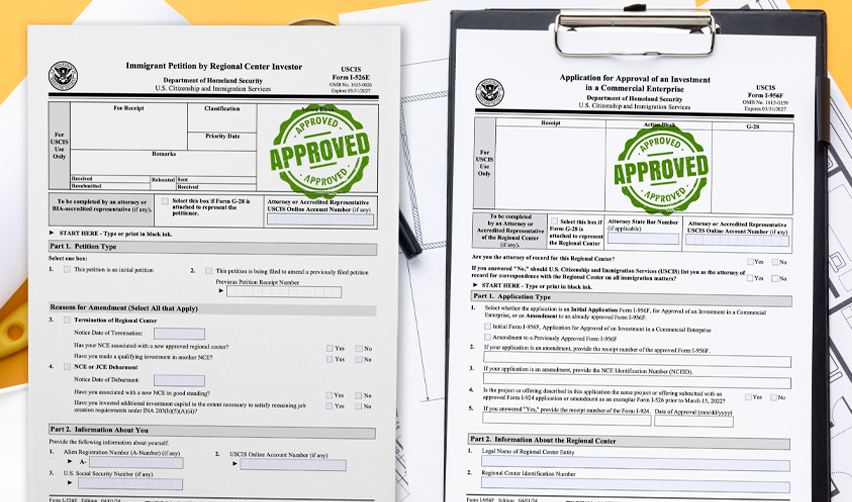
The two filings are linked at both the filing stage and the approval stage.
At the filing stage, a regional center must file Form I-956F and have it receipted by USCIS before EB-5 investors can file their own I-526E petitions based on an investment in that project.
The project application does not need to be approved at that point. Under the USCIS Policy Manual, an investor may file Form I-526E while the project application remains pending, but USCIS does not make a final decision on the investor’s petition until it makes a final decision on the associated project application.
At the approval stage, the dependency is absolute. Even if you file your I-526E, USCIS will not approve it until the associated I-956F for your project has been approved. The linkage cuts the other way too: if the I-956F is denied, any investor petition tied to that project will likely be denied as well, even if the investor’s personal documentation was strong.
The March 2026 USCIS Processing Change
In early 2026, USCIS changed how it sequences petitions in a way that raised the practical stakes of project approval. Effective March 30, 2026, the new inventory management model means no I-526E petition is assigned for review until the associated I-956F project application is approved.
Under the new order of operations, the project’s approval is the pacing item for all associated investor petitions. Rural petitions are then assigned for review first through a dedicated first-in, first-out queue, and non-rural petitions may be grouped into separate sub-queues for high unemployment area (HUA), infrastructure, and unreserved cases to promote reserved visa usage. Those reserved categories were created by the RIA, which sets aside 20% of visas each year for rural investments, 10% for high-unemployment areas, and 2% for infrastructure projects.
The practical effect is that investors in projects with an approved I-956F now sit in a materially better position, since their petitions can move into review without waiting on a project decision.
For anyone deciding when to file, one date is worth keeping in view: the current $800,000 and $1,050,000 minimums apply to I-526E petitions filed before January 1, 2027, when the inflation adjustment takes effect.
What Project Approval Does and Does Not Guarantee
An approved I-956F is a meaningful checkpoint, but it is important to be precise about what it covers.
What it does mean: when USCIS approves a project application, it signals that the agency has reviewed and accepted the project’s structure, job creation methodology, and business plan credibility. It also removes the largest project-side variable from your own petition timeline, since your I-526E cannot be approved without it.
What it does not mean: project approval does not guarantee individual I-526E approval. Your petition can still fail on investor-specific grounds, most commonly source-of-funds documentation. Project-side changes also matter: a material change of circumstances in an I-956F-approved project may lead to an I-526E denial.
Project approval is also not a judgment on financial merit. USCIS reviews the project for immigration eligibility, not for its financial prospects. Financial due diligence remains your responsibility regardless of the project’s immigration status.
How to Use This Distinction in Your Due Diligence

Three practical takeaways follow from the difference between the two approvals.
First, ask every regional center a precise question: has the I-956F for this specific project been approved, or only filed? “USCIS approved project” should mean an approved I-956F, and a serious sponsor will show you the approval notice. Regional centers with approved rural projects now hold a real advantage because their offerings are more adjudication-ready under the new processing model.
Second, understand where your petition would sit in the queue. A rural project with an approved I-956F combines the fastest project-side status with the priority rural queue. If a project’s I-956F is still pending, your petition enters the review queue once the project is approved.
Third, remember that petition approval is only the midpoint of the immigration process. After your I-526E is approved and you obtain conditional permanent residence, you must still file Form I-829 to remove the conditions on your Green Card by demonstrating that the required jobs were created.
More than 3,000 families from over 70 countries have selected EB-5 projects sponsored by EB5AN regional centers. Our expert team has more than a decade of experience and offers clients high-quality, low-risk EB-5 regional center projects with a 100% USCIS project approval rate.
If you would like to know more about your EB-5 investment options, book a free call with our expert team today.