

The U.S. Department of State has released the November 2026 Visa Bulletin, with forward movement in several employment-based immigrant visa categories. For EB-5 investors, the key takeaway remains consistent: all reserved set-aside categories remain current for every country.
U.S. Citizenship and Immigration Services (USCIS) has confirmed that employment-based adjustment of status applicants may use the Dates for Filing chart in November. This means that applicants in the United States may file Form I-485 if their priority date is earlier than the listed filing date for their category and country, even if that date is not yet current under the Final Action Dates chart.
The Visa Bulletin remains the primary resource for tracking immigrant visa availability. It includes two main charts. The Final Action Dates chart determines when a visa may be issued or when USCIS can approve an adjustment of status application. At this stage, an applicant’s priority date must fall before the listed cutoff date. The Dates for Filing chart indicates when applicants may be eligible to submit their applications earlier, if USCIS permits its use.
Understanding Key Visa Bulletin Terms
Implications for EB-5 Immigrant Investors
Work With EB5AN to Pursue Permanent Residency Through EB-5
Understanding Key Visa Bulletin Terms
The Final Action Dates chart controls when applicants can move forward with final adjudication or file for adjustment of status when USCIS designates its use. When a category is listed as “current,” there is no backlog, and applicants may proceed regardless of priority date.
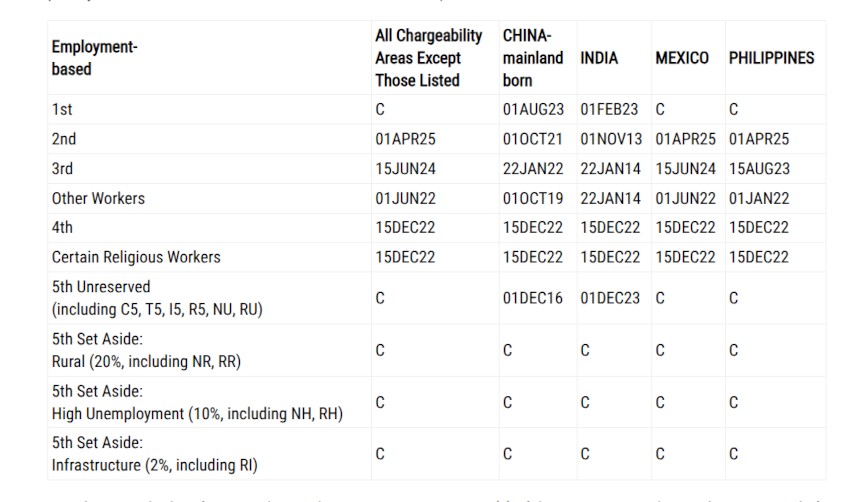
November brings forward movement in several employment-based final action dates, most notably a three-month advance in EB-2 for most countries and gains in EB-3 for China, India, and most other countries. All EB-5 categories are unchanged from October.
Highlights From the November 2026 Charts
The November bulletin brings modest forward movement for China and India. EB-1 China advances by one month to August 1, 2023, while EB-1 India remains at February 1, 2023. EB-2 China remains at October 1, 2021, and EB-2 India remains at November 1, 2013. EB-3 China advances by two weeks to January 22, 2022, and EB-3 India advances by three weeks to January 22, 2014.
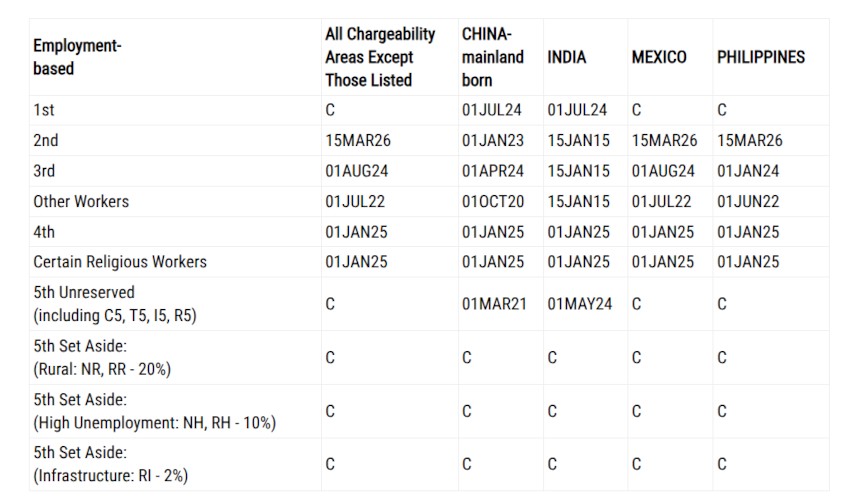
In the EB-5 unreserved category, China remains at December 1, 2016, and India remains at December 1, 2023. On the Dates for Filing chart, EB-5 unreserved China holds at March 1, 2021, and India holds at May 1, 2024.
For most other countries, EB-2 and EB-3 move forward after retrogressing in October. EB-2 advances by three months to a final action date of April 1, 2025, and EB-3 advances by one month to June 15, 2024. EB-3 Philippines remains at August 15, 2023.
For EB-5 investors, the reserved set-aside categories remain current for all countries.
Here’s the Final Action Dates chart:
Dates for Filing chart:
Implications for EB-5 Immigrant Investors
The November 2026 bulletin continues to reflect a stable environment for EB-5 investors. Reserved set-aside visas remain fully available worldwide.
EB-5 unreserved cutoff dates for China and India hold at their October levels on both charts, so both countries still face cutoff dates in the unreserved category. EB-5 reserved set-asides, by contrast, remain current for all countries, including China and India. EB-2 and EB-3 advanced this month for most other countries, but they remain subject to cutoff dates, which further highlights this contrast. For investors facing waits in other employment-based categories, the value of reserved set-aside visas remains clear. Filing under a reserved category continues to offer a path that avoids the cutoff dates affecting the unreserved pool. Rural projects also continue to benefit from priority processing at USCIS under the EB-5 Reform and Integrity Act of 2022.
Because USCIS is accepting the Dates for Filing chart in November, adjustment of status eligibility is broader compared to months when the Final Action Dates chart is used. EB-5 unreserved applicants chargeable to China with a priority date earlier than March 1, 2021, and those chargeable to India with a priority date earlier than May 1, 2024, may file Form I-485 this month. Final approval still requires a priority date that is current under the Final Action Dates chart.
What Is Driving Movement in the November Bulletin
The November bulletin does not include a State Department explanation for this month’s movement. The changes come in the second month of fiscal year 2027, as the State Department continues to allocate the new year’s immigrant visa numbers. Most of the advances are on the Final Action Dates chart, while the Dates for Filing chart is largely unchanged from October.
In the October bulletin, the State Department described its “Rest of World” retrogressions in EB-2 and EB-3 as necessary to keep visa issuances within fiscal year 2027 quarterly and annual limits and said it would continue to monitor the situation and make adjustments as needed. In November, EB-2 and EB-3 final action dates for most countries recover part of the ground lost in October.
The November bulletin includes no new warnings for employment-based categories. Cutoff dates may still shift as demand develops over the new fiscal year. Currently, EB-5 reserved set-aside categories remain the most reliable route for investors who need visa numbers to stay available.
Work With EB5AN to Pursue Permanent Residency Through EB-5
The November 2026 Visa Bulletin reflects movement in employment-based categories, with EB-5 reserved set-asides remaining current for all countries. Investors preparing to file should also note that new USCIS EB-5 filing fees take effect on November 30, 2026.
More than 3,000 families from over 70 countries have selected EB-5 projects sponsored by EB5AN regional centers. Our expert team has more than a decade of experience and offers clients high-quality, low-risk EB-5 regional center projects with a 100% USCIS project approval rate.
Schedule a free call with EB5AN to learn more about current EB-5 opportunities and begin your application while visa availability and processing conditions remain favorable.