
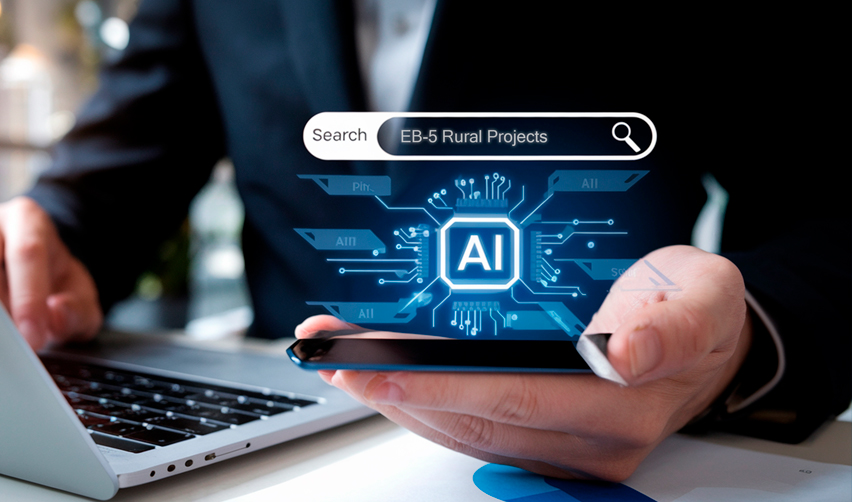
Before committing capital to an EB-5 project, investors face a familiar challenge: sorting through a large amount of information and determining which opportunities deserve closer attention. That challenge has become even more pronounced as rural projects continue to attract interest due to their reserved visa set-asides and priority processing advantages. By 2026, artificial intelligence has emerged as a useful tool for conducting preliminary due diligence, helping investors review documents, identify potential concerns, and better understand a project’s fundamentals before engaging professional advisors.
AI is not a replacement for legal counsel, financial analysis, or independent due diligence. It cannot verify every claim made by a project sponsor, nor can it predict future outcomes. What it can do is help investors organize information more efficiently and ask more informed questions at an earlier stage in the evaluation process.
The Growing Importance of Rural EB-5 Projects
Making Sense of Large Volumes of Project Information
Evaluating the Developer’s Track Record
Reviewing Economic and Job Creation Assumptions
Analyzing Local Market Conditions
Identifying Potential Red Flags
Comparing Multiple Rural Opportunities
Improving Communication With Advisors
A Smarter Starting Point, Not the Final Answer
The Growing Importance of Rural EB-5 Projects

Rural projects occupy a unique position within the EB-5 landscape. Since the implementation of the EB-5 Reform and Integrity Act, rural investments have benefited from reserved visa allocations and priority processing that have made them especially attractive to many foreign investors. As a result, developers, regional centers, and project sponsors have increasingly focused on rural offerings across industries.
For investors, however, the appeal of a rural designation should not overshadow the need for careful evaluation. Every project carries its own risks, regardless of location. Construction timelines, job creation assumptions, market demand, capital structures, and developer experience all remain critical considerations.
This is where AI can provide practical assistance during the early stages of research.
Making Sense of Large Volumes of Project Information
One of the most immediate benefits of AI is its ability to process extensive documentation quickly. Rural EB-5 projects often provide investors with private placement memoranda (PPM), business plans, economic reports, market studies, construction information, and various offering materials.
For many investors, especially those reviewing opportunities in a language that is not their native one, the sheer volume of material can be overwhelming.
Modern AI tools can summarize lengthy documents, highlight key sections, and generate plain-language explanations of complex financial or economic concepts. Instead of spending days navigating hundreds of pages, investors can gain an initial understanding of a project’s structure in a much shorter period.
This does not eliminate the need to read important documents carefully. Rather, it helps investors identify which areas deserve closer examination and which questions should be raised with project sponsors and advisors.
Evaluating the Developer’s Track Record
A project’s success often depends heavily on the experience and credibility of the development team behind it. Investigating that background has traditionally required searching through corporate websites, news articles, public records, and industry reports.
AI-powered research tools can streamline this process by collecting and organizing publicly available information about developers, regional centers, executives, and affiliated companies. Investors can use these tools to identify completed projects, prior EB-5 offerings, litigation history, regulatory issues, media coverage, and industry reputation.
The goal is not to rely on AI’s conclusions but to use it as a research assistant. If an AI system identifies a history of delayed projects, construction disputes, or failed developments, those findings can become starting points for further verification.
Likewise, a strong record of successful project completion may provide additional context when assessing a sponsor’s credibility.
Reviewing Economic and Job Creation Assumptions
Job creation remains at the center of every EB-5 investment. Rural projects often rely on detailed economic analyses that estimate direct, indirect, and induced job creation resulting from construction and operational activities. These reports can be highly technical, particularly for investors without an economics background.
AI can help translate complex modeling assumptions into more understandable language. Investors can use AI tools to examine whether projected employment numbers appear heavily dependent on future assumptions, aggressive timelines, or uncertain market conditions.
For example, if a project’s job creation projections depend on achieving exceptionally high occupancy rates or revenue targets, AI-assisted analysis may help flag those assumptions for closer review. Investors can then discuss the underlying methodology with qualified economists and immigration professionals.
Analyzing Local Market Conditions
Rural projects are often located in areas that investors may know very little about. Understanding local economic conditions, population trends, workforce availability, and industry demand can be difficult when evaluating opportunities in unfamiliar regions.
AI research tools can assist by gathering information from public sources and generating overviews of local market dynamics.
While investors should independently verify important information, AI can help build an initial picture of the environment in which a project is expected to operate.
Identifying Potential Red Flags
Preliminary due diligence often involves looking for warning signs that may warrant additional scrutiny. AI can be particularly useful in this area because it can compare information across multiple documents and identify inconsistencies.
For instance, an AI tool may detect differences between projected construction timelines in separate reports or highlight financial assumptions that appear inconsistent with other project materials. It may also identify language that shifts significant risks onto investors or reveal dependencies on future financing that have not yet been secured.
None of these observations automatically indicate a problematic project. Development projects frequently involve changing assumptions and evolving circumstances. Nevertheless, identifying potential concerns early allows investors to focus their attention more effectively.
The earlier questions arise, the more time there is to investigate them thoroughly.
Comparing Multiple Rural Opportunities
Many EB-5 investors evaluate several projects before making a decision. Comparing those opportunities can become difficult when each offering uses different formats, projections, and presentation styles.
AI can help create a more standardized comparison process. Investors can use it to summarize key characteristics of multiple projects, including capital structure, developer experience, estimated job creation, exit strategy, construction status, and risk factors.
Having information organized consistently makes it easier to evaluate strengths and weaknesses across different offerings.
Importantly, AI should not be used to generate simplistic rankings or investment recommendations. EB-5 decisions involve factors that extend beyond financial analysis, including immigration objectives, personal risk tolerance, and individual circumstances.
Improving Communication With Advisors
Perhaps one of the most valuable uses of AI is helping investors engage more effectively with their professional advisors.
After reviewing project materials with AI assistance, investors often arrive at meetings with more focused questions. They may have a better understanding of the project’s financing structure, job creation methodology, or development timeline before speaking with immigration attorneys, securities lawyers, economists, or due diligence consultants.
Professional advisors remain essential participants in the EB-5 process. AI can help investors prepare for those conversations, but it cannot replace the judgment and expertise that experienced professionals provide.
A Smarter Starting Point, Not the Final Answer

As rural EB-5 projects continue to attract investor attention in 2026, artificial intelligence is becoming an increasingly useful component of the preliminary due diligence process. Its greatest strength lies in helping investors navigate large amounts of information, understand complex project materials, and identify areas that deserve further investigation.
Used thoughtfully, AI can make the early stages of project evaluation more efficient and less intimidating. Investors can gain a clearer understanding of a project’s structure, the sponsor’s background, local market conditions, and key assumptions before committing significant time and resources.
At the same time, AI has limitations that should not be overlooked. It relies on the quality of available information, may overlook important context, and cannot independently verify every claim made by a project sponsor. Major investment decisions should always be supported by professional legal, financial, and immigration guidance.
More than 3,000 families from over 70 countries have selected EB-5 projects sponsored by EB5AN regional centers. Our expert team has more than a decade of experience and offers clients high-quality, low-risk EB-5 regional center projects with a 100% USCIS project approval rate.
If you would like to know more about your EB-5 investment options, book a free call with our expert team today.