

Investors considering the EB-5 program frequently ask whether rural projects are a safer choice than urban ones. The question is reasonable: rural projects carry a distinct set of advantages under current law, and for many investors they represent the better path to a U.S. Green Card. But “safer” depends on which type of risk you are inquiring about.
Immigration risk and investment risk are different problems. Rural projects have structural immigration advantages that urban projects do not. On the investment side, the question is more nuanced, and the answer turns almost entirely on the quality of the specific project rather than its geography. This post separates those two dimensions and explains what each means for your decision.
What Makes a Project Rural Under EB-5 Rules
How Rural Projects Differ From Urban Projects on Immigration
The Investment Risk Question
What Project-Level Due Diligence Actually Covers
How to Think About the Safer Choice
What Makes a Project Rural Under EB-5 Rules
Under the EB-5 program, a rural targeted employment area (TEA) is any location that is outside a Metropolitan Statistical Area (MSA) and outside a city or town with a population of 20,000 or more, based on the most recent census data. The definition is geographic and precise. If a project sits within an MSA or a municipality of 20,000 or more people, it does not qualify as rural.
Projects in high-unemployment urban neighborhoods can qualify as a different type of TEA, a high-unemployment area; these are commonly called ‘urban’ EB-5 projects. Both rural and urban projects carry a minimum investment amount of $800,000, compared to $1,050,000 for non-TEA investments. But the benefits available to rural investors go further than those available to urban investors, which is why the distinction matters.
How Rural Projects Differ From Urban Projects on Immigration

From an immigration standpoint, rural projects hold two concrete advantages under the EB-5 Reform and Integrity Act of 2022 (RIA): the largest share of reserved visas, and priority processing. Urban projects also draw from a reserved category, but the rural allocation is twice as large, and priority processing applies only to rural petitions.
Reserved Visas
The RIA reserves 32% of the annual EB-5 visa allocation across three set-aside categories: 20% for rural projects, 10% for high-unemployment area projects, and 2% for infrastructure projects.
Rural projects receive the largest single share of reserved visas. For investors from countries with high EB-5 demand, such as China and India, this is a meaningful structural advantage. Retrogression occurs when demand from a given country exceeds the available visa supply. Investors in the non-set-aside general pool have no protection against retrogression. Investors in a rural set-aside category are drawing from a dedicated allocation, which reduces the risk of long visa queue delays.
Priority Processing
The RIA directs USCIS to prioritize the processing of Form I-526E petitions filed for rural projects. For investors who need to know their immigration outcome quickly, particularly those with children approaching age 21 or with pending U.S. status decisions, faster I-526E processing has practical value that goes beyond the abstract. Urban projects do not receive this same priority designation under the statute.
What Urban Projects Offer
Urban projects do not carry the same immigration advantages rural projects do. Their set-aside allocation is smaller, and they do not receive priority processing. What can make an urban project the right choice is investment merit rather than category. A specific urban project may have a stronger sponsor, a more protective capital structure, or clearer demand fundamentals than the rural options an investor is considering. For an investor who has done the diligence, a better-underwritten urban project can be worth more than rural’s faster immigration track.
The Investment Risk Question
On financial risk, the rural-versus-urban framing is less useful than it first appears. The quality of a specific project, its developer, its capital structure, and its economic fundamentals matter far more than whether it sits inside or outside a metropolitan area.
Rural markets do carry some characteristics that warrant attention. Demand for commercial or residential space in rural areas can be less diversified than in cities. At the same time, urban projects are not automatically lower-risk. Luxury real estate in metropolitan areas is more exposed to economic cycles. A well-structured rural project with proven demand drivers, experienced sponsors, and adequate capitalization can present a stronger risk profile than a poorly structured urban project.
The EB-5 program requires that investor capital be “at risk,” meaning no guaranteed returns. That requirement applies equally to rural and urban projects. What varies is the specific economic context in which each project operates and how well the project sponsors have accounted for that context in their planning.
What Project-Level Due Diligence Actually Covers
Because project quality drives investment risk more than geography does, the due diligence process matters regardless of which category an investor is considering. For any EB-5 project, rural or urban, a thorough review should examine the following areas.
Developer Track Record
A credible developer should have a history of completing comparable projects on time and on budget, and should be willing to discuss past challenges openly. In rural markets, where contractor relationships and community approvals matter, a sponsor with established local presence can reduce many operational uncertainties.
Capital Stack Position
EB-5 investors should understand where their capital sits within the project’s capital structure. Investors in a senior loan position, secured by a first-priority lien on project assets, have more downside protection than investors in a subordinate or equity position. A well-structured project will explain clearly how EB-5 capital is deployed, what security, if any, backs it, and what the realistic exit path looks like.
Job Creation Cushion
Every EB-5 investment must create at least 10 full-time U.S. jobs per investor, and the job count must be verified at the time of I-829 filing. A project that estimates exactly 10 jobs per investor leaves no margin for construction delays or underperformance. A project allowing for a meaningful cushion above the minimum, often described in terms of jobs per investor in the offering documents, gives investors more protection if the underlying assumptions shift during the investment period.
Project Readiness
Projects that are already under construction, or that have already received senior financing from third-party lenders, have demonstrated a level of feasibility that pre-construction projects have not. Third-party lenders conduct their own due diligence before committing capital. An EB-5 project where a bank or institutional lender has already taken a senior position signals that independent underwriters have assessed and accepted the project’s fundamentals.
How to Think About the Safer Choice
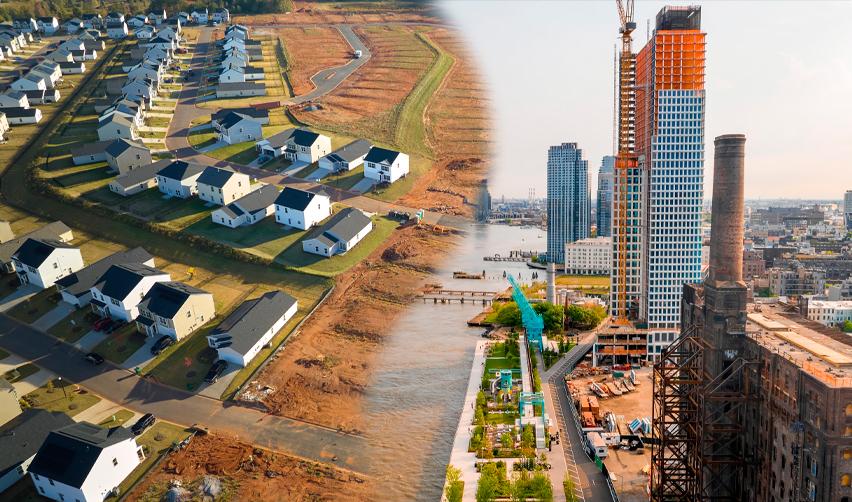
If the question is immigration safety, meaning the probability of reaching a U.S. Green Card efficiently and without prolonged delays, rural projects hold a structural advantage.
If the question is investment safety, meaning the probability that your capital will be returned and your project will create the required jobs, the answer is not about rural versus urban. It is about the project sponsor, the capital structure, the economic case for the underlying business, and how honestly those elements are presented in the offering documents.
Most investors are pursuing a Green Card first and a financial return second. For those investors, the combination of a larger visa set-aside quota, priority processing, and a well-underwritten project makes rural EB-5 the most defensible choice for the majority of applicants.
Investors from countries with low EB-5 demand, or who have a strong preference for a specific urban project should weigh those circumstances carefully. No single category is right for every investor, and any decision should be made with the guidance of an experienced immigration attorney.
More than 3,000 families from over 70 countries have selected EB-5 projects sponsored by EB5AN regional centers. Our expert team has more than a decade of experience and offers clients high-quality, low-risk EB-5 regional center projects with a 100% USCIS project approval rate.
If you would like to know more about your EB-5 investment options, book a free call with our expert team today.