

Two upcoming regulatory deadlines will increase the total cost of pursuing an EB-5 Green Card by between $104,275 and $141,775 within the next 60 days. On November 30, 2026, initial government filing charges for Form I-526E will rise from $4,675 to $8,950—an increase of $4,275.
On January 1, 2027, the minimum investment amount under the EB-5 Reform and Integrity Act of 2022 (RIA) is scheduled to increase from $800,000 to an estimated $900,000 or $937,500 for targeted employment area (TEA) projects.
“Investors still have time to file at today’s costs, but they need to start preparing now,” says Sam Silverman, managing partner of EB5AN. “Retain an experienced immigration attorney and begin gathering your source-of-funds documents. That work takes time, and starting early gives you room to review EB-5 projects carefully and file a complete petition before the increases take effect.”
Preparing an EB-5 petition requires retaining an immigration attorney, documenting source of funds, conducting project due diligence, and assembling the Form I-526E petition. Starting early provides sufficient time to collect financial records, verify fund transfers, and submit a complete filing before higher fees take effect.
Get Started With the EB-5 Process—Schedule a Free Call With EB5AN
When Do EB-5 Form I-526E Filing Fees Increase, and How Much Will They Cost?
When Do EB-5 Minimum Investment Amounts Increase, and What Are the Projected Amounts?
What Steps Should EB-5 Investors Take to Prepare Before the Deadlines?
What Rural and High Unemployment TEA Projects Are Available Through EB5AN?
How Can Investors File Form I-526E Before EB-5 Costs Rise?
When Do EB-5 Form I-526E Filing Fees Increase, and How Much Will They Cost?
The Form I-526E filing fee increases on November 30, 2026, raising the total initial government filing charges from $4,675 to $8,950—a combined increase of $4,275. The Department of Homeland Security (DHS) published this final fee rule on September 30, 2026, establishing the new fee schedule for all initial petitions postmarked on or after November 30, 2026.
The current and new charges for an initial filing are:
| Government fee | Before November 30, 2026 | On or after November 30, 2026 |
|---|---|---|
| Form I-526E filing fee | $3,675 | $7,850 |
| Separate EB-5 Integrity Fund fee | $1,000 | $1,100 |
| Combined total | $4,675 | $8,950 |
The Form I-526E petition fee increases by $4,175, rising from $3,675 to $7,850. An additional $100 increase in the EB-5 Integrity Fund fee brings the total government increase to $4,275.
These government charges cover initial petition submission only. They do not include the minimum capital investment, project administrative fees, immigration attorney fees, or subsequent immigration filings for family members.
To use the current $4,675 fee schedule, Form I-526E petitions must be postmarked before November 30, 2026. Prospective investors should consult an immigration attorney immediately to establish a filing timeline that accommodates source-of-funds document collection and regional center project selection.
When Do EB-5 Minimum Investment Amounts Increase, and What Are the Projected Amounts?
The EB-5 minimum investment amount is scheduled to adjust for inflation on January 1, 2027, increasing from $800,000 to an estimated $900,000 or $937,500 for TEA projects, and from $1,050,000 to an estimated $1,200,000 or $1,250,000 for standard non-TEA projects. Under the EB-5 Reform and Integrity Act of 2022 (RIA), minimum capital requirements undergo automatic five-year inflation adjustments based on the Consumer Price Index.
The statutory calculation adjusts the standard non-TEA minimum using cumulative changes in the Consumer Price Index and rounds down to the nearest $50,000. The reduced minimum for targeted employment areas (rural and high unemployment areas) and infrastructure investments is set at 75% of the adjusted standard amount.
Based on August 2026 inflation data, the standard minimum is projected to rise from $1,050,000 to $1,250,000. At a standard baseline of $1,250,000, the 75% TEA rate equals $937,500 before rounding, or $900,000 if DHS applies rounding down to the nearest $50,000 as outlined in its July 2026 proposed rule. If cumulative inflation falls below the higher threshold, the standard amount would rise to $1,200,000, yielding the same $900,000 TEA minimum.
Under either projection, TEA investors face an increase of $100,000 to $137,500 in required capital.
The higher investment threshold applies to Form I-526E petitions filed on or after January 1, 2027. Selecting a project or transferring capital without filing Form I-526E does not lock in the $800,000 minimum.
Filing Form I-526E before November 30, 2026, avoids both the $4,275 government fee increase and the minimum investment increase. Filing between November 30, 2026, and December 31, 2026, requires paying the higher government fees but locks in the current $800,000 TEA investment minimum.
What Steps Should EB-5 Investors Take to Prepare Before the Deadlines?
EB-5 investors should retain an immigration attorney, assemble source-of-funds records, and select an approved regional center project before the upcoming cost deadlines.
To complete an EB-5 petition before costs increase, investors should follow these steps:
- Retain an experienced EB-5 immigration attorney: Engage legal counsel early to evaluate immigration objectives, assess the capital source, and establish a filing schedule targeting submission before November 30, 2026.
- Compile source-of-funds documentation: Gather lawful source-of-funds evidence, including tax returns, employment records, business ownership documents, real estate transaction records, or gift documentation. In addition to confirming the origin of funds, document the complete transfer path between financial accounts.
- Compare EB-5 projects and regional center track records: Evaluate regional center approval histories, developer track records, job-creation buffers, and construction schedules. Request audited records and third-party reports.
- Examine capital structure and security terms: Review the offering documents to assess capital stack seniority, mortgage security, equity pledges, and developer repayment guaranties.
- Verify Form I-956F approval status: Confirm that the regional center has filed or received approval for Form I-956F (Application for Approval of an Investment in a Commercial Enterprise), which USCIS requires before an investor’s Form I-526E petition.
- Execute subscription documents and file Form I-526E: Coordinate subscription agreements, capital transfer confirmations, and legal petition packets to ensure a postmark date prior to the applicable deadlines.
Maintaining progress on source-of-funds documentation during project selection prevents administrative delays from pushing filings past the deadlines.
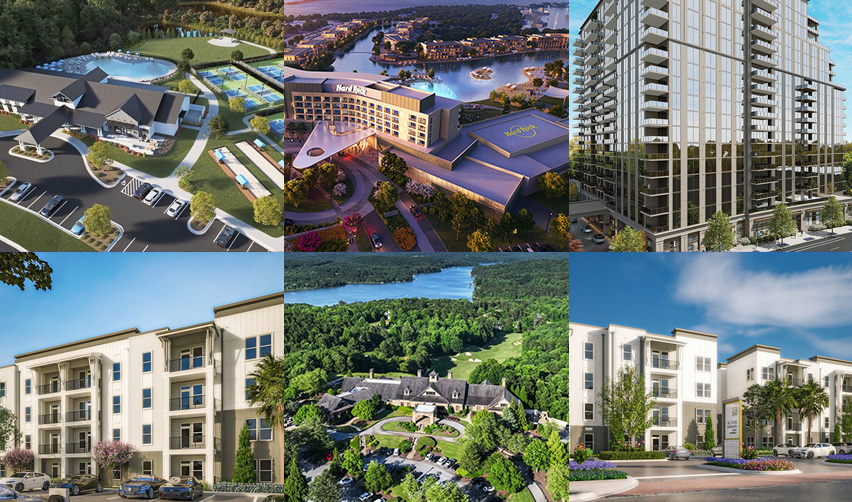
What Rural and High Unemployment TEA Projects Are Available Through EB5AN?
EB5AN offers rural and high unemployment area (HUA) investment opportunities with Form I-956F approvals and independent loan security:
- Currahee Club (Senior Loan): A rural residential community spanning 1,087 acres in Toccoa, Georgia. The project features home sites, amenities, and a Jim Fazio-designed golf course managed by Troon Privé. The offering holds Form I-956F approval, and the senior loan is secured by a recorded first mortgage and an equity pledge.
- Hard Rock Pointe Vista (Senior Loan): A hotel and condominium development on Lake Texoma qualifying for both rural and high unemployment TEA status. The project includes a 217-room Hard Rock hotel, 131 branded condominiums, and the Caribbean Bay water park. The offering holds Form I-956F approval, construction is in progress, and the senior loan is secured by mortgages and an equity pledge.
- Grand Park (Senior Loan): A 264-acre rural master-planned community in Fraser, Colorado, near Winter Park Resort, including single-family homes, apartments, retail space, and lodging. The project holds Form I-956F approval, with over 410 qualifying EB-5 jobs created as of July 2026. The senior loan is secured by a recorded mortgage and equity pledge.
- Lakeview Landing Phase 2 (Equity and Loan): A 208-unit rural multifamily apartment community in Granbury, Texas, developed by Realty Capital Residential, within the same 48-acre mixed-use development as Phase 1. Each offering qualifies as both a rural and an HUA project. The equity offering carries a 4% preferred return, while the debt offering features a distinct loan structure.
- Spring Haven (Loan): An HUA active-adult community in Newnan, Georgia, developed by The Kolter Group as part of its Cresswind series. The project holds Form I-956F approval, reports 100% of required EB-5 jobs already created, and includes a repayment guaranty from a Kolter parent entity.
- Brandon Multifamily (Equity and Loan Offerings): A 280-unit HUA apartment community in Florida developed by The Kolter Group. The project holds Form I-956F approval. The equity offering provides a 5% preferred return, while the loan offering includes a parent company repayment guaranty.
- Elyse Atlanta (Loan): A 194-unit condominium development on West Paces Ferry Road in Buckhead, Atlanta, qualifying as an HUA project. Construction is underway with over 394 qualifying jobs created. The offering features a three-year loan term with completion, funding, and repayment guaranties.
How Can Investors File Form I-526E Before EB-5 Costs Rise?
Investors can secure the current $800,000 TEA investment minimum and the existing $4,675 government filing fee by postmarking Form I-526E before November 30, 2026. Filing before this initial deadline prevents $4,275 in added government charges and protects against a projected $100,000 to $137,500 increase in minimum required capital.
For investors unable to file by November 30, submitting Form I-526E before January 1, 2027, preserves the $800,000 TEA capital requirement, even though the new $8,950 government filing charges will apply.
To begin petition preparation, contact an experienced immigration attorney to initiate source-of-funds reviews. Schedule a free consultation with EB5AN to examine qualifying rural and HUA projects with Form I-956F approvals and begin the EB-5 visa process at current investment levels.