
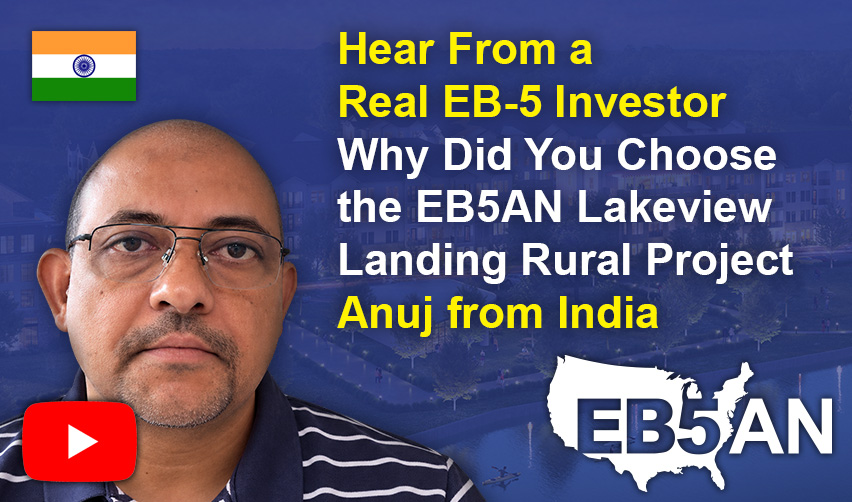
My name is Anuj. I am originally from India, have worked as a banker for 30 years, and currently live in Dubai. I have lived in more than five countries, and I have many relatives and children in the United States.
Although I have never lived there, I visit for holidays and to see family. I recently invested in EB5AN’s Lakeview Landing rural EB-5 loan project.
My primary reason for pursuing EB-5 was my son, who is studying in the United States. The uncertainty surrounding work visas, including H-1B, made me think carefully about what would happen after he graduated. I wanted him to have the flexibility to work in the United States without the continuing stress of depending on a work visa.
Timing also mattered to me. I understood that the EB-5 program in its current form could change in the future, so I wanted to submit my application under the structure available when I made the decision. Once I concluded that EB-5 was the right approach for my family, I did not want to delay unnecessarily.
The process required several separate decisions. I had to select an immigration attorney, develop a source-of-funds strategy, compare regional centers, decide between rural and high-unemployment projects, and choose an offering that matched my financial preferences. Understanding where to start the EB-5 process helped me turn those questions into an order I could follow.
The most time-consuming part was the source of funds. It took roughly three to four months because I changed the planned structure twice. My capital came from salary income, but over many years I had invested that income in different assets. I therefore had to trace how I acquired those assets and locate bank statements that were 10 or even 15 years old.
My project search eventually brought me to EB5AN. I considered about four regional centers, including two I found through my own research and two suggested by my immigration attorney. One of those suggestions was EB5AN. My discussions with Jordan gave me the information and time I needed to make a decision without feeling pushed.
I chose Lakeview Landing because it was a rural apartment project with a shorter term than many of the alternatives I reviewed. I preferred a straightforward project focused on one asset class rather than a more complex hotel or resort development. The subscription process was smooth, and my experience with EB5AN has been excellent so far.
In this post, I explain how I chose my attorney, why the source-of-funds work took several months, how I compared regional centers and projects, how I used artificial intelligence as a research aid, and why I would recommend EB5AN to other investors.
Watch Anuj’s Interview Highlights
Watch Anuj’s Full Interview
Why I Chose EB-5 for My Son
How I Selected an EB-5 Immigration Attorney
Why My Source-of-Funds Work Took Three to Four Months
How I Compared Regional Centers
Why I Preferred a Rural Project
Why I Chose Lakeview Landing
How I Used AI During Project Research
My Experience Working With EB5AN
My Advice for Prospective EB-5 Investors
Why I Chose EB-5 for My Son
My son’s plans after university drove the decision. Studying in the United States was only one stage. The larger question was whether he would be able to remain there and build a career after graduation. For an international student, immigration status can shape which opportunities are realistically available, so I wanted to address that uncertainty before it became urgent.
I was familiar with the United States through my family and regular visits, even though I had never lived there myself. That made the decision concrete rather than theoretical. I could see why my son wanted the option to stay, and I viewed EB-5 as a family decision that could give him greater control over where and for whom he worked.
I also knew that beginning the process would require a substantial commitment of time and capital. Once I decided to proceed, I wanted to move while the program structure I had evaluated was still in place. That meant finding qualified professionals and preparing the application rather than waiting for every uncertainty to resolve itself.
How I Selected an EB-5 Immigration Attorney
My research began with a Google search for the EB-5 program. I first contacted a regional center other than EB5AN. As part of those discussions, that organization gave me the names of three or four immigration law firms. I spoke with all of them to understand their process, fees, and knowledge of the program before deciding whom to engage.
I selected an attorney who had experience at an immigration law firm and was beginning an independent practice. I believed an independent practitioner might have more time to work closely through my documents. Her answers also showed that she understood the program. I did not choose simply by looking for the largest or best-known firm.
My advice is to look at two factors together: experience and availability. An attorney may have an impressive name, but an investor also needs someone who can devote enough time to the individual case. Source-of-funds work is detailed, and the quality of the working relationship matters when the attorney and investor must examine years of financial records.
Why My Source-of-Funds Work Took Three to Four Months
The delay in my case did not come from an inability to explain how I earned the money. I have worked in banking for decades, and the underlying source was salary income. The complication was that income earned over time had moved into different asset classes. Establishing the complete path required records connecting the salary, the investments, and the capital eventually used for EB-5.
Some of the supporting bank statements were 10 or 15 years old. I had retained enough records that the task was manageable, but it still required effort. This experience taught me that lawful income alone does not make the documentation automatic. The investor must be able to show how money moved through each relevant stage.
I also changed my proposed funding structure twice. Tax optimization was part of the decision, as was the timing of when to liquidate certain assets. Each change affected the documents and tracing work. The three-to-four-month timeline therefore reflected choices on my side as well as the work needed to assemble the evidence.
For another investor, the exact records will depend on how the capital was earned and invested. The broader lesson is to take the process seriously and begin as soon as possible. It is also useful to keep more than one funding option available. If the preferred structure becomes impractical, a workable plan B or plan C can prevent the entire filing from stopping.
How I Compared Regional Centers
Once my attorney was in place, I asked about possible projects and regional centers. I reviewed roughly four regional centers in total. I found two through my own research, while my attorney suggested that I examine two others. EB5AN was one of her suggestions, and that introduction led to my conversations with Jordan.
The firms differed in how they communicated. Some representatives responded promptly, while another did not. Responsiveness alone cannot decide an investment, but it reveals how seriously a firm treats an investor’s questions. If it is difficult to obtain answers before investing, that experience deserves attention during regional center due diligence.
Jordan was consistently responsive. Our discussions were calm and balanced, and he explained the advantages and disadvantages of different projects.
I do not like being pushed into a decision. I felt that Jordan gave me the information I requested without an aggressive sales pitch, and that approach increased my confidence in working with EB5AN.
Why I Preferred a Rural Project
One early decision was whether to choose a rural project or one in a high-unemployment area. The first regional center I contacted primarily offered high-unemployment projects, so I spent time considering that category before deciding that a rural offering better matched my priorities.
Visa availability was important. I compared the 20% rural reservation with the 10% reservation for high-unemployment projects. I was also told that decisions for rural projects could move faster. Based on the information available to me, the rural category appeared to offer a stronger combination of reserved visa availability and speed.
Why I Chose Lakeview Landing
I considered both rural and high-unemployment offerings while speaking with Jordan. Lakeview Landing appealed to me because it was an apartment project. I was more comfortable with apartments used by residents than with commercial projects such as hotels or resorts. The asset class was easier for me to understand and evaluate.
Simplicity mattered as well. I looked at a large ski-resort project but found it complex. I preferred a project centered on a single asset class. Lakeview Landing gave me that simpler structure, while the project’s location within a larger development provided additional context for my research.
The investment term was another important difference. I understood Lakeview Landing to have a three-plus-one-year term, compared with five-plus-one years for many other projects I reviewed. A shorter expected commitment was more attractive to me, so investment duration became one of the reasons I selected the project.
My choice reflected my own preferences rather than a claim that every investor should choose the same kind of project. Another person may be comfortable with a hotel, resort, or more complicated development. I wanted an apartment project, a rural category, a shorter term, and a structure I could explain clearly to myself.
How I Used AI During Project Research
The project documents I reviewed were substantial. Some were 50 or 60 pages, while others ran to 120 pages. I used tools such as Claude and ChatGPT to synthesize the materials and identify the main features I needed to examine. This made it easier to organize questions across several projects.
I also used AI to look beyond the projections presented in the documents. I wanted to understand how the business assumptions compared with the market and what publicly available information suggested about each project’s outlook. The tools helped me find lines of inquiry that I could then consider alongside the formal materials.
For Lakeview Landing, that research indicated that the project formed part of a larger development at the site and that a local government authority was participating in infrastructure development. I did not recall seeing all of that context in the project documentation. The additional public information helped me understand the setting more fully.
AI did not make the final decision for me. I combined those summaries and public-information searches with my own review, discussions with regional centers, and questions to Jordan. The value was synthesis and organization: the tools helped me process a large volume of material and compare it more consistently.
My Experience Working With EB5AN
Once I decided to join Lakeview Landing, the subscription process was absolutely smooth. EB5AN’s responsiveness was excellent, and my questions were answered within a day. I received timely, substantive responses throughout the process and had no complaints about how the investment was handled.
The quality of those answers mattered as much as the speed. Jordan had already given me balanced views while I compared the available projects, and that same standard continued during subscription. The experience supported my sense that EB5AN would communicate directly rather than pressure me to move before I was ready.
I also had the opportunity to meet Jordan in Houston while I was there for a family visit. By then, our earlier discussions had already built confidence, and meeting in person was a welcome part of the experience. My application has since been submitted, and my experience with EB5AN remains excellent.
My Advice for Prospective EB-5 Investors
Start early. Source-of-funds documentation is involved, even when the capital comes from a clear source such as salary. Old bank records, investment transactions, tax considerations, and decisions about asset liquidation can all add time. Beginning early gives the investor and attorney room to choose the cleanest workable structure.
Choose an experienced immigration attorney who can devote time to the case. Ask questions about the process and fees, but also assess how the attorney will work through your records. The right lawyer should understand the program and have enough availability to examine the facts carefully.
Be clear about the source-of-funds structure as early as possible, and keep backup options available. If the first structure changes because of taxes, liquidation timing, or missing records, an alternative can preserve momentum. Clarity at the beginning is better than rebuilding the approach after months of work.
Compare projects instead of accepting the first option presented. Decide whether rural or high unemployment better suits your immigration priorities. Consider the asset class, project complexity, investment term, and the responsiveness of the people answering your questions. The right choice is the one that fits your own priorities and that you understand.
For parents facing work-visa uncertainty for a child studying in the United States, I believe EB-5 can be a practical way to address that problem if the family can commit the capital. Based on my research and experience so far, I would be happy to recommend both my immigration attorney and EB5AN.