
More than four years have passed since the EB-5 Reform and Integrity Act of 2022 (RIA) introduced the most significant changes to the EB-5 program in decades. Since then, the post-RIA EB-5 market has grown rapidly, thousands of investors have filed I-526E petitions, and the EB-5 program has continued to provide foreign nationals and their families with U.S. Green Cards.
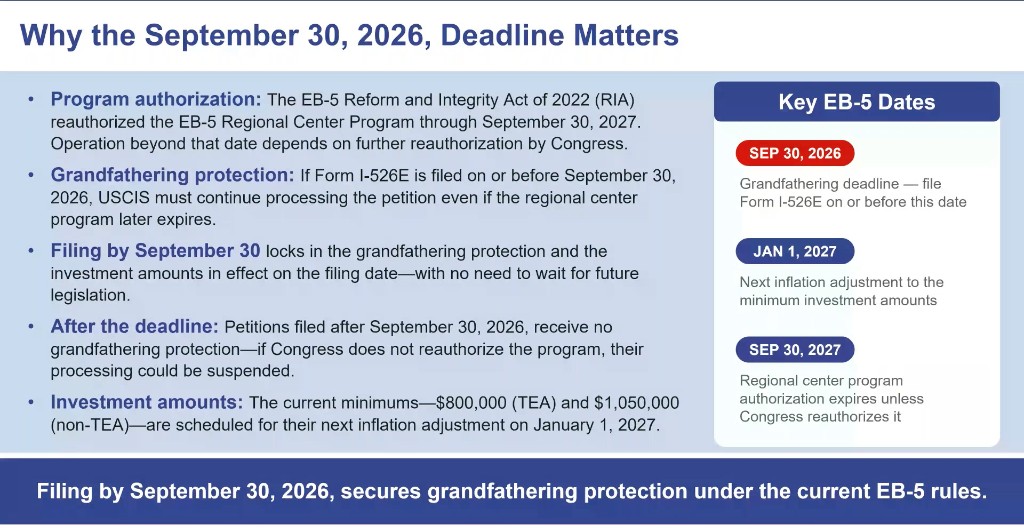
But the RIA also introduced an important deadline for EB-5 investors. Under the RIA, investors who file their Form I-526E petitions by September 30, 2026, receive grandfathering protection that allows their cases to continue to be adjudicated—even if the EB-5 Regional Center Program later expires or is temporarily suspended.
That deadline is now only about 30 days away — and with it, the final window for new EB-5 investors to file under the RIA’s current grandfathering provision.
September 30, 2026, does not mark the expiration of the regional center program itself, which remains authorized through September 30, 2027. Investors can continue filing after the grandfathering deadline. But those who file after September 30, 2026, will no longer receive the same statutory protection under the law as it currently stands.
For foreign nationals considering EB-5, now is the time to begin the investment process and secure their U.S. Green Cards.
To explain what the deadline means and what prospective investors should do to file by September 30, EB5AN held an investor education webinar hosted by managing partners Sam Silverman and Mike Schoenfeld and senior VP Ahmed Khan.
The webinar covers the practical steps required to file before September 30, including source-of-funds preparation and selecting an EB-5 project. We also explain what investors should do if meeting the grandfathering deadline is no longer realistic.
EB5AN is offering free consultations for prospective EB-5 investors who want to file before September 30. Our team can help investors connect with an experienced EB-5 immigration attorney and identify the steps needed to begin preparing an I-526E filing immediately.
As we discuss in the webinar, getting started now is crucial. The September 30 deadline is the final opportunity for new regional center investors to secure the RIA’s current grandfathering protection.
For families pursuing U.S. permanent residence through EB-5, acting within this window can provide an important safeguard against the uncertainty and potential delays that could result from a future lapse in the regional center program.
We invite prospective investors to schedule a free consultation with EB5AN and begin the EB-5 process today. In the meantime, please watch the full webinar or highlights—or read our summary below.
Schedule a Free Consultation to File Your EB-5 Petition by September 30
Highlights
Full Webinar
What the September 30, 2026, Grandfathering Deadline Means for EB-5 Investors
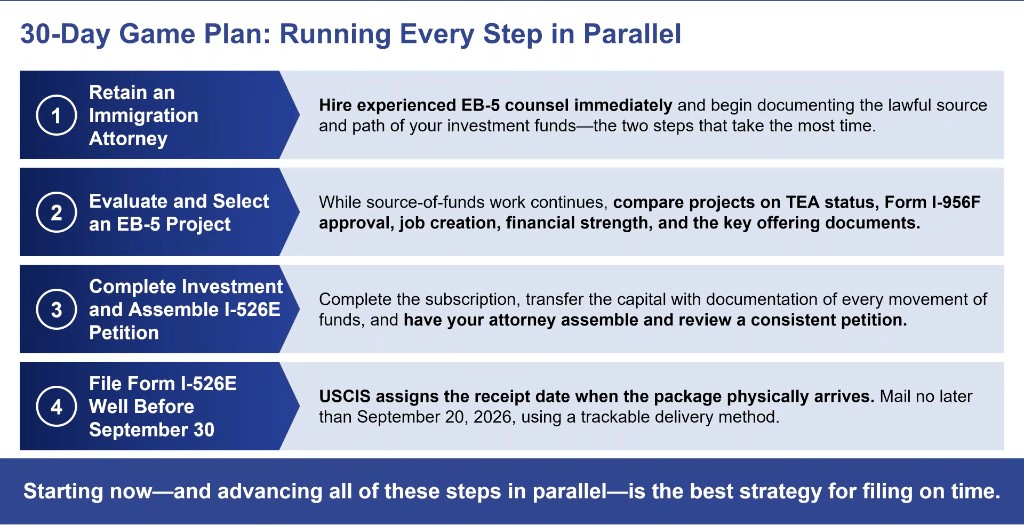
How to Prepare an EB-5 Petition Before September 30
- Hire an EB-5 Immigration Attorney Immediately
- Evaluate EB-5 Projects While the Attorney Prepares the Source-of-Funds Case
- Choose EB-5 Projects With Form I-956F Approval
- Complete the Subscription and Investment Early Enough to File
Choosing an I-956F-Approved EB-5 Project Before the Deadline
- Currahee Club Rural EB-5 Project
- Hard Rock Pointe Vista Rural EB-5 Project
- Spring Haven Urban EB-5 Project
- Brandon Multifamily Urban EB-5 Project
- Choosing a Project
Prospective EB-5 Investors Should Begin the Process Now
What the September 30, 2026, Grandfathering Deadline Means for EB-5 Investors
The grandfathering provision was one of the important investor protections created by the RIA in 2022.
The RIA also introduced broader safeguards for EB-5 investors, increased oversight of regional centers, and strengthened transparency and compliance requirements across the program.
Before the RIA, regional center investors had no statutory protection against a lapse in program authorization. When the EB-5 Regional Center Program expired in June 2021, thousands of pending petitions were effectively placed on hold. USCIS could not continue processing those cases until Congress reauthorized the program in March 2022.
The EB-5 Program itself dates to 1990, and the regional center program was created in 1992. For most of its history, the regional center program remained available through repeated congressional renewals, although many of those extensions were short-term.
The RIA addressed that problem. Regional center investors who file on or before September 30, 2026, are protected if the program later expires. USCIS can continue adjudicating those petitions even during a future lapse in authorization.
The regional center program itself remains authorized through September 30, 2027. As a result, investors who file after September 30, 2026, can still pursue EB-5 under the current law. Their petitions simply will not have the same grandfathering protection.
For an investor who can prepare a strong, complete case before September 30, filing within the grandfathering period offers a significant layer of immigration safety.
That does not mean EB-5 investors should submit weak or incomplete cases simply to beat the deadline. In 2026, USCIS has become increasingly demanding in its review of EB-5 petitions, particularly with respect to source and path of funds, project documentation, and compliance with RIA requirements.
Investors who cannot reasonably complete their cases before September 30 still have another significant reason to move quickly.
Beginning January 1, 2027, EB-5 investment amounts are scheduled to be adjusted for inflation. The current minimum investment is $800,000 for a project located in a rural area or high-unemployment area and $1,050,000 for investments outside a TEA. The new amounts have not yet been finalized, but investors should expect an increase.
For this reason, September 30 and December 31 represent two distinct deadlines—both very significant for EB-5 investors.
Investors who file by September 30 can obtain grandfathering protection and preserve the current investment amount. Investors who miss September 30 can still file under the regional center program, but they should consider completing their investments and petitions well before the end of the year to avoid the scheduled 2027 increase.
How to Prepare an EB-5 Petition Before September 30
Hire an EB-5 Immigration Attorney Immediately
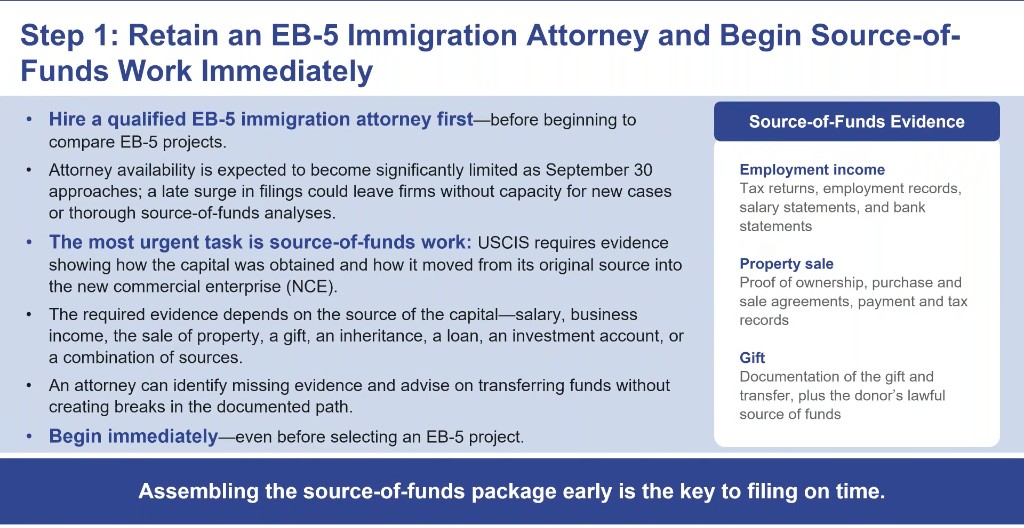
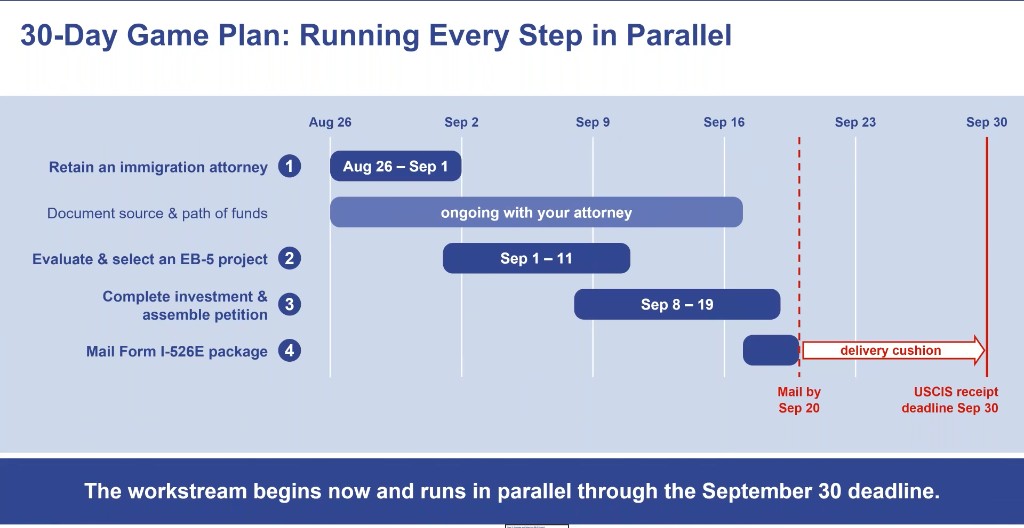
The most important first step to meeting the September 30 deadline is retaining an experienced EB-5 immigration attorney.
Documenting the source and path of funds is typically the most time-consuming part of an investor’s I-526E petition.
The immigration attorney must establish that the investor’s EB-5 capital was obtained through lawful means and trace the movement of those funds into the EB-5 investment. Depending on the source of capital, this can require a variety of sources.
These include employment records, tax returns, bank statements, property records, loan documents, corporate records, gift documentation, transaction histories, and other evidence.
Even sources that appear straightforward can require substantial documentation.
An investor whose capital comes from salary, bonuses, stock compensation, or accumulated savings may initially expect the source-of-funds analysis to be simple. But the immigration attorney may still need records covering years of earnings, bank activity, asset purchases, transfers, and other transactions to establish a clear source and path of funds.
With approximately 30 days remaining before September 30, attorney capacity has also become a practical concern. Many experienced EB-5 attorneys are already handling significant filing volumes and may stop accepting cases intended for filing before the deadline.
Investors planning to file by September 30 should therefore retain counsel immediately and begin providing documentation as soon as possible.
Evaluate EB-5 Projects While the Attorney Prepares the Source-of-Funds Case
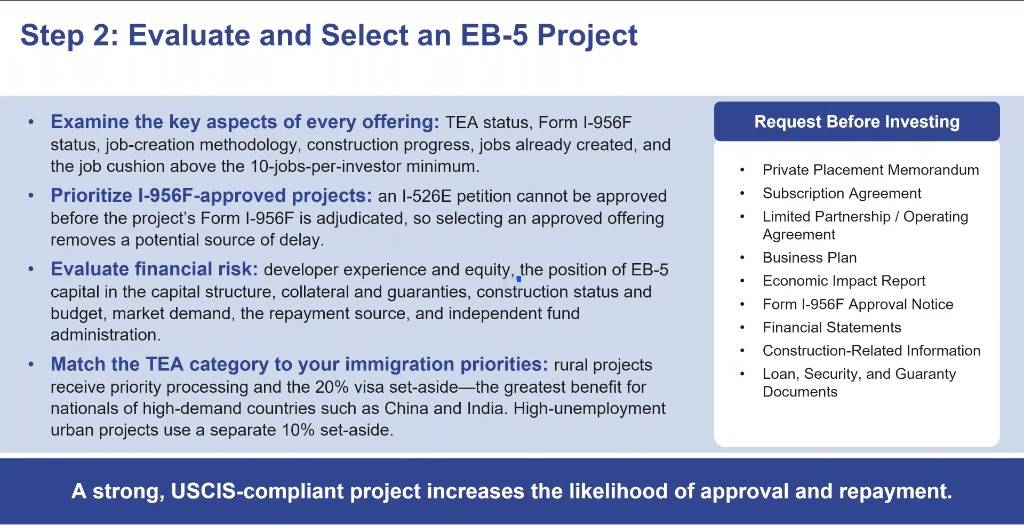
Investors should start researching EB-5 projects while the source-of-funds work is still underway.
An investor does not need to wait until the source-of-funds package is finished before selecting EB-5 projects. While the immigration attorney reviews the investor’s documentation, the investor can compare available EB-5 projects, review offering documents, speak with regional centers, and determine which investment best fits his family’s priorities.
Those priorities will vary.
Some investors place the greatest emphasis on immigration speed and may prefer a rural project because rural petitions qualify for priority processing and rural investments receive 20% of the annual EB-5 visa allocation.
Other investors may prefer a high-unemployment-area project involving a major developer, an established real estate market, a shorter expected investment period, or a different risk-and-return profile.
Investors from China, India, and other high-demand countries should also consider the possibility of future visa backlogs. Filing volume has increased substantially in the rural category, particularly as investors have responded to priority processing.
The best project category for an individual investor can therefore depend on country of birth, visa availability, adjustment-of-status eligibility, investment objectives, and other circumstances.
Moreover, EB-5 processing trends have changed significantly since the RIA. Before investors had meaningful approval data on rural priority processing, approximately twice as many filings were going into high-unemployment-area projects as rural projects. As the effects of rural priority processing became clearer, that ratio shifted in the opposite direction, with roughly twice as many filings going to rural projects.
Recent USCIS data also shows substantially more pending rural petitions, although rural projects benefit from twice the visa set-aside allocated to high-unemployment areas.
Your choice of an EB-5 project should reflect your individual priorities in terms of immigration and financial outcome.
Choose EB-5 Projects With Form I-956F Approval
Form I-956F approval has become particularly important in the current adjudication environment.
USCIS uses Form I-956F to review the underlying EB-5 project. Approval confirms that USCIS has reviewed the project’s principal EB-5 documentation and found the filing compliant with applicable program requirements.
An investor who files in a project with a pending I-956F assumes additional immigration risk. If USCIS later denies the project’s I-956F, individual investors may face denial of their related I-526E petitions and may have to reinvest and file again.
That risk carries even greater consequences as September 30 approaches. An investor could successfully file before the grandfathering deadline—and then lose the benefit of that timing if the underlying project is later denied and a new petition must be filed.
For investors filing during this period, choosing a project that already has I-956F approval reduces risk significantly.
Financial due diligence is still important as well. Investors should review the project’s capital structure, construction status, developer financial strength, job creation, and offering documents before investing.
Additionally, keep in mind that a regional center’s marketing materials should never substitute for reading the offering documents.
Complete the Subscription and Investment Early Enough to File
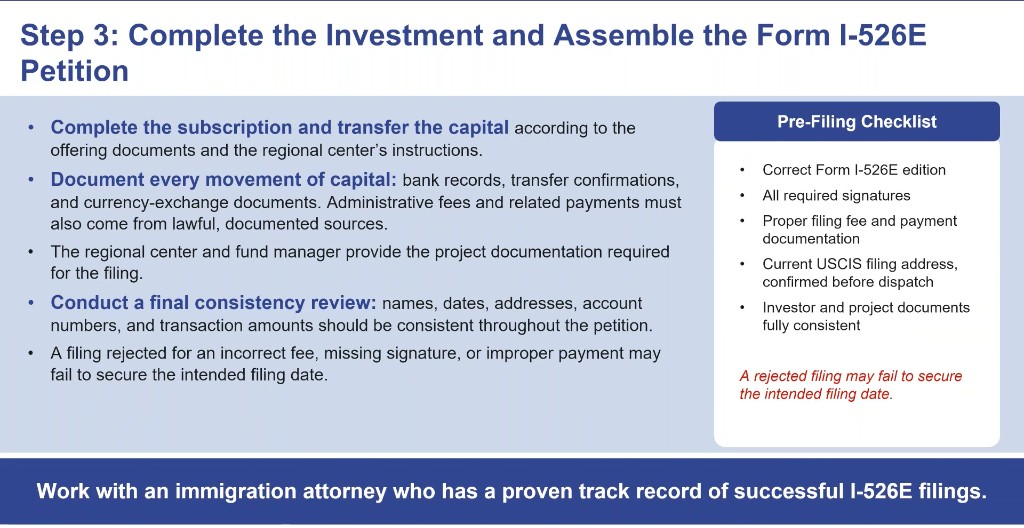
Once the attorney is comfortable with the source-of-funds documentation and the investor has selected a project, the investor can complete the subscription process and transfer the required capital.
A regional center’s processing times are key at this stage.
EB5AN generally completes subscription processing very quickly, often within approximately 24 hours after receiving the required materials. Other regional centers may require several days or longer. Investors should understand these timelines before reaching the final days of the filing period.
For most EB5AN investors, the full subscription and funding process can be completed within approximately two to three days, and in some cases even faster. Investors working against the September deadline should nevertheless allow substantially more time than the minimum required in case banking, documentation, or other unexpected issues arise.
After the subscription and investment are complete, the regional center supplies the necessary project documents to the investor’s immigration attorney. The attorney then assembles the complete I-526E petition with the investor’s source-of-funds documentation and supporting evidence.
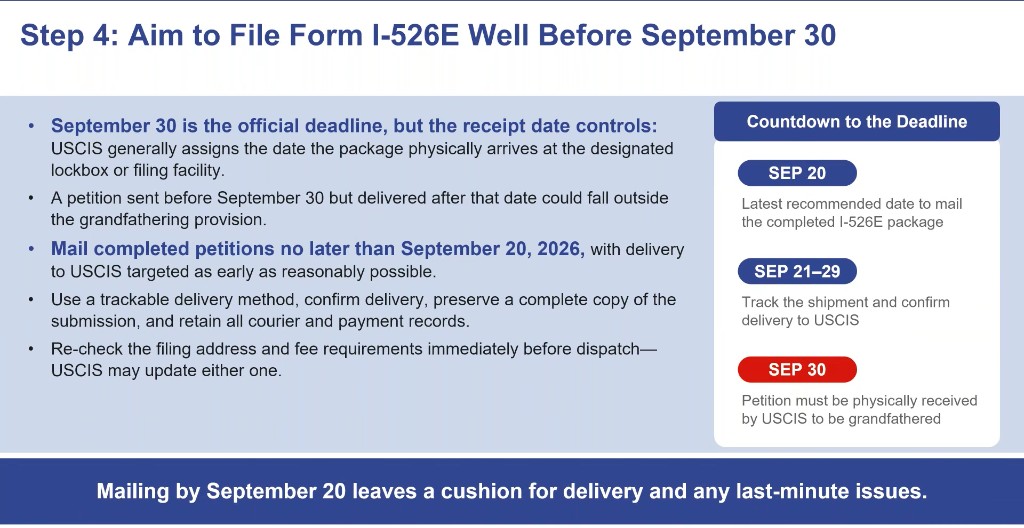
Investors should also remember that Form I-526E remains a paper filing.
Shipping delays, law-firm processing constraints, courier problems, or other unexpected issues can become serious problems when a petition is mailed at the last possible moment.
A safer target to mail Form I-526E is approximately September 20. That provides additional time for final review, printing, shipping, delivery, and resolution of unexpected issues before the statutory deadline.
Choosing an I-956F-Approved EB-5 Project Before the Deadline
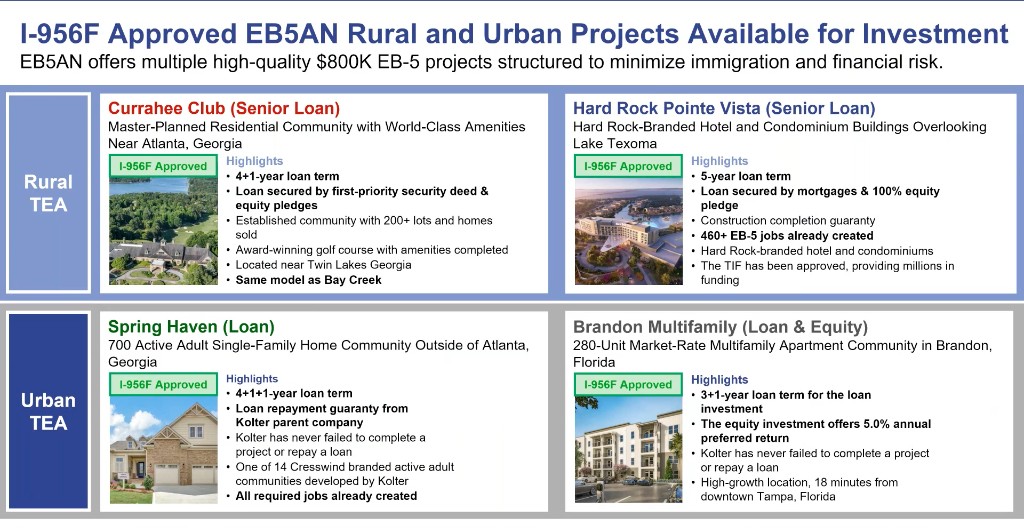
EB5AN currently offers both rural and high-unemployment-area investments with Form I-956F approval, allowing investors to compare projects with substantially different immigration and financial characteristics.
EB5AN has received more than 30 Form I-956F approvals under the RIA without a project denial and has increasingly emphasized obtaining project approval before making new offerings broadly available to investors.
Currahee Club Rural EB-5 Project
Currahee Club is a rural EB-5 project in Toccoa, Georgia, centered on an established master-planned golf community.
The project includes an existing championship golf course, clubhouse and recreational amenities, single-family residential development, and hospitality components. The EB-5 investment is structured as a senior loan secured by a recorded mortgage.
The development is fully permitted and entitled under its approved master plan, limiting many of the early-stage entitlement and development risks associated with new real estate projects.
Currahee Club recently received Form I-956F approval from USCIS. Its rural location also qualifies investors for rural priority processing and access to the 20% rural visa set-aside.
The EB-5 loan has a four-year term with a possible one-year extension, offering investors a relatively defined investment timeline.
The project’s residential and hospitality model also follows the same general development fundamentals as earlier EB5AN rural projects including Bay Creek and Twin Lakes.
Hard Rock Pointe Vista Rural EB-5 Project
Hard Rock Pointe Vista is a rural EB-5 development on Lake Texoma near the Texas-Oklahoma border.
The project includes a Hard Rock Hotel and branded residences within the much larger Pointe Vista master-planned development.
A significant feature of the project is its existing job creation. More than 460 qualifying EB-5 jobs have already been created and recognized in the project’s approved I-956F filing. For investors entering while sufficient jobs remain available, this substantially reduces job-creation risk.
The project also benefits from the Hard Rock brand, local government support, tax-increment financing, and a developer with a substantial balance sheet.
Hard Rock Pointe Vista has received Form I-956F approval and qualifies as a rural project. The EB-5 investment has a five-year loan term.
Spring Haven Urban EB-5 Project
Spring Haven is a high-unemployment-area project being developed by Kolter Group, one of EB5AN’s longest-standing development partners.
The development is a 700-home Cresswind active-adult community in Newnan, Georgia, about 45 minutes from Atlanta.
The project is already well advanced. The community includes approximately 700 homes, with about 260 already sold and approximately 180 delivered to buyers. Residents are already living in the community, and the development is already generating profits. The required EB-5 jobs have also already been created.
The EB-5 loan benefits from a repayment guarantee provided by a Kolter parent company.
EB5AN and Kolter have worked together for more than a decade across numerous EB-5 projects, and Kolter has repaid tens of millions of dollars in EB-5 capital to investors.
For investors who prioritize advanced development, completed job creation, an experienced developer, and significant financial protections, Spring Haven provides an alternative to the rural category.
Brandon Multifamily Urban EB-5 Project
Brandon Multifamily is another high-unemployment-area project being developed with Kolter.
The development is a 280-unit multifamily rental apartment community in Brandon, Florida.
The project is designed around a relatively short development and investment timeline. Construction is expected to take approximately two years, followed by a stabilization period, creating a potential three-to-four-year timeline for return of EB-5 capital.
The project is available in both loan and equity structures.
The equity option offers a 5% annual preferred return and may appeal to investors who want greater financial upside while remaining comfortable with the additional risk associated with an equity investment.
The project’s structure also takes advantage of the post-RIA sustainment framework, under which qualifying investments generally must remain invested for at least two years. This can allow capital to be returned before the investor’s entire immigration process has concluded when the applicable EB-5 requirements have been satisfied.
Choosing a Project
Each of the above projects presents a different combination of immigration benefits, development risk, financial protections, investment duration, and potential return. Investors should compare those characteristics with their own priorities and review the complete offering materials before making an investment decision.
Project availability may also become a practical consideration as September 30 approaches. EB5AN investments are offered on a first-come, first-served basis, without reservations, and individual offerings could fill before the grandfathering deadline.
Prospective EB-5 Investors Should Begin the Process Now
There is still time for some investors to file before September 30, 2026, but completing a well-documented EB-5 petition within the remaining window requires immediate action.
The first priority should be retaining an experienced immigration attorney and beginning source-of-funds work. Project due diligence can proceed at the same time so that the investment can be completed as soon as the legal documentation is ready.
Investors should also leave sufficient time for subscription processing, transferring funds, assembling the final petition, and physically delivering the filing to USCIS.
For investors whose circumstances make a September filing unrealistic, the opportunity to pursue EB-5 remains. The regional center program is authorized through September 30, 2027. However, the scheduled inflation adjustment on January 1, 2027, creates another important deadline for investors who want to invest at the current $800,000 minimum amount.
EB5AN currently has five Form I-956F-approved investment options across its rural and high-unemployment-area offerings.
Prospective investors can contact EB5AN to review project offering documents, compare available options, and obtain referrals to experienced EB-5 immigration attorneys.
Schedule a free consultation with EB5AN today to explore available projects and begin preparing your EB-5 petition before September 30, 2026.