
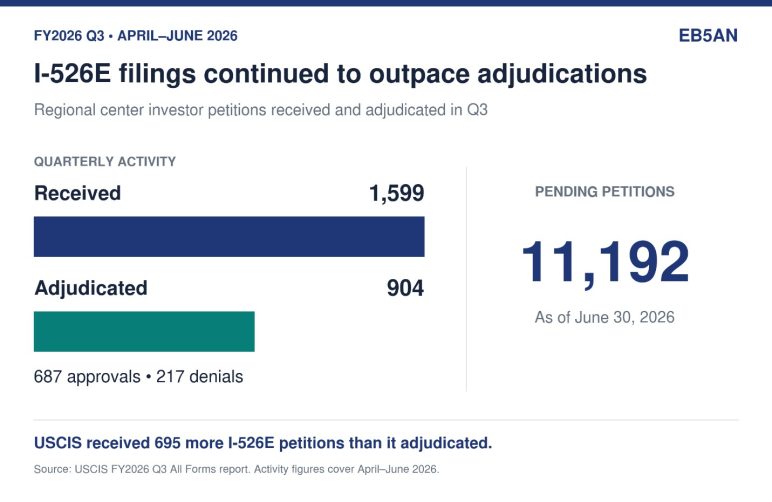
USCIS’s latest EB-5 data shows that new investor filings continued to outpace adjudications in FY2026 Q3, covering April 1 through June 30, 2026. Although I-526E receipts declined modestly from the previous quarter, USCIS also completed fewer petitions. Pending I-526E inventory reached 11,192 by June 30.
Rural projects remained the largest category for new EB-5 investor filings, while India narrowly overtook China in both quarterly and fiscal-year-to-date receipts.
At the project level, USCIS completed more I-956F applications and reported a shorter median processing time. I-829 receipts, meanwhile, increased sharply, contributing to a larger inventory of petitions awaiting removal of conditions.
For prospective investors, these developments make careful preparation increasingly important. The data shows continued demand for EB-5—but also a meaningful share of denials among completed cases.
With the September 30, 2026, grandfathering deadline almost here—along with the January 1, 2027, increase in EB-5 amounts—investors need to evaluate EB-5 projects and prepare their source-of-funds documentation early enough to submit a strong I-526E filing.
We encourage prospective EB-5 investors to read our analysis below and gain industry insights into where the EB-5 program is headed in the remaining months of 2026 and beyond. These insights can help you prepare a strong EB-5 filing for a prompt Green Card approval for yourself and your family.
I-526E Filings Decline Modestly, but Pending Inventory Continues to Grow
Rural Projects Remain the Largest Filing Category
India Narrowly Overtakes China in New Investor Filings
I-526E Denials Rise to 24% of Completed Cases
Project-Level Processing Improves, but I-956F Denials Deserve Attention
Standalone and Legacy I-526 Cases Show Different Processing Patterns
I-829 Receipts Increase Sharply, Adding to Pending Inventory
Preparing a Strong Filing Before January 1, 2027
I-526E Filings Decline Modestly, but Pending Inventory Continues to Grow
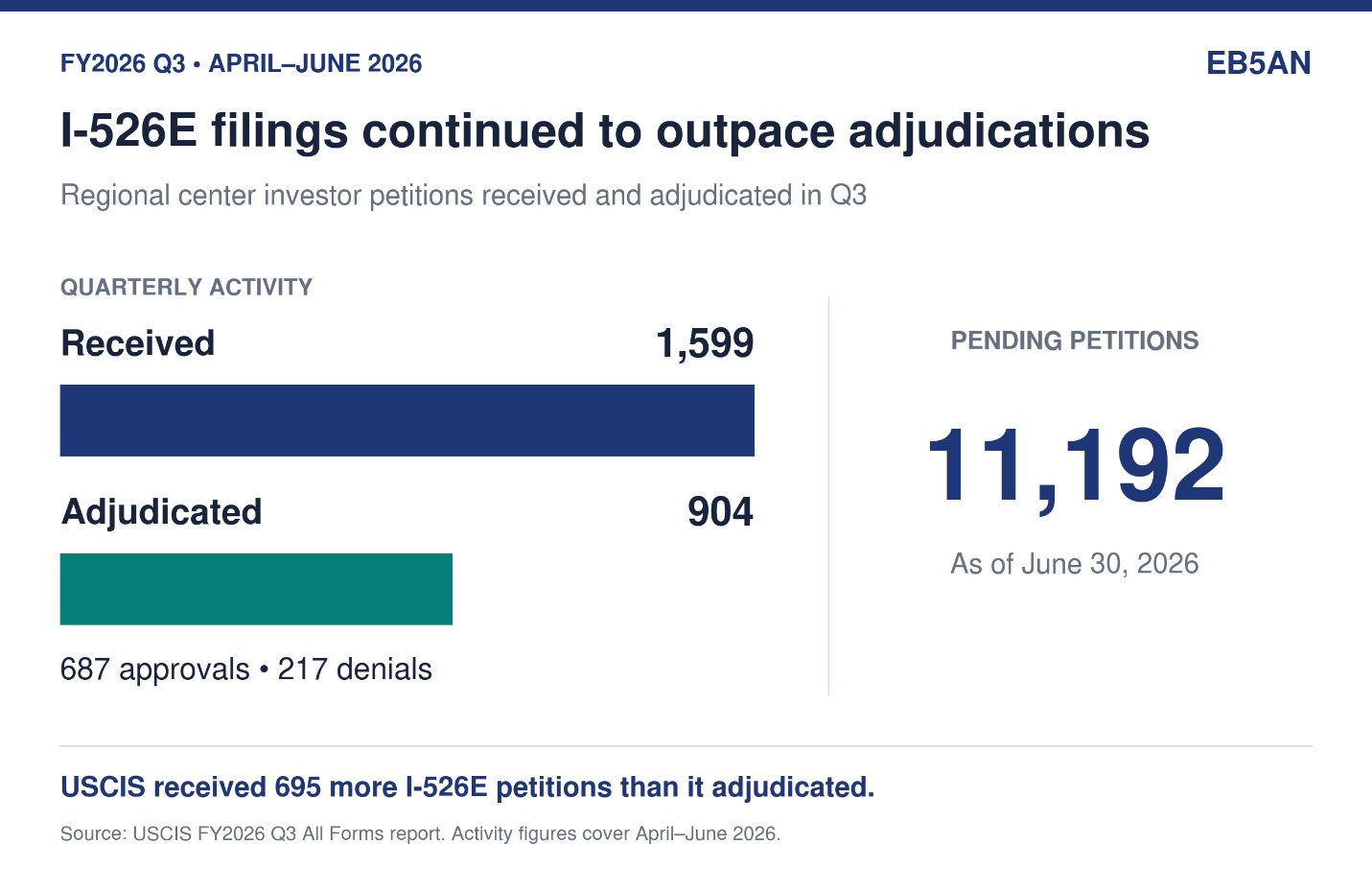
USCIS received 1,599 Form I-526E petitions from regional center investors in Q3, down from 1,699 in Q2. That was a decline of 5.9%. Standalone investors filed another 66 Form I-526 petitions, bringing combined new investor receipts to 1,665.
Regional center filings represented 96% of these receipts, continuing to account for the overwhelming majority of new EB-5 investor petitions.
USCIS adjudicated 904 I-526E cases during Q3, including 687 approvals and 217 denials. Adjudications fell 7.8% from the 980 reported for Q2, a larger percentage decline than the decrease in receipts.
The relationship between receipts and adjudications helps explain the growing pending inventory of I-526E petitions. USCIS completed approximately 57 I-526E cases for every 100 new petitions received in Q3. Receipts exceeded adjudications by 695.
The first nine months of FY2026 show a similar pattern. USCIS received 4,986 I-526E petitions and adjudicated 2,850, leaving a difference of 2,136.
Adjudication volume has remained well below incoming filings over the fiscal year to date.
Indeed, USCIS’s quarter-end figures show an increase of 739 pending I-526E petitions from the Q2 figure reported previously.
For EB-5 investors, the data shows that a modest decline in filings has not been enough to reduce the number of pending I-526E petitions.
Rural Projects Remain the Largest Filing Category
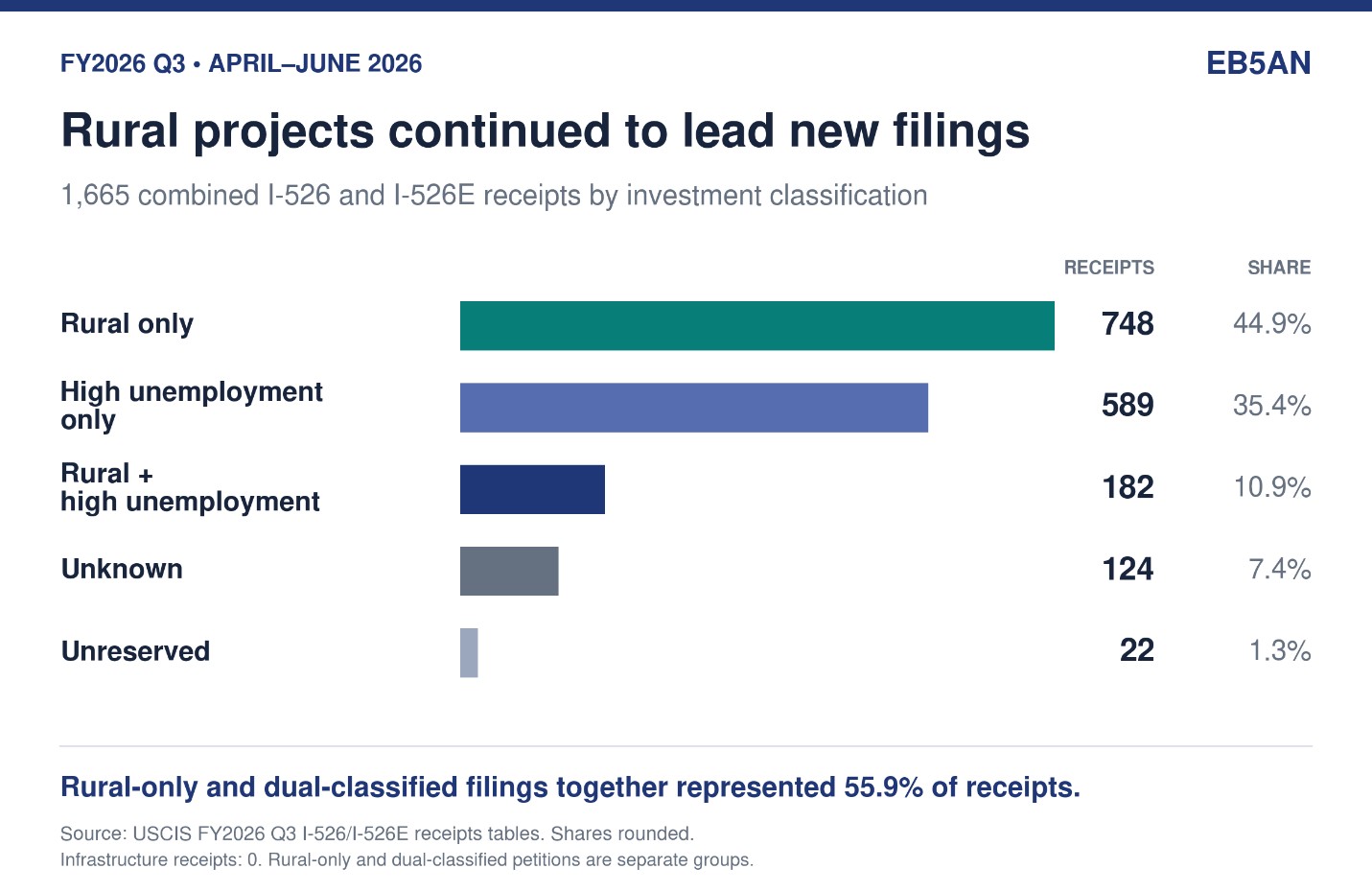
Rural filings accounted for 748 combined I-526 and I-526E receipts in Q3, representing 44.9% of new investor filings. At the same time, high-unemployment filings accounted for 589 receipts, or 35.4%.
Another 182 petitions were classified as both rural and high-unemployment area investments.
Rural-only filings remained ahead of every other classification, although their share fell below half of quarterly receipts. They declined 17.1% from 902 in Q2, compared with a 6.1% decline in high-unemployment-only receipts.
Filings classified as both rural and high-unemployment increased 19.0%, from 153 to 182.
Counting the rural-only and dual-classified groups together, 930 petitions, or 55.9% of Q3 receipts, carried a rural classification. Each petition is counted once in that calculation.
The longer reporting period also shows rural investments leading demand. During the first nine months of FY2026, rural-only filings totaled 2,649, or 50.7% of combined investor receipts.
High-unemployment-only filings totaled 1,856, or 35.5%, while another 423 petitions were classified as both.
Rural investments still offer a key immigration advantage: the EB-5 Reform and Integrity Act of 2022 requires USCIS to prioritize rural regional center investor petitions. Since the RIA was enacted in 2022, we have seen a pronounced difference between rural and urban processing times, with rural filings being adjudicated significantly faster.
India Narrowly Overtakes China in New Investor Filings
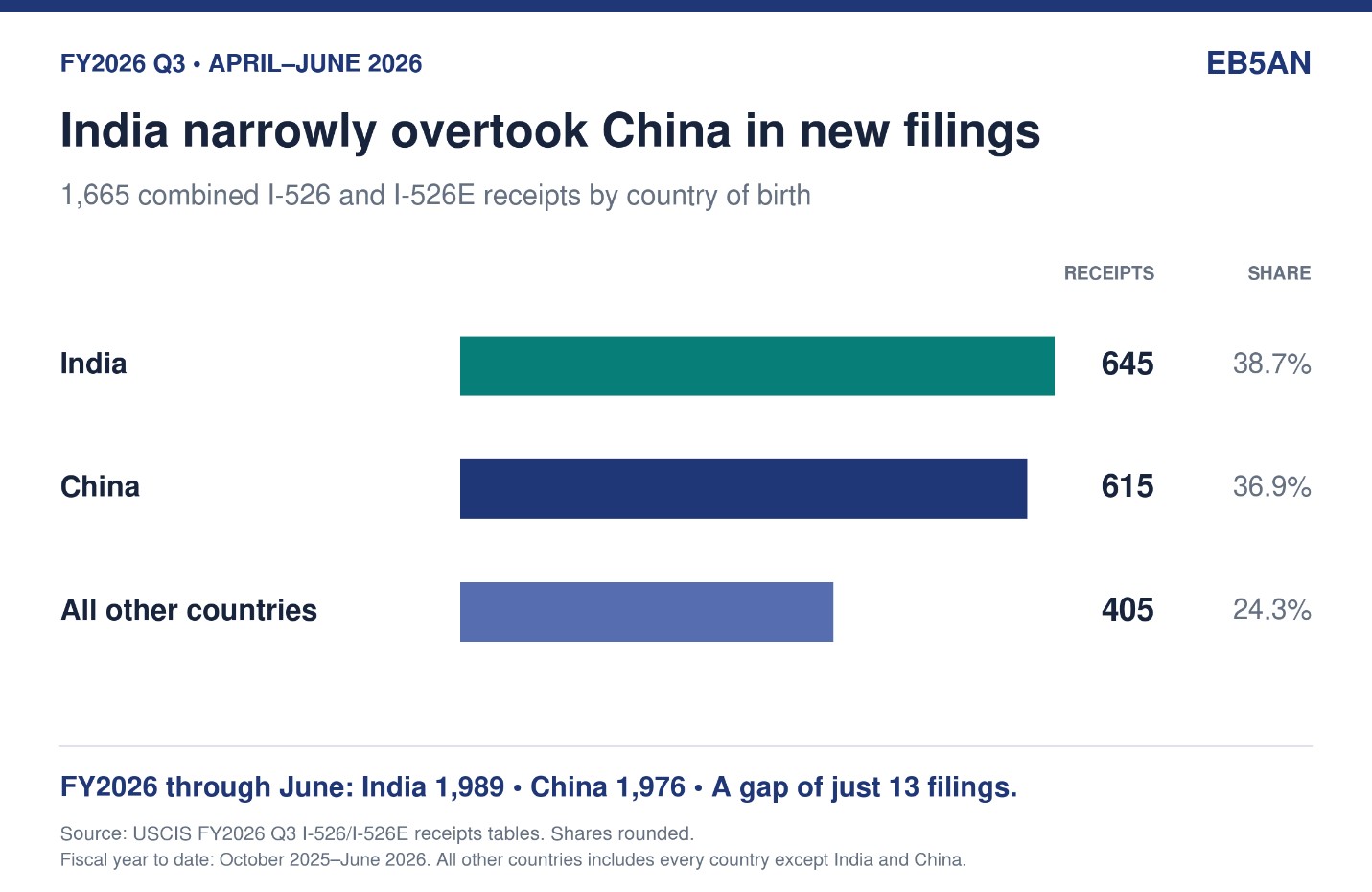
Investors born in India accounted for 645 combined I-526 and I-526E receipts in Q3, compared with 615 from investors born in China. Together, the two countries represented 75.7% of new investor receipts.
It’s worth noting that EB-5 filings from Indian-born investors declined 2.9% from Q2, while receipts from Chinese-born investors declined 12.9%. India moved ahead because its filings declined less, rather than because of a new quarterly surge.
The year-to-date totals remain particularly close: India led China by just 13 petitions through June. Both countries continue to account for a substantial share of EB-5 demand.
For these investors, priority processing and set-aside visa availability are two crucial benefits from rural projects. The September 2026 Visa Bulletin lists all three EB-5 set-aside categories as current for all countries. But in the unreserved category, India is listed as unavailable for the rest of the fiscal year, while mainland China has a final action date of December 1, 2016.
The high concentration of filings from India and China gives investors reason to monitor future demand closely. However, the data do not establish when a set-aside cutoff date might appear or how long any resulting wait might be.
I-526E Denials Rise to 24% of Completed Cases
Of the 904 I-526E cases completed in Q3, 687 were approved and 217 were denied. Approvals represented 76.0% of completed cases, while denials accounted for 24.0%.
The denial share increased from 20.3% in Q2, a rise of 3.7 percentage points. Across the first nine months of FY2026, USCIS approved 2,258 I-526E petitions and denied 592, producing an approval share of 79.2% among completed cases.
These percentages only describe the petitions USCIS decided during the reporting period. They do not mean that 24% of investors who filed in Q3 will receive denials. Completed cases may have been filed in earlier quarters, and the reports do not track the eventual outcomes of a single group of new filings.
The data also does not identify denial reasons or show whether denials were concentrated in particular projects.
Nevertheless, the number of denials reinforces the importance of preparing a well-supported I-526E petition. Investors should work with immigration counsel to document the lawful source and transfer of their investment funds. They should also examine the project materials supporting EB-5 compliance and job creation potential.
The reported I-526E median processing time increased to 13.6 months, compared with 11.7 months in Q2. This measures the time from receipt to completion for cases decided during the quarter, including approvals and denials.
Project-Level Processing Improves, but I-956F Denials Deserve Attention
USCIS completed 82 Form I-956F applications in Q3, up from 59 in Q2, an increase of 39.0%. It approved 60 applications and denied 22.
New I-956F receipts totaled 77, slightly below completions. Pending inventory declined from the previously reported 186 applications to 177, while the median processing time fell from 8.1 months to 5.4 months.
These figures show stronger quarterly output at the project-review stage. They also contrast with I-526E processing, where completions declined and the reported median increased.
Interestingly, denials accounted for 26.8% of I-956F adjudications in Q3, compared with 20.3% in Q2. Because the report covers only 82 completed applications and does not explain their circumstances, that percentage should not be treated as a prediction for every pending EB-5 project.
For project selection, an existing I-956F approval remains valuable evidence that USCIS has reviewed the offering’s immigration documentation. Investors should verify that the approval covers the offering in which they plan to invest and ask about subsequent changes. Separately, they must also evaluate financing, construction progress, job creation, and repayment terms.
Standalone and Legacy I-526 Cases Show Different Processing Patterns
Standalone investors filed 66 Form I-526 (that is, direct) petitions in Q3. USCIS completed 16 cases, comprising five approvals and 11 denials. Pending inventory reached 858, and the reported median processing time was 32.3 months.
The figures show a substantial difference between standalone and regional center processing times.
Legacy I-526 petitions must also be considered separately. USCIS completed 97 legacy cases in Q3, including 17 approvals and 80 denials. Pending legacy inventory fell to 960, while the median processing time reached 99.2 months.
These cases involve older I-526 form editions that predate the post-RIA filing structure.
Combining legacy, standalone, and regional center figures into a single EB-5 approval rate would obscure the trends that matter most to prospective EB-5 investors.
I-829 Receipts Increase Sharply, Adding to Pending Inventory
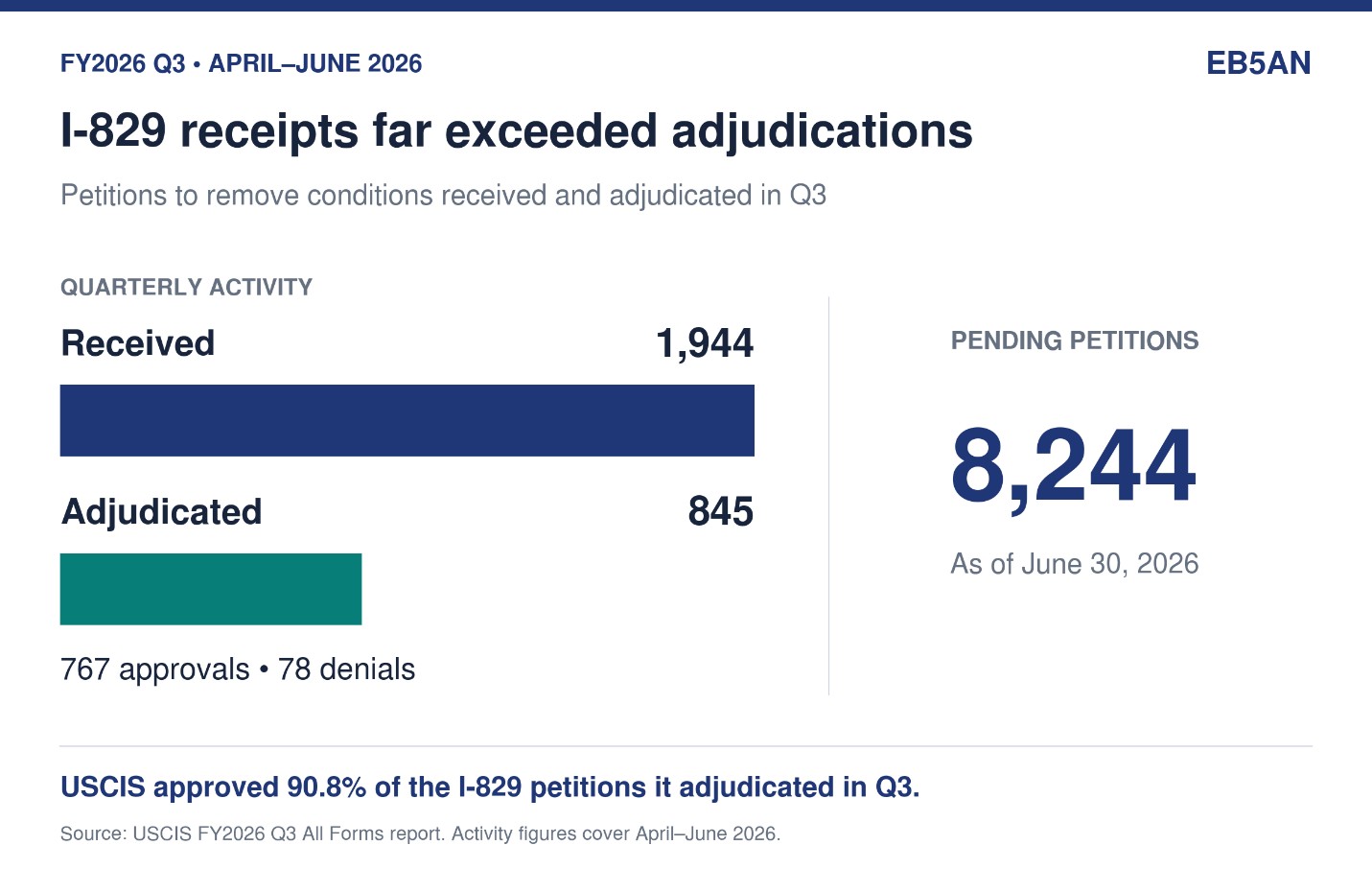
USCIS received 1,944 Form I-829 petitions in Q3, up 71.1% from 1,136 in Q2. These petitions seek removal of conditions from investors’ permanent resident status.
Completions increased much more modestly. USCIS completed 845 I-829 petitions, up 4.8% from Q2, with 767 approvals and 78 denials. Approvals represented 90.8% of completed cases.
Although USCIS adjudicated more I-829 petitions, the increase in incoming filings was substantially larger. Receipts exceeded completions by 1,099, and pending inventory reached 8,244, approximately 15.0% above the Q2 figure reported previously.
The median processing time also increased, from 10.9 months to 12.8 months.
Across the first nine months of FY2026, USCIS approved 2,450 I-829 petitions out of 2,656 completions, an approval share of 92.2%. Most adjudicated cases therefore continued to result in removal of conditions, even as pending inventory grew.
For new investors, Form I-829 deserves attention before they even select a project. The project’s ability to create qualifying jobs and maintain reliable supporting records remains important well beyond I-526E approval. Investors should examine the job-creation cushion and understand how the regional center will document progress and support their eventual I-829 filings for a permanent Green Card.
Preparing a Strong Filing Before January 1, 2027
The Q3 data shows a continued high demand for EB-5 visa immigration. I-526E receipts remained well above adjudications, pending inventory exceeded 11,000, and the median for completed cases increased. Rural investments continued to lead new filings, while India and China remained nearly equal sources of investor demand.
These trends make project selection and careful preparation of I-526E filings especially important for EB-5 applicants.
Taken together, the Q3 figures show an EB-5 program that continues to attract substantial investor demand while USCIS works through a growing volume of cases. The increase in pending I-526E petitions is particularly notable: even with slightly fewer new filings during the quarter, receipts continued to exceed adjudications by a wide margin.
For prospective investors, that makes the quality and completeness of an I-526E filing increasingly important.
The data also reinforces the importance of looking beyond headline processing numbers when evaluating an EB-5 investment. Rural projects continue to account for a substantial share of new filings and benefit from priority processing, but project selection still requires careful analysis of immigration compliance, job creation, financing, construction progress, and the structure for repayment.
An I-956F approval can provide important immigration-related information, but it does not replace due diligence.
Most importantly, investors considering EB-5 should give themselves enough time to make those decisions carefully. Selecting a project, completing due diligence, documenting the lawful source and path of funds, transferring the investment, and preparing an I-526E petition all take time.
And for investors planning to move forward in the coming months, there is also another important date approaching.
The EB-5 minimum investment amounts are scheduled to increase on January 1, 2027, based on inflation. The current minimums of $800,000 for targeted employment area (TEA) investments and $1,050,000 for other investments will therefore rise, making filing before the adjustment potentially significant for investors seeking to invest at today’s amounts.
To review available EB-5 projects and discuss how they fit your immigration goals, schedule a free consultation with EB5AN.