

Receiving notice that your Form I-526E has been approved is a significant milestone, but it is not the end of the EB-5 process. For most investors, I-526E approval is the point at which the immigration steps become more concrete and time-sensitive. What comes next depends on where you are located, what country you were born in, and whether a visa number is immediately available to you.
This post walks through each stage that follows I-526E approval: how visa availability works, the two paths to a conditional Green Card, what the conditional period requires, and how to file Form I-829 to complete the process and receive permanent resident status.
How Visa Availability Determines Your Next Step
Consular Processing Is the Path for Investors Outside the U.S.
Adjustment of Status Is the Path for Investors Inside the U.S.
Your Conditional Green Card: What It Covers and What It Requires
Filing Form I-829 to Remove Conditions
How Visa Availability Determines Your Next Step
Before you can proceed to a Green Card, a visa number must be available in your category. The U.S. Department of State publishes a monthly Visa Bulletin that tracks which EB-5 categories are current, meaning open for filing. Your priority date, which is the date USCIS received your I-526E petition, must be on or before the cutoff date shown in the bulletin for your country of birth and visa category.
For most investors born outside mainland China and India, EB-5 visas in both the unreserved category and the reserved set-aside categories have remained current in recent months, meaning the visa number is available as soon as the I-526E is approved. Those investors can move directly into consular processing or adjustment of status without waiting.
The unreserved EB-5 category has been backlogged for investors born in mainland China or India for years. However, the reserved set-aside categories created by the EB-5 Reform and Integrity Act (RIA) of 2022 have so far remained current worldwide, including for Chinese and Indian nationals. Investors from those countries who invest in a rural or urban EB-5 project may be able to proceed without a long wait, but this can change as demand in the set-aside categories grows. Always verify the current Visa Bulletin before making any filing decisions and talk to an immigration attorney.
Investors whose I-526E petitions were filed on or before September 30, 2026, are covered by the grandfathering provision in the RIA. Their petitions continue to be adjudicated, their priority dates hold, and their path through consular processing or adjustment of status and on to the I-829 stays open even if Congress allows the Regional Center Program to lapse. The program’s current authorization runs through September 30, 2027, a separate date that is often confused with the grandfathering cutoff.
Consular Processing Is the Path for Investors Outside the U.S.
Investors who are outside the United States when their I-526E is approved, and who are not eligible to file for adjustment of status, go through consular processing to obtain an immigrant visa.
After the I-526E is approved, USCIS forwards the case to the National Visa Center (NVC). Once the NVC fees are paid, the investor and any derivative family members complete Form DS-260, the online immigrant visa application, and submit civil documents such as birth certificates, marriage certificates, and police certificates.
When the NVC determines that the file is documentarily complete, you need to go through a medical examination and an interview. After a successful interview, an immigrant visa is stamped into the investor’s passport. Upon entering the United States with that visa, the investor and eligible family members are admitted as conditional permanent residents and receive their conditional Green Cards. The consular processing timeline after I-526E approval typically runs several months, though this varies by consulate and individual case circumstances.
Adjustment of Status Is the Path for Investors Inside the U.S.
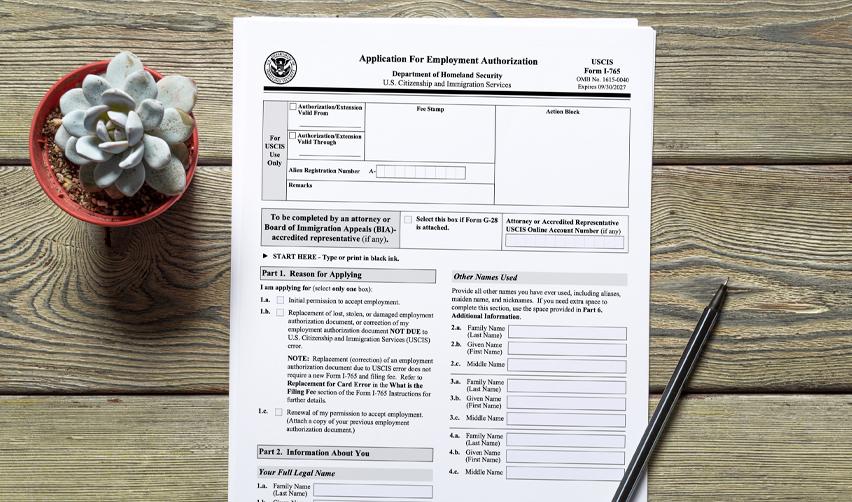
Investors who are already inside the United States on a valid nonimmigrant visa, and whose visa category is current, can apply to adjust their status to conditional permanent residence without leaving the country. This is done by filing Form I-485, Application to Register Permanent Residence or Adjust Status.
One of the most significant changes introduced by the RIA is the concurrent filing option. Investors whose visa category is current when they file their I-526E may file the I-485 at the same time as the I-526E petition, without waiting for the I-526E to be approved first. Along with the I-485, investors can also file Form I-765 for an Employment Authorization Document (EAD) and Form I-131 for Advance Parole, which allows international travel while the application is pending. These documents are typically issued within a few months of filing, giving investors the ability to work and travel in the U.S. while their case moves forward.
Your Conditional Green Card: What It Covers and What It Requires
Whether obtained through consular processing or adjustment of status, the initial EB-5 Green Card is a conditional one, valid for two years. It confers the same rights as any other lawful permanent resident status: the holder can live anywhere in the United States, work for any employer, travel internationally, and enroll in schools and institutions.
The conditional status reflects the fact that USCIS needs to verify that the investor met the program’s core requirements. Specifically, the investment must have remained at risk throughout the required sustainment period, and the project must have created or be in the process of creating at least ten full-time jobs for qualifying U.S. workers. These are requirements the investor must be able to document when they later file to remove conditions.
Filing Form I-829 to Remove Conditions
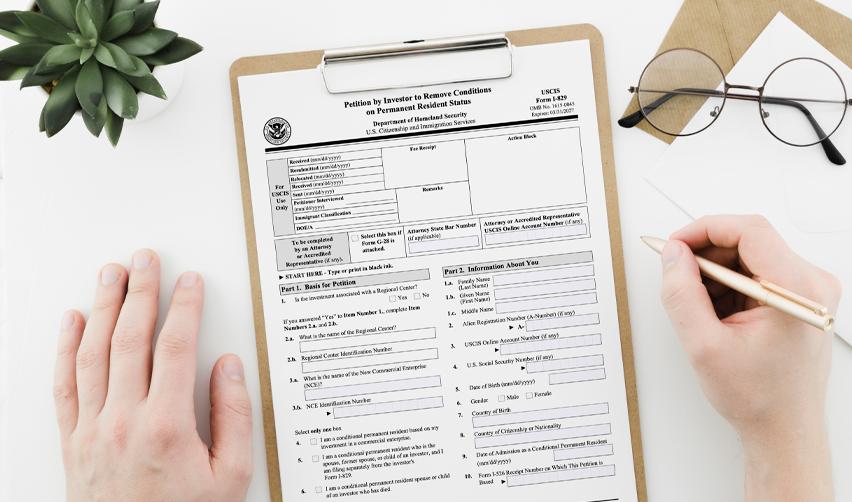
Form I-829, Petition by Investor to Remove Conditions on Permanent Resident Status, is the final major filing in the EB-5 process. It must be filed during the 90-day window immediately before the second anniversary of the date the investor became a conditional permanent resident. The expiration date on the conditional Green Card marks the close of that window. Filing too early will result in rejection; failing to file at all before the deadline can result in termination of status and potential removal proceedings.
The I-829 asks the investor to demonstrate that the qualifying investment was made and sustained, and that the required jobs were created or are in the process of being created. Supporting documents typically include bank statements, wire transfer records, audited financial statements from the new commercial enterprise, and evidence of job creation such as payroll records or a third-party economic impact report prepared by the regional center’s economist.
The investor can continue to live, work, and travel during this time. Upon approval of the I-829, the conditions are removed and the investor receives a 10-year permanent Green Card, renewable indefinitely. Eligible family members listed on the petition receive the same outcome.
Investors should begin gathering documentation well in advance, ideally at least a year before the conditional Green Card expires. This allows time to identify any gaps in the job creation record or fund documentation, and to work with immigration counsel to address them before the filing.
More than 3,000 families from over 70 countries have selected EB-5 projects sponsored by EB5AN regional centers. Our expert team has more than a decade of experience and offers clients high-quality, low-risk EB-5 regional center projects with a 100% USCIS project approval rate.
If you would like to know more about your EB-5 investment options, book a free call with our expert team today.