

The U.S. Department of State has released the January 2026 Visa Bulletin, bringing additional forward movement across several employment-based immigrant visa categories. For EB-5 investors, the most important takeaway remains unchanged: all reserved set-aside categories continue to stay current for every country.
U.S. Citizenship and Immigration Services (USCIS) has confirmed that employment-based adjustment of status applicants must use the Dates for Filing chart in January. This allows eligible applicants in the United States to submit their Forms I-485 earlier, even if Final Action Dates have not yet been reached.
Understanding Key Visa Bulletin Terms
Highlights From the January 2026 Charts
Why the Current EB-5 Environment Favors New Filings
Work With EB5AN to Pursue Permanent Residency Through EB-5
Understanding Key Visa Bulletin Terms
The Visa Bulletin is the primary reference for tracking immigrant visa availability. It includes two main charts. The Final Action Dates chart determines when a visa can actually be issued or when USCIS may approve an adjustment of status application. To move forward at this stage, an applicant’s priority date must be earlier than the listed cutoff date for their country and preference category.
The Dates for Filing chart, on the other hand, allows certain applicants to submit their adjustment of status paperwork earlier when USCIS determines that additional visa numbers are available. When a category is listed as “current,” no backlog exists, and applicants may proceed regardless of priority date.
Highlights From the January 2026 Charts
January’s bulletin reflects broad, incremental progress across employment-based preferences. Several EB-1 and EB-2 categories advanced under both charts, particularly for China, India, and the rest of the world. EB-3 and EB-4 categories also saw modest but consistent movement, continuing the gradual forward trend seen in recent months.
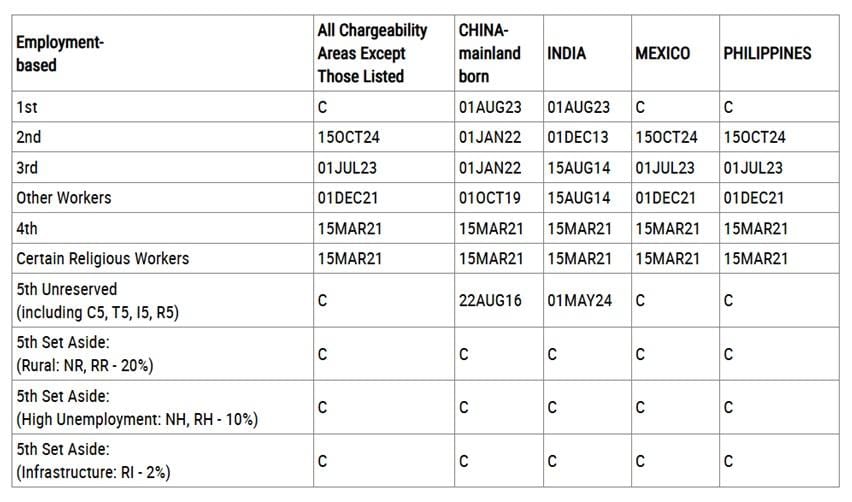
For EB-5 investors, the most notable changes appear in the unreserved category. Under the Dates for Filing chart, EB-5 China unreserved advances from July 22, 2016, to August 22, 2016. EB-5 India unreserved also moves forward, advancing from April 1, 2022, to May 1, 2024. All other countries remain current in the unreserved category for filing purposes.
The Final Action Dates chart shows similar progress. EB-5 China unreserved advances by one month, from July 15, 2016, to August 15, 2016. EB-5 India unreserved moves from July 1, 2021, to May 1, 2022.
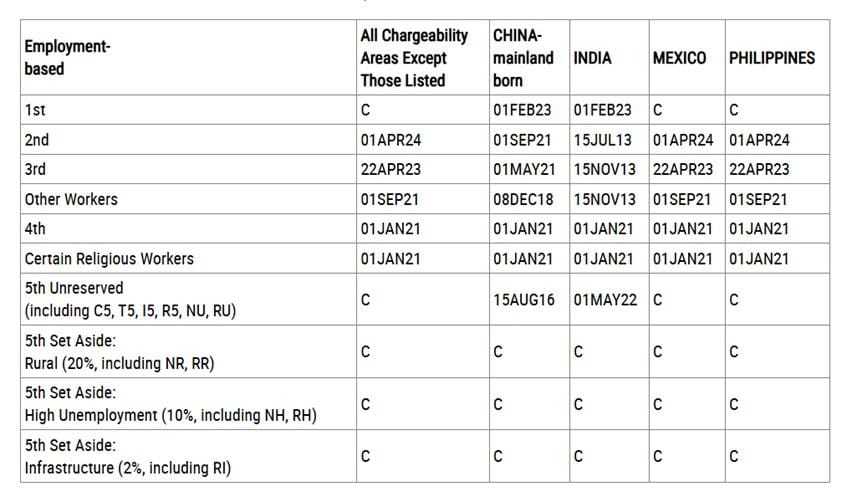
Most importantly, the EB-5 reserved set-aside categories—rural (20% of annual visas), high-unemployment (10%), and infrastructure (2%)—remain current for all countries under both charts.
Implications for EB-5 Immigrant Investors
The January 2026 updates reinforce a pattern that has remained consistent throughout the past year. While unreserved EB-5 categories for China and India continue to experience long waiting times, reserved set-aside categories remain fully available and unaffected by cutoffs.
For investors from backlogged countries, this distinction is critical. Filing under a reserved category allows investors to avoid the lengthy delays associated with the unreserved pool. Rural projects, in particular, continue to benefit from priority processing at USCIS under the EB-5 Reform and Integrity Act of 2022. This combination of current visa availability and faster adjudication has made rural EB-5 investments the clearest and most predictable path to permanent residence for new applicants.
Investors already in the United States benefit further from USCIS’s decision to honor the Dates for Filing chart. Because set-aside categories remain current, many eligible investors may file Form I-485 concurrently with Form I-526E, gaining access to employment authorization and advance parole while their petitions are pending.
Why the Current EB-5 Environment Favors New Filings
The current visa environment remains favorable for EB-5 investors considering when to begin the process. Reserved visas remain fully open worldwide, and rural petitions continue to receive processing priority. Filing earlier secures a priority date and offers protection if demand eventually leads to retrogression in reserved categories.
For families already in the United States, concurrent filing provides immediate practical benefits. Employment authorization documents allow spouses to work legally, while advance parole enables international travel during the waiting period. These benefits can significantly improve quality of life while the EB-5 petition is under review.
At the same time, demand for EB-5 remains strong. Starting the process under current conditions allows investors to take advantage of today’s visa availability before future shifts in demand or policy affect timelines.
Work With EB5AN to Pursue Permanent Residency Through EB-5

The January 2026 Visa Bulletin confirms continued progress across employment-based categories and reinforces the stability of EB-5 reserved visas. While backlogs persist in unreserved categories for certain countries, set-aside visas continue to offer reliability and predictability for investors seeking U.S. permanent residence.
EB5AN has guided more than 2,700 families from over 70 countries through the EB-5 process. With more than a decade of experience and a long track record of successful USCIS project approvals, our team focuses on low-risk regional center investments designed to support both immigration and financial goals.
Schedule a free call with EB5AN to learn more about current EB-5 opportunities and begin your application while visa availability and processing conditions remain favorable.