

On July 2, 2026, the Department of Homeland Security, through U.S. Citizenship and Immigration Services, published a major EB-5 Notice of Proposed Rulemaking in the Federal Register. The rule appears at 91 FR 40676 and spans 127 Federal Register pages. It would implement parts of the EB-5 Reform and Integrity Act of 2022 and affect several areas of the EB-5 program, including job calculation, project exemplar applications, targeted employment area designation, redeployment, and investor protections.
The public comment period closed on August 31, 2026, under docket USCIS-2026-0100. By the deadline, the Federal Register docket showed more than 460 public comments, including a submission of more than 150 pages from Invest in the USA (IIUSA), the EB-5 industry’s trade association. The EB-5 industry has now had its opportunity to weigh in, and the next step belongs to DHS.
DHS must now review and respond to those comments before publishing any final rule. As of early September 2026, DHS has not announced a timeline for a final rule. The final regulation could keep the current language, revise it, narrow it, or remove certain provisions before they take effect.
Even so, the NPRM shows where USCIS may be trying to move the EB-5 program. And one of the most significant proposed changes concerns bridge financing.
DHS proposes to stop allowing EB-5 projects to claim job-creation credit for jobs tied to financing that is later repaid with EB-5 capital. The change appears in proposed 8 C.F.R. § 204.407(e)(1), which states that jobs attributable to any financing repaid with EB-5 investment capital may not be claimed as jobs created by that EB-5 capital.
This would be a major shift. Bridge financing has long been used in EB-5 developments to allow projects to begin construction before all EB-5 capital has been raised.
The proposal suggests that DHS may be taking a stricter view of the connection between an investor’s EB-5 capital and the jobs being counted. USCIS may no longer be willing to treat jobs created by earlier financing as EB-5 jobs simply because EB-5 capital later replaced that financing.
This article explains what bridge financing is, how it has historically supported EB-5 job creation, what DHS is proposing to change, and how investors can review EB-5 projects if USCIS adopts a stricter rule. That review should include the project’s job-creation cushion, documentation, developer strength, and regional center compliance.
We will also review EB5AN’s industry-leading record of job creation—an increasingly important factor for a successful EB-5 application.
Background: The EB-5 NPRM and the Future of the EB-5 Program
What Bridge Financing Means in EB-5 Projects
How Bridge Financing Has Been Used to Support EB-5 Job Creation
What DHS Proposes to Change About Bridge Financing
Why This Proposed Change Could Affect EB-5 Capital Structures
What the Bridge Financing Proposal Could Mean for EB-5 Project Selection
The Role of Regional Centers and Developers Under a Stricter Bridge Financing Rule
EB5AN’s Job-Creation Record and the Bridge Financing Proposal
Securing Your Green Cards Under Changing EB-5 Policies

Background: The EB-5 NPRM and the Future of the EB-5 Program
The NPRM is DHS’s proposed regulatory framework for implementing major parts of the EB-5 Reform and Integrity Act of 2022. The RIA was signed on March 15, 2022, and reauthorized the regional center program through September 30, 2027. It reshaped the program by adding new integrity measures, compliance duties, investor protections, and project-level requirements.
The proposed rule would replace much of the existing EB-5 regulatory structure. DHS proposes to remove and reserve 8 C.F.R. § 204.6 and create a new Subpart D for EB-5 regulations. This would give USCIS a clearer post-RIA framework for enforcing policy.
Some of these changes would codify rules that have already been in effect since the RIA. For example, the NPRM would codify the current $1,050,000 standard minimum investment amount and the $800,000 reduced minimum for targeted employment area and infrastructure investments. It would also define a higher $1,400,000 investment amount for high-employment areas.
Still, an NPRM is not a final law. It is a proposed rule that allowed the public to comment before DHS issues a final regulation. With the comment period now closed, USCIS could keep the bridge-financing proposal as written, adopt a narrower version, or revise the proposal after reviewing comments from investors, attorneys, regional centers, developers, and industry groups.
For now, USCIS is reconsidering a financing tool that has been widely used in EB-5 developments. Investors and industry stakeholders should understand the proposal now because it could affect how future projects document job creation.
What Bridge Financing Means in EB-5 Projects
Bridge financing is temporary or interim financing that allows a project to move forward before a more permanent source of capital is available.
In EB-5, a developer may use bridge loans or bridge equity to begin land work, permitting, site preparation, or construction while EB-5 capital is still being raised. Later, once EB-5 investors subscribe, the EB-5 capital may replace or repay that earlier financing.
This has been common because EB-5 fundraising takes time. Real estate and infrastructure projects often cannot wait until every EB-5 investor has invested before construction begins.
Bridge financing can also make a project more attractive to investors. A project that has already broken ground may appear more credible than a project that exists only in offering materials. Visible construction progress can support the business plan and reduce some execution uncertainty.
For many investors, an under-construction project is more reassuring. They want to know that the project is funded, active, and moving forward. Bridge financing has often helped developers show that progress while continuing to raise EB-5 capital.
How Bridge Financing Has Been Used to Support EB-5 Job Creation
Every EB-5 investor must be credited with at least 10 qualifying U.S. jobs. For regional center projects, many jobs are calculated through economic modeling rather than through direct payroll records alone.
The regional center program represents most EB-5 activity. DHS notes that more than 90% of EB-5 petitions are filed through regional centers. It has also accounted for more than 90% of EB-5 investment capital and almost 95% of jobs created through EB-5 investments.
Regional center investors may use direct and indirect job creation to satisfy the EB-5 job requirement. Under the proposed rule, up to 90% of the job-creation requirement may be established through indirect job estimates, while at least 10% must be established through direct jobs. Those estimates must use economically and statistically valid, transparent, and reproducible methodologies.
In many real estate and infrastructure projects, those models may use construction spending, development expenditures, operating revenue, or other accepted inputs, depending on the project and methodology. Construction expenditures often play a major role in the job-creation analysis.
Historically, if a project began construction with bridge financing and EB-5 capital later replaced that financing, jobs connected to the earlier spending could often be counted toward EB-5 job creation when the structure complied with USCIS policy.
This became a major project-finance tool. Developers could start construction before completing the EB-5 raise, while investors could still receive job-creation credit from a project that was already underway.
That structure helped align two different needs. Developers needed timely capital to keep projects moving. Investors needed credible job creation for immigration purposes. Properly structured bridge financing helped serve both goals.
Bridge financing remains an acceptable source of EB-5 job creation under today’s rules. New applicants can still benefit from investing in a project that uses bridge financing as a basis for job creation.
And even if the proposed changes take effect, DHS has indicated that any new policy regarding bridge financing will not apply retroactively.
What DHS Proposes to Change About Bridge Financing
DHS proposes to eliminate job-creation credit for jobs attributable to financing that is repaid with EB-5 capital.
The reason is tied to how DHS reads the RIA’s job-creation language. DHS focuses on the requirement that the new commercial enterprise must benefit the U.S. economy by creating jobs. DHS interprets that wording as requiring a closer connection between the investor’s EB-5 capital and the jobs being counted.
In other words, DHS is questioning whether jobs created by earlier financing should be credited to EB-5 investors if EB-5 capital only comes in later to repay or replace that financing.
DHS also points to problems with past bridge-financing practice. According to the NPRM, bridge financing has been used inconsistently, with no clearly defined standard. DHS notes that some applicants have characterized financing with maturities of 10 years or more as bridge financing because EB-5 capital later replaced it.
A short-term bridge loan used to start construction is different from long-term project debt that is later refinanced. USCIS appears concerned that the label “bridge financing” has sometimes been stretched too far.
Still, DHS does not suggest that every use of bridge financing is weak or abusive. The NPRM recognizes that there may be credible uses of bridge financing. It also notes that post-RIA Form I-956F filings have often presented more realistic examples, such as projects that have already broken ground and obtained permits to continue construction.
If finalized in its strictest form, the proposal would break from longstanding industry reliance on bridge financing. It could also change how many EB-5 projects prepare their economic reports, capital-stack documents, and I-956F filings.
DHS Is Also Considering a Less Restrictive Alternative
DHS is not only proposing to eliminate bridge-financing job credit. The NPRM also asks for comments on whether bridge financing should be allowed within clearer limits.
These are two distinct options.
The strict option would fully eliminate job credit for financing repaid with EB-5 capital. Under that approach, jobs created by bridge financing could not be credited to EB-5 investors whose capital later repays or replaces that financing.
The less restrictive option would allow bridge financing but impose limits. DHS asks whether bridge financing should be limited by maturity period and by the amount of bridge financing as a percentage of total project costs.
DHS refers to typical commercial bridge-financing maturities of 12 to 36 months. It also notes that many lenders limit bridge financing amounts to around 80% of total project costs, while suggesting that EB-5 may require a more limited approach because immigration benefits depend on jobs resulting from the investor’s capital.
Those details suggest that USCIS may be open to distinguishing short-term, credible bridge financing from financing that is labeled “bridge” but functions more like long-term project debt.
The industry used the comment period to make exactly that argument. IIUSA, the U.S. Chamber of Commerce, and numerous regional center operators, developers, economists, and fund administrators filed comments urging DHS to preserve bridge financing with clear limits and integrity measures rather than eliminate it. IIUSA described the proposal as reversing more than a decade of settled USCIS policy and warned that eliminating bridge-financing job credit could steer EB-5 capital away from stronger, already-financed projects and toward weaker ones. Several commenters also pointed out that DHS itself acknowledged in the NPRM that projects that have already broken ground are often more credible. A guardrail approach could address USCIS’s concern about loose or overly broad use of bridge financing while still allowing credible projects to move forward before the EB-5 raise is complete.
The final rule could therefore be more moderate than the strict proposal, although DHS is not required to adopt the industry’s recommendations.
Investors should not treat the most restrictive version as if it were already final. But they should take the proposal seriously because it shows that bridge-financing job credit is under close review.
Why This Proposed Change Could Affect EB-5 Capital Structures
In EB-5, the capital structure can affect the immigration risk because it determines which expenditures support job creation.
If jobs tied to repaid bridge financing can no longer count, some projects may need to change how they raise and deploy capital. Developers may need to show a clearer connection between EB-5 capital and the expenditures that create jobs.
Economic reports may also need to rely more heavily on spending directly funded by EB-5 capital or on other job-creation inputs that remain clearly permissible. Projects that depend heavily on bridge-financing replacement may have less room for error if those jobs are excluded.
This could affect project planning from the beginning. A developer may need to think differently about construction timing, loan maturity, EB-5 draw schedules, and how each source of capital is used.
Regional centers may need to review loan documents, sources and uses, construction budgets, economic reports, offering materials, and I-956F evidence with more care.
Under proposed 8 C.F.R. § 204.421, regional centers would need to submit project-level evidence showing that the project will create enough qualifying jobs for the investors in the offering. That evidence would typically include an economic impact analysis tied to the job-creating activity.
If the final rule changes the treatment of bridge financing, the regional center and developer must be able to show that the project’s job-creation analysis still works under USCIS standards.
The strongest projects will likely be those designed with a conservative job-creation structure from the start. A project that depends on aggressive assumptions may become harder to defend if USCIS adopts a stricter final rule.
What the Bridge Financing Proposal Could Mean for EB-5 Project Selection
EB-5 investors need more than a financially viable project. They need a project that can document enough qualifying jobs under USCIS rules.
If the final rule limits or eliminates job credit from bridge financing repaid with EB-5 capital, investors will need to pay closer attention to how a project’s jobs are being calculated.
The question is not simply whether a project uses bridge financing. A project may use it for legitimate reasons. The more useful question is whether the project’s job-creation case depends heavily on jobs tied to bridge financing that EB-5 capital later repays.
Investors should review whether the project would still satisfy EB-5 job-creation requirements if some bridge-financing-related jobs were reduced, excluded, or questioned by USCIS. This is where the job-creation cushion becomes especially valuable.
Each EB-5 investor must be credited with at least 10 qualifying jobs. A project with only a narrow margin may be more vulnerable if USCIS rejects certain inputs or applies a stricter interpretation. A project with a larger cushion gives investors more room if job calculations change, construction assumptions shift, or certain expenditures are not accepted.
The cushion may be especially relevant for projects with shorter construction timelines. Under the proposed rule, if estimated jobs are created by construction activity lasting less than two years, only up to 75% of the job-creation requirement may be satisfied through indirect job estimates, and direct jobs would be prorated based on the length of the job-creating activity.
A stronger project should create significantly more jobs than the minimum required. The cushion should not depend on the project’s claims alone. Instead, it should be supported by a conservative economic report that explains which expenditures or activities generate the jobs.
The project’s capital stack should also be realistic and well documented. If bridge financing is involved, investors should understand how it is structured, how long it is expected to remain in place, how it will be repaid, and how the project would support job creation if final rules limit bridge-financing credit.
Developer strength will also become more relevant. A qualified developer with experience completing similar projects may be better positioned to keep construction on schedule, manage financing, and produce the evidence needed for EB-5 compliance.
Further, investors should look for a regional center operator that can monitor the project, review job-creation evidence, respond to changing USCIS guidance, and work with developers to keep filings compliant.
The NPRM does not mean investors must automatically avoid every project that uses bridge financing. But investors should understand how much the project depends on bridge financing for job creation and whether the project still has a strong immigration case if USCIS adopts a stricter final rule.
The Role of Regional Centers and Developers Under a Stricter Bridge Financing Rule
If USCIS finalizes a stricter bridge-financing rule, regional centers and developers will need to adjust quickly.
Regional centers may need to review whether current and future I-956F filings rely on bridge financing in ways that could be affected. Developers may need to structure financing so the connection between EB-5 capital and job creation is easier to document.
The strongest operators will likely be those that already treat compliance, economic analysis, and project monitoring as core parts of the EB-5 process. A project team that waits for problems to appear during adjudication may put investors in a weaker position.
This may become even more important because the NPRM would place significant weight on project-level filings. USCIS would review the regional center’s project application and rely on that adjudication for project-level issues such as job creation and TEA qualification. If the project application is weak, investors may face problems that could have been addressed earlier.
EB5AN’s Job-Creation Record and the Bridge Financing Proposal
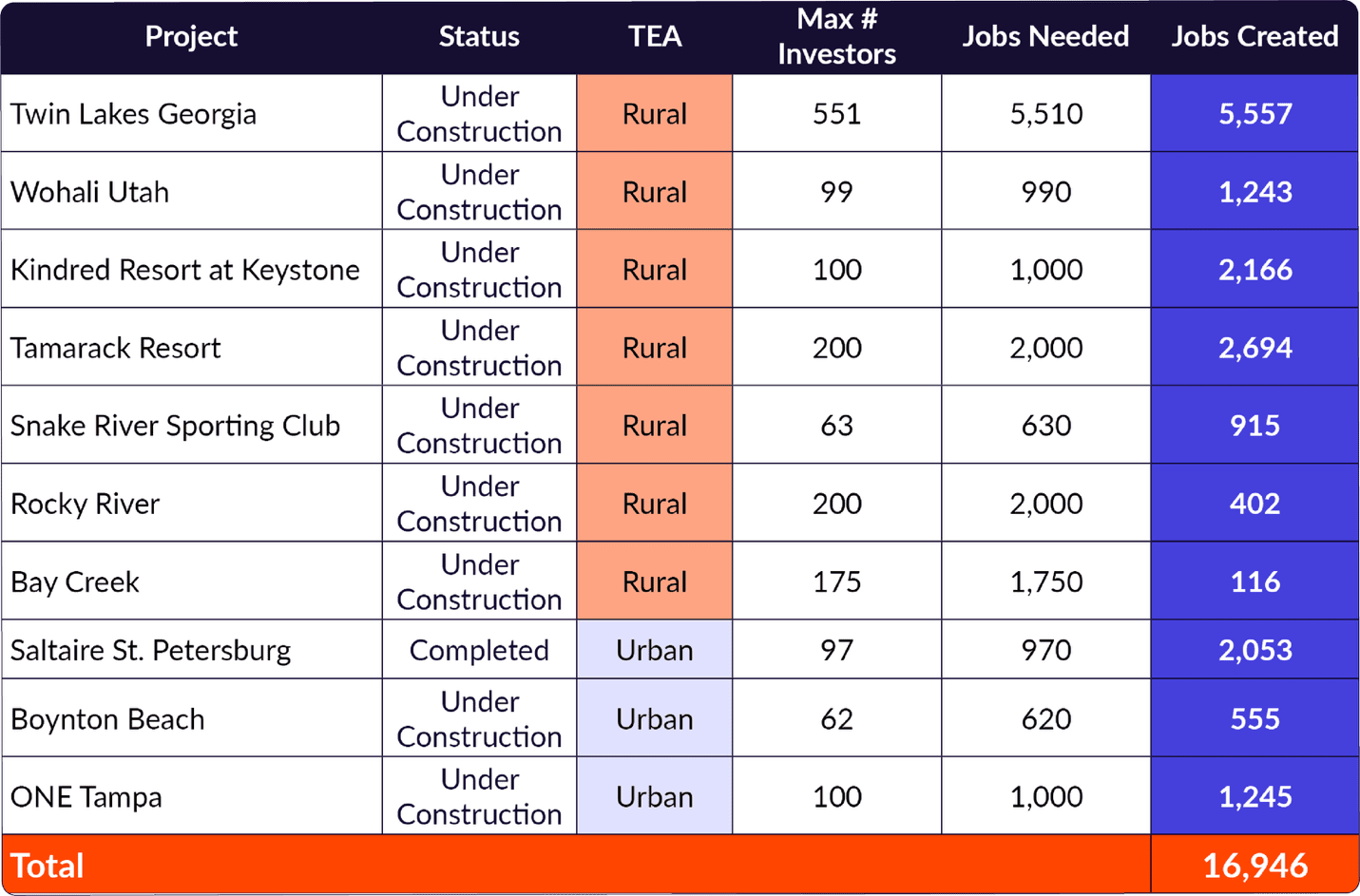
The bridge-financing proposal makes EB5AN’s job-creation record especially relevant. Every EB-5 investor needs at least 10 qualifying jobs. If USCIS adopts a stricter rule for jobs connected to repaid bridge financing, investors will need projects with more than a thin job cushion.
EB5AN’s post-RIA projects have already created more than 16,000 EB-5-eligible jobs. Our project data shows 16,946 jobs created across the projects listed above. Those jobs support the EB-5 requirement for 1,316 investors, with 3,786 jobs above the minimum needed.
Several projects already show a large surplus. Kindred Resort at Keystone has created 2,166 jobs against 1,000 jobs needed. Saltaire St. Petersburg has created 2,053 jobs against 970 jobs needed. Tamarack Resort has created 2,694 jobs against 2,000 jobs needed.
Many of the projects are still under construction, so job creation is expected to continue as additional construction spending occurs. That matters because EB-5 job creation is often tied to documented project expenditures. As construction advances, the job-creation record can become stronger.
This connects directly to the proposed bridge-financing rule. If USCIS later excludes or limits jobs tied to repaid bridge financing, projects with narrow job margins could face more pressure. Projects with a larger surplus may have more room if certain job inputs are questioned.
That is why EB5AN reviews job creation from the beginning of the project-selection process. We look for credible development budgets, experienced developers, realistic construction timelines, and job estimates that are not built around the minimum requirement. In a stricter policy environment, those details will matter even more.
Securing Your Green Cards Under Changing EB-5 Policies
The NPRM does not change the rules today, and bridge financing remains an acceptable source of job creation for now. But if DHS finalizes a stricter bridge-financing rule, EB-5 investors will need to look more closely at the jobs behind each project.
The central question would be: Can the project still document enough qualifying jobs if USCIS gives less credit to earlier financing that EB-5 capital later repays?
That makes job cushion, documentation, and project oversight even more important. EB5AN’s post-RIA projects have already created more than 16,000 EB-5-eligible jobs, with a large surplus above the minimum needed for the investors in those offerings. For investors reviewing projects before any final rule is issued, that kind of cushion may become even more valuable.
Timing also matters for investors who are considering EB-5 now. Under the RIA, investors who file Form I-526E on or before September 30, 2026, are grandfathered: USCIS must continue processing their petitions even if Congress later allows the regional center program to lapse after its current September 30, 2027, authorization. Petitions filed after September 30, 2026, do not receive that protection. Because DHS has also indicated that any new bridge-financing policy would not apply retroactively, investors whose petitions are filed before a final rule takes effect would generally be evaluated under the job-creation rules in place today. That gives investors who are close to a decision a strong reason to complete project selection and file promptly.
For more guidance on securing your U.S. Green Cards through EB-5, we invite you to schedule a free consultation with EB5AN.